Introduction: Why Material Cost Matters in Tactical Backpack Manufacturing
In the tactical gear industry, product success is rarely determined by appearance alone. A tactical backpack must deliver reliable performance, long-term durability, user comfort, and consistent quality under demanding conditions. Behind every high-performance tactical backpack is a series of critical manufacturing decisions — and material selection is one of the most important.
For brands, distributors, and procurement professionals, understanding Tactical Backpack Material Cost is essential for developing competitive products while maintaining profitability. Material cost directly influences manufacturing budgets, product positioning, retail pricing, and long-term customer satisfaction.
However, controlling material costs does not mean choosing the cheapest available materials. A professional tactical backpack manufacturer understands that the real objective is achieving the right balance between:
- Durability and cost efficiency
- Performance and production scalability
- Material quality and market positioning
- User expectations and manufacturing feasibility
The most successful tactical backpacks are not necessarily built with the most expensive materials. They are built with the right materials for the intended application.
1. Understanding the Key Factors That Influence Tactical Backpack Material Cost
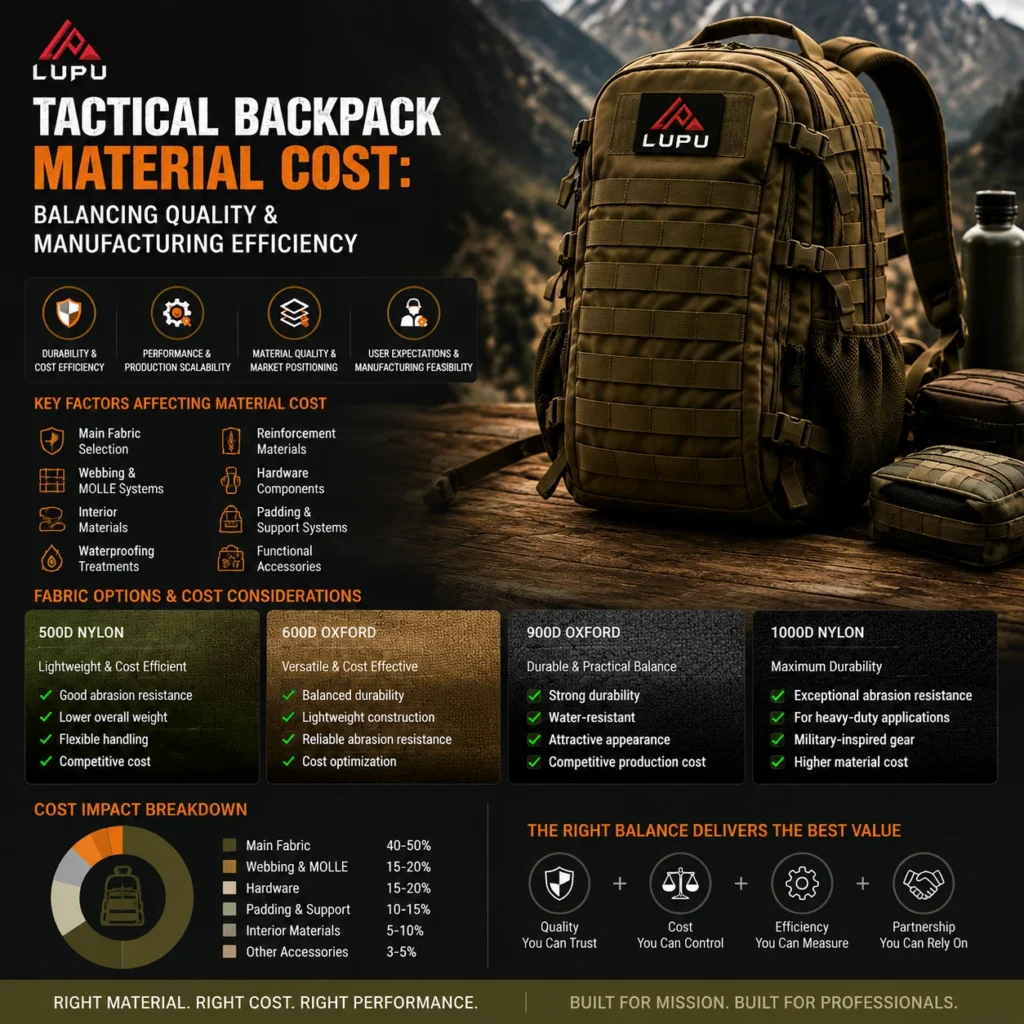
The total material cost of a tactical backpack is determined by multiple components working together. While the outer fabric usually represents the largest portion of material investment, every component — from webbing to zippers — contributes to the final product cost.
A professional cost evaluation should consider:
- Main fabric selection
- Reinforcement materials
- Webbing and MOLLE systems
- Hardware components
- Interior organization materials
- Padding and structural support systems
- Waterproofing treatments
- Functional accessories
Each choice affects not only the material price but also manufacturing efficiency and product performance.
2. Fabric Selection: The Foundation of Tactical Backpack Material Cost
2.1 500D Nylon: Lightweight Performance With Cost Efficiency
500D nylon is one of the most widely used materials in tactical and outdoor backpack manufacturing.
Its advantages include:
- Good abrasion resistance
- Lower overall product weight
- Flexible handling characteristics
- Competitive material cost
For brands targeting everyday carry (EDC), outdoor recreation, travel, and urban tactical markets, 500D nylon often provides an effective balance between durability and affordability.
Compared with heavier fabrics, 500D nylon can reduce:
- Material consumption
- Shipping weight
- Production complexity
This makes it a practical choice for large-volume commercial production.
2.2 600D Oxford Fabric: A Cost-Efficient Solution for Versatile Tactical Applications
600D Oxford fabric has become a widely adopted material for производители тактических рюкзаков because it provides:
- Balanced durability
- Lightweight construction
- Reliable abrasion resistance
- Competitive material cost
For commercial tactical backpacks, EDC bags, outdoor backpacks, and everyday carry solutions, 600D Oxford offers an effective balance between:
- Manufacturing efficiency
- Functional performance
- Market competitiveness
Compared with heavier tactical fabrics, 600D Oxford helps brands reduce overall Tactical Backpack Material Cost while maintaining sufficient durability for daily and professional applications.
For many OEM projects, selecting 600D Oxford fabric provides a practical solution for achieving cost optimization, production scalability, and consistent product quality without compromising essential performance.
2.3 900D Oxford Fabric: A Practical Balance Between Cost and Performance
900D Oxford fabric has become a popular alternative for tactical backpack manufacturers because it provides:
- Strong durability
- Water-resistant performance
- Attractive appearance
- Competitive production cost
For commercial tactical backpacks, outdoor bags, and professional carry solutions, 900D Oxford offers an excellent balance between:
- Manufacturing efficiency
- Product reliability
- Market affordability
For many OEM projects, selecting 900D Oxford instead of premium nylon can significantly optimize the overall Tactical Backpack Material Cost while maintaining strong product performance.
2.4 1000D Nylon: Maximum Durability for Professional Applications
1000D nylon is considered a premium tactical backpack material because of its exceptional abrasion resistance and rugged performance.
It is commonly selected for:
- Professional tactical equipment
- Heavy-duty outdoor applications
- Military-inspired gear designs
- High-performance backpacks
However, higher durability also creates additional costs.
Factors affecting cost include:
- Higher fabric weight
- Increased raw material usage
- More demanding sewing requirements
- Additional reinforcement needs
While 1000D nylon increases product durability, it may not always be the best choice for every market segment. A well-designed product requires matching material performance with actual user requirements.
3. Webbing, MOLLE Systems, and Hardware: Small Components With Significant Cost Impact
Many buyers focus primarily on fabric costs, but tactical backpack performance depends heavily on supporting components.
3.1 Webbing Materials
MOLLE webbing is a defining feature of tactical backpacks.
Material considerations include:
- Nylon strength
- Webbing density
- Load-bearing capability
- Stitching requirements
Higher-quality webbing improves:
- Attachment reliability
- Long-term durability
- User confidence
However, additional MOLLE coverage also increases:
- Material consumption
- Sewing time
- Quality inspection requirements
3.2 Buckles and Adjustment Hardware
Buckles, clips, and adjustment components directly affect user experience.
Common material choices include:
- Standard plastic hardware
- Premium tactical-grade buckles
- Reinforced composite materials
Cost differences depend on:
- Бренд
- Strength rating
- Environmental resistance
- Production availability
Selecting reliable hardware helps reduce potential product failures and warranty costs.
3.3 Zippers and Metal Components
Zippers are often overlooked but represent a critical durability point.
Professional tactical backpack production evaluates:
- Zipper strength
- Smooth operation
- Weather resistance
- Long-term cycle performance
A lower-cost zipper may reduce initial production expenses but create higher after-sales risks.
4. Interior Materials and Organization Systems
Modern tactical backpacks are not only external protection systems; they are also equipment organization platforms.
Interior materials influence both functionality and cost.
Common interior components include:
- Polyester lining
- Mesh pockets
- Elastic retention systems
- Hook-and-loop panels
- Foam padding
- Protective compartments
Advanced internal organization improves:
- Equipment accessibility
- User efficiency
- Product differentiation
However, additional compartments and structures increase:
- Material usage
- Cutting processes
- Sewing operations
- Assembly time
Therefore, designers must carefully balance organization features with production efficiency.
5. How Material Selection Affects Manufacturing Efficiency
Material choice is directly connected to factory productivity.
A professional tactical backpack manufacturer evaluates not only the material price but also how efficiently it can be processed.
Important considerations include:
Cutting Efficiency
Different fabrics require different cutting methods.
Factors include:
- Fabric thickness
- Material stability
- Layer requirements
Sewing Requirements
Heavy-duty tactical materials often require:
- Stronger needles
- Reinforced stitching
- Specialized machines
- Additional labor time
Production Consistency
Materials with stable supply and predictable quality help manufacturers maintain:
- Consistent output
- Reduced defects
- Better delivery reliability
A material with slightly higher unit cost may actually reduce total manufacturing costs if it improves production efficiency.
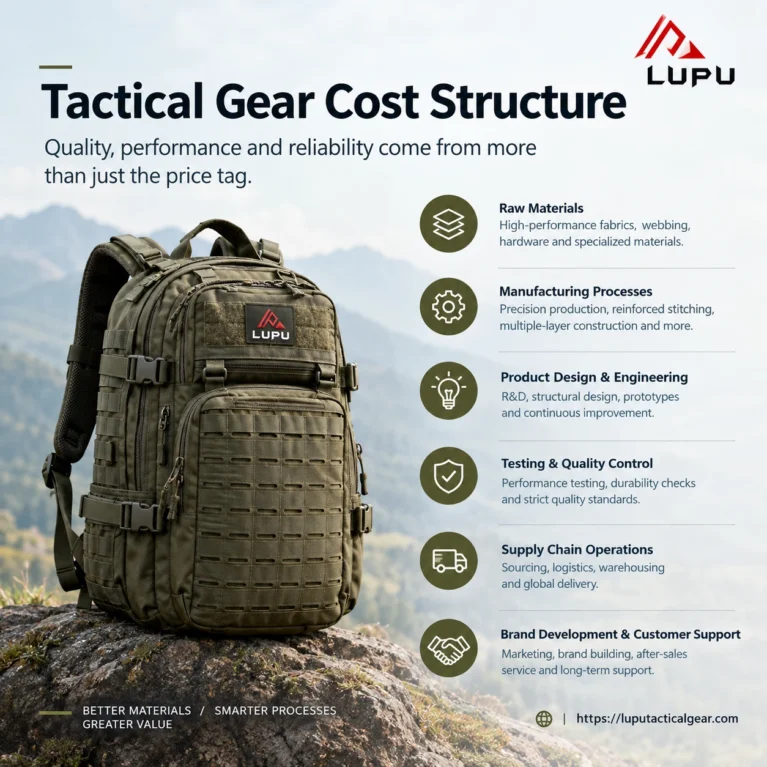
6. Tactical Backpack Material Cost Breakdown: A Professional View
A tactical backpack cost structure typically includes several material categories:
Outer Shell Materials
Includes:
- Main fabric
- Reinforcement panels
- Protective coatings
Impact:
Determines durability, appearance, and weather resistance.
Functional Components
Includes:
- Молнии
- Пряжки
- Веревка
- Attachment systems
Impact:
Determines reliability and user experience.
Structural Components
Includes:
- Foam padding
- Back support systems
- Shoulder strap reinforcement
Impact:
Determines comfort and load-carrying capability.
Interior Components
Includes:
- Linings
- Storage systems
- Protective layers
Impact:
Determines organization and usability.
A professional buyer should evaluate the complete material system rather than focusing on individual component prices.
7. Material Testing: The Hidden Factor in Long-Term Cost Control
Quality testing is not simply an additional expense. It is a strategy for reducing long-term costs.
Professional tactical backpack manufacturers evaluate:
Fabric Performance
Testing may include:
- Abrasion resistance
- Tear strength
- Water resistance
- Color durability
Hardware Reliability
Testing includes:
- Buckle strength
- Zipper performance
- Load testing
Real-World Performance
Field simulation evaluates:
- Carrying comfort
- Weight distribution
- Environmental durability
Poor material decisions often create hidden expenses:
- Product returns
- Customer complaints
- Replacement costs
- Brand reputation damage
8. How OEM Buyers Should Evaluate Tactical Backpack Material Cost
For brands developing тактические рюкзаки на заказ, material selection should begin with product requirements rather than budget limitations.
Step 1: Define the Application
Consider:
- Professional tactical use
- Outdoor activities
- Travel applications
- Everyday carry markets
Different applications require different material solutions.
Step 2: Match Material Performance With Market Position
Premium products may require:
- Higher-grade fabrics
- Stronger hardware
- Advanced construction
Commercial products may prioritize:
- Cost efficiency
- Lightweight design
- Large-scale production
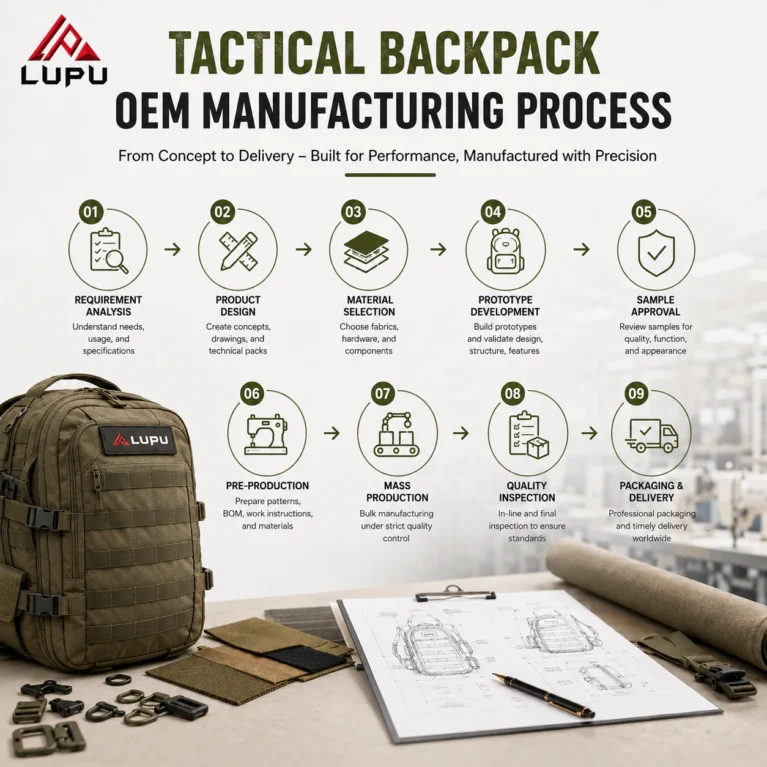
Step 3: Select an Experienced Manufacturing Partner
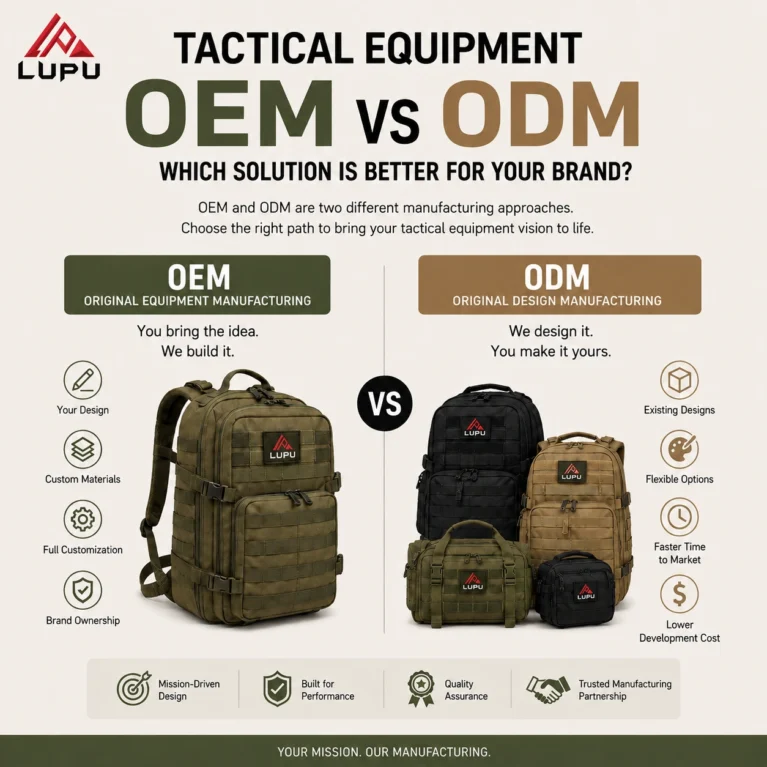
A capable OEM/ODM tactical backpack manufacturer can help optimize:
- Material selection
- Production efficiency
- Quality control
- Supply chain stability
The right manufacturing partner does not simply reduce cost — they improve overall product value.
9. Common Mistakes When Managing Tactical Backpack Material Cost
Choosing Materials Based Only on Price
The lowest-cost material may create:
- Reduced durability
- Poor user experience
- Increased replacement rates
Over-Specifying Materials
Using premium materials without market justification can lead to:
- Higher production costs
- Reduced competitiveness
- Limited customer adoption
Ignoring Manufacturing Efficiency
Material decisions must consider:
- Processing requirements
- Labor investment
- Production scalability
The best solution is always a balance between performance and efficiency.
10. Future Trends in Tactical Backpack Materials
The tactical gear industry continues to evolve toward smarter material solutions.
Emerging trends include:
Lightweight High-Strength Materials
Manufacturers are exploring fabrics that provide:
- Improved durability
- Reduced weight
- Better mobility
Sustainable Performance Materials
More brands are considering:
- Recycled fabrics
- Responsible sourcing
- Environmentally conscious production
Advanced Coating Technologies
New treatments improve:
- Water resistance
- Surface protection
- Material lifespan
Future tactical backpacks will focus on optimizing performance while maintaining responsible manufacturing practices.
Conclusion: The Right Approach to Tactical Backpack Material Cost
Tactical Backpack Material Cost is not simply a calculation of fabric prices. It represents a complete decision-making process involving performance requirements, manufacturing efficiency, market positioning, and long-term product value.
Successful tactical backpack development requires a professional approach:
- Choose materials based on application needs
- Balance durability with production efficiency
- Evaluate the complete material system
- Work with experienced manufacturing partners
Для tactical brands and procurement teams, the goal is not the lowest material cost — it is achieving the highest product value through intelligent material selection.
A reliable tactical backpack manufacturer helps transform material choices into durable, competitive, and market-ready products.