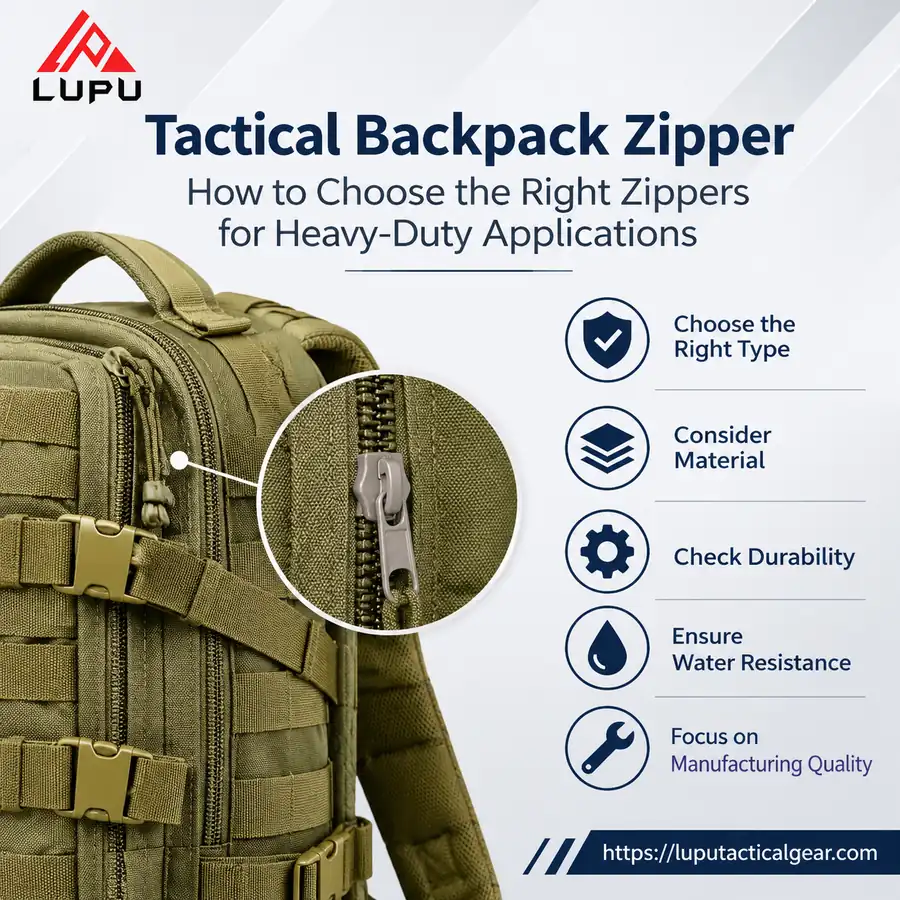
A tactical backpack is only as reliable as the components that work together to support its intended function. While manufacturers often focus on fabric specifications, stitching strength, load-bearing structures, and modular attachment systems, zipper selection deserves the same level of engineering attention.
A Tactical Backpack Zipper is more than a simple closure component. It is a mechanical system that must maintain consistent engagement, withstand repeated operation, accommodate the surrounding fabric construction, and function reliably under the conditions for which the backpack is designed.
Для бренды тактического снаряжения, military equipment suppliers, wholesalers, and product developers, selecting the right zipper involves considerably more than choosing a larger size or a familiar brand. Zipper construction, chain geometry, slider compatibility, tape material, opening configuration, stitching integration, and environmental requirements all influence finished-product performance.
From a tactical backpack manufacturer’s perspective, the most effective approach is to specify zippers according to compartment function and actual operating conditions, then validate the complete zipper assembly through prototype evaluation and appropriate quality testing.
This guide explains how to make those decisions systematically, from understanding zipper components to developing reliable specifications for OEM and ODM manufacturing.
1. Understanding the Anatomy of a Tactical Backpack Zipper
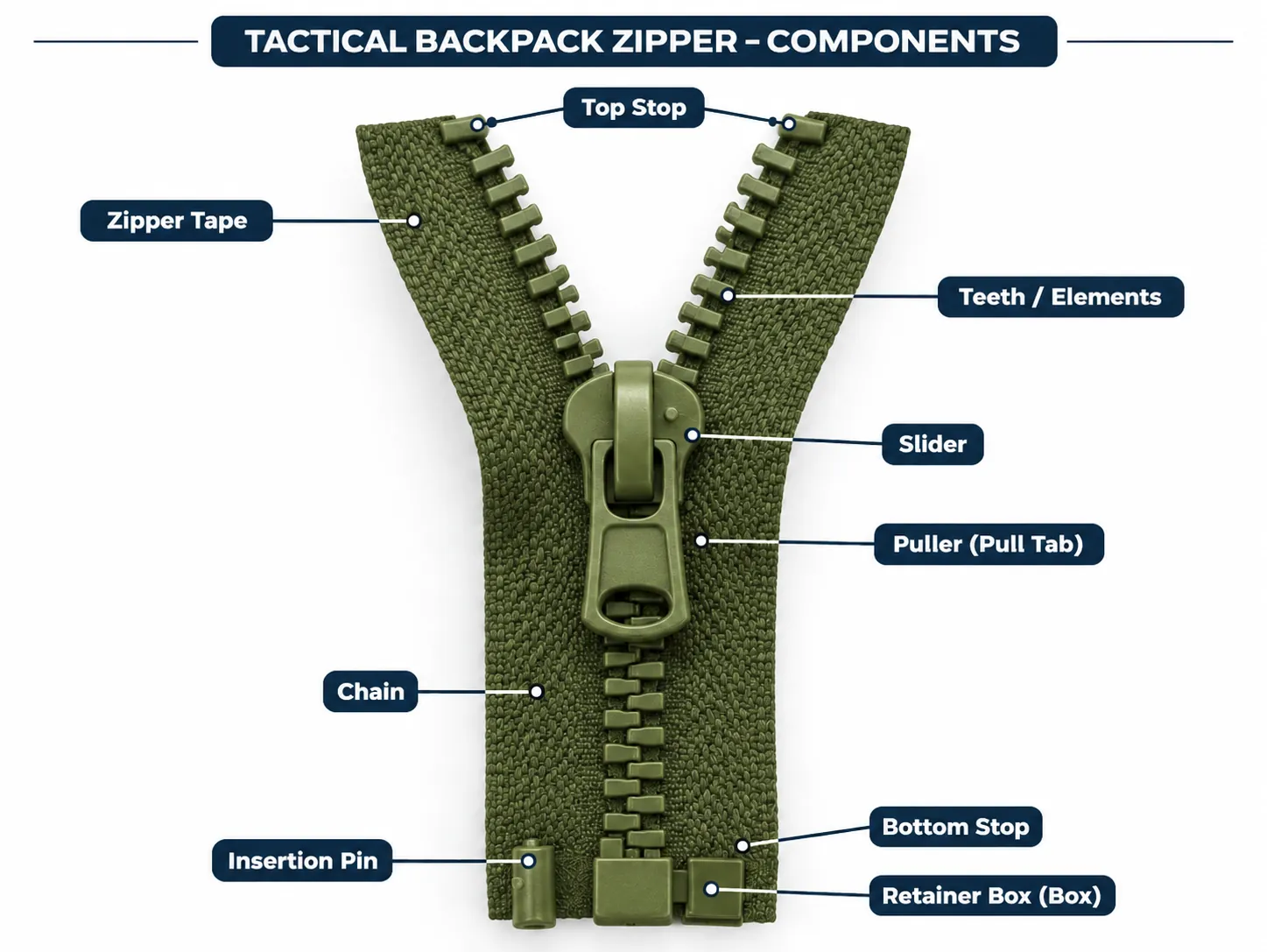
Before comparing zipper types or selecting specifications, it is important to understand how a zipper works as an integrated mechanical assembly.
A conventional zipper consists of several interacting components. Each has a different function, and weaknesses in any one of them can affect the performance of the entire closure system.
1.1 Zipper Teeth and Coils
The zipper chain is the central engagement mechanism.
Depending on its construction, the chain may consist of individual molded teeth, individual metal elements, or a continuous coil attached to the zipper tape.
Its primary function is to create a consistent mechanical connection when the slider moves along the chain.
Important considerations include:
- Element geometry and dimensional consistency.
- Engagement accuracy between opposing chain elements.
- Resistance to lateral separation.
- Flexibility along curved opening paths.
- Compatibility with the selected slider.
- Resistance to deformation during repeated operation.
A zipper chain should not be evaluated by appearance alone. Two zippers with similar dimensions may have different engagement characteristics, material properties, and operating performance.
For a tactical backpack, chain selection must account for the opening configuration and the mechanical demands generated by the compartment.
1.2 Zipper Tape
Zipper tape is the textile foundation onto which the chain elements are attached.
It also provides the material interface between the zipper and the surrounding backpack fabric.
Common tape materials include polyester and nylon.
When evaluating zipper tape, manufacturers should consider:
- Tensile characteristics.
- Thickness and dimensional stability.
- Flexibility and bending behavior.
- Abrasion resistance.
- Color consistency.
- Compatibility with the backpack’s fabric and coating system.
Tape construction is particularly important when integrating zippers into heavy fabrics such as 500D or 1000D nylon.
A tape that is too flexible, too thick, or poorly matched to the surrounding material can complicate sewing operations and affect the finished opening geometry.
The goal is not simply to choose the thickest tape. It is to establish a compatible construction that maintains consistent positioning and reliable attachment throughout production.
1.3 Zipper Slider
The slider controls the engagement and separation of the zipper chain.
Its internal geometry guides the two sides of the chain into or out of engagement as the slider moves.
Important slider specifications include:
- Compatibility with the zipper chain.
- Internal channel geometry.
- Body material and surface finish.
- Operating resistance.
- Locking mechanism.
- Pull-tab attachment.
- Dimensional consistency.
An incompatible slider can cause excessive operating resistance, incomplete chain engagement, or premature wear.
This is why zipper chain and slider specifications should always be evaluated together rather than purchased as unrelated components.
1.4 Stops, Separators, and Reinforcement Components
Stops prevent the slider from moving beyond its intended operating range.
The configuration depends on whether the zipper is closed-end, open-end, or designed for two-way operation.
Typical configurations include:
- Top stops.
- Bottom stops.
- Separating bottom components.
- Reinforced zipper termination points.
- Two-way slider arrangements.
Для тактические рюкзаки, zipper endpoints deserve particular attention because they are often exposed to concentrated stress when users pull the opening apart or place oversized equipment inside the compartment.
A properly designed zipper system considers these endpoints as part of the overall structural design.
Manufacturer’s perspective: A high-quality zipper chain cannot compensate for a poorly matched slider, weak tape, or inadequate installation. Reliable zipper performance comes from the compatibility of the complete assembly.
2. Types of Zippers Used in Tactical Backpacks: Coil vs. Molded Plastic vs. Metal
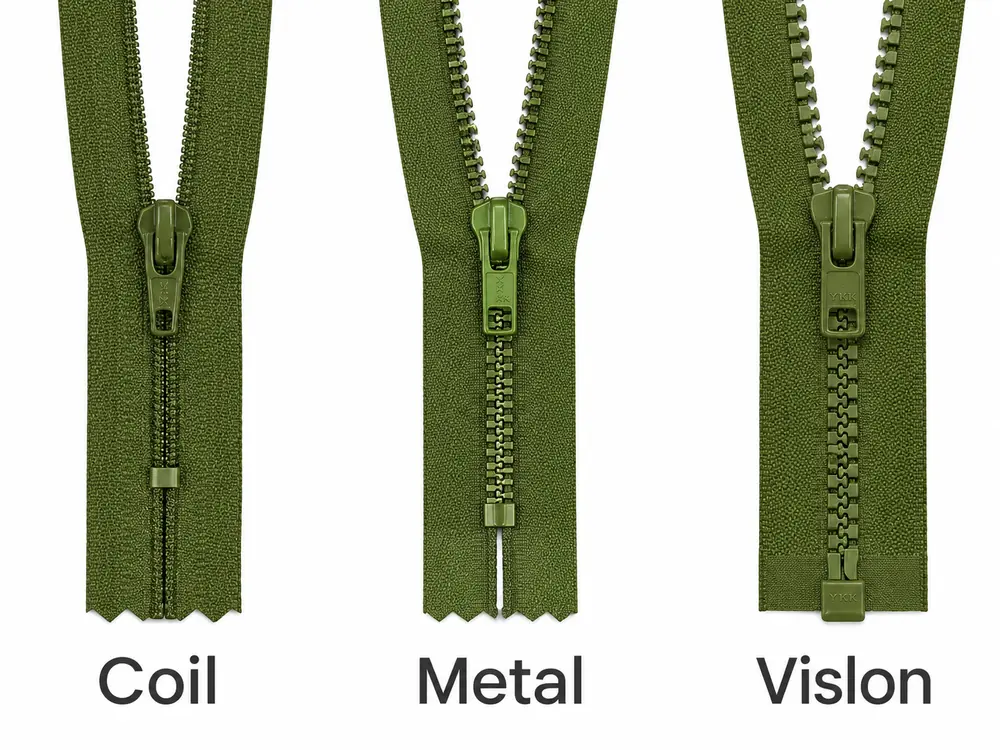
Three major zipper constructions are commonly considered in backpack manufacturing: nylon coil, molded plastic, and metal.
Each offers different mechanical and design characteristics.
There is no universally superior option. The appropriate selection depends on compartment geometry, intended use, operating environment, weight requirements, and the overall backpack construction.
2.1 Nylon Coil Zippers
Nylon coil zippers use continuous polymer coil elements attached to textile tape.
Their flexible construction makes them particularly useful when an opening needs to follow a curved or irregular path.
Key characteristics:
- High flexibility.
- Relatively low weight.
- Suitability for curved compartment openings.
- Smooth operation when properly matched with the slider.
- Broad application across different backpack configurations.
Nylon coil zippers are frequently used in internal pockets, organizer compartments, accessory storage, and selected main compartments.
However, their flexibility should not be confused with unlimited mechanical strength.
Performance depends on the coil geometry, material consistency, slider compatibility, tape construction, and the forces applied during use.
For example, a coil zipper installed around a heavily loaded opening may experience lateral forces that exceed the intended performance of the selected chain.
In such cases, manufacturers should review the opening design, loading conditions, and reinforcement strategy rather than simply assume that a different zipper size will solve the problem.
2.2 Molded Plastic Zippers
Molded plastic zippers use individually formed polymer teeth attached to the zipper tape.
Their construction can provide a relatively substantial chain profile and is often considered for larger compartment openings.
Key characteristics:
- Individually molded teeth.
- Defined tooth geometry.
- Relatively substantial chain construction.
- Availability in different dimensions and configurations.
- Potential suitability for larger equipment compartments.
Molded plastic zippers can be appropriate for main compartments, equipment storage sections, and other applications where their construction matches the design requirements.
However, performance depends heavily on polymer selection, tooth dimensions, molding consistency, and the compatibility of the slider.
Temperature exposure, material aging, and dimensional variation should also be considered when selecting components for specialized applications.
2.3 Metal Zippers
Metal zippers use individual metal elements attached to textile tape.
Depending on the metal and surface treatment, they can provide a distinctive mechanical feel and may be suitable for specialized heavy-duty bag applications.
Key characteristics:
- Individual metal elements.
- Defined mechanical engagement.
- Different available metal and finish options.
- Generally greater weight than comparable polymer constructions.
- Additional corrosion considerations.
Metal zippers may be appropriate for selected equipment bags where their characteristics align with the product requirements.
However, they are not automatically stronger or more durable in every application.
Corrosion resistance, surface treatment, slider compatibility, element deformation, and operating environment must all be evaluated.
For tactical backpacks exposed to moisture, salt, dirt, or frequent outdoor use, metal components require particular attention to material selection and environmental testing.
2.4 Comparative Evaluation: Which Zipper Type Is Best?
|
Evaluation Factor |
Nylon Coil |
Molded Plastic |
Metal |
|
Construction |
Continuous coil |
Individual molded teeth |
Individual metal teeth |
|
Гибкость |
Generally high |
Design-dependent |
Generally lower |
|
Вес |
Generally low |
Умеренный |
Generally higher |
|
Curved openings |
Highly suitable |
Depends on design |
Less suitable |
|
Corrosion considerations |
Generally low |
Generally low |
Important |
|
Typical application |
Pockets and curved openings |
Larger compartments |
Specialized equipment bags |
|
Main selection concern |
Coil and slider compatibility |
Tooth consistency and material |
Corrosion and weight |
The correct selection should always be based on the complete application rather than a simplified comparison of materials.
For example, a flexible coil zipper may be more suitable for a curved organizer pocket, while a molded plastic zipper may be more appropriate for a particular large equipment compartment.
A metal zipper may also be suitable for a specialized design, provided its weight and corrosion characteristics are acceptable.
3. Understanding Zipper Sizes: What Do #5, #8, and #10 Actually Mean?
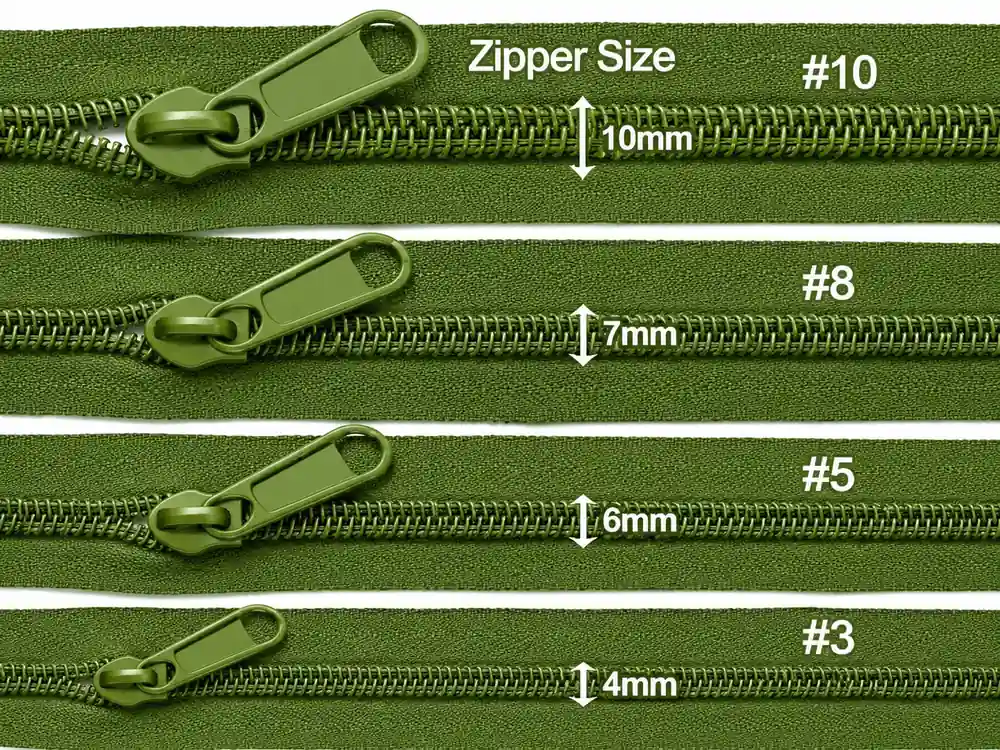
Zipper size is one of the most frequently discussed specifications during tactical backpack development.
However, it is also one of the most frequently misunderstood.
Numbers such as #5, #8, and #10 generally refer to zipper gauge categories associated with the approximate width of the closed chain. They do not directly represent breaking strength, load capacity, or overall durability.
Actual dimensions and performance characteristics may vary between zipper manufacturers and construction types.
3.1 Understanding Zipper Gauge and Chain Width
Zipper gauge provides a convenient way to identify a general zipper size category.
Nevertheless, the gauge number should not be treated as a universal mechanical performance rating.
When specifying a zipper, manufacturers should request the actual technical dimensions and relevant performance data from the component supplier.
This is especially important when changing suppliers or developing products that require consistent specifications across different production batches.
3.2 #5 Zippers: Applications and Limitations
#5 zippers are commonly considered for medium-sized compartments and secondary storage sections.
Potential applications include:
- Front organizer pockets.
- Internal accessory pockets.
- Smaller equipment compartments.
- Selected side storage sections.
Their relatively compact construction can help reduce unnecessary bulk and weight.
However, their suitability depends on the opening size, expected contents, operating frequency, and surrounding construction.
A #5 zipper should not automatically be rejected for tactical applications, nor should it be selected for a heavily loaded compartment without evaluating the actual requirements.
3.3 #8 Zippers: A Practical Option for Larger Compartments
#8 zippers offer a larger chain profile than #5 constructions.
They may be suitable for compartments that require a more substantial closure system while maintaining reasonable design flexibility.
Potential applications include:
- Medium-to-large equipment compartments.
- Frequently accessed storage sections.
- Selected main compartment openings.
- Larger accessory compartments.
Their actual suitability depends on the zipper construction and the mechanical demands of the application.
3.4 #10 Zippers: When Larger Chain Construction Is Appropriate
#10 zippers are often considered for larger backpack openings and applications where a more substantial chain construction is desired.
Potential applications include:
- Large main compartments.
- Oversized equipment storage sections.
- Specialized tactical equipment bags.
- Designs requiring larger zipper elements.
However, a #10 zipper is not automatically the correct choice for every heavy-duty backpack.
An oversized zipper can increase component cost, bulk, and design constraints without providing meaningful benefits if the surrounding construction is the actual limiting factor.
For example, if a zipper opening is poorly reinforced or the fabric around it deforms under load, increasing zipper gauge alone may not resolve the underlying issue.
3.5 How Manufacturers Determine the Correct Zipper Size
A systematic selection process should include:
- Identify the function of the compartment.
- Define the expected contents and loading conditions.
- Determine the opening dimensions and geometry.
- Evaluate opening frequency and operating requirements.
- Consider fabric thickness and reinforcement construction.
- Confirm chain and slider compatibility.
- Test the complete assembly in a representative prototype.
The objective is to achieve balanced performance across the entire opening system.
Important: Zipper size should be treated as a component specification, not as a substitute for mechanical testing.
4. How to Choose the Right Zipper for Different Tactical Backpack Applications
A tactical backpack may contain several different compartments, each with its own functional requirements.
Using the same zipper specification throughout the entire product may simplify procurement, but it does not necessarily produce the best engineering result.
A more effective approach is to establish a zipper specification for each compartment according to its intended function.
4.1 Main Compartment Zippers
The main compartment typically represents one of the most important zipper applications.
It must provide convenient access to the backpack’s primary storage volume while maintaining reliable operation.
К ключевым факторам относятся:
- Opening dimensions.
- Expected contents.
- Frequency of access.
- Chain and slider compatibility.
- Opening curvature.
- Reinforcement at zipper endpoints.
- Potential interference from internal or external structures.
A main compartment designed to carry bulky equipment may require a different zipper configuration from a lightweight daypack.
The zipper path should also be designed carefully. Sharp turns and poorly controlled curvature can increase operating resistance and create localized stress.
Where two-way access is required, the designer should evaluate slider configuration and the opening’s intended operating sequence.
4.2 Front Organizer Pocket Zippers
Front organizer pockets typically contain smaller items such as tools, documents, electronic accessories, and personal equipment.
These compartments often require frequent opening and closing.
The selection should prioritize:
- Smooth operation.
- Appropriate chain dimensions.
- Flexible opening geometry.
- Easy access.
- Compatibility with internal pocket construction.
For curved organizer pockets, a flexible coil zipper may be a suitable solution, provided the chain and slider specifications meet the required performance criteria.
4.3 Side Pocket and Accessory Compartment Zippers
Side pockets and accessory compartments often occupy areas exposed to external abrasion, movement, and contact with surrounding equipment.
Their zipper design should consider:
- Exposure to abrasion.
- Potential snagging.
- Limited installation space.
- Compatibility with external webbing and attachment systems.
An important design consideration is the relationship between the zipper path and external attachment points.
If MOLLE webbing, compression straps, or other hardware interfere with zipper movement, users may experience restricted access or premature component wear.
4.4 Hydration Compartment Zippers
Hydration compartments introduce additional functional requirements.
These compartments may contain a water reservoir, hose routing, and related accessories.
Zipper design should consider:
- Reservoir dimensions.
- Internal compartment volume.
- Hose exit configuration.
- Accessibility for cleaning and replacement.
- Moisture exposure.
- Separation from other stored equipment.
The zipper itself does not need to provide waterproof performance unless the product specification specifically requires it.
In many designs, appropriate drainage, material selection, and compartment construction are more important than simply choosing a water-resistant zipper.
4.5 Medical and Specialized Equipment Compartments
Medical and specialized equipment backpacks may require carefully organized compartments and rapid access to specific contents.
The zipper configuration should support the intended opening sequence and allow users to reach the required equipment without unnecessary obstruction.
Important design factors include:
- Opening direction.
- Compartment visibility.
- Internal organization.
- Pull-tab accessibility.
- Opening dimensions.
- Compatibility with removable organizers.
For products where access speed is important, prototype evaluation should include realistic operating scenarios rather than relying exclusively on visual inspection.
Manufacturer’s perspective: Different compartments should be specified according to their individual functions. A properly engineered tactical backpack uses a balanced component system rather than applying the largest available zipper to every opening.
5. Choosing the Right Zipper Slider: Locking Mechanisms, Pullers, and Operational Reliability
Zipper chain selection receives considerable attention, but slider design is equally important.
The slider determines how the chain engages and disengages. Its geometry, compatibility, and locking mechanism directly influence operation.
5.1 Automatic-Locking Sliders
Automatic-locking sliders incorporate a mechanism that helps prevent unintended slider movement when the pull tab is released.
They may be appropriate for compartments where maintaining the selected closure position is important.
However, the locking mechanism must be compatible with the intended operating conditions.
Manufacturers should evaluate:
- Lock engagement consistency.
- Ease of operation.
- Compatibility with the chain.
- Wear of the locking mechanism.
- Performance after repeated use.
5.2 Non-Locking Sliders
Non-locking sliders allow the zipper to move without an integrated automatic locking mechanism.
They may be suitable for selected internal compartments or applications where the zipper’s position is controlled through the backpack’s construction.
The selection should consider the possibility of unintended movement during carrying, handling, and equipment loading.
5.3 Double-Pull and Dual-Slider Configurations
Two-way zipper systems allow users to open a compartment from different directions.
They are commonly considered for large openings where flexible access is useful.
Potential advantages include:
- Adjustable opening positions.
- More convenient access to large compartments.
- Flexible opening arrangements.
- Better accommodation of certain equipment layouts.
However, additional sliders introduce more components and potential maintenance considerations.
The chain, slider orientation, opening geometry, and stop configuration must all be compatible.
5.4 Extended Pull Tabs and Tactical Zipper Pulls
Zipper pulls are particularly relevant to tactical backpacks because users may operate them while wearing gloves or handling other equipment.
Common configurations include:
- Extended metal pull tabs.
- Molded polymer pullers.
- Cord-based zipper extensions.
- Custom branded pull accessories.
Important design factors include:
- Grip size.
- Pull length.
- Attachment strength.
- Material durability.
- Resistance to snagging.
- Ease of operation.
A pull tab that is too short may be difficult to operate with gloves. An excessively long pull can catch on surrounding equipment.
The best design provides sufficient grip without introducing unnecessary bulk or interference.
5.5 Common Slider-Related Problems
Typical slider-related issues include:
- Excessive operating resistance.
- Chain separation after closure.
- Inconsistent locking.
- Slider deformation.
- Pull-tab detachment.
- Incompatibility with the selected chain.
These problems should be evaluated systematically.
Replacing the slider without identifying the underlying cause may only provide a temporary solution.
6. Zipper Materials and Surface Treatments: What Matters in Harsh Environments?
Material selection influences the performance and service life of the zipper system.
However, material properties should always be evaluated in relation to the complete product construction and intended operating environment.
6.1 Polyester vs. Nylon Zipper Tape
Polyester and nylon are both widely used in textile zipper tape construction.
They have different physical and chemical characteristics, but neither material is universally superior.
Evaluation should consider:
Polyester zipper tape:
- Dimensional stability.
- Moisture absorption characteristics.
- Color consistency.
- Compatibility with different backpack fabrics.
- Resistance to environmental exposure.
Nylon zipper tape:
- Mechanical characteristics.
- Textile construction.
- Abrasion behavior.
- Compatibility with the surrounding material system.
The actual performance depends on yarn specifications, weave structure, finishing treatments, tape density, and manufacturing quality.
For OEM development, buyers should request relevant technical specifications rather than relying solely on the generic material name.
6.2 Polymer Materials Used in Molded Zipper Teeth
Molded zipper elements are produced from polymer materials selected according to the intended application.
Relevant considerations include:
- Dimensional consistency.
- Tooth geometry.
- Material toughness.
- Temperature-related performance.
- Resistance to environmental aging.
- Compatibility with slider construction.
Material selection should account for the operating environment and the required mechanical characteristics.
A component that performs adequately under ordinary indoor conditions may behave differently under prolonged exposure to temperature extremes or other environmental stresses.
6.3 Metal Zipper Finishes and Corrosion Resistance
Metal zipper components require particular attention when products are designed for outdoor or moisture-exposed applications.
Corrosion resistance depends on factors such as:
- Base metal composition.
- Surface treatment.
- Coating quality.
- Environmental exposure.
- Contact with other materials.
- Storage and maintenance conditions.
Where corrosion resistance is a critical requirement, the manufacturer should establish an appropriate test method and acceptance criteria.
Visual appearance alone is not sufficient evidence of long-term corrosion performance.
6.4 Water-Resistant Zippers vs. Waterproof Zippers
Water-resistant and waterproof zippers are not interchangeable terms.
Water-resistant zipper constructions are designed to reduce water penetration under specified conditions.
Depending on the design, they may incorporate:
- Protective coatings.
- Laminated tape.
- Water-resistant chain construction.
- Protective flaps.
- Additional closure features.
However, even a specialized water-resistant zipper cannot guarantee that the complete backpack is waterproof.
Water may enter through:
- Needle holes.
- Fabric seams.
- Attachment points.
- Unprotected openings.
- Other construction interfaces.
For products requiring water protection, the entire backpack assembly must be evaluated.
This includes fabric, seams, zipper construction, closure design, and the relationship between all potential water-entry points.
7. How to Integrate Tactical Backpack Zippers into Heavy-Duty Fabric Construction
One of the most important aspects of tactical backpack manufacturing is the integration between the zipper and the surrounding fabric structure.
A zipper can meet its supplier’s component specifications and still perform poorly after installation if the sewing configuration, fabric compatibility, or reinforcement design is inadequate.
7.1 Matching Zipper Tape with Backpack Fabrics
Tactical backpacks commonly use durable woven fabrics, including different specifications of nylon and polyester.
Examples include 500D and 1000D nylon fabrics, depending on the intended application.
When selecting zipper tape, manufacturers should evaluate:
Fabric thickness.
- Coating characteristics.
- Material flexibility.
- Seam construction.
- Tape compatibility.
- Dimensional stability during sewing.
For heavier fabrics, the zipper installation process may require adjustments to sewing equipment, needle selection, thread specifications, and material handling.
The objective is to create a consistent connection without damaging the zipper tape or surrounding fabric.
7.2 Seam Allowance and Stitching Configuration
Seam allowance affects the amount of material available for attaching the zipper.
An inconsistent seam allowance can result in uneven openings, fabric distortion, and inconsistent zipper operation.
Important manufacturing controls include:
- Consistent seam allowance.
- Appropriate stitch type.
- Suitable thread selection.
- Correct needle size and point.
- Controlled stitch tension.
- Accurate alignment during sewing.
Stitch density should be determined according to the fabric, thread, construction, and expected mechanical demands.
Simply increasing the number of stitches does not automatically improve seam performance. Excessive perforation can weaken certain textile constructions.
7.3 Reinforcing High-Stress Zipper Endpoints
Zipper endpoints are potential stress concentration areas.
When users open a tightly packed compartment, forces may be transferred to the end of the zipper and the surrounding fabric.
Depending on the product design, reinforcement may include:
- Additional fabric layers.
- Bar-tack stitching.
- Reinforced seam construction.
- Improved load distribution.
- Carefully designed zipper termination geometry.
Reinforcement should be applied according to actual stress conditions rather than added indiscriminately.
7.4 Preventing Zipper Misalignment During Production
Zipper misalignment can affect both appearance and operation.
Common causes include:
- Inaccurate cutting.
- Uneven feeding during sewing.
- Inconsistent tape tension.
- Incorrect positioning.
- Poor fixture control.
- Fabric distortion.
Manufacturers should establish controlled sewing procedures and inspection points to identify these issues before the product reaches final assembly.
Manufacturer’s perspective: Zipper reliability is a product-level engineering result. It depends not only on the zipper supplier but also on how the zipper is integrated into the backpack’s textile structure.
8. Tactical Backpack Zipper Durability Testing: How Manufacturers Evaluate Performance
Testing is essential for verifying whether a zipper system meets the intended product requirements.
However, no single test can represent every aspect of zipper performance.
A reliable quality program should combine component-level testing, finished-product evaluation, and inspection of the complete zipper assembly.
8.1 Zipper Reciprocation Testing
Reciprocation testing evaluates zipper operation through repeated opening and closing cycles.
Depending on the applicable method, testing may assess:
- Operating smoothness.
- Chain engagement.
- Slider movement.
- Wear of components.
- Functional deterioration.
The test procedure should define the operating conditions, sample preparation, cycle requirements, and acceptance criteria.
Testing should not rely on an arbitrary cycle count without a defined relationship to the intended product requirements.
8.2 Crosswise Strength and Chain Separation Testing
This testing evaluates the resistance of a zipper chain to separation under a defined force.
It is particularly relevant when the closure may experience lateral stress.
Important considerations include:
- Test specimen configuration.
- Applied force.
- Loading direction.
- Chain construction.
- Failure mode.
- Recorded results.
The result should be interpreted in relation to the actual zipper specification and product application.
8.3 Slider Pull-Off and Retention Testing
Slider retention and puller attachment should also be evaluated.
Potential failure modes include:
- Slider detachment.
- Pull-tab separation.
- Failure of the attachment point.
These tests are particularly relevant when a backpack uses extended pulls or specialized zipper accessories.
8.4 Zipper Tape Strength and Attachment Testing
Zipper tape forms the connection between the chain and the backpack.
Its mechanical performance is therefore important.
Evaluation may include:
- Tape tensile characteristics.
- Attachment strength.
- Seam strength.
- Resistance to tearing.
- Performance under defined loading conditions.
For finished backpacks, the zipper-to-fabric seam should also be evaluated because component-level tape strength does not necessarily represent installed performance.
8.5 Environmental and Corrosion Testing
Products designed for outdoor or specialized environments may require additional evaluation.
Depending on the application, testing can include:
- Temperature conditioning.
- Humidity exposure.
- Corrosion evaluation of metal components.
- Contamination exposure.
- Water-resistance evaluation.
- Cleaning and maintenance assessments.
The test selection should reflect actual customer requirements rather than assuming every tactical backpack needs every possible environmental test.
8.6 Establishing a Practical Zipper Quality-Control Plan
A structured inspection program should cover multiple production stages.
|
Inspection Stage |
Key Inspection Items |
Quality Objective |
|
Incoming inspection |
Chain dimensions, tape condition, slider compatibility, color |
Verify component consistency |
|
Prototype evaluation |
Opening geometry, alignment, operating resistance |
Confirm design compatibility |
|
In-process inspection |
Stitching, reinforcement, positioning, fabric distortion |
Prevent assembly defects |
|
Finished-product inspection |
Smooth operation, appearance, closure function |
Verify product consistency |
|
Performance testing |
Repeated operation and applicable mechanical tests |
Evaluate specified performance |
Two ASTM standards are particularly relevant when establishing zipper testing procedures:
- ASTM D2061, Standard Test Methods for Strength Tests for Zippers.
- ASTM D2062, Standard Test Methods for Operability of Zippers.
The applicable edition, test method, specimen preparation, and acceptance requirements should be confirmed before testing.
Referencing a standard does not automatically mean a product is certified or compliant. Actual compliance claims must be supported by appropriate testing and documentation.
9. Common Tactical Backpack Zipper Failures and How Manufacturers Prevent Them
Understanding failure mechanisms is one of the most effective ways to improve product design and manufacturing consistency.
A zipper failure rarely occurs without an underlying cause.
Corrective action should begin with identifying the actual failure mode rather than immediately replacing the component.
9.1 Zipper Teeth or Coils Separating Under Stress
Possible causes:
- Incompatible slider and chain.
- Incomplete chain engagement.
- Excessive lateral loading.
- Damaged elements.
- Manufacturing inconsistency.
Preventive measures:
- Verify component compatibility.
- Evaluate chain engagement.
- Review opening geometry.
- Reduce unnecessary stress concentration.
- Conduct appropriate mechanical testing.
If separation repeatedly occurs near a particular section of the opening, the surrounding construction should also be inspected.
9.2 Zipper Slider Getting Stuck
Possible causes:
- Dirt or debris.
- Damaged chain elements.
- Misaligned zipper tape.
- Fabric interference.
- Slider deformation.
- Excessive curvature.
Preventive measures:
- Maintain accurate sewing alignment.
- Avoid unnecessary sharp turns.
- Select compatible sliders.
- Control fabric positioning.
- Inspect the zipper path during assembly.
A zipper that operates smoothly before installation but becomes difficult to operate after sewing may indicate an integration problem rather than a defective component.
9.3 Zipper Tape Tearing Away from the Backpack
Possible causes:
- Insufficient seam allowance.
- Inappropriate stitching configuration.
- Inadequate reinforcement.
- Poor material compatibility.
- Concentrated stress at the opening.
Preventive measures:
- Review seam construction.
- Improve reinforcement where necessary.
- Match zipper tape with the surrounding fabric.
- Evaluate the complete attachment structure.
This failure mode is particularly important in heavily loaded compartments.
9.4 Corrosion or Surface Deterioration
Possible causes:
- Unsuitable metal selection.
- Insufficient surface protection.
- Moisture exposure.
- Incompatible materials.
- Poor storage conditions.
Preventive measures:
- Specify appropriate hardware materials.
- Verify surface treatment requirements.
- Establish environmental acceptance criteria.
- Conduct relevant corrosion testing.
9.5 Premature Wear of Zipper Pulls
Possible causes:
- Inadequate puller construction.
- Weak attachment.
- Repeated impact.
- Poor material selection.
Preventive measures:
- Evaluate puller geometry.
- Verify attachment strength.
- Select appropriate materials.
- Test under representative operating conditions.
The most important principle is to distinguish component failure from installation failure. Effective corrective action requires understanding how the complete zipper system behaves within the backpack.
10. How to Specify a Tactical Backpack Zipper for OEM/ODM Manufacturing
For tactical gear brands and importers, clear zipper specifications are essential to maintaining product consistency.
A vague instruction such as “use heavy-duty zippers” provides insufficient information for controlled manufacturing.
The manufacturer needs measurable requirements that can be communicated to component suppliers, incorporated into technical documents, and verified during production.
10.1 Define the Intended Application
Start by identifying where the zipper will be installed and what it is expected to do.
Specify:
- Main compartment or secondary pocket.
- Expected contents.
- Operating frequency.
- Environmental exposure.
- Opening configuration.
- Required accessibility.
- Functional and appearance requirements.
A zipper for an internal document pocket should not automatically receive the same specification as a large equipment compartment.
10.2 Establish Zipper Technical Specifications
A professional zipper specification should include the following information:
|
Specification Item |
Required Information |
|
Zipper construction |
Nylon coil, molded plastic, or metal |
|
Zipper gauge |
#5, #8, #10, or specified alternative |
|
Tape material |
Polyester, nylon, or approved construction |
|
Tape color |
Standard or customized color reference |
|
Slider type |
Automatic-locking or non-locking |
|
Slider configuration |
Single-pull or double-pull |
|
Puller design |
Standard, extended, molded, or custom |
|
Chain length |
Exact required dimensions |
|
Opening configuration |
Closed-end, open-end, or two-way |
|
End-stop construction |
Applicable stop configuration |
|
Water-resistance requirement |
Defined requirement, if applicable |
|
Branding |
Custom puller or other approved details |
|
Testing requirements |
Agreed test methods and acceptance criteria |
These specifications should be documented in the product technical package.
Any approved changes to zipper components should be reviewed before mass production.
10.3 Evaluate Samples Before Bulk Production
Sample approval is an important stage in tactical backpack development.
A zipper should not be approved solely because the component looks correct.
The evaluation process should include:
- Verify the chain and slider specifications.
- Confirm the zipper dimensions.
- Check color and appearance.
- Install the zipper into a representative prototype.
- Evaluate smooth operation.
- Inspect stitching and alignment.
- Conduct applicable performance tests.
- Record and approve the final specification.
The approved sample should become a reference for subsequent production.
10.4 Establish Quality Requirements with the Manufacturer
Before bulk production, the buyer and manufacturer should agree on:
- Approved zipper supplier and component specification.
- Incoming inspection requirements.
- Functional inspection criteria.
- Applicable test procedures.
- Sample approval requirements.
- Component traceability where required.
- Change-control procedures.
This is particularly important when a product uses customized zipper colors, branded pullers, or specialized hardware.
A documented specification helps reduce the risk of unapproved substitutions and inconsistent production batches.
10.5 Questions Buyers Should Ask Their Производитель тактического снаряжения
- When evaluating a potential OEM/ODM partner, buyers should consider asking:
- Which zipper constructions do you recommend for my intended backpack application?
- Can you provide technical specifications for the chain and slider?
- How do you verify zipper compatibility before mass production?
- Can you customize zipper tape colors and puller configurations?
- What zipper-related inspections are included in your quality-control process?
- Can the relevant component suppliers provide supporting test documentation?
- How do you control zipper specifications between prototype approval and bulk production?
An experienced manufacturer should be able to explain the reasoning behind its component recommendations rather than simply offering a list of available zipper sizes.
11. Frequently Asked Questions About Tactical Backpack Zippers
What Is the Best Zipper for a Tactical Backpack?
There is no single zipper type that is best for every tactical backpack.
Nylon coil zippers are often suitable for flexible and curved openings. Molded plastic zippers may be appropriate for larger compartment designs, while metal zippers can serve specialized applications where their mechanical characteristics are desirable.
The correct choice depends on compartment function, chain construction, slider compatibility, fabric integration, and operating conditions.
Is a #10 Zipper Stronger Than a #5 Zipper?
A #10 zipper generally has a larger chain profile than a #5 zipper, but size alone does not establish mechanical strength.
Actual performance depends on chain construction, materials, element geometry, slider compatibility, and test results.
Buyers should evaluate relevant technical specifications rather than assume that a larger gauge guarantees superior performance.
Are Nylon Coil Zippers Suitable for Heavy-Duty Tactical Backpacks?
Yes, nylon coil zippers can be suitable for selected heavy-duty tactical backpack applications.
Their flexibility makes them useful for curved openings and complex compartment designs.
However, their suitability must be evaluated according to the expected loading conditions, coil specifications, slider compatibility, and installation method.
What Is the Difference Between a Water-Resistant and Waterproof Zipper?
A water-resistant zipper is designed to reduce water penetration under specified conditions.
A waterproof zipper requires a more comprehensive construction and performance evaluation.
Importantly, a waterproof zipper does not automatically make the entire backpack waterproof because seams, needle holes, and other construction details can still allow water penetration.
Why Does My Backpack Zipper Keep Separating?
Common causes include incompatible sliders, incomplete chain engagement, worn or damaged elements, excessive lateral stress, and poor zipper installation.
The correct solution depends on identifying the failure location and underlying cause.
Replacing the zipper without investigating the surrounding construction may not prevent the problem from recurring.
Can Tactical Backpack Zippers Be Customized for OEM Orders?
Yes. Depending on supplier capabilities and minimum order requirements, customization may include:
- Zipper gauge.
- Chain construction.
- Tape color.
- Slider configuration.
- Puller design.
- Custom branding.
- Chain length.
- Opening configuration.
For consistent bulk production, all approved specifications should be documented and verified during sample development.
How Do Manufacturers Test Tactical Backpack Zipper Durability?
Manufacturers can evaluate zipper performance through several methods, including:
- Reciprocation testing.
- Chain separation testing.
- Slider retention testing.
- Tape strength testing.
- Zipper-to-fabric attachment evaluation.
- Environmental and corrosion testing where applicable.
The test program should be selected according to the intended application and agreed product requirements.
Conclusion: Choosing a Tactical Backpack Zipper Is an Engineering Decision
Selecting the right Tactical Backpack Zipper requires a comprehensive understanding of mechanical construction, material properties, compartment design, manufacturing integration, and quality verification.
A larger zipper is not automatically a better zipper. A premium component cannot compensate for poor installation, and a technically suitable chain may still fail if its slider, tape, or surrounding fabric construction is incompatible.
For tactical backpack brands and professional equipment suppliers, the most reliable approach is to define zipper requirements according to actual product applications, evaluate complete zipper assemblies during prototype development, and establish clear quality-control criteria before mass production.
At LUPU, zipper selection should be considered part of the overall tactical backpack engineering process. From component specifications and material compatibility to sewing integration and finished-product inspection, every detail contributes to the performance and consistency of the final product.
Whether you are developing a new tactical backpack collection, improving an existing design, or sourcing a customized product for your brand, a technically informed manufacturing partner can help you make better component decisions and establish a more reliable production process.
Developing a тактический рюкзак на заказ?
Contact LUPU to discuss your product requirements, zipper configurations, material selection, and OEM/ODM manufacturing possibilities. Our team can help evaluate your design requirements and identify suitable component solutions for your intended application.
Email: