Introduction: Why Waterproof Tactical Bags Matter
Modern tactical equipment is expected to perform reliably in some of the harshest environments imaginable. Whether used by military personnel, law enforcement officers, emergency responders, hunters, survivalists, or outdoor enthusiasts, a tactical bag is more than a storage solution—it is mission-critical equipment.
One of the most important characteristics of premium gear is waterproof capability. Exposure to rain, river crossings, mud, snow, humidity, and prolonged outdoor operations can compromise sensitive equipment and supplies. As a result, Waterproof Tactical Bags have become an essential category within the tactical gear industry.
However, creating a truly waterproof tactical bag involves far more than applying a surface coating. Waterproof performance results from the careful integration of fabric technology, engineering design, construction methods, sealing techniques, and quality testing.
This article explores how waterproof tactical bags are manufactured and what separates professional-grade products from ordinary water-resistant backpacks.
What Defines a Truly Waterproof Tactical Bag?
Many products claim to be waterproof, but the terminology is often misunderstood.
Waterproof vs Water-Resistant vs Weatherproof
|
特徴 |
Water-Resistant |
Weatherproof |
防水 |
|
Light rain protection |
√ |
√ |
√ |
|
Heavy rainfall protection |
限定 |
Good |
Excellent |
|
Prolonged exposure |
No |
Partial |
Yes |
|
Water immersion resistance |
No |
No |
Yes |
|
Sealed seams required |
No |
Optional |
Yes |
|
Waterproof zippers/closures |
Not necessary |
Recommended |
Essential |
A professional waterproof system depends on several factors:
- Fabric impermeability
- Seam integrity
- Closure systems
- Structural design
- Manufacturing precision
- Quality control standards
A weak point in any of these areas can compromise the entire bag.
Core Materials Used in Waterproof Tactical Bags
Materials determine approximately 70% of a tactical bag’s durability and waterproof performance.
High-Density Base Fabrics
500D and 1000D Nylon
High-density nylon remains the industry standard because of its balance between:
- Abrasion resistance
- Tear strength
- 柔軟性
- Weight efficiency
500D nylon offers lighter weight and better mobility, while 1000D nylon provides superior durability for demanding military applications.
Polyester Oxford Fabric
Polyester Oxford fabric offers:
- UV resistance
- Lower moisture absorption
- Cost-effectiveness
- Good dimensional stability
It is commonly used in mid-range tactical bags.
Cordura® Fabrics
Cordura® fabrics are renowned for exceptional:
- Abrasion resistance
- Tensile strength
- Long service life
- Ruggedness
These fabrics are frequently selected for professional military and outdoor applications.
Waterproof Coatings and Laminations
The fabric itself is not inherently waterproof. Waterproof performance comes from coatings and membranes.
Polyurethane (PU) Coating
PU coating is widely used because it offers:
- 柔軟性
- Lightweight characteristics
- Cost efficiency
- Hydrostatic resistance
Multiple PU layers can significantly increase water resistance.
メリット
- Soft hand feel
- 軽量
- Excellent flexibility
制限事項
- Gradual degradation over time
- Lower abrasion resistance than TPU
TPU Lamination
Thermoplastic Polyurethane (TPU) laminates are considered premium solutions.
Benefits include:
- Superior waterproofing
- Greater elasticity
- Resistance to oils and chemicals
- Better low-temperature performance
TPU-laminated fabrics are commonly found in high-end Waterproof Tactical Bags designed for extended outdoor use.
PVC Coating
PVC coatings provide:
- Excellent waterproof barriers
- High durability
- Lower manufacturing costs
However, PVC materials are:
- Heavier
- Less environmentally friendly
- Less flexible in cold climates
Durable Water Repellent (DWR) Treatment
DWR creates a hydrophobic surface that causes water to bead and roll off rather than saturating the fabric.
Although DWR alone does not make a bag waterproof, it enhances the overall system by preventing surface wetting.
Waterproof Coatings & Treatments Comparison Table
|
Feature / Material |
Polyurethane (PU) Coating |
TPU Lamination |
PVC Coating |
Durable Water Repellent (DWR) Treatment |
|
Waterproof Level |
Medium–High (depends on layers) |
Very High (premium waterproofing) |
High (strong barrier) |
Low (surface water resistance only) |
|
Mechanism |
Coating applied to fabric |
Laminated membrane bonded to fabric |
Plastic coating layer |
Surface chemical treatment |
|
柔軟性 |
高い |
Very High (elastic) |
Low–Medium (stiff, especially cold) |
Very High (no fabric change) |
|
重量 |
軽量 |
Medium (slightly heavier than PU) |
Heavier |
No significant weight change |
|
Durability / Abrasion Resistance |
Medium |
高い |
高い |
Low (wears off over time) |
|
Temperature Performance |
Good |
Excellent (including low temps) |
Poor in cold conditions |
Good, but degrades with use |
|
Chemical / Oil Resistance |
Low–Medium |
高い |
Medium |
低い |
|
Cost Efficiency |
High (cost-effective) |
Low (premium cost) |
High (cheap) |
High (very low cost) |
|
Environmental Impact |
中程度 |
Better than PVC |
Poor (less eco-friendly) |
Moderate (requires reapplication) |
|
Typical Use Cases |
Everyday backpacks, tactical gear |
High-end Waterproof Tactical Bags, outdoor expedition gear |
Budget waterproof gear, industrial covers |
All outdoor fabrics as a supplemental treatment |
重要な洞察
- PU coatingbalances cost, flexibility, and waterproof performance.
- TPU laminationis the premium solution for long-term, high-performance waterproofing.
- PVC coatingprioritizes durability and cost but sacrifices weight and cold-weather performance.
- DWR treatmentis not waterproofing on its own, but enhances surface water resistance in any system.
Waterproof Construction Techniques
Fabric quality alone cannot guarantee waterproof performance. Construction methods are equally important.
Seam Sealing Technology
Needle stitching creates thousands of tiny holes, which become potential water entry points.
Manufacturers solve this problem using:
Heat-Sealed Tape
Special waterproof tape is bonded over stitched seams using:
- Heat
- Pressure
- Controlled temperature
This process closes needle holes and prevents water penetration.
Welded Seams
Advanced waterproof tactical bags may eliminate stitching entirely.
Methods include:
- High-frequency welding
- Radio-frequency welding
- Ultrasonic welding
These techniques fuse materials together to create seamless waterproof joints.
Critical Reinforcement Areas
Extra attention is given to:
- Shoulder straps
- MOLLE attachment panels
- Bottom corners
- コンプレッション・ストラップ
- Load-bearing interfaces
These areas experience high stress and require reinforced sealing.
Lamination vs Coating Systems
Coated Fabric Construction
Structure:
Fabric Base
↓
PU Coating
↓
DWR Finish
Advantages:
- Affordable
- Flexible
- 軽量
Best for:
- Everyday tactical use
- Hunting
- Camping
Laminated Composite Construction
Structure:
Outer Fabric
↓
Waterproof Membrane
↓
Backing Layer
Advantages:
- Superior waterproof performance
- Better longevity
- Improved puncture resistance
Common in:
- Military gear
- Expedition packs
- Maritime applications
Structural Design for Water Resistance
Smart engineering minimizes opportunities for water intrusion.
Roll-Top Closure Systems
Roll-top systems provide:
- Fewer entry points
- Adjustable volume
- Excellent waterproof protection
They are commonly used in dry bags and special operations equipment.
Storm Flaps
Storm flaps shield:
- Zippers
- Main compartments
- Secondary pockets
By redirecting rainwater away from openings, they significantly improve weather resistance.
Drainage Channels
Strategic channeling helps:
- Reduce water accumulation
- Improve runoff efficiency
- Prevent standing moisture
Waterproof Zippers and Closure Systems
Closures are among the weakest points of any tactical bag.
PU-Coated Waterproof Zippers
These zippers feature:
- Rubberized coatings
- Tight sealing structures
- Enhanced weather resistance
Ideal for:
- Laptop compartments
- Electronics storage
- Medical kits
Splash-Resistant Zippers
Suitable for:
- Light rain
- Daily outdoor activities
However, they are not fully waterproof under immersion.
Airtight Waterproof Zippers
Used in premium military and marine applications.
Characteristics:
- Pressure resistance
- Complete sealing
- Maximum water protection
Their complexity contributes to higher production costs.
Hybrid Closure Systems
Many manufacturers combine:
- Roll-top closures
- Drawstrings
- Buckles
- Storm flaps
This multi-layer approach enhances waterproof performance.
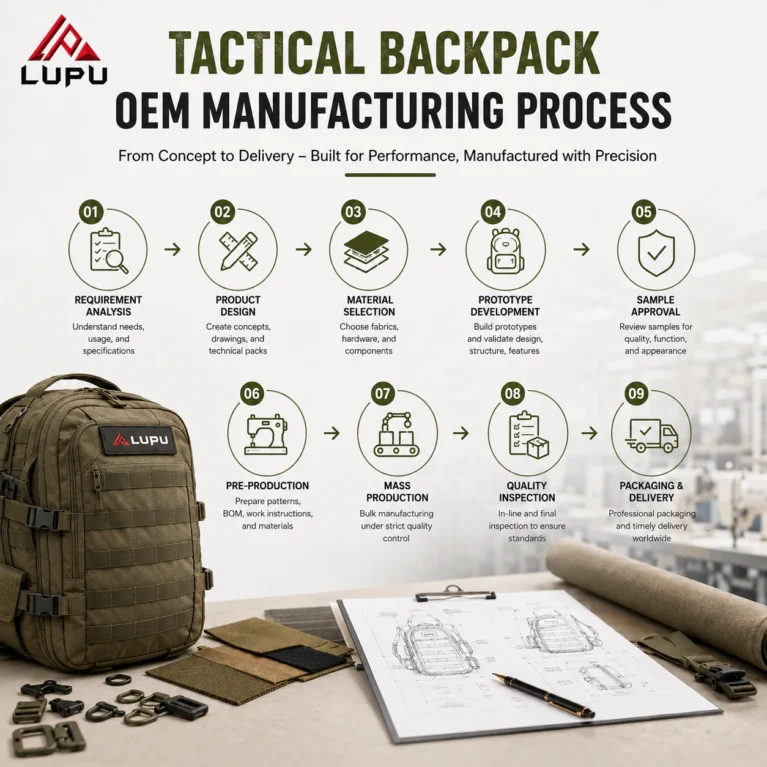
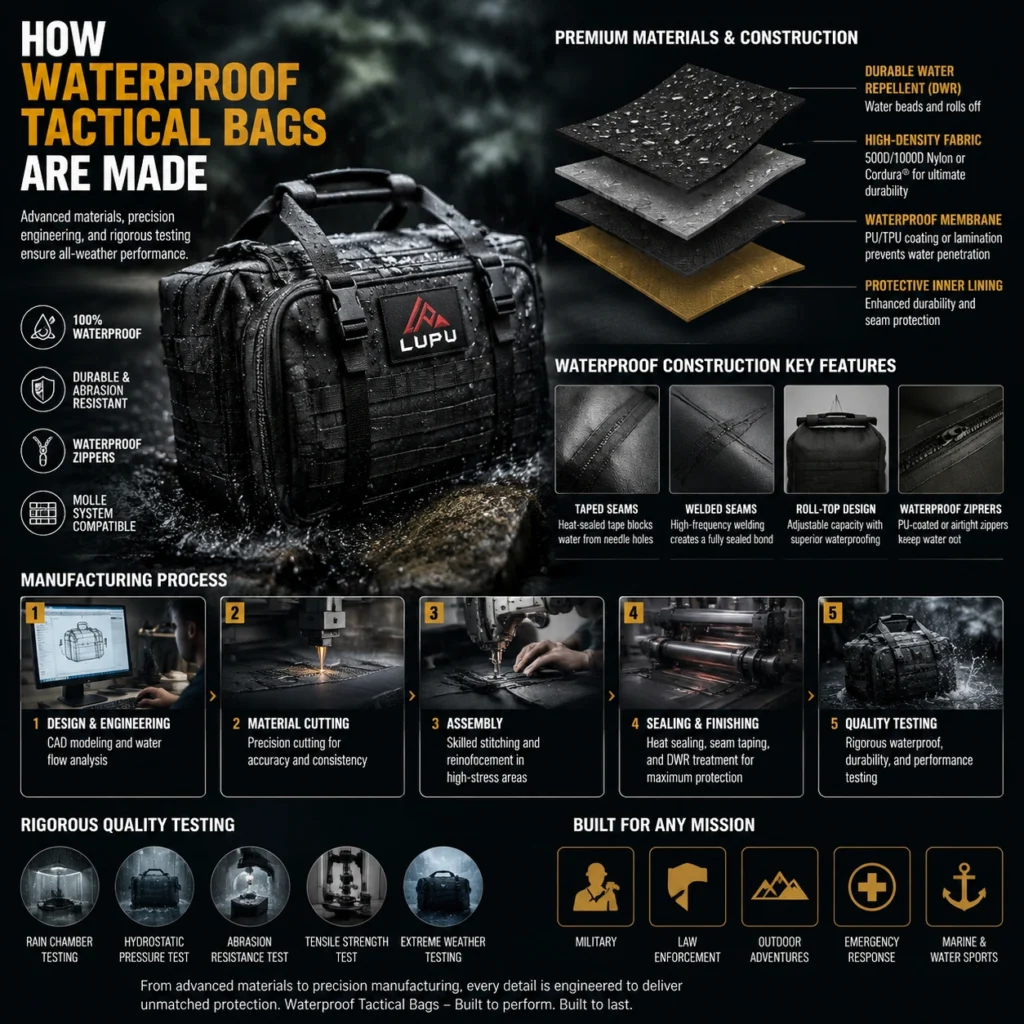
Manufacturing Process of Waterproof Tactical Bags
Design and Engineering
Professional タクティカルギアメーカー begin with:
CAD Modeling
Engineers analyze:
- Load distribution
- Pocket arrangement
- Stress concentration
Water Flow Simulation
Computer modeling helps determine:
- Potential leak paths
- Structural weaknesses
- Drainage efficiency
材料切断
Precision cutting systems include:
CNC Cutting
Advantages:
- High accuracy
- Reduced waste
- Consistent dimensions
Laser Cutting
Benefits include:
- Clean edges
- Improved efficiency
- Enhanced precision
Assembly Process
At our facility, the assembly process reflects over 20 years of expertise in tactical gear manufacturing. We provide modular and waterproof solutions that allow our B2B partners to fulfill specific market needs through our custom and wholesale tactical bags service programs.
Skilled technicians assemble:
- Main compartments
- MOLLE webbing systems
- Reinforcement layers
- Shoulder harnesses
- Internal structures
High-stress areas often feature:
- Box stitching
- Bartack reinforcement
- Double stitching
Waterproof Sealing
After sewing, products undergo:
- Heat sealing
- Seam taping
- Lamination bonding
- Pressure treatment
Each process must maintain precise temperature and pressure parameters.
Quality Testing and Waterproof Verification
Premium manufacturers perform extensive quality assurance tests.
Rain Chamber Testing
Artificial rain systems simulate:
- Heavy rainfall
- Wind-driven rain
- Long-term exposure
Hydrostatic Pressure Testing
Measures how much water pressure fabric can withstand before leakage occurs.
Higher ratings indicate better waterproof performance.
Abrasion Resistance Testing
Repeated friction cycles evaluate:
- Surface wear
- Coating durability
- Long-term reliability
Tensile Strength Testing
Examines:
- Stitch integrity
- Seam strength
- Fabric durability
Environmental Testing
Products may be exposed to:
- Extreme heat
- Sub-zero temperatures
- Humidity cycles
- UV radiation
This ensures consistent performance across diverse environments.
Trade-Offs in Waterproof Tactical Bag Design
Every engineering decision involves compromise.
Weight vs Protection
Thicker materials provide better durability but increase carrying weight.
Flexibility vs Structural Strength
Rigid constructions offer stability but reduce comfort.
Breathability vs Waterproofing
Completely sealed systems retain moisture inside, while ventilated designs sacrifice some waterproof capability.
Cost vs Performance
Premium components such as:
- TPU laminates
- Airtight zippers
- Welded seams
significantly increase manufacturing costs.
Real-World Applications of Waterproof Tactical Bags
Military Operations
Protection for:
- Ammunition
- Communication equipment
- Night vision devices
法執行機関
Reliable storage for:
- Medical supplies
- Electronics
- Duty gear
Emergency Preparedness
Keeps essential items safe during:
- Floods
- Hurricanes
- Natural disasters
Hiking and Bushcraft
Protects:
- Clothing
- Food supplies
- Navigation devices
Maritime Activities
Essential for:
- Kayaking
- Boating
- Fishing
- Water rescue operations
How to Evaluate High-Quality Waterproof Tactical Bags
Before purchasing, examine several critical factors.
Fabric Specifications
Look for:
- 500D or 1000D nylon
- TPU-laminated materials
- Durable DWR finishes
Seam Construction
High-quality bags should feature:
- Seam taping
- Reinforced stress points
- Precision stitching
Zipper Quality
Premium waterproof zippers greatly improve reliability.
Cheap zippers are often the first component to fail.
Bottom Reinforcement
The base should resist:
- Abrasion
- Moisture
- Impact
Double-layer construction is preferred.
MOLLE System Strength
Check:
- Stitch density
- Webbing alignment
- Reinforcement quality
Poorly sewn MOLLE systems can compromise durability.
Future Innovations in Waterproof Tactical Bags
The tactical industry continues to evolve.
Emerging technologies include:
Nano-Coating Technology
Microscopic coatings offer:
- Enhanced hydrophobic properties
- Lower weight
- Improved breathability
Self-Healing Materials
Advanced polymers can repair minor scratches and punctures automatically.
Ultrasonic Seam Welding
Provides:
- Stronger joints
- Reduced bulk
- Improved waterproof integrity
Sustainable Waterproof Solutions
Manufacturers are increasingly adopting:
- PFAS-free DWR treatments
- Recycled nylon fabrics
- Environmentally responsible TPU laminates
These innovations support both performance and sustainability.
結論
Manufacturing high-performance Waterproof Tactical Bags involves far more than adding a waterproof coating. True waterproof capability results from the integration of advanced materials, precision engineering, sophisticated sealing technologies, and rigorous quality control.
From high-density nylon fabrics and TPU laminates to welded seams and waterproof zippers, every component contributes to overall protection. The best waterproof tactical bags are designed as complete systems, where material science and manufacturing expertise work together to ensure reliable performance under demanding conditions.
As outdoor adventures, tactical operations, and emergency preparedness requirements continue to evolve, waterproof technology will remain one of the defining characteristics of premium tactical gear. Understanding how these bags are made enables buyers, distributors, and gear professionals to make informed decisions and recognize the difference between ordinary water-resistant products and truly mission-ready waterproof solutions.
関連記事
トップ50:世界のタクティカルギアブランド・リスト