For tactical gear importers, brand owners, and wholesale distributors, production lead time is more than a manufacturing detail. It directly affects inventory planning, product launches, seasonal demand, warehouse capacity, and delivery commitments to customers.
When sourcing tactical backpacks, buyers often ask a simple question: How long will production take? However, an accurate answer requires more than a single estimated number. The schedule depends on product specifications, material availability, customization requirements, order quantity, sample approval, factory capacity, and quality control procedures.
Understanding Tactical Backpack Production Lead Time helps importers make more realistic purchasing decisions, identify potential delays before they occur, and coordinate manufacturing with international shipping and sales plans.
From a manufacturing perspective, the most reliable approach is to break the order into clear stages, define when the production clock starts, and agree on measurable milestones with the supplier.
1. What Is Tactical Backpack Production Lead Time?
Tactical backpack production lead time generally refers to the period required to prepare and manufacture an order according to the agreed specifications. Depending on the supplier’s definition, it may begin after order confirmation or only after critical requirements, materials, and approvals are in place.
This distinction matters because two suppliers may quote different lead times while referring to different stages of the same process.
Manufacturing Lead Time vs. Total Procurement Lead Time
For international buyers, it is useful to distinguish manufacturing lead time from the total procurement timeline.
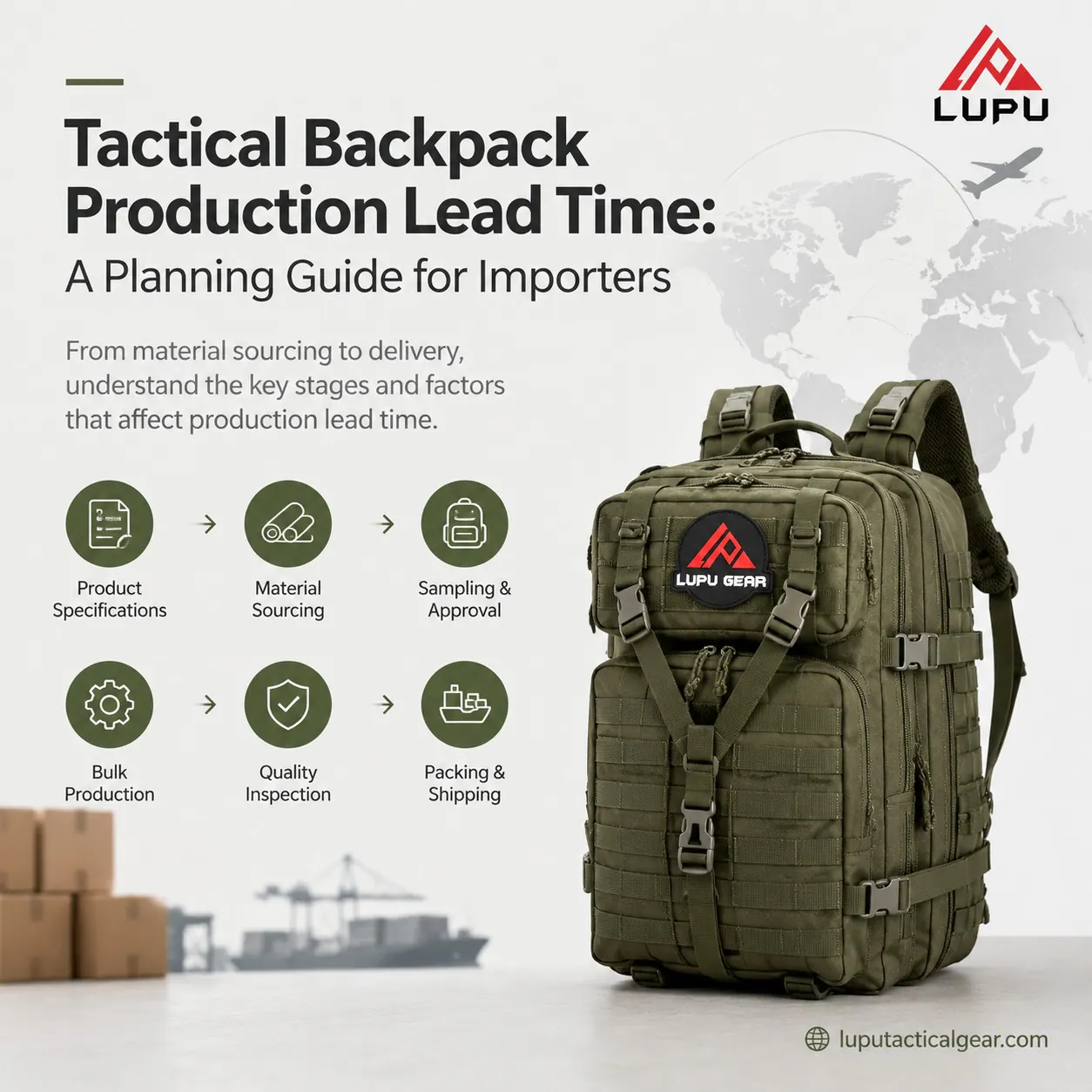
The total timeline may include the following stages:
- Product specification and quotation confirmation
- Material sourcing and component preparation
- Prototype development and sample approval, when required
- Bulk production and assembly
- Quality inspection, finishing, and packing
- Dispatch preparation and export documentation
- International transportation, customs clearance, and delivery
Not every stage is included in a factory’s quoted production time. For example, a supplier may quote the bulk manufacturing period separately from sampling and material preparation. International freight and customs clearance are also generally separate from factory production.
A quoted production lead time should never be treated as an estimated warehouse arrival date unless the supplier has explicitly included transportation and delivery in the schedule.
When comparing quotations, ask each manufacturer to specify the start point, end point, included activities, and assumptions behind the estimate. This creates a consistent basis for evaluating suppliers and planning replenishment.
When Does the Production Clock Start?
A confirmed purchase order does not always mean that production can begin immediately.
For a customized tactical backpack, several conditions may need to be satisfied first:
- The product specifications and technical details are confirmed.
- The reference sample or pre-production sample has been approved, if applicable.
- Required fabrics, webbing, buckles, zippers, and other components are available or have a confirmed delivery schedule.
- Branding, labels, packaging, and other customization details are finalized.
- Payment terms and the production schedule have been confirmed.
- The supplier has agreed in writing on the official production start date.
These conditions help prevent misunderstandings. If a buyer assumes the lead time starts when the purchase order is issued, while the manufacturer starts counting only after sample approval and material readiness, the two parties may have very different expectations.
For this reason, importers should request a written definition of the production start date before placing a bulk order.
2. The Main Stages of Tactical Backpack Manufacturing
Understanding how a tactical backpack moves through the factory makes it easier to identify schedule risks and communicate effectively with a supplier.
The exact workflow varies by product design and manufacturing arrangement, but most OEM and ODM projects involve the following stages.
Stage 1: Product Specifications and Technical Confirmation
Before materials are purchased or production is scheduled, the タクティカルギアメーカー needs a clear understanding of the product.
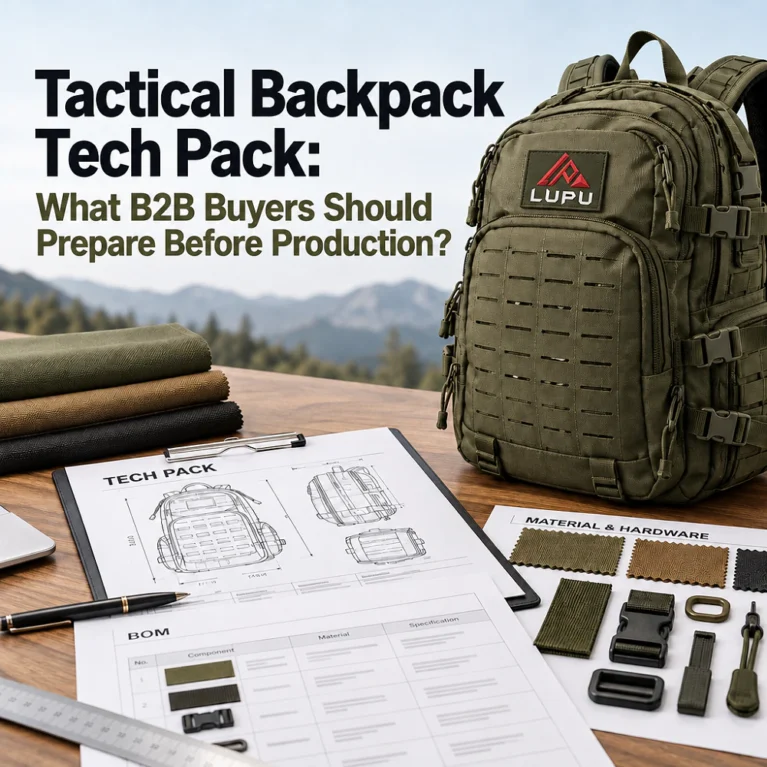
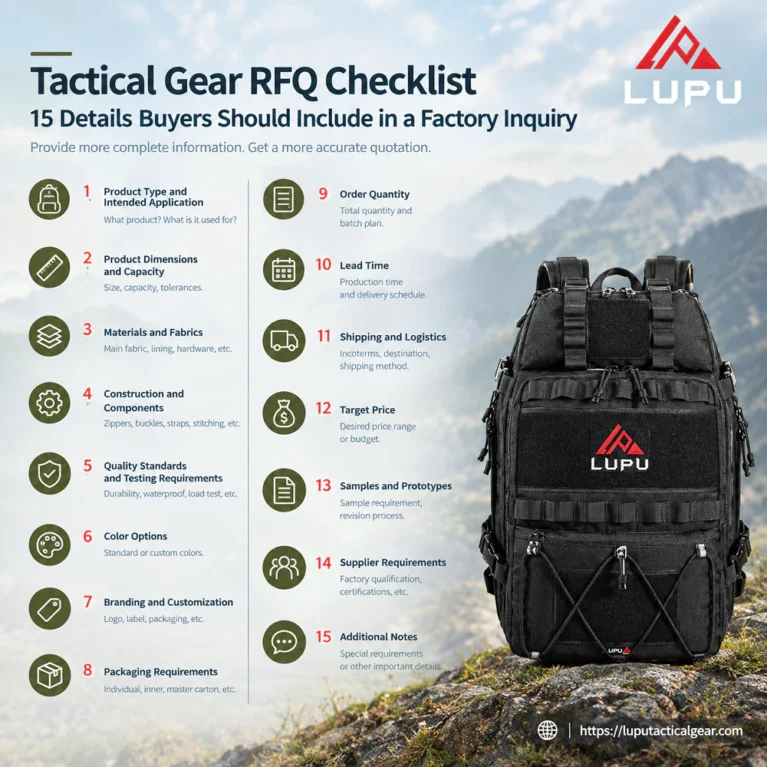
A technical specification should cover the backpack’s dimensions, capacity requirements, fabric type, color, lining, webbing, zipper specifications, buckle models, pocket layout, reinforcement details, logo application, and packaging requirements.
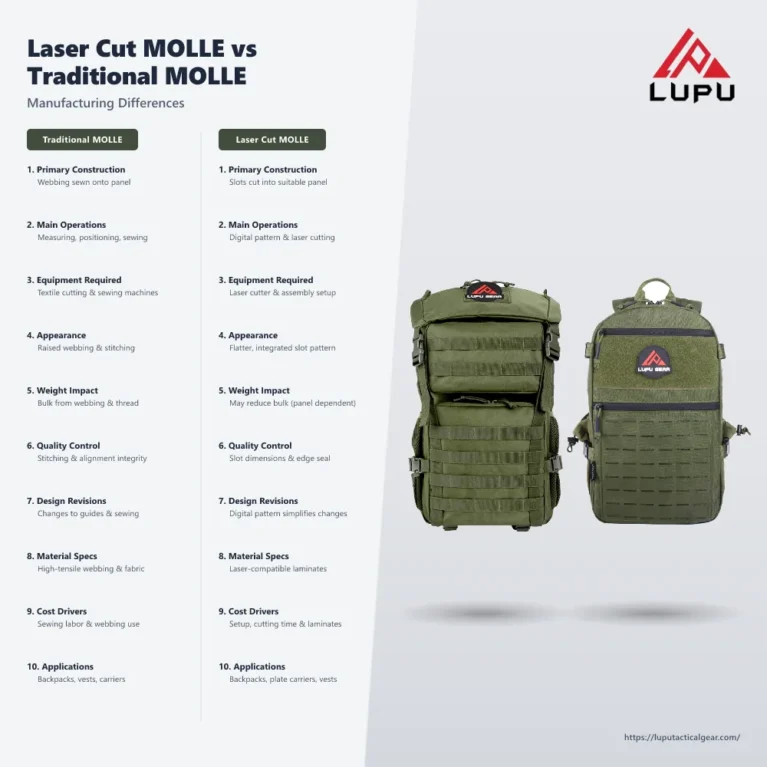
For tactical backpacks with modular features, the specification may also need to identify the placement and dimensions of MOLLE-style webbing, attachment points, hook-and-loop panels, and accessory interfaces.
Incomplete specifications can create avoidable delays. If the buyer changes pocket dimensions, fabric weight, color, or logo placement after development has started, the manufacturer may need to revise patterns, source different materials, or produce another sample.
Practical recommendation: Confirm the technical pack, artwork, color references, and component requirements as early as possible. The more complete the product definition, the easier it is to prepare an accurate schedule.
Stage 2: Material Sourcing and Preparation
Material readiness is one of the most important variables in tactical backpack production.
Common materials and components include コルドゥラ, nylon or polyester fabrics, coated textiles, webbing, zippers, buckles, hook-and-loop fasteners, mesh, foam, lining materials, labels, and packaging supplies.
The sourcing timeline depends on whether the required items are standard materials already available to the manufacturer or customized components that must be ordered separately.
For example, a project using standard black fabric and established hardware may involve fewer sourcing uncertainties than a new design requiring a specific camouflage pattern, custom color matching, special buckle specifications, or proprietary branding components.
Material availability should not be judged solely by whether a supplier has a similar item in stock. Buyers should confirm the actual specification, color, quality requirements, and quantity available for the order.
A material substitution may affect appearance, performance, compatibility, or consistency across the finished product. Any proposed substitution should therefore be reviewed and approved before it is used in bulk production.
Practical recommendation: Ask the manufacturer to identify critical or long-lead components and confirm whether they are in stock, reserved for the order, or still awaiting タクティカルギアサプライヤー delivery.
Stage 3: Prototype Development and Sample Approval
Sampling allows the buyer and manufacturer to evaluate the design before committing to bulk production.
Depending on the project, the sample may be used to check dimensions, compartment layout, strap adjustment, stitching, reinforcement, hardware compatibility, logo placement, color, and overall construction.
For a complex tactical backpack, the first sample may reveal issues that are difficult to identify from drawings alone. The buyer may request changes to pocket access, strap positioning, internal organization, or attachment layouts.
Each revision can affect the schedule. The manufacturer may need to update patterns, prepare new materials, modify construction details, or make another sample for review.
Sample approval is therefore not simply an administrative step. It is a key production-control milestone.
Before approving a sample, importers should confirm that the approved version reflects the intended bulk specification. If a sample contains temporary materials or components that differ from the planned production version, those differences should be documented.
Practical recommendation: Consolidate feedback into one clear revision list whenever possible. Include marked-up photographs, dimension references, artwork files, and specific acceptance criteria rather than relying on general comments such as “improve the design.”
Stage 4: Bulk Production and Assembly
Once the relevant approvals and production requirements are in place, the order can move into bulk manufacturing according to the agreed schedule.
Depending on the factory’s workflow, production may involve material inspection, fabric cutting, component preparation, sewing, reinforcement, installation of webbing and hardware, assembly, and finishing.
Tactical backpacks often contain multiple compartments, attachment systems, reinforced stress points, and several types of materials. These features can require additional operations and careful coordination between production steps.
The production schedule is influenced not only by the number of backpacks ordered but also by the time and resources required to manufacture each unit consistently.
A high-volume order may benefit from production planning and process standardization, but it can also require more time for cutting, sewing, assembly, and inspection. A smaller order is not automatically faster if it involves a new design, special materials, or a production setup that has not been established.
Practical recommendation: Request a milestone-based production schedule instead of relying only on a promised completion date. Where appropriate, ask the manufacturer to explain the planned sequence of material preparation, cutting, sewing, assembly, and finishing.
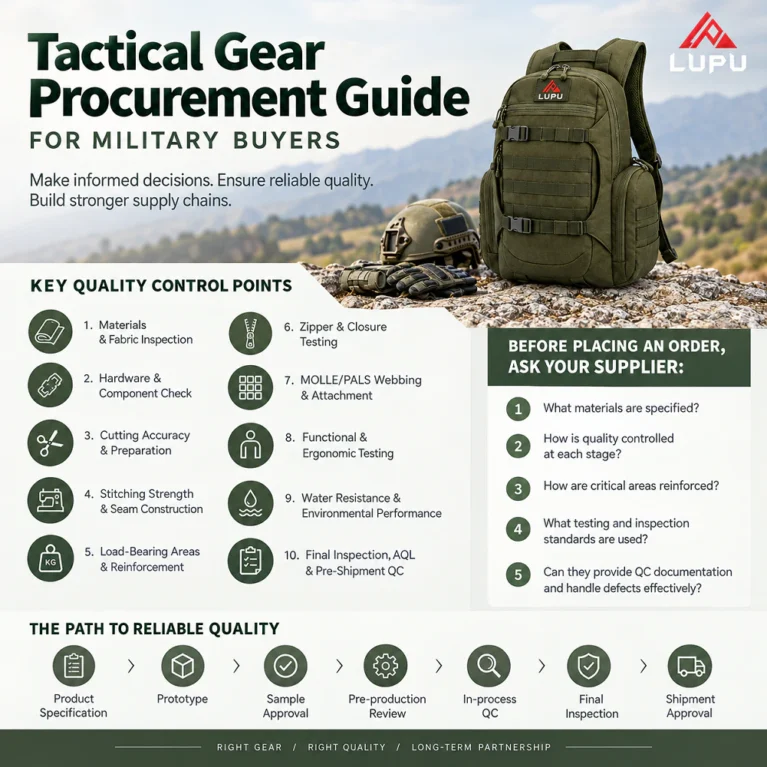
Stage 5: Quality Inspection, Finishing, and Packing
Production completion and order readiness for dispatch are not necessarily the same event.
After assembly, the manufacturer may need to conduct final inspection, correct identified defects, clean and finish the products, verify labels and accessories, and pack the order according to the agreed requirements.
For tactical backpacks, inspection criteria may include dimensions, stitching quality, zipper operation, buckle function, strap adjustment, reinforcement, branding accuracy, and conformity to the approved sample or specification.
Packaging requirements can also affect the schedule. Individual polybags, hangtags, barcodes, carton markings, custom packaging, and special packing instructions may require additional preparation.
If a quality issue is identified, the time needed for correction depends on its nature and extent. This is one reason buyers should clarify the inspection process and acceptance criteria before bulk production begins.
Practical recommendation: Agree on the inspection checklist, packaging specifications, and required shipping documents early. This reduces the risk of discovering unresolved requirements at the end of the production cycle.
3. What Factors Affect Tactical Backpack Production Lead Time?
No single factor determines the schedule of every tactical backpack order. Lead time is usually the result of several connected variables.
3.1 Order Quantity and Production Capacity
Order quantity affects material purchasing, cutting plans, sewing allocation, assembly, and final inspection.
Larger orders may require additional production lines or a longer manufacturing window. Smaller orders may require less total production work, but their lead time can still be affected by material availability, setup requirements, and the factory’s existing schedule.
The manufacturer’s available capacity also matters. A factory with relevant product experience and a suitable production process may be better positioned to plan the order than a supplier that must first establish unfamiliar operations.
When evaluating capacity, buyers should ask whether the proposed schedule reflects the factory’s actual workload and the resources allocated to their order.
3.2 OEM and ODM Customization Requirements
Customization is a major consideration for brands developing private-label tactical backpacks.
A relatively straightforward project using an existing design and standard components may involve fewer development steps than a fully customized product requiring new patterns, unique compartment layouts, special materials, or custom hardware.
OEM projects can require detailed coordination around buyer-provided specifications. ODM projects may involve additional design development, prototype evaluation, and decisions about the final product configuration.
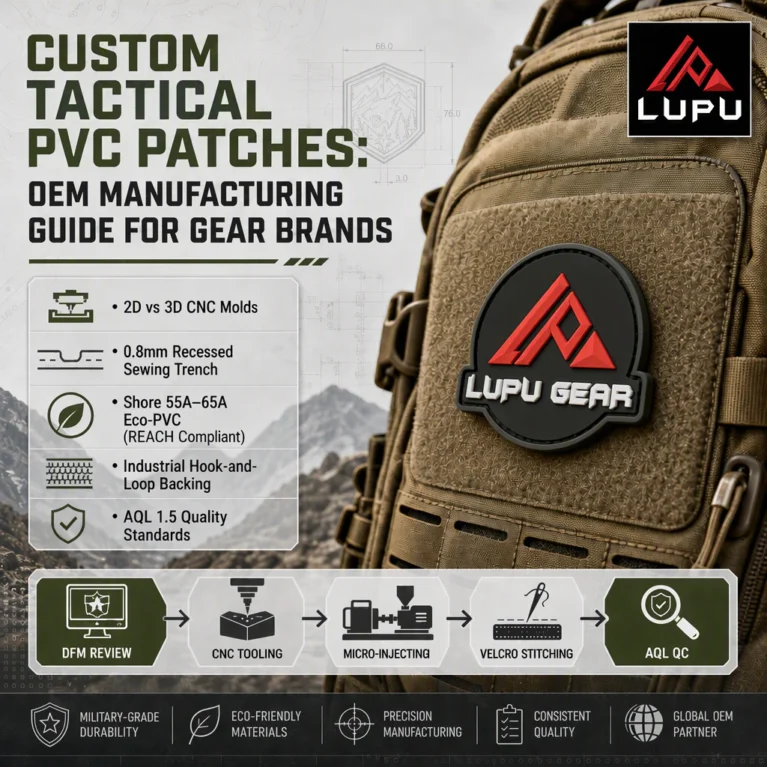
Logo customization also varies in complexity. Embroidery, screen printing, heat transfer, woven labels, and hook-and-loop patches may have different preparation requirements, depending on the design and production method.
Importers should clarify which customization elements are included in the initial schedule and which require separate development or approval.
3.3 Fabric, Hardware, and Component Availability
The availability of one critical component can influence the schedule of the entire order.
A backpack may be ready for assembly in most respects but still be unable to proceed because a required buckle, zipper, fabric color, or custom label has not arrived.
This risk is more significant when components are custom-made, sourced from different suppliers, or subject to minimum order quantities.
Color matching can also require additional coordination. A color reference or digital image alone may not fully represent the appearance of the final material, so physical swatches or approved color standards may be needed.
Buyers should ask suppliers to distinguish between confirmed material availability and estimated replenishment dates.
3.4 Product Complexity and Construction Requirements
Two backpacks with similar external dimensions may require very different amounts of production work.
A design with multiple compartments, internal organizers, padded sections, reinforced attachment points, modular webbing, and complex strap systems generally involves more operations than a simpler bag.
Construction details can also affect consistency and inspection requirements. For example, additional reinforcement at stress points may require specific sewing operations and closer checks against the approved specification.
The relevant question is not simply how large the backpack is, but how many manufacturing operations are required and how demanding those operations are.
3.5 Changes After Sample or Specification Approval
Late changes are a common source of schedule disruption.
A revision to fabric, color, dimensions, pocket placement, logo artwork, hardware, or packaging may affect materials that have already been purchased or work that has already been completed.
The impact depends on when the change is requested. A minor adjustment before material purchasing may be manageable, while the same change during bulk production may require rework, replacement components, or additional inspection.
To control this risk, the buyer and manufacturer should agree on a change-management process that identifies the requested revision, evaluates its cost and schedule impact, and records approval before implementation.
3.6 Seasonal Demand and Factory Scheduling
Manufacturing capacity is not static. Seasonal demand, other confirmed orders, supplier availability, staffing, and planned factory maintenance can affect the production window.
Importers planning around peak retail periods, trade shows, product launches, or seasonal sales should discuss scheduling well in advance.
However, placing an order early does not automatically guarantee an earlier completion date. The supplier must still confirm material readiness, available capacity, and the production slot allocated to the project.
A realistic plan should be based on a confirmed schedule rather than assumptions about general factory availability.
4. How Long Does Tactical Backpack Production Take?
There is no universal lead time that applies to every tactical backpack order.
A reliable estimate depends on the product, quantity, customization level, material status, sample requirements, factory workload, and the scope of activities included in the quotation.
For this reason, importers should be cautious about comparing suppliers solely by the shortest number of days advertised.
Repeat Orders Using an Established Specification
Repeat orders may be easier to schedule when the product specification is unchanged, the approved sample is available for reference, materials can be sourced reliably, and production methods are already established.
However, a repeat order should not automatically be assumed to have the same lead time as the previous order. Material availability, order quantity, production capacity, and changes in demand may differ.
Before placing a repeat order, confirm whether the previous materials and components are still available and whether the manufacturer can maintain the same specifications.
Customized Orders Based on Existing Designs
A customized order based on an established design may involve changes to colors, logos, labels, packaging, or selected features.
The schedule depends on the extent of customization and whether those changes require new materials, sample approval, or additional setup.
If the requested changes are clearly defined and the necessary components can be sourced promptly, planning may be more straightforward than for a completely new design. Nevertheless, the manufacturer should assess the actual requirements before confirming the timeline.
New Product Development and Fully Customized Designs
A new tactical backpack design may require more coordination because product development, pattern preparation, sample production, design revisions, and material selection can all affect the schedule.
The number of sample rounds is particularly important. If the buyer and manufacturer need several rounds to resolve dimensions, construction details, or material choices, the development period will extend accordingly.
For new products, importers should request a schedule that separates development and sampling from bulk manufacturing. This makes it easier to track progress and identify where decisions are still outstanding.
Request a Phase-by-Phase Estimate
Instead of asking only, “How many days will production take?” request a breakdown of the expected timeline.
|
Schedule item |
What to confirm |
|
Product development |
Whether new patterns, prototypes, or design revisions are required |
|
Material preparation |
Which materials are available and which need to be sourced |
|
Sample approval |
Who approves the sample and how revisions are handled |
|
Bulk production |
The agreed production window and key milestones |
|
Final inspection |
Inspection scope and process for addressing nonconformities |
|
Packing and dispatch |
When the order is expected to be packed and ready for shipment |
|
International delivery |
Estimated transit and customs arrangements, confirmed separately |
Ask the manufacturer to state the assumptions behind each estimate. If a component is not yet confirmed or sample approval is outstanding, that uncertainty should be visible in the plan.
A useful schedule should identify not only the expected completion date but also the conditions that must be met to achieve it.
5. How Importers Can Reduce Production Delays
Importers cannot control every variable in a manufacturing project, but they can reduce avoidable delays through better preparation and communication.
5.1 Prepare a Complete Technical Pack
A clear technical pack reduces repeated questions and minimizes the risk of different interpretations.
Where applicable, include product dimensions, material specifications, color references, component details, construction requirements, branding artwork, packaging instructions, and quality acceptance criteria.
If some details remain undecided, list them as open items and assign a deadline for resolution.
5.2 Approve Samples Promptly and Clearly
Sample approval should betreated as a scheduled milestone rather than an informal exchange of messages.
Before the sample is made, agree on the expected review process. After receiving it, consolidate feedback and identify which changes are mandatory, which are optional, and which require a revised sample.
A written approval record helps both parties establish the correct reference for bulk production.
5.3 Confirm Materials Before the Production Window
Discuss critical materials and components before finalizing the bulk schedule.
Ask whether the fabric, webbing, zippers, buckles, labels, and packaging are available in the required specifications and quantities. For customized items, request the expected sourcing period and confirm how material delays will be communicated.
Where substitutions are proposed, review and approve them formally rather than allowing unapproved alternatives to enter production.
5.4 Establish Milestones and Responsibilities
A production plan should identify the main milestones, responsible contacts, expected completion dates, and information required from each party.
For example, the buyer may be responsible for providing final logo artwork and approving the pre-production sample, while the manufacturer may be responsible for material preparation, production updates, inspection, and packing.
Clear responsibilities reduce the risk of a schedule slipping because an approval or decision has been overlooked.
5.5 Keep Communication Structured
Frequent communication is useful only when it provides actionable information.
Instead of asking for general updates, buyers can ask specific questions:
- Has material preparation been completed?
- Has bulk production started?
- Which production milestone has been completed?
- Are any components or approvals affecting the schedule?
- What corrective action is planned if a milestone is delayed?
- Has the expected dispatch date changed?
A consistent reporting format helps buyers identify risks early and coordinate their own purchasing, warehousing, and sales activities.
5.6 Plan for Shipping and Delivery Separately
Even when manufacturing finishes on schedule, international delivery may still be affected by freight availability, transportation method, customs procedures, documentation, and the destination market.
Importers should therefore work backward from the required warehouse arrival date, allowing time for production, inspection, dispatch preparation, transportation, customs clearance, and any necessary contingency.
The amount of contingency needed depends on the route, shipping method, season, and consequences of a delay. It should be planned according to the specific order rather than applied as an unsupported universal rule.
6. Tactical Backpack Production Planning Checklist for Importers
Before confirming a bulk order, use the following checklist to verify that the schedule is based on clear requirements.
Product and specification
- Confirm dimensions, materials, colors, construction details, and components.
- Finalize branding artwork, labels, and packaging requirements.
- Document all customization requirements and approved alternatives.
Sampling and approval
- Confirm whether a prototype or pre-production sample is required.
- Define sample review responsibilities and feedback deadlines.
- Record final sample approval and any permitted production tolerances.
Materials and capacity
- Verify the availability of critical fabrics and components.
- Identify custom or long-lead items.
- Confirm the planned production window and the assumptions behind it.
Production and quality control
- Agree on the production start date and key milestones.
- Define inspection criteria and how nonconforming products will be handled.
- Confirm packing requirements and the documents needed for dispatch.
Shipping and delivery
- Separate the factory completion date from the dispatch date.
- Estimate transit and customs clearance independently.
- Work backward from the required arrival date and plan an appropriate contingency.
Completing these checks does not eliminate every possible disruption, but it makes the order easier to manage and helps both parties identify schedule risks before they become urgent.
7. Questions to Ask Your Tactical Backpack Manufacturer
Before committing to an order, importers should ask the manufacturer questions that reveal how the production schedule is calculated.
- What event officially starts the production lead time?
Confirm whether the clock starts at purchase order confirmation, deposit receipt, final specification approval, sample approval, material readiness, or another agreed milestone.
- Does the quoted timeline include material sourcing and sampling?
Ask for a breakdown of development, material preparation, bulk production, inspection, and packing. This prevents comparisons between quotations that cover different activities.
- Which materials or components could affect the schedule?
Identify items that have not yet been confirmed and ask how their delivery dates will be tracked.
- What production milestones will be reported?
Agree on practical checkpoints so that both parties can monitor progress without waiting until the planned completion date.
- How are design changes handled after approval?
Ask how the manufacturer evaluates the impact of revisions on cost, materials, and the production schedule.
- What inspection standards and acceptance criteria will apply?
Confirm how the finished products will be checked and what happens if an issue is identified.
- Does the completion date mean factory completion, dispatch, or arrival at the destination?
These are different milestones. Make sure the quotation and purchase order use clear definitions.
- How will potential delays be communicated?
Ask who will notify you, what information will be provided, and how revised dates and corrective actions will be documented.
A professional manufacturing partner should be able to explain the basis of its estimate, identify known dependencies, and communicate schedule changes clearly. No supplier can eliminate every uncertainty, but a transparent planning process makes those uncertainties easier to manage.
8. Final Thoughts: Plan Milestones, Not Just Dates
Managing Tactical Backpack Production Lead Time requires more than choosing a supplier with an attractive delivery promise. It involves coordinating product development, material sourcing, sample approval, bulk manufacturing, quality inspection, packing, and international delivery.
For importers and タクティカルギアブランド, the most useful production estimate is one that explains what is included, what must happen before work can begin, and how progress will be measured.
A complete technical pack, timely approvals, confirmed material requirements, realistic milestones, and structured communication can reduce avoidable delays and improve purchasing decisions.
When evaluating a tactical backpack manufacturer, look beyond the headline lead time. Assess whether the supplier understands your product requirements, can explain the manufacturing workflow, and is prepared to manage the order against an agreed schedule.
Planning Your Next Tactical Backpack Order?
LUPU Tactical Gear works with brands, wholesalers, distributors, and importers seeking tactical backpack manufacturing and OEM/ODM customization solutions.
Share your product specifications, estimated order quantity, customization requirements, and target delivery date to discuss the production planning requirements for your project.
Contact LUPU Tactical Gear
Request an order-specific production schedule and quotation based on your actual product requirements.