Tactical equipment design is becoming increasingly complex. Buyers expect products that balance durability, weight, comfort, modularity, and manufacturing consistency, while brands need to respond to changing requirements without allowing development costs and lead times to grow unnecessarily.
Artificial intelligence (AI) is introducing new possibilities for addressing these challenges. From generating design concepts and comparing material options to analyzing product configurations and supporting manufacturing inspections, AI-assisted technologies can help tactical equipment developers make more informed decisions throughout the product development process.
However, AI Tactical Gear Design is not simply about using algorithms to create visually impressive equipment. Its real value lies in connecting design decisions with measurable requirements, engineering constraints, manufacturing capabilities, and physical validation.
について タクティカルギアメーカー, OEM/ODM suppliers, and professional procurement teams, understanding this distinction is essential. AI can expand the range of design possibilities, but experienced designers and engineers must still determine whether a product is practical, manufacturable, and suitable for its intended application.
1. What Is AI Tactical Gear Design?
AI Tactical Gear Design refers to the application of artificial intelligence and related digital technologies to the development, evaluation, and improvement of tactical equipment.
Depending on the tools and available data, these technologies can support concept generation, design comparison, material analysis, ergonomic evaluation, and selected manufacturing quality-control tasks.
Potential applications include tactical backpacks, plate carriers, tactical vests, chest rigs, hydration packs, and modular load-carrying systems.
Several technologies are particularly relevant.
Generative AI can help designers explore visual concepts, alternative product layouts, and configuration ideas during early development.
Machine learning can identify patterns in suitable datasets, such as historical inspection records or structured product performance data, when sufficient reliable information is available.
Computer-aided engineering and simulation can help evaluate defined engineering questions, such as structural behavior or load-related deformation, depending on the software and model assumptions.
Computer vision can support the identification of visible defects, including inconsistent stitching, misplaced components, or missing details, provided that the inspection system has been appropriately developed and validated.
These technologies serve different purposes. A generated product image, a simulation result, and a machine-vision inspection report are not interchangeable forms of evidence.
A concept image may help communicate a design direction, but it cannot establish fabric strength, seam durability, load-bearing performance, or production readiness.
The most effective approach combines digital tools with engineering judgment, physical prototypes, and appropriate testing.
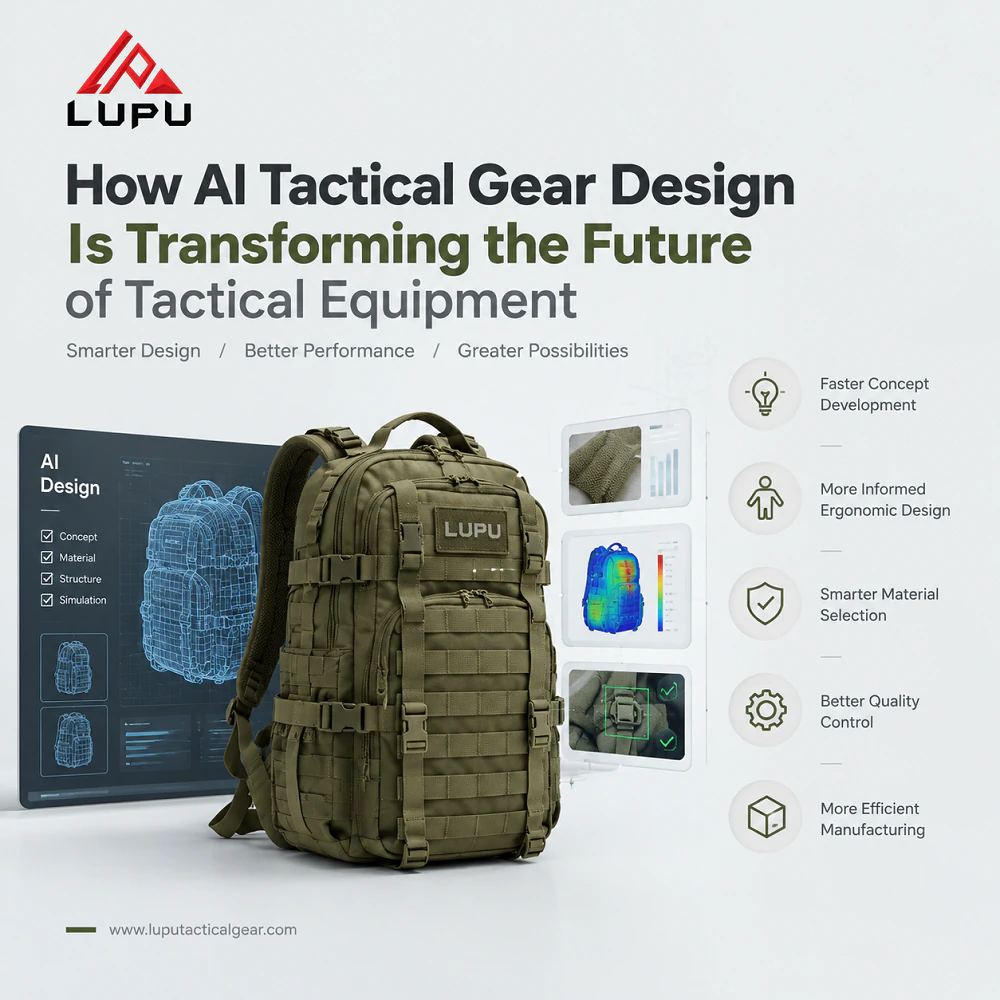
2. Five Ways AI Is Transforming Tactical Gear Design
2.1 Faster Concept Development and Design Iteration
Traditional tactical equipment development often involves multiple rounds of sketches, technical drawings, samples, and revisions. Each iteration may require coordination between designers, product developers, buyers, and manufacturing teams.
AI-assisted visualization can help accelerate the early stages of this process.
For example, when developing a tactical backpack, a design team might explore several alternative arrangements for the main compartment, front utility pockets, side attachment points, hydration access, and external MOLLE panels.
These alternatives can help stakeholders compare design directions before committing resources to physical samples.
AI-assisted tools may also help translate written specifications into preliminary visual concepts, making it easier for buyers to communicate their requirements.
Nevertheless, generated concepts must be reviewed carefully. An image may show attractive pockets, straps, or attachment systems without accounting for seam allowances, zipper access, component interference, or practical assembly requirements.
The objective is not to eliminate design iterations. It is to make early iterations more informative so that physical prototyping can focus on the most promising and technically feasible options.
2.2 More Informed Ergonomic Design
Comfort and load distribution are important considerations in tactical equipment development, particularly for backpacks and load-carrying systems used for extended periods.
AI-assisted analysis may help designers organize anthropometric information, user feedback, and relevant product measurements to identify potential improvements.
Areas worth evaluating include:
- Shoulder strap geometry and adjustment range.
- Back-panel shape, ventilation, and contact areas.
- Waist-belt positioning and load transfer.
- Access to equipment during movement.
- Interference between straps, pouches, and other components.
- Fit across the intended user population.
Consider a tactical backpack with a substantial external load. Its carrying performance depends not only on the shoulder straps but also on the relationship between the frame or support structure, back panel, hip belt, load position, and user’s body dimensions.
AI can help explore design alternatives or analyze structured test data. However, its recommendations are only as useful as the underlying information and evaluation methods.
A design that appears ergonomic in a digital rendering may still create pressure points, restrict movement, or feel unstable under realistic loading conditions.
For this reason, physical fit evaluations and wear trials remain important. Where appropriate, these should involve representative users, defined load conditions, and consistent evaluation criteria.
2.3 Smarter Material Selection
Material selection involves balancing several competing requirements.
A lightweight fabric may reduce overall product weight but require additional reinforcement in high-stress areas. A heavier fabric may provide desirable abrasion resistance while increasing carrying weight and material costs.
Water resistance, tear strength, flexibility, coating characteristics, sewing compatibility, and availability may also affect the final decision.
AI-assisted analysis can help organize and compare material data against a defined set of requirements.
For example, when developing a tactical backpack, a team could compare candidate fabrics using documented specifications for:
- Fabric weight and thickness.
- Abrasion and tear resistance.
- Tensile strength.
- Water resistance.
- Coating and surface characteristics.
- Material cost and supply availability.
- Compatibility with the intended construction method.
The design team can then identify which materials merit further evaluation.
However, a material specification should not be treated as proof of finished-product performance. Results can depend on test methods, specimen preparation, construction details, and manufacturing conditions.
A fabric described as waterproof, for example, does not automatically make the finished backpack waterproof. Stitching, seams, zippers, closures, and construction methods can all affect water ingress.
The practical value of AI lies in helping designers compare evidence and identify trade-offs—not in replacing material testing or supplier verification.
2.4 Better Modularity and Equipment Integration
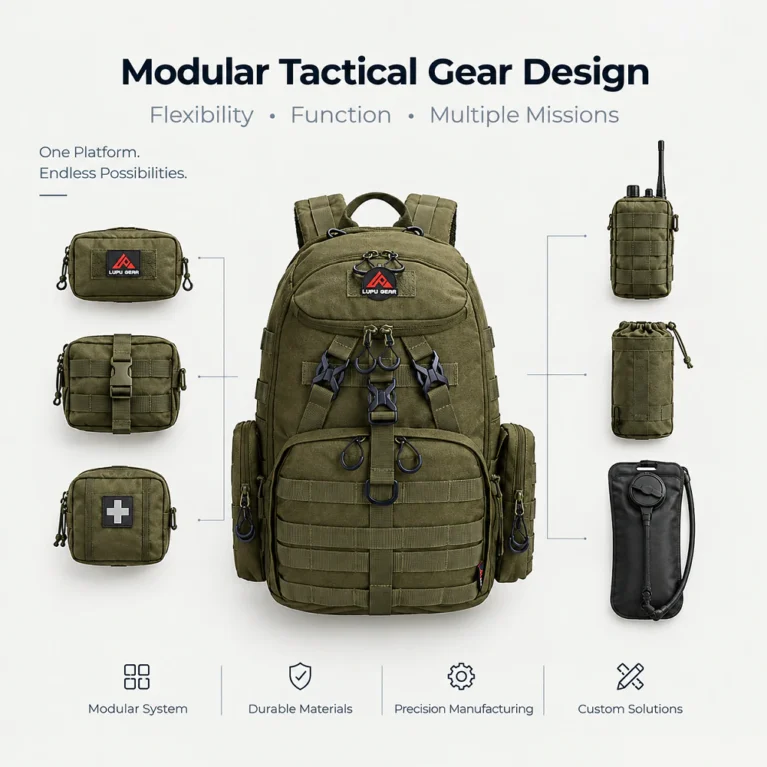
Modularity allows users and buyers to configure equipment for different applications. MOLLE-compatible panels, removable pouches, hydration systems, and adjustable attachment points are common examples of modular design considerations.
However, adding more attachment points does not automatically create a better product.
Poorly positioned pouches may obstruct access to the main compartment. External accessories can interfere with straps or hydration tubes. Additional components may also increase weight, bulk, and manufacturing complexity.
AI-assisted visualization and configuration analysis can help teams explore these relationships earlier in the design process.
For a modular tactical backpack, designers might compare alternative pouch arrangements and evaluate:
- Access to frequently used compartments.
- Clearance between adjacent components.
- Attachment compatibility.
- Strap adjustment and movement.
- Overall dimensions and external bulk.
- The effect of different configurations on carrying balance.
These checks can reveal questions that deserve further engineering review before a prototype is produced.
Yet visual compatibility is not the same as mechanical compatibility. Attachment strength, dimensional tolerances, stitching integrity, and performance under load still require appropriate verification.
A successful modular system should offer meaningful flexibility without introducing unnecessary complexity.
2.5 Improved Design for Manufacturing and Quality Control
A tactical equipment design must work not only for the end user but also for the people and processes responsible for producing it.
A complex pocket arrangement, difficult seam intersection, or inconsistent component placement can create manufacturing challenges even when the product concept looks straightforward.
AI-assisted design review may help identify potential production issues earlier, particularly when supported by accurate technical drawings, established construction rules, and manufacturing feedback.
Relevant areas include pattern development, material utilization, seam placement, component positioning, and assembly sequence.
Computer vision may also support selected quality-inspection tasks. For example, a properly configured inspection system could flag visible stitching irregularities, missing components, or deviations in the placement of designated features.
Such systems require suitable image data, controlled inspection conditions, and validation against known defects. They may also struggle with variations in fabric texture, lighting, product positioning, and complex three-dimensional structures.
Most importantly, detecting visible defects does not establish the full quality of a finished product.
A backpack may look correct while containing insufficiently secured seams or components that fail under load. Those issues require appropriate inspection and performance testing.
AI can help improve the consistency of defined processes, but it should complement—not replace—a structured quality management system.
3. How AI Fits into the Tactical Equipment Development Process
AI is most useful when it supports a disciplined product development workflow rather than operating as an isolated design tool.
Stage 1: Requirements Analysis
The process begins with clear product requirements.
Designers and buyers should establish the intended application, capacity, dimensions, material requirements, carrying configuration, target cost, and relevant performance criteria.
AI-assisted tools may help organize specifications, compare requirements, and identify conflicting priorities.
For example, a request for greater storage capacity, lower weight, and higher durability may involve trade-offs that need to be resolved before detailed design begins.
Stage 2: Concept Development
The team explores alternative layouts and product configurations.
AI-generated visuals can help communicate ideas, but designers should distinguish preliminary concepts from approved technical designs.
Each promising concept must be assessed against practical requirements and manufacturing constraints.
Stage 3: Engineering and Prototyping
Selected concepts are translated into technical drawings, patterns, component specifications, and construction instructions.
Physical samples help establish whether the proposed design can be manufactured and assembled as intended.
At this stage, the team can identify issues that were not apparent during concept development, including difficult sewing operations, inadequate reinforcement, and restricted component access.
Stage 4: Testing and Validation
Prototypes are evaluated against predefined acceptance criteria.
Depending on the product, this may include dimensional inspection, seam and attachment checks, load testing, abrasion assessment, wear trials, and water-resistance evaluation.
AI-assisted analysis can help organize results and identify patterns, but the testing method must be appropriate to the claim being evaluated.
Stage 5: Production and Continuous Improvement
Once a design is approved, manufacturing feedback and inspection records can inform subsequent improvements.
Recurring defects may indicate that a construction detail, material specification, production instruction, or inspection procedure needs review.
When the data is reliable, AI-assisted analysis may help identify patterns that deserve investigation.
The final decision should remain grounded in verified findings rather than algorithmic recommendations alone.
This process is iterative. Testing and production feedback may require designers to revisit earlier decisions before a product is ready for consistent manufacturing.
4. Practical Applications Across Tactical Equipment Categories
Different product categories present different design challenges. AI should therefore be applied according to the product’s intended use and engineering requirements.
タクティカル・バックパック
For tactical backpacks, potential applications include compartment layout exploration, reinforcement planning, material comparison, and analysis of carrying configurations.
Designers must still consider load distribution, zipper accessibility, seam construction, attachment strength, and comfort.
A backpack intended for everyday carry may have different priorities from one designed for extended outdoor use or specialized equipment transport.
Tactical Vests and Plate Carriers
For tactical vests and plate carriers, AI-assisted visualization may help explore panel geometry, adjustment systems, pouch placement, and component compatibility.
Fit, mobility, and access should be assessed across the intended user range.
Where a product is intended to accommodate protective inserts, the design must follow the applicable product specifications and relevant validation requirements. A digital concept alone cannot establish ballistic protection or other protective performance.
Hydration Packs and Chest Rigs
Hydration packs and chest rigs require careful coordination between storage, fit, access, and component routing.
AI-assisted tools may help compare compartment arrangements, hydration tube routing, attachment positions, and strap configurations.
Physical evaluation remains necessary to confirm that the system functions correctly during movement and under realistic use conditions.
Custom OEM/ODM Tactical Equipment
OEM/ODM development often involves translating a buyer’s requirements into a manufacturable product.
AI-assisted visualization can support discussions about colors, dimensions, logo placement, pocket arrangements, materials, and modular configurations.
It may also help teams compare alternatives before committing to sample production.
However, the manufacturer must still confirm technical feasibility, sourcing requirements, production tolerances, and quality expectations.
For buyers, the important question is not whether a supplier uses AI. It is whether the タクティカルギアサプライヤー can turn the approved design into a consistent, verifiable finished product.
5. The Limitations of AI Tactical Gear Design
AI offers useful capabilities, but its limitations must be understood before it is incorporated into product development.
5.1 Generated Designs May Be Impractical
AI-generated visuals can contain unrealistic seams, incompatible components, inaccessible pockets, or structures that cannot be assembled efficiently.
Every concept needs technical review before it becomes a production specification.
5.2 Incomplete Data Can Produce Misleading Results
AI-assisted recommendations depend on the quality and relevance of the data used.
If material specifications are inconsistent, inspection records are incomplete, or user feedback does not represent the intended population, the resulting analysis may be unreliable.
5.3 Simulation Is Not a Substitute for Physical Testing
Digital models simplify real-world conditions and depend on assumptions about materials, geometry, loads, and boundary conditions.
A simulation may help evaluate a defined engineering question, but its results do not automatically establish the performance of a manufactured product.
Physical testing is particularly important when assessing seams, buckles, attachment points, fabric behavior, and other components affected by real manufacturing variation.
5.4 Human Judgment Remains Essential
Experienced designers must interpret requirements, recognize practical constraints, assess trade-offs, and decide which recommendations deserve further investigation.
AI can generate alternatives, but it cannot independently guarantee that those alternatives satisfy every functional, manufacturing, or commercial requirement.
5.5 Intellectual Property and Data Security Matter
Product drawings, proprietary patterns, customer specifications, and unreleased designs may contain commercially sensitive information.
Manufacturers should review data retention, access permissions, confidentiality provisions, and the terms governing the use of external AI tools.
Sensitive customer information should not be uploaded to a platform without appropriate authorization and safeguards.
The central principle is straightforward: AI should support informed engineering decisions, not create an appearance of technical certainty where evidence is missing.
6. How Tactical Gear Manufacturers Can Adopt AI Effectively
Manufacturers do not need to automate every stage of product development at once. A focused implementation strategy is often more practical.
Step 1: Identify a specific problem.
Start with a clearly defined challenge, such as comparing backpack layouts, improving the organization of product specifications, or identifying selected visual defects during inspection.
Step 2: Establish measurable criteria.
Determine how success will be evaluated. Relevant measures might include design revision time, sample rejection rates, inspection consistency, material utilization, or the number of production issues identified before bulk manufacturing.
Step 3: Organize reliable data.
Use consistent material specifications, technical drawings, inspection records, and testing documentation. Clear data definitions are essential for meaningful comparisons.
Step 4: Run a limited pilot project.
Choose a product with manageable complexity and clearly defined requirements. Compare the AI-assisted workflow with the existing process instead of assuming the new approach will automatically be better.
Step 5: Validate the results.
Have experienced personnel review recommendations and confirm important findings through appropriate technical checks, prototypes, and physical tests.
Step 6: Expand based on evidence.
Adopt additional tools only when the pilot demonstrates a meaningful benefit relative to cost, implementation effort, and operational risk.
For smaller manufacturers, AI-assisted concept visualization and specification organization may provide a more accessible starting point than advanced simulation or automated inspection systems.
The right implementation strategy depends on the manufacturer’s capabilities, production volume, data quality, and development priorities.
7. What AI Means for Tactical Gear Buyers and Procurement Teams
AI is not only a manufacturing consideration. It can also influence how professional buyers communicate requirements and evaluate suppliers.
Better Communication During Product Development
Visual concepts can help buyers explain their preferred layouts, dimensions, colors, and functional requirements.
Clearer communication may reduce misunderstandings during early design discussions, although approved technical drawings and written specifications remain necessary.
More Structured Customization
Buyers can work with manufacturers to compare alternative materials, pocket configurations, attachment systems, and product dimensions.
The final selection should reflect the intended application, budget, manufacturing feasibility, and verified performance requirements.
More Informed Supplier Evaluation
When evaluating an OEM/ODM tactical gear supplier, buyers should look beyond digital renderings and ask practical questions:
- Can the supplier translate design concepts into accurate technical specifications?
- What procedures govern sample development and revision approval?
- How are material specifications and supplier documentation verified?
- What quality-control procedures are used during production?
- Which performance claims are supported by testing or documented evidence?
- How are customer drawings, designs, and confidential specifications protected?
A supplier’s AI capabilities may be useful, but they do not replace manufacturing experience, process control, or product validation.
For professional buyers, these fundamentals remain central to assessing whether a supplier can deliver products that consistently meet the agreed specifications.
8. The Future of AI Tactical Gear Design
The role of AI in tactical equipment development is likely to evolve as design software, data management, simulation tools, and manufacturing systems become more integrated.
Several developments deserve attention.
More connected development workflows. Design concepts, technical specifications, prototype feedback, and production records may become easier to connect, helping teams trace decisions throughout the product lifecycle.
More data-informed customization. Better-organized user requirements and product performance data may help designers compare configurations more systematically.
Expanded quality-inspection capabilities. Computer vision may support additional inspection tasks where defects can be defined clearly and detected reliably under controlled conditions.
More efficient resource use. Digital concept evaluation may reduce some unnecessary physical iterations when the models are suitable for the task and their recommendations are validated.
Closer collaboration between designers and AI tools. Rather than removing human involvement, successful implementations are likely to depend on designers who can formulate useful questions, interpret results, and recognize when further testing is required.
These developments are possibilities, not guaranteed outcomes. Their practical value will depend on technical maturity, implementation costs, data quality, and the needs of individual manufacturers.
The long-term opportunity is to integrate AI into a disciplined engineering process, where every design decision can be evaluated against clear requirements and appropriate evidence.
9. Conclusion: Better Tactical Equipment Requires More Than AI
AI Tactical Gear Design is creating new opportunities to explore product concepts, compare materials, evaluate configurations, and support selected manufacturing and quality-control tasks.
Its greatest potential lies in helping manufacturers make better-informed decisions earlier in development, when design changes may be easier to assess and implement.
Yet digital concepts and automated recommendations cannot replace the fundamentals of tactical equipment engineering. Materials must be appropriate for their intended use. Construction details must be manufacturable. Fit and functionality must be evaluated. Quality claims must be supported by evidence.
For tactical gear manufacturers and B2B buyers, the most valuable approach is to combine AI-assisted capabilities with experienced design teams, clear technical specifications, disciplined quality management, and physical product validation.
The future of tactical equipment design will not be determined by how much AI a manufacturer uses, but by how effectively that technology helps turn sound engineering decisions into reliable, production-ready products.
For brands and procurement teams exploring タクティカルバックパック, hydration packs, tactical vests, or other load-carrying equipment, a strong development partnership should begin with clearly defined requirements, realistic design expectations, and a transparent sample and validation process.