In the world of tactical equipment, fabric selection is not a cosmetic decision—it is a performance-critical engineering choice. Whether for military operations, law enforcement duty, survival expeditions, or advanced EDC (Everyday Carry) setups, the material used in gear construction directly determines durability, survivability, and operational efficiency.
Among the most frequently compared textiles in this domain is Cordura vs Oxford Fabric. These two materials represent fundamentally different design philosophies: one prioritizes extreme durability under mechanical stress, while the other emphasizes lightweight versatility and cost efficiency.
Understanding their real differences requires more than surface-level comparisons. It demands a technical breakdown of fiber composition, weave architecture, mechanical resistance, and real-world tactical behavior.
1. Why Fabric Choice Matters in Tactical Gear?
Tactical gear operates in environments where failure is not an option. A torn backpack, degraded holster, or compromised plate carrier can lead to mission failure or safety risks.
The primary functions of tactical textiles include:
- Load-bearing structural support
- Abrasion and tear resistance under friction-heavy environments
- Environmental protection (rain, UV, dust, mud)
- Weight optimization for mobility and endurance
In this context, the Cordura vs Oxford Fabric debate becomes a foundational question in gear engineering rather than a simple consumer preference.
2. Tactical Fabric Performance Requirements
To evaluate fabrics properly, we must define the performance metrics used in professional textile engineering.
2.1 Abrasion Resistance
This measures how well a fabric withstands surface wear from repeated friction—critical for backpacks, load-bearing straps, and ground-contact gear.
2.2 Tear Strength
The ability to resist propagation of cuts or punctures. Tactical environments often involve sharp edges, debris, and mechanical stress.
2.3 Tensile Strength
The maximum force a fabric can withstand before structural failure.
2.4 Environmental Resistance
Includes:
- UV degradation resistance
- Moisture resistance
- Temperature stability
2.5 Weight-to-Performance Ratio
A crucial metric in mobile operations where every gram affects endurance and agility.
3. Cordura Fabric: Engineering for Extreme Durability
Cordura is not a single fabric type but a brand of high-performance textiles originally developed using high-tenacity nylon fibers, most commonly nylon 6,6.
3.1 Material Structure
Cordura typically uses:
- High-denier nylon yarns (e.g., 500D, 1000D, or higher)
- Air-textured filament technology
- Dense woven construction
This structure creates a material with exceptional resistance to abrasion and tearing.
3.2 Mechanical Properties
Cordura is widely regarded as a benchmark in tactical textiles due to:
- Extremely high abrasion resistance (far exceeding standard polyester fabrics)
- Superior tensile strength under load
- Excellent resistance to scuffing and surface degradation
3.3 Tactical Applications
Cordura is commonly used in:
- Military backpacks and rucksacks
- Plate carriers and armor carriers
- Duty belts and load-bearing systems
- Holsters and weapon accessories
- Reinforced footwear components
3.4 Strengths
- Exceptional durability in harsh environments
- Long operational lifespan
- High reliability under repeated mechanical stress
3.5 Limitations
- Higher cost of production
- Increased weight compared to lighter fabrics
- Slight rigidity in some high-denier variants
4. Oxford Fabric: Lightweight Versatility and Cost Efficiency
Oxford fabric is a woven textile typically made from polyester or nylon yarns arranged in a basket weave structure. Unlike Cordura, it is designed for flexibility and general-purpose utility rather than extreme durability.
4.1 Weave Structure
Oxford fabric uses:
- Basket weave (commonly 2×1 or 2×2 patterns)
- Fine or medium denier synthetic fibers
- Optional PU or PVC coatings for waterproofing
This structure creates a smoother, lighter textile with good flexibility.
4.2 Mechanical Properties
Oxford fabric offers:
- Moderate abrasion resistance
- Good flexibility and foldability
- Lightweight structure suitable for portable gear
However, it does not match Cordura in long-term mechanical endurance.
4.3 Tactical Applications
Oxford fabric is widely used in:
- Lightweight backpacks
- Tent walls and outdoor shelters
- Rain covers and protective gear
- Budget-friendly tactical equipment
4.4 Strengths
- Low weight
- Cost-effective manufacturing
- High versatility in consumer outdoor gear
4.5 Limitations
- Lower resistance to abrasion and tearing
- Reduced lifespan under heavy load conditions
- Performance heavily dependent on coatings rather than fiber strength
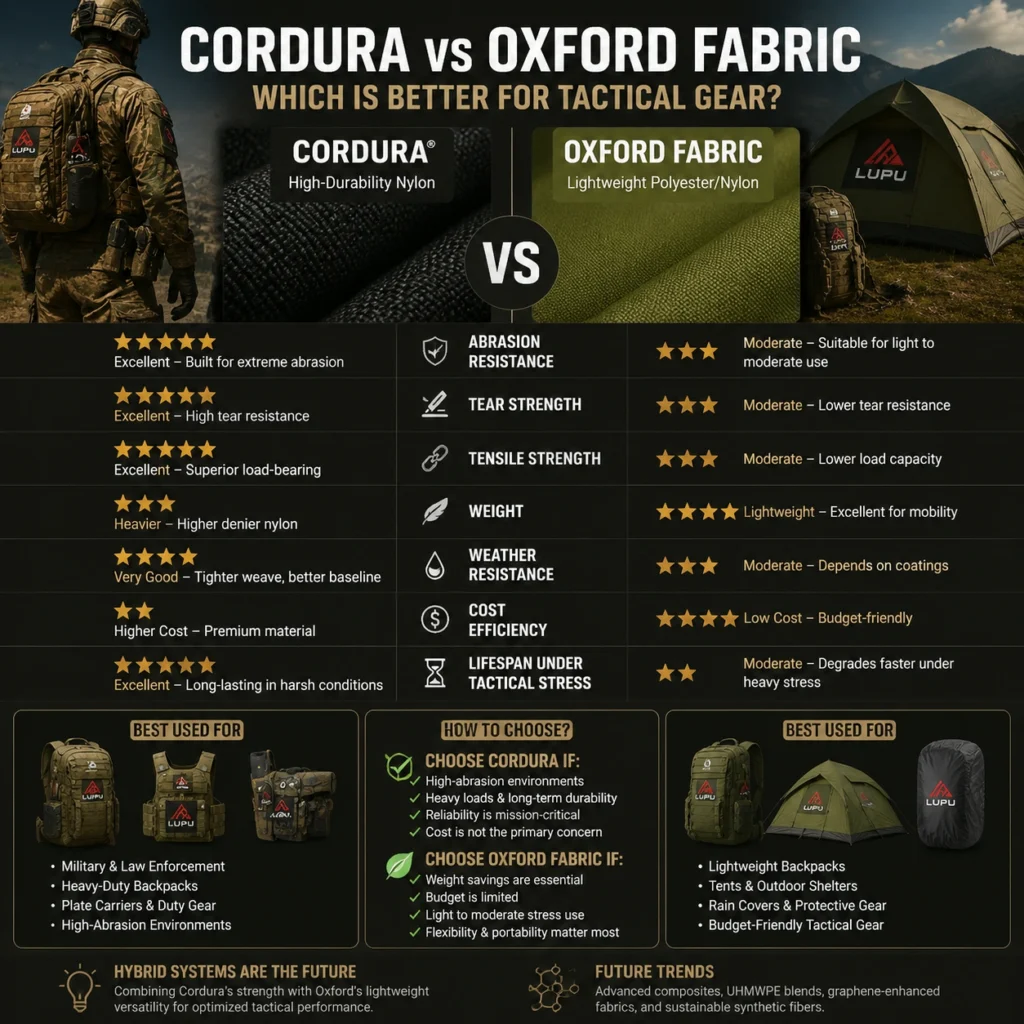
5. Cordura vs Oxford Fabric: Technical Comparison
A direct Cordura vs Oxford Fabric evaluation reveals fundamental engineering differences.
5.1 Durability and Abrasion Resistance
Cordura is designed for high-friction environments and can withstand repeated contact with rough surfaces such as rock, concrete, and metal equipment.
Oxford fabric, while functional, shows faster surface wear under identical conditions due to its lighter weave and lower denier fibers.
Conclusion: Cordura dominates in durability.
5.2 Weight and Mobility
Oxford fabric excels in ultralight applications. Its lower density makes it ideal for users prioritizing speed and portability.
Cordura, especially in 1000D variants, introduces noticeable weight but compensates with structural integrity.
Conclusion: Oxford fabric wins in weight efficiency.
5.3 Weather Resistance
Neither fabric is inherently waterproof. Both rely on coatings (PU, PVC, or DWR treatments).
However:
- Cordura’s tighter weave improves baseline moisture resistance
- Oxford fabric depends more heavily on surface coatings for protection
Conclusion: Slight advantage to Cordura in untreated conditions.
5.4 Cost Efficiency
Oxford fabric is significantly cheaper to produce due to simpler yarn requirements and weaving processes.
Cordura involves higher-grade fibers and more complex manufacturing standards.
Conclusion: Oxford fabric is more cost-efficient.
5.5 Lifespan Under Tactical Stress
Cordura consistently outperforms Oxford fabric in long-term field use, especially under:
- Heavy load carriage
- Abrasion-heavy environments
- Repeated folding and stress cycles
Oxford fabric tends to degrade faster in high-intensity scenarios.
Cordura vs Oxford Fabric Technical Performance Comparison (Engineering Perspective)
|
Performance Dimension |
Cordura (High-Strength Nylon) |
Oxford Fabric |
Engineering Conclusion |
|
Abrasion Resistance |
Extremely high: High-density nylon with high-denier construction, suitable for rock, metal, and high-friction environments |
Moderate: Lighter weave structure, more prone to surface wear, depends heavily on coating |
Cordura is significantly superior for high-wear tactical environments |
|
Tear Strength |
High: Stable fiber chain structure with slow tear propagation |
Moderate to low: Looser weave, more likely to tear under concentrated stress |
Cordura is better for load-bearing and structural applications |
|
Tensile Strength |
High: Excellent molecular structure of nylon 6,6 allows sustained load resistance |
Moderate: Limited fiber strength, suitable for light-duty use |
Cordura is more suitable for structural tactical gear |
|
Weight Efficiency |
Heavier: High-denier versions significantly increase overall weight |
Lightweight: Low-density fabric, easy to carry and compress |
Oxford fabric is better for lightweight mobility-focused applications |
|
Weather Resistance |
Moderate to high: Naturally better moisture resistance, enhanced significantly with coatings |
Moderate: Heavily dependent on PU/PVC coatings for waterproofing |
Cordura is more stable in untreated conditions |
|
Cost Efficiency |
High cost: Premium materials and manufacturing processes increase price |
Low cost: Simple production and scalable manufacturing |
Oxford fabric offers better cost efficiency |
|
Operational Lifespan |
Long: Maintains structural integrity under prolonged high-stress use |
Short to medium: Degrades faster under heavy or repeated use |
Cordura is better for long-term tactical deployment |
|
Load-Bearing Capacity |
High: Suitable for heavy-duty backpacks, armor carriers, and tactical load systems |
Low to medium: Best for lightweight or auxiliary equipment |
Cordura is preferred for primary load-bearing structures |
|
Environmental Adaptability |
Harsh environments (desert, jungle, urban tactical operations) |
Light to moderate outdoor environments |
Cordura has a broader operational range |
Engineering Conclusion (Technical Insight)
- Cordura = High-Reliability Structural Tactical Textile
- Oxford Fabric = Lightweight Utility Textile
From an engineering design perspective:
- Cordura prioritizes extreme durability and structural reliability under mission-critical conditions
- Oxford fabric prioritizes weight reduction, flexibility, and cost efficiency
6. Real-World Tactical Applications
6.1 Military and Law Enforcement
Cordura is the dominant choice due to its reliability under combat and duty conditions. Equipment failure tolerance is extremely low, making durability the priority.
6.2 Outdoor Survival and Expedition Use
Both materials are used depending on mission profile:
- Cordura for heavy-duty packs and gear
- Oxford fabric for lightweight shelters and secondary equipment
6.3 Urban Tactical and EDC Gear
Hybrid designs are common:
- Cordura reinforcement in stress zones
- Oxford fabric in non-load-bearing areas
7. Engineering Insight: Why Cordura Performs Better
Cordura’s advantage lies in material science:
- Higher denier fibers increase load distribution
- Nylon 6,6 has superior molecular chain strength
- Dense weaving reduces localized stress concentration
- Improved friction resistance delays surface failure
In contrast, Oxford fabric prioritizes flexibility over structural density, which reduces long-term resilience under tactical stress.
8. When Oxford Fabric Is the Better Choice?
Despite Cordura’s superiority in durability, Oxford fabric remains highly relevant in tactical design when:
- Weight reduction is critical
- Budget constraints exist
- Gear is used in low to moderate stress environments
- Flexibility and packability are prioritized
In such cases, Oxford fabric provides a rational engineering tradeoff.
9. Hybrid Fabric Systems in Modern Tactical Gear
Modern produttori di attrezzi tattici increasingly avoid single-material designs.
Common hybrid strategies include:
- Cordura-reinforced bottoms on backpacks
- Oxford fabric body panels for weight reduction
- Multi-layer laminates combining strength and flexibility
This approach optimizes performance by placing materials where they are most effective.
10. How to Choose Between Cordura and Oxford Fabric?
A practical decision framework:
Choose Cordura if:
- You operate in high-abrasion environments
- Gear carries heavy loads
- Long-term durability is critical
- Reliability outweighs cost
Choose Oxford fabric if:
- Weight savings are essential
- Budget is limited
- Gear is used in light tactical or outdoor contexts
- Flexibility and portability matter more than endurance
11. Future Trends in Tactical Fabrics
The evolution of tactical textiles is moving beyond traditional Cordura vs Oxford Fabric comparisons.
Emerging innovations include:
- UHMWPE (Ultra-high-molecular-weight polyethylene) blends
- Ballistic nylon composites
- Graphene-enhanced textiles
- Sustainable synthetic fiber alternatives
These materials aim to bridge the gap between durability and lightweight performance.
12. Conclusion: Cordura vs Oxford Fabric in Tactical Gear
The Cordura vs Oxford Fabric debate does not produce a universal winner because the two materials are engineered for different operational philosophies.
- Cordura represents maximum durability and mission-critical reliability
- Oxford fabric represents lightweight efficiency and cost-effective versatility
In tactical engineering terms, the correct choice is not about superiority—it is about contextual optimization. The best gear is not made from the strongest fabric alone, but from the smartest combination of materials tailored to operational demands.
Correlato:
Top 50: Elenco globale delle marche di attrezzi tattici