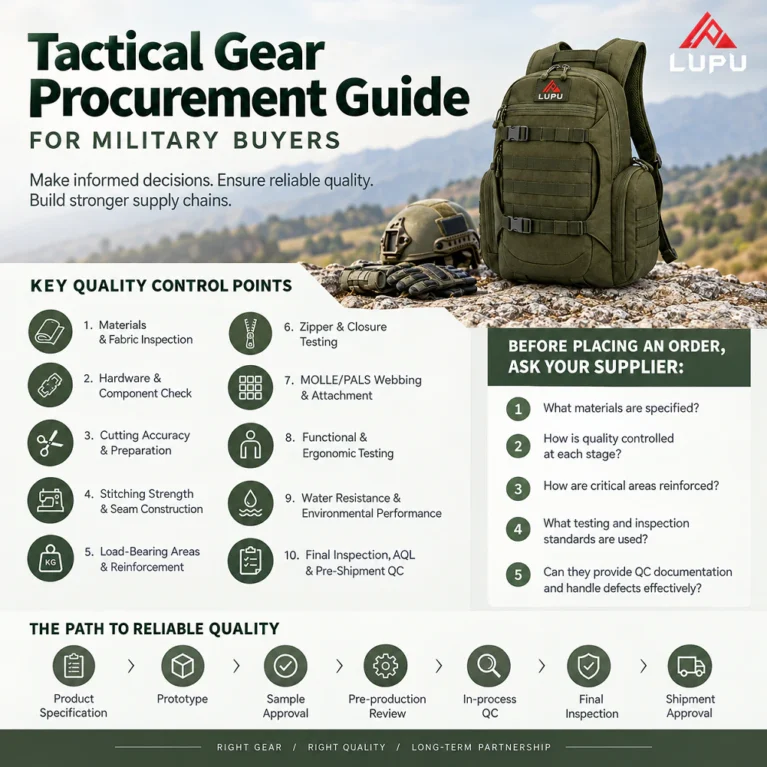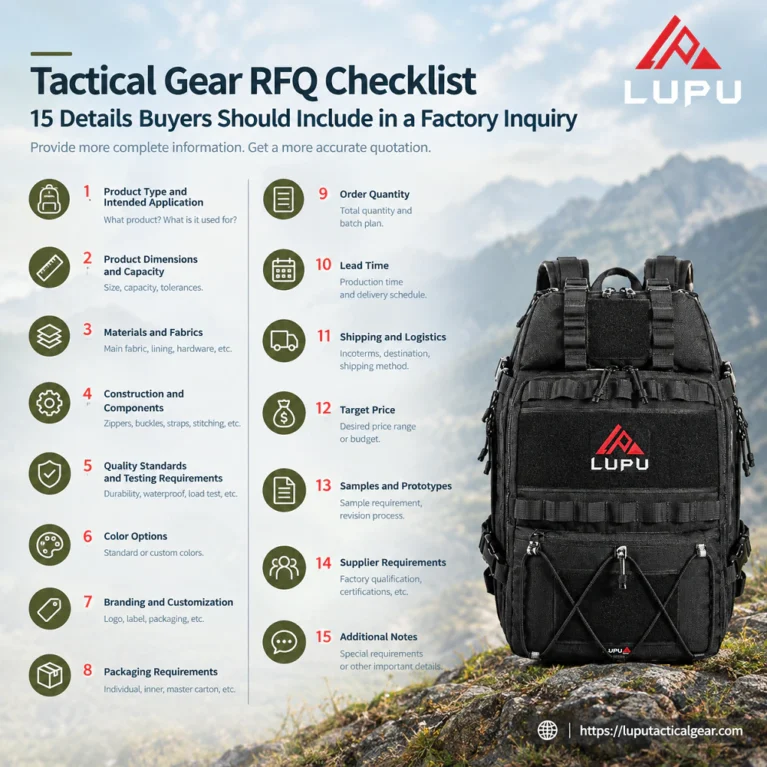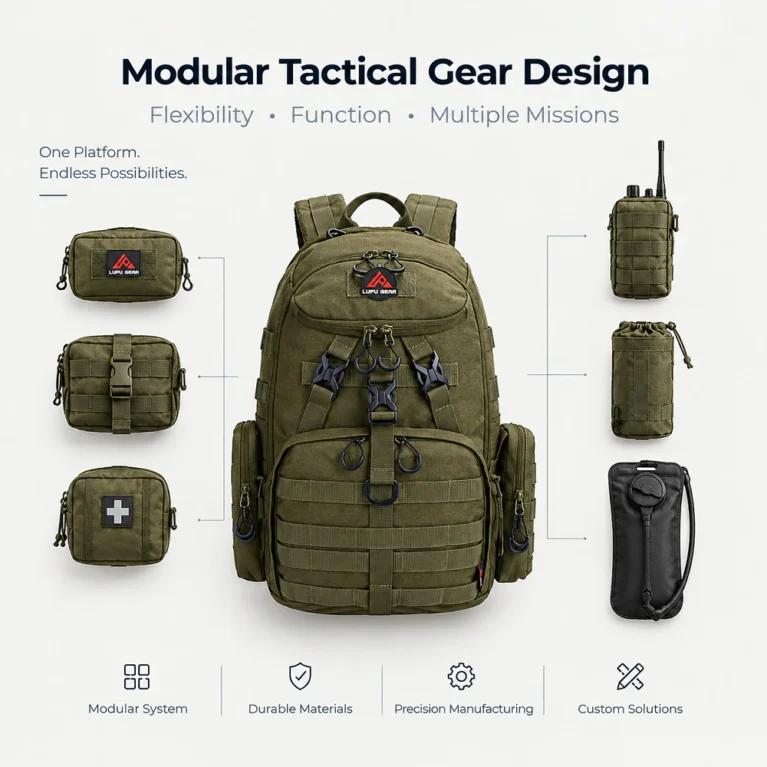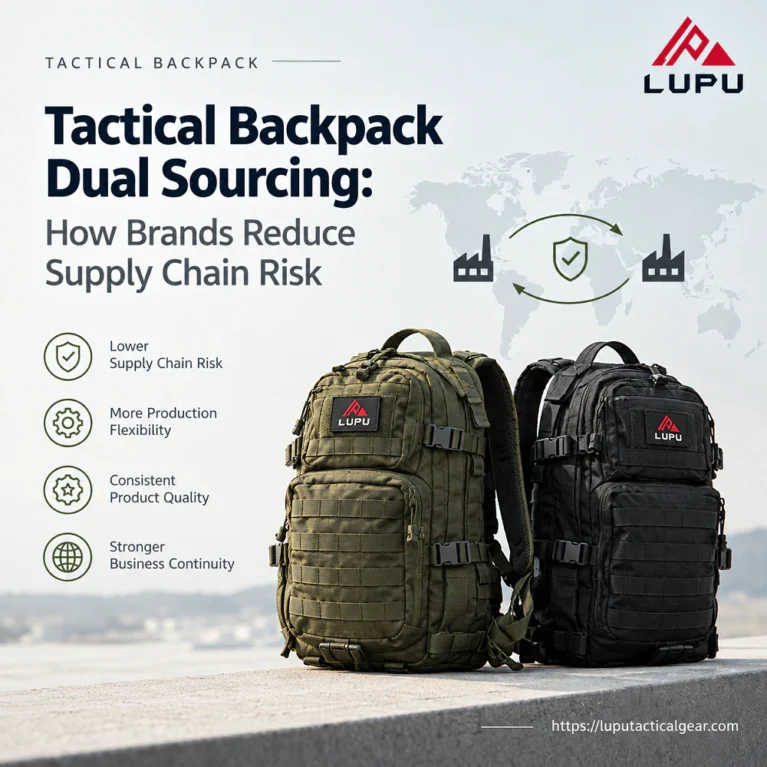
For B2B buyers developing a custom tactical backpack, the path from an initial concept to a production-ready product involves far more than choosing a design and requesting a quotation. Every detail—from fabric specifications and load-bearing construction to zipper selection, MOLLE compatibility, and quality inspection criteria—can influence the final product’s performance, cost, and consistency.
This is where a tactical backpack tech pack becomes essential.
A well-prepared tech pack gives buyers and manufacturers a common technical reference throughout product development, sampling, material sourcing, and bulk production. It helps translate design expectations into measurable requirements, making it easier to evaluate manufacturing feasibility, compare quotations, and control product quality.
However, many buyers begin a project with only a reference image, a general capacity target, and a list of preferred features. These materials are useful starting points, but they rarely provide enough information to support accurate costing and consistent manufacturing.
As a tactical backpack manufacturing specialist, I recommend approaching pre-production preparation as a structured process rather than a single document-collection task.
In this guide, we will explain what a tactical backpack tech pack should include, which technical decisions B2B buyers need to make before production, and how to prepare a custom backpack project for a more efficient OEM or ODM manufacturing process.
1. What Is a Tactical Backpack Tech Pack?
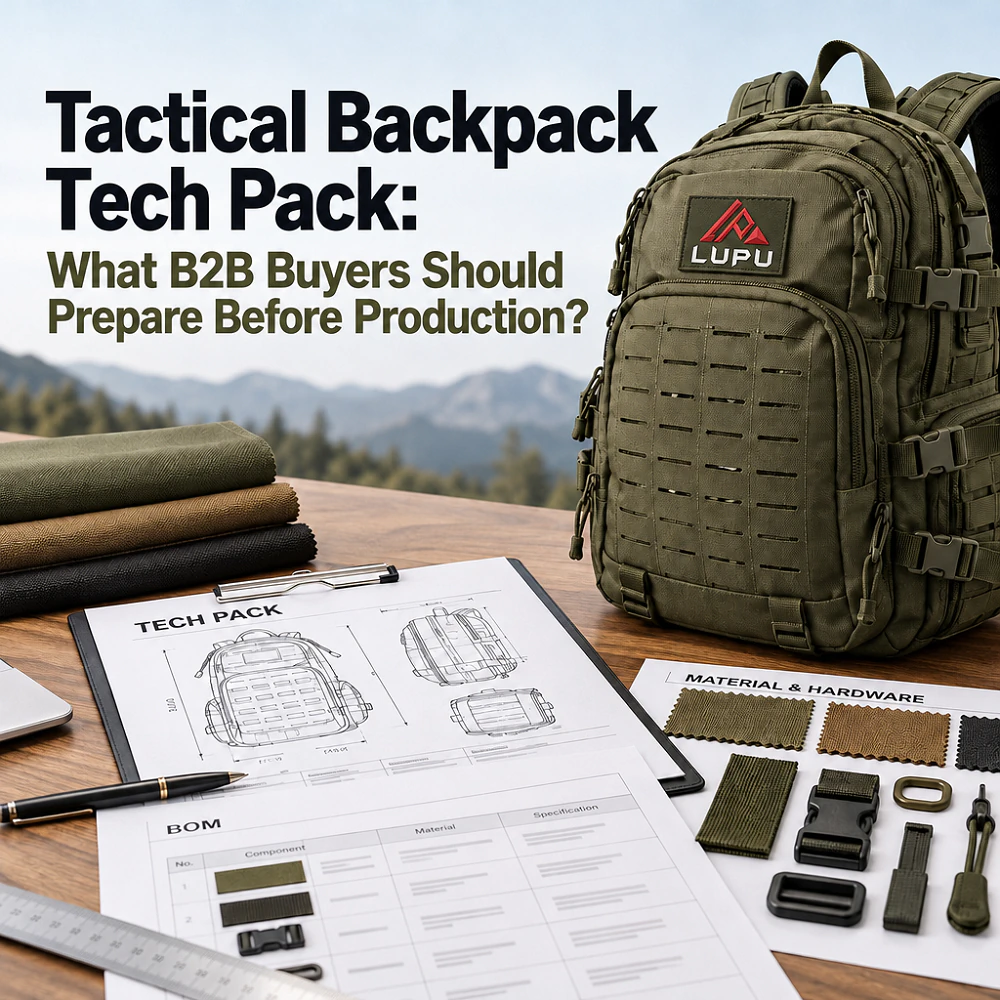
A tactical backpack tech pack is a technical specification document that communicates how a backpack should be designed, constructed, finished, tested, and packaged.
It serves as a working reference for the buyer’s product development team and the manufacturer’s technical, sourcing, sampling, production, and quality control teams.
Unlike a product brief, which describes the overall concept and target market, a tech pack translates that concept into information that can be used to manufacture and inspect the finished product.
A comprehensive tactical backpack tech pack typically includes:
- Product overview and intended application.
- Technical drawings and dimension specifications.
- Bill of materials (BOM).
- Fabric, webbing, hardware, and trim specifications.
- Compartment layouts and construction details.
- Stitching and reinforcement requirements.
- Branding, labeling, and packaging instructions.
- Performance testing and quality acceptance criteria.
- Sample revisions and approval records.
The exact level of detail depends on the project’s complexity and development stage.
For example, a private-label backpack based on an existing manufacturer design may require relatively limited structural changes. A fully customized tactical backpack with specialized compartments, modular attachment systems, and specific load-bearing requirements will generally need more detailed engineering documentation.
Product Brief vs. Tech Pack: What Is the Difference?
A product brief explains what the buyer wants to achieve. A tech pack explains how the product requirements should be implemented and verified.
Consider the difference between these two instructions:
Product brief: Develop a durable 30-liter tactical backpack with multiple compartments.
Technical specification: Define the target dimensions, capacity measurement method, approved shell fabric, zipper configuration, compartment layout, webbing spacing, reinforcement construction, and applicable inspection requirements.
The first communicates the concept. The second gives the manufacturer a clearer basis for estimating costs, developing samples, and planning production.
A complete specification does not mean every design decision must be finalized before contacting a factory. It means confirmed requirements should be documented, assumptions should be identified, and unresolved decisions should be discussed openly.
2. Define the Product Concept, Target Market, and Intended Use
Before selecting fabrics or discussing unit prices, B2B buyers should establish the purpose of the backpack.
A tactical backpack designed for everyday carry has different priorities from a pack intended for outdoor equipment, intensive field use, or specialized professional applications.
Without a clearly defined use case, buyers and manufacturers may make different assumptions about capacity, materials, organization, comfort, and durability.
Identify the Target Product Category
Start by identifying the product’s intended position within the market.
Possible categories include:
- Everyday tactical backpacks.
- Outdoor and hiking-inspired tactical packs.
- MOLLE-compatible modular backpacks.
- Equipment-carrying and utility backpacks.
- Private-label tactical backpacks for retail and wholesale distribution.
- Custom backpacks designed around specific organizational or carrying requirements.
Next, clarify the target customer, expected selling price, preferred visual style, and principal product benefits.
These details help the produttore di attrezzi tattici understand which features deserve priority and where cost adjustments may be appropriate.
Translate Intended Use into Functional Requirements
A useful product brief should answer several practical questions:
- What equipment or personal items will the backpack carry?
- What is the expected load range?
- How frequently will the product be used?
- Will it be exposed to rain, dust, abrasion, or changing temperatures?
- How important are low weight, structural support, and carrying comfort?
- Does the user need quick access, dedicated equipment compartments, or modular attachment points?
- Are there specific storage dimensions or accessory compatibility requirements?
The answers should influence the technical specification.
For example, a backpack intended for lightweight everyday use may prioritize compact dimensions, organization, and reduced overall weight. A pack designed for heavier equipment may require more attention to shoulder strap construction, load distribution, back-panel structure, and reinforced attachment points.
Prepare Reference Materials
Buyers should provide as many useful references as possible, including:
- Front, rear, side, and interior photographs.
- Annotated sketches or CAD drawings.
- Images showing specific pockets, straps, and attachment systems.
- Existing product samples, where available.
- Preferred materials and color references.
- A list of required features and optional features.
When using competitor products as references, identify the specific characteristics to reproduce rather than assuming the manufacturer should copy every detail.
Manufacturing recommendation: Separate mandatory requirements from design preferences. This distinction gives the manufacturer room to suggest practical improvements without compromising the product’s essential functions.
3. Prepare Technical Drawings, Dimensions, and Tolerances
Technical drawings are among the most important components of a tactical backpack tech pack.
A backpack may look correct in a photograph while still having incorrect compartment proportions, uncomfortable strap geometry, poorly positioned attachment points, or insufficient clearance for intended equipment.
Clear drawings help reduce these ambiguities.
Include Multiple Product Views
At a minimum, provide the following views when relevant to the design:
- Front view showing the main panel, pockets, and webbing layout.
- Rear view showing the shoulder straps, back panel, and adjustment systems.
- Side views showing depth, profile, and compression straps.
- Top and bottom views showing openings, seams, and base construction.
- Interior views showing dividers, sleeves, and compartment organization.
- Detail drawings showing zipper paths, strap attachments, reinforcement areas, and other critical features.
Each drawing should include callouts identifying the relevant components.
For complex constructions, enlarged detail drawings can be more useful than adding excessive notes to a single overall view.
Create a Measurement Specification Sheet
The measurement sheet should define the dimensions that matter to the finished product.
Depending on the design, these may include:
|
Measurement area |
Example specifications |
|
Overall body |
Height, width, depth |
|
Main compartment |
Internal dimensions and opening dimensions |
|
Secondary compartments |
Pocket width, height, and depth |
|
Carrying system |
Shoulder strap length, width, and adjustment range |
|
Handles |
Length, width, and attachment position |
|
Webbing |
Width, spacing, and number of rows |
|
Functional openings |
Zipper length and access opening dimensions |
|
Capacity |
Target volume and calculation method |
Measurements should be defined consistently. Buyers and manufacturers must agree on where each measurement begins and ends, how curved areas are measured, and whether the backpack is empty or loaded during evaluation.
Capacity also requires attention. A stated 30-liter capacity, for example, should be associated with an agreed calculation method or testing procedure. External dimensions alone do not establish the usable volume of a backpack with multiple pockets and irregular internal spaces.
Specify Acceptable Tolerances
A nominal measurement is not necessarily an exact finished measurement.
For each critical dimension, define the target value and acceptable variation. Tolerances should reflect the product’s construction, intended fit, manufacturing capability, and functional requirements.
For instance, a buyer may specify a nominal body height of 45 cm and an agreed dimensional tolerance. The exact tolerance should be established with the manufacturer rather than selected arbitrarily.
Critical interfaces may need tighter controls than nonfunctional cosmetic dimensions. A pocket intended to hold a specific piece of equipment, for example, may require a different acceptance range from a decorative exterior panel.
Manufacturing recommendation: Do not use one universal tolerance for every part of the backpack. Define tolerances according to the function and importance of each measurement.
4. Prepare a Detailed Bill of Materials and Fabric Specifications
The bill of materials is a central part of the tactical backpack tech pack because materials influence product weight, appearance, durability, manufacturing complexity, and cost.
A description such as “heavy-duty nylon tactical backpack” is not sufficient for a reliable quotation.
Different fabrics sold under similar descriptions may vary in yarn properties, weave, coating, finish, thickness, weight, and performance.
List Every Important Material and Component
The BOM should identify the major materials used in the product, including:
Main materials
- Outer shell fabric.
- Interior lining.
- Pocket and divider materials.
- Reinforcement fabrics.
- Back-panel and shoulder strap padding.
- Binding tape and other finishing materials.
Functional components
- Zippers and sliders.
- Buckles and adjusters.
- Webbing and elastic components.
- Hook-and-loop materials.
- Drawcords, cord locks, and other closures.
- Mesh panels and drainage-related components, where applicable.
Finishing components
- Woven labels and care labels.
- Printed graphics and embroidered logos.
- Patches and branding accessories.
- Hangtags, protective bags, inserts, and cartons.
For each component, record its description, specification, color, location, and approval status. Quantity per backpack or estimated consumption should be included when available.
If a component has a critical functional or aesthetic role, identify whether the manufacturer must use a named brand or whether an equivalent component may be proposed for approval.
How Should Buyers Choose Between 500D and 1000D Nylon?
Denier is a measure of linear density for yarn. It can help distinguish material options, but it does not independently determine the quality or service life of a finished backpack.
Both 500D and 1000D nylon may be appropriate depending on the product design.
A lighter fabric may help reduce overall weight, while a heavier fabric may be considered for areas exposed to demanding abrasion conditions. However, actual performance also depends on fabric construction, yarn characteristics, coating, finishing, reinforcement design, and the way the backpack is assembled.
Buyers should evaluate materials against the intended use rather than assuming that a higher denier rating always produces a better product.
Important questions include:
- What abrasion resistance is required?
- Is weight a major product priority?
- Does the fabric need a particular coating or finish?
- Are colorfastness and appearance consistency important?
- What level of water resistance is required?
- Will the material be suitable for the intended sewing and construction methods?
Define Color and Finish Standards
Color consistency can become challenging when a backpack uses several materials, such as shell fabric, webbing, binding, and molded hardware.
Specify approved color references and, where appropriate, provide physical swatches or signed-off material samples.
Also identify relevant finish requirements, including coating type, surface appearance, texture, and any performance expectations that need verification.
Manufacturing recommendation: Require approval before substituting critical materials. A replacement fabric that appears similar may behave differently during sewing or change the product’s weight, structure, appearance, or test performance.
5. Document Construction, Stitching, and Reinforcement Requirements
A tactical backpack’s performance depends not only on the materials selected but also on how those materials are assembled.
A strong fabric cannot compensate for a poorly designed attachment point. Similarly, adding more stitches does not automatically guarantee a stronger seam.
The tech pack should therefore document critical construction details rather than relying on general descriptions such as “reinforced stitching.”
Define the Main Construction Requirements
Specify the relevant details for:
- Seam locations and seam types.
- Stitch type and stitch density where required.
- Seam allowances and finishing methods.
- Binding construction.
- Zipper installation.
- Shoulder strap attachment.
- Grab handle attachment.
- Compression strap attachment.
- Reinforcement patches and load-bearing areas.
Where a particular construction method is important to performance or appearance, include an enlarged drawing or a written construction note.
Identify High-Stress Areas
For most tactical backpack designs, particular attention should be given to the areas where loads are transferred between the bag and the user.
These commonly include:
- Shoulder strap anchor points.
- Grab handles.
- Compression strap attachment points.
- Lower strap anchors.
- Modular webbing attachment zones.
- Corners and other areas exposed to repeated stress.
The required reinforcement should be determined by the intended load, construction geometry, material properties, and relevant test results.
Buyers should communicate the expected load conditions and agree on how critical attachment points will be evaluated.
Include Functional Construction Details
Depending on the design, the tech pack may also need to specify:
- Hydration routing and hose openings.
- Drainage features.
- Compression systems.
- Padded equipment sleeves.
- Adjustable dividers.
- Removable accessories.
- Ventilation-related back-panel construction.
Each feature should have a clear purpose and an identifiable location in the drawings.
Manufacturing recommendation: If a construction detail affects load-bearing performance, fit, or product safety, treat it as a controlled technical requirement rather than a cosmetic preference.
6. Specify Zippers, Buckles, Webbing, and MOLLE Compatibility
Hardware and modular attachment systems deserve their own section because seemingly minor component differences can affect functionality and product consistency.
Identify Hardware Specifications
For zippers, specify the required type, size, length, slider configuration, and any relevant functional requirements.
For buckles and adjusters, document the dimensions, design, color, and intended use. Where component strength is important, define the applicable performance requirements and verification method.
Webbing specifications should cover width, material, color, and other properties necessary for the application.
If a preferred component brand is essential, state it explicitly. If alternatives are acceptable, establish a process for reviewing and approving proposed substitutes.
Define MOLLE-Compatible Attachment Requirements
For a tactical backpack with a MOLLE-style modular attachment system, buyers should document:
- Webbing width.
- Vertical and horizontal spacing.
- Number of rows and attachment zones.
- Placement relative to pockets, seams, and reinforcement panels.
- Stitching and reinforcement requirements.
- Compatibility expectations for the intended accessories.
The design should be evaluated as a complete attachment system rather than a collection of webbing strips.
Nominally similar webbing may not provide the same fit or usability when spacing, thickness, flexibility, or attachment geometry differs.
Validate Compatibility During Sampling
If the backpack must accommodate particular pouches or accessories, test the approved sample with representative items.
Check whether the accessories attach correctly, remain secure under the intended conditions, and can be removed without interfering with adjacent components.
The tech pack should record any interface dimensions or fit requirements that are essential to the product’s intended use.
Manufacturing recommendation: Never assume that a modular attachment system is compatible merely because it looks similar to a reference design. Confirm the interface requirements and verify them on a physical sample.
7. Prepare Branding, Colorways, Labels, and Packaging
Branding and packaging can introduce additional production complexity, particularly when a buyer plans to launch multiple colorways or SKUs.
These requirements should be documented before the final sample approval rather than added informally after bulk production planning begins.
Define Logo and Artwork Requirements
Provide the approved logo files and specify:
- Logo placement.
- Finished dimensions.
- Color references.
- Embroidery, printing, woven label, or patch application method.
- Relevant backing or attachment details.
- Artwork version and approval status.
Vector artwork is generally useful for scalable production artwork, while additional production-ready files may be required depending on the application method.
The manufacturer should confirm that the selected method is suitable for the material and desired appearance.
Manage Multiple Colorways and SKUs
When a product has several colors or configurations, create a clear specification for each version.
Identify which elements change between variants and which remain identical. This helps prevent errors involving webbing colors, zipper components, lining, labels, and packaging.
For large product ranges, a master specification with controlled variant-specific details may be more efficient than maintaining disconnected documents.
Document Packaging and Labeling
Depending on the sales channel and destination market, packaging specifications may include:
- Hangtags and product inserts.
- Care and content labels, where applicable.
- Barcode and SKU information.
- Individual protective packaging.
- Carton dimensions and packing quantities.
- Carton markings and shipping labels.
- Retail presentation requirements.
Buyers should verify applicable labeling and import requirements for their intended markets rather than assuming that one packaging configuration satisfies every destination.
Manufacturing recommendation: Approve the complete branded product—including labels, artwork placement, and packaging—before releasing the final production specification.
8. Establish Performance Requirements and Quality Control Standards
A well-developed tactical backpack tech pack must explain how the finished product will be evaluated.
Words such as “durable,” “heavy-duty,” and “water-resistant” communicate intentions, but they do not define measurable acceptance criteria.
Quality requirements should be relevant to the product’s intended use and supported by appropriate test methods.
Identify the Tests That Matter
Depending on the design, buyers may need to consider:
Seam and attachment strength: Evaluate critical seams, shoulder strap anchors, and other load-bearing components under defined test conditions.
Abrasion resistance: Assess selected fabrics or finished components where repeated friction is a relevant concern.
Zipper and buckle functionality: Check operation, engagement, adjustment, and repeated use as appropriate.
Colorfastness: Evaluate resistance to relevant forms of color change or transfer when required.
Water resistance: Specify whether the requirement applies to the fabric, a coated component, a particular seam, or the complete finished backpack.
Load-related performance: Define the intended loading condition and any applicable durability or structural evaluation.
The selected tests should reflect actual product risks. Not every backpack needs every possible test, and a test performed on a fabric swatch does not automatically establish the performance of the complete backpack.
Define Acceptance Criteria
For each required test, specify as applicable:
- Test method or agreed procedure.
- Sample preparation and conditioning.
- Load, duration, cycle count, or other relevant test conditions.
- Acceptance threshold.
- Sampling requirements.
- Responsible testing party.
- Required report or approval record.
Where a recognized standard is appropriate, identify the exact standard and relevant version rather than referencing it vaguely.
If the buyer requires independent laboratory testing, clarify whether the laboratory, cost, sample quantity, and testing schedule are included in the project plan.
Develop a Quality Inspection Plan
A practical inspection plan usually addresses three stages.
Incoming material inspection: Verify material identity, color, relevant specifications, and component conformity.
In-process inspection: Check critical construction details, dimensions, stitching, reinforcement, and assembly consistency.
Final inspection: Evaluate appearance, dimensions, functionality, labeling, packaging, and other agreed acceptance criteria.
The parties should also agree on defect classifications, sampling procedures, reporting methods, and corrective-action responsibilities.
Manufacturing recommendation: Quality control is most effective when requirements are defined before production. It is much harder to resolve disputes when the buyer and manufacturer have different interpretations of acceptable quality.
9. Complete Sample Development and Pre-Production Approval
Sampling is the stage where drawings, materials, construction methods, and functional expectations are evaluated together.
A sample should not be treated merely as a visual demonstration. It is an opportunity to identify problems before the product is manufactured in quantity.
Understand the Main Sample Stages
Depending on project complexity, development may involve several stages.
Prototype sample: Used to evaluate the initial concept, dimensions, compartment layout, and general construction approach.
Revised development sample: Incorporates feedback from the first sample and addresses identified design or functional issues.
Pre-production sample: Intended to confirm the agreed design and production-relevant materials, components, and construction before bulk manufacturing.
Production reference sample: A retained, approved sample may be used as a reference for subsequent production inspections where agreed.
Not every project requires every stage. The sampling plan should be proportionate to the product’s complexity and risk.
Use a Structured Sample Evaluation Checklist
When reviewing a sample, assess more than its appearance.
Check the following:
- Overall dimensions and measurement tolerances.
- Capacity and compartment usability.
- Access to pockets and closures.
- Shoulder strap adjustment and carrying comfort.
- Fabric, lining, and hardware conformity.
- Webbing layout and accessory compatibility.
- Stitching, reinforcement, and finishing.
- Branding, color consistency, and label placement.
- Packaging and product presentation.
If a sample will be evaluated under load, document the loading conditions and assessment method.
Establish Formal Sample Approval
To avoid confusion, consolidate feedback into a written revision list.
Each comment should identify the component, location, required change, and relevant drawing or specification reference.
Once revisions are complete, confirm the approved sample and update the tech pack accordingly. Record any accepted deviations so that they are not mistakenly treated as manufacturing defects later.
The final approved specification should be the version released to production.
Manufacturing recommendation: Avoid approving a sample while major questions about materials, dimensions, construction, or functional performance remain unresolved. Changes introduced after approval may require new samples, additional material sourcing, or revised production planning.
10. Prepare Commercial Information for an Accurate OEM Quotation
A technically detailed product specification is only one part of a production-ready project. Manufacturers also need sufficient commercial information to estimate costs and plan capacity.
An incomplete request for quotation may produce a price that appears attractive but excludes important requirements.
Provide Order Quantity and Product Variant Information
Include the estimated order quantity, expected colorways, number of SKUs, and any known reorder plans.
Clarify whether the order quantity applies to the total project or to each individual color or configuration. This distinction can affect material purchasing, component minimums, and production efficiency.
If the order is a preliminary estimate rather than a firm commitment, state that clearly.
Confirm the Quotation Scope
Ask the tactical backpack manufacturer to identify the assumptions behind the quotation.
Relevant items may include:
- Fabric and hardware specifications.
- Material consumption and production waste assumptions.
- Custom tooling or development costs, if applicable.
- Sample fees and revision allowances.
- Branding and packaging requirements.
- Minimum order quantities.
- Production lead-time assumptions.
- Payment terms and quotation validity.
- Inspection and testing costs.
- Shipping terms and freight arrangements.
The quotation should make it clear which costs are included and which may be charged separately.
Evaluate Total Commercial Value
When comparing tactical backpack OEM suppliers, ensure that each quotation is based on the same specification, order quantity, packaging scope, quality requirements, and delivery assumptions.
A lower unit price may reflect a different material, simpler construction, reduced inspection scope, or excluded customization costs.
Buyers should evaluate the complete offer rather than relying on price alone.
Manufacturing recommendation: If a tactical backpack supplier proposes a cost-saving alternative, ask which specification changes are involved and whether the alternative can meet the product’s intended performance requirements. Approve any changes before they enter the production specification.
11. Common Tactical Backpack Tech Pack Mistakes to Avoid
Even experienced buyers can overlook details that create unnecessary revisions or misunderstandings during development.
Mistake 1: Relying Only on Reference Images
Photographs rarely show every measurement, internal component, seam allowance, or reinforcement detail.
Better approach: Use photographs as visual references and support them with drawings, measurements, and written specifications.
Mistake 2: Using Vague Material Descriptions
Terms such as “premium nylon” or “military-grade fabric” do not identify a precise material.
Better approach: Specify the relevant fabric characteristics, finish, color, performance requirements, and approval method.
Mistake 3: Ignoring Measurement Tolerances
Without agreed tolerances, a dimensional difference may be interpreted as acceptable by one party and unacceptable by the other.
Better approach: Define tolerances for critical dimensions and establish a consistent measurement procedure.
Mistake 4: Assuming Hardware and MOLLE Compatibility
Components that appear similar may not fit or function identically.
Better approach: Specify critical interface dimensions and validate the combination during sample development.
Mistake 5: Approving Samples Without Documenting Changes
Verbal instructions or scattered messages can result in conflicting production information.
Better approach: Maintain a written revision history and release only the approved specification.
Mistake 6: Leaving Quality Requirements Subjective
Statements such as “excellent stitching” do not define measurable acceptance criteria.
Better approach: Document the relevant inspection points, test methods, tolerances, and acceptance thresholds.
Mistake 7: Overlooking Packaging and Labeling
A finished backpack may meet its physical specifications but still require rework if its packaging or labeling does not meet the agreed requirements.
Better approach: Include branding, labels, packing instructions, and destination-specific requirements in the project documentation.
Mistake 8: Failing to Control Document Versions
An outdated BOM or drawing may remain in circulation after a revision has been approved.
Better approach: Assign document numbers, revision identifiers, dates, and approval status to the production specification.
The objective is not to eliminate every question before development begins. It is to ensure that important decisions are documented, changes are controlled, and both parties understand what has been approved.
12. Final Pre-Production Checklist for B2B Buyers
Before releasing a zaino tattico personalizzato project for bulk production, review the following checklist.
Product and Design
☐ Product concept, target market, and intended use are defined.
☐ Technical drawings include the necessary views and construction details.
☐ Critical dimensions, capacity, and tolerances are documented.
☐ Mandatory features are distinguished from optional design preferences.
Materials and Construction
☐ The BOM identifies the main materials, hardware, and trims.
☐ Fabric specifications, colors, and finishes are approved.
☐ Stitching and reinforcement requirements are documented.
☐ Zippers, buckles, webbing, and modular interfaces are specified.
☐ Any permitted material substitutions require documented approval.
Branding and Packaging
☐ Logo artwork, dimensions, placement, and application method are approved.
☐ Each colorway and SKU has clear specifications.
☐ Labels and packaging requirements are confirmed.
☐ Destination-specific labeling and import requirements have been reviewed.
Quality and Sampling
☐ Relevant product tests and acceptance criteria are defined.
☐ Inspection stages and defect-handling procedures are agreed.
☐ The required sample stage has been completed.
☐ Sample revisions and exceptions are documented.
☐ The final production specification matches the approved design.
Commercial and Production Planning
☐ Order quantity and product variants are confirmed or clearly estimated.
☐ Quotation assumptions and excluded costs are understood.
☐ Delivery expectations and shipping terms are agreed.
☐ Document revision control is established.
☐ The required approvals have been recorded before production release.
Completing this checklist does not guarantee that every production risk has been eliminated. It does, however, provide a stronger basis for communication, costing, quality control, and production planning.
13. Frequently Asked Questions About Tactical Backpack Tech Packs
What should a tactical backpack tech pack include?
A tactical backpack tech pack should include a product brief, technical drawings, dimensions and tolerances, a bill of materials, fabric and hardware specifications, construction details, branding and packaging requirements, quality acceptance criteria, and sample approval records. The exact contents depend on the complexity of the product and the stage of development.
Do I need a complete tech pack before contacting a tactical backpack manufacturer?
No. A clear product brief, reference photographs, preliminary dimensions, intended use, estimated order quantity, and target price range can be enough to begin a discussion.
However, more detailed specifications are generally necessary for accurate costing, meaningful sample approval, and controlled bulk production. An experienced manufacturer can help identify missing information and establish the next development steps.
What is the difference between OEM and ODM tactical backpack manufacturing?
In a typical OEM arrangement, the buyer provides the product design or detailed requirements for the manufacturer to produce. In an ODM arrangement, the manufacturer provides an existing design or development platform that the buyer may customize.
Actual service scope varies by supplier, so buyers should confirm who is responsible for design development, tooling, intellectual property, material selection, and final specification approval.
How do I choose the right fabric for a custom tactical backpack?
Start with the intended application, expected load, abrasion exposure, weight target, structure, appearance, and budget.
Compare fabric construction, yarn characteristics, coating, finish, and relevant test results rather than choosing solely by denier rating. The final material should be evaluated as part of the complete backpack design.
How can I obtain a more accurate tactical backpack OEM quotation?
Provide the manufacturer with your drawings, dimensions, BOM or preliminary material requirements, customization details, order quantity, colorways, packaging requirements, and target delivery schedule.
If some specifications remain undecided, identify them clearly and ask the manufacturer to state any assumptions used in the quotation.
When should bulk production begin?
Bulk production should begin only after the parties have completed the agreed development and approval process. This normally includes confirmation of the production specification, critical materials, sample approval, quality requirements, commercial terms, and delivery plan.
Any unresolved exceptions should be documented and explicitly accepted before production release.
Final Thoughts: A Better Tech Pack Creates a Better Starting Point for Production
Preparing a tactical backpack tech pack is not simply an administrative exercise. It is an essential step in translating a product idea into a specification that can be manufactured, inspected, and reproduced consistently.
For B2B buyers, the most important priorities are clear: define the product’s intended use, specify measurable dimensions, identify materials and components, document construction requirements, establish quality criteria, and maintain control over sample approval and technical revisions.
Not every project needs a fully engineered document at the first meeting. What every successful project needs is a clear process for turning initial requirements into an approved production specification.
Working with a capable tactical backpack manufacturer early in the development process can help identify technical constraints, evaluate material alternatives, and clarify the cost and production implications of design decisions before they become expensive changes.
Planning your next custom tactical backpack project?
Prepare your reference images, preliminary drawings, material preferences, estimated order quantity, and target delivery schedule. Share them with your manufacturing partner to discuss technical feasibility, sample development, and a quotation based on your actual requirements.
A well-defined project is easier to evaluate, easier to improve, and better positioned for a controlled transition from concept to bulk production.