Introduction: Why Tactical Gear Materials Matter More Than You Think
When people evaluate tactical equipment, they often focus on design, brand reputation, or modular features. However, in real operational environments—whether military deployment, law enforcement duty, or extended outdoor survival—the true performance of any gear is fundamentally determined by one factor: Tactical Gear Materials.
Materials define whether a backpack survives abrasive rock surfaces, whether a plate carrier maintains structural integrity under repeated stress, or whether a pouch fails at the worst possible moment. In tactical systems, design can be copied, but material performance cannot be faked.
This guide provides a deep, engineering-level breakdown of the three dominant materials in modern tactical gear: Nylon, Polyester, and Cordura. It explores not only what they are, but why they behave differently under stress, how they are engineered, and how professionals select between them in real-world scenarios.
1. Fundamentals of Tactical Gear Materials Science
To understand Tactical Gear Materials, we must move beyond marketing terms and examine textile engineering principles.
1.1 Key Performance Indicators
Every tactical fabric is evaluated based on measurable mechanical properties:
- Tensile strength– resistance to being pulled apart
- Tear resistance– ability to stop a small cut from spreading
- Abrasion resistance– endurance against friction and surface wear
- Environmental stability– UV, moisture, and temperature resilience
- Weight efficiency– strength-to-weight optimization
In tactical environments, failure rarely happens gradually. It is usually sudden. That is why high-performance materials prioritize catastrophic failure resistance over cosmetic durability.
1.2 Fabric Construction: Why Weave Matters
Material performance is not just about fiber type—it is also about structure:
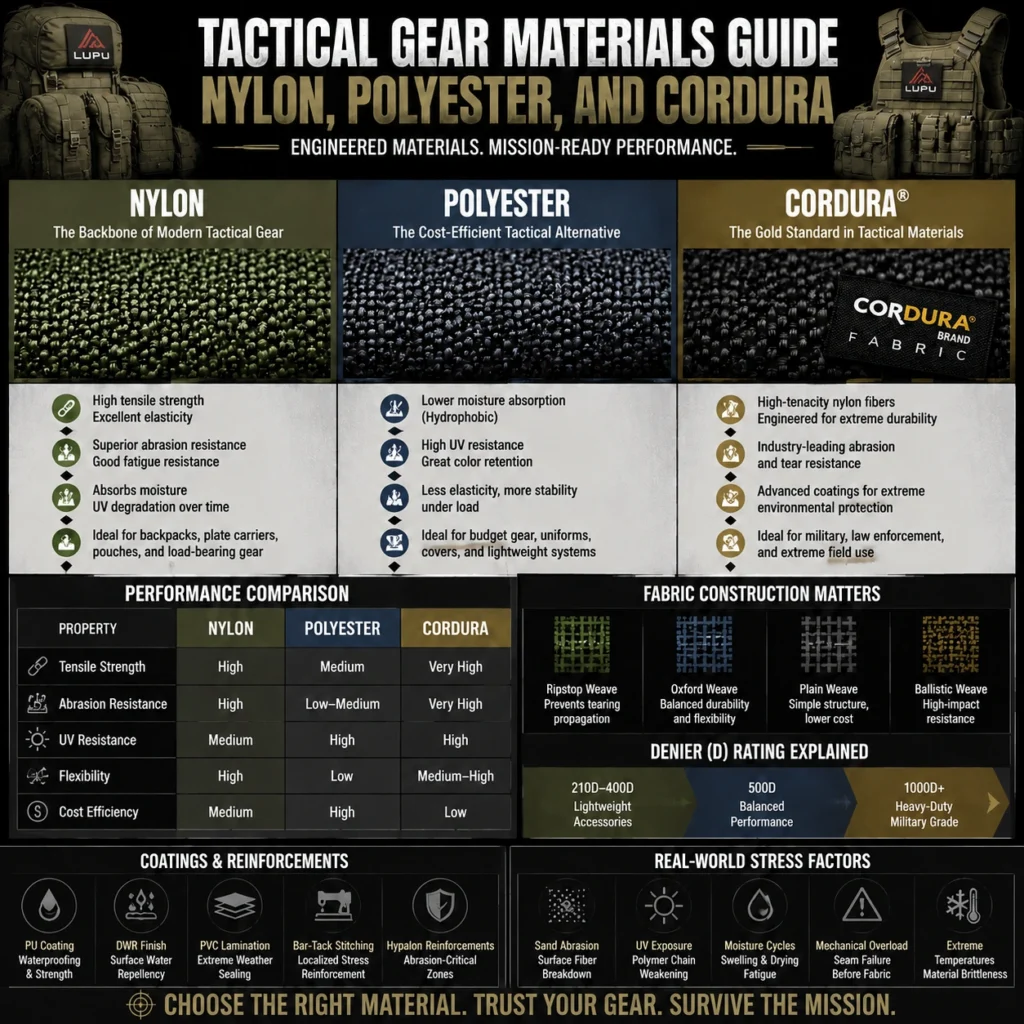
- Ripstop weave: reinforced grid pattern that prevents tearing propagation
- Oxford weave: balanced durability and flexibility
- Plain weave: simple structure, lower cost, moderate strength
- Ballistic weave: engineered for high-impact resistance
1.3 Denier Rating Explained
Denier (D) measures fiber thickness:
- 210D–400D: lightweight tactical accessories
- 500D: balanced performance standard
- 1000D+: heavy-duty military-grade gear
However, denier alone is misleading. A lower-denier Cordura can outperform higher-denier generic nylon due to fiber engineering.
2. Nylon: The Backbone of Modern Tactical Equipment
2.1 Material Identity
Nylon is a synthetic polyamide polymer originally developed for industrial applications. In modern Tactical Gear Materials, it is the most widely used base fiber due to its exceptional balance of strength, elasticity, and manufacturability.
2.2 Engineering Performance
Nylon offers a combination of properties that make it ideal for load-bearing tactical systems:
- High tensile strength relative to weight
- Excellent elasticity under stress (prevents sudden tearing)
- Superior abrasion resistance compared to polyester
- Good fatigue resistance under repeated load cycles
One of nylon’s defining characteristics is its ability to deform slightly under stress and return to shape, which helps distribute impact forces across fabric structures.
2.3 Operational Applications
Nylon dominates mid-to-high tier tactical gear:
- Taktische Rucksäcke
- Plate carriers and chest rigs
- Modular pouches (MOLLE systems)
- Holsters and retention gear
2.4 Advantages and Limitations
Stärken:
- Excellent durability-to-weight ratio
- High flexibility under dynamic load
- Widely available and cost-efficient in production
Weaknesses:
- Absorbs moisture (can increase weight when wet)
- UV degradation over long exposure cycles
- Requires coatings for full environmental protection
3. Polyester: The Cost-Efficient Tactical Alternative
3.1 Material Structure
Polyester is a synthetic polymer known for dimensional stability and chemical resistance. In Tactical Gear Materials, it is commonly used in budget-friendly or climate-stable applications.
3.2 Performance Characteristics
Compared to nylon, polyester behaves differently under environmental stress:
- Lower moisture absorption (hydrophobic nature)
- Higher UV resistance
- Better color retention under sunlight exposure
- Less elasticity, meaning reduced deformation under load
This lower elasticity is a double-edged sword: it improves shape stability but reduces energy absorption under stress.
3.3 Tactical Applications
Polyester is widely used in:
- Entry-level taktische Rucksäcke
- Uniform fabrics
- Lightweight gear and covers
- Non-critical load-bearing systems
3.4 Advantages and Limitations
Stärken:
- Excellent resistance to sunlight degradation
- Lower manufacturing cost
- Stable performance in dry environments
Weaknesses:
- Lower abrasion resistance compared to nylon
- Reduced mechanical flexibility
- More prone to catastrophic tearing under extreme load
4. Cordura: The Gold Standard of Tactical Gear Materials
4.1 What Cordura Really Is
Cordura is not a single material but a performance textile brand system developed using high-tenacity nylon fibers. It represents a class of engineered fabrics optimized for extreme durability.
In professional Tactical Gear Materials discussions, Cordura is often treated as the benchmark standard.
4.2 Fiber Engineering Technology
Cordura achieves superior performance through:
- High-tenacity nylon fiber construction
- Air-textured yarn systems for enhanced abrasion resistance
- Advanced polymer coatings (PU, DWR)
- Optimized weave density control
This combination results in a fabric that resists wear at a molecular level rather than just a structural level.
4.3 Performance Benchmark
Cordura consistently outperforms standard nylon and polyester in:
- Abrasion resistance (industry-leading standard)
- Tear propagation resistance
- Long-term structural integrity
- Multi-cycle load endurance
It is designed for environments where gear is dragged, scraped, compressed, and exposed to repeated mechanical stress.
4.4 Tactical Applications
Cordura is widely used in premium systems:
- Military-grade rucksacks
- Law enforcement duty gear
- Expedition and survival equipment
- High-end MOLLE-compatible systems
4.5 Trade-Offs
Even premium materials have limitations:
- Higher cost per unit
- Slight weight increase depending on coating
- Requires precision manufacturing to maximize performance
5. Comparative Analysis: Nylon vs Polyester vs Cordura
5.1 Performance Overview
|
Property |
Nylon |
Polyester |
Cordura |
|
Tensile Strength |
Hoch |
Medium |
Sehr hoch |
|
Abrasion Resistance |
Hoch |
Low–Medium |
Sehr hoch |
|
UV Resistance |
Medium |
Hoch |
Hoch |
|
Flexibility |
Hoch |
Niedrig |
Medium–High |
|
Cost Efficiency |
Medium |
Hoch |
Niedrig |
5.2 Use-Case Logic
The selection of Tactical Gear Materials should never be arbitrary:
- Urban tactical use→ Nylon or lightweight Cordura
- Budget training gear→ Polyester
- Military / extreme field use→ High-denier Cordura systems
5.3 Hybrid Systems in Modern Gear
Modern tactical gear rarely relies on a single material. Instead, Hersteller taktischer Ausrüstung use hybrid construction:
- Cordura outer shells + nylon reinforcement zones
- Polyester linings for moisture control
- Multi-layer laminates for ballistic compatibility
This engineering approach balances durability, weight, and cost.
6. Coatings and Reinforcement Technologies
Material performance is heavily influenced by post-processing treatments:
- PU coatings: waterproofing and structural reinforcement
- DWR finishes: surface water repellency
- PVC lamination: extreme weather sealing
- Bar-tack stitching: localized stress reinforcement
- Hypalon reinforcements: abrasion-critical zones
These technologies often determine real-world durability more than fiber type alone.
7. Real-World Stress Testing and Failure Modes
Laboratory results rarely match field conditions. Tactical materials degrade differently depending on environment:
- Sand abrasion accelerates surface fiber breakdown
- UV exposure weakens polymer chains over time
- Moisture cycles cause swelling and drying fatigue
- Mechanical overload leads to seam failure before fabric failure
In many cases, tactical gear fails at stitching points rather than the fabric itself—highlighting the importance of system-level engineering.
8. How to Choose the Right Tactical Gear Materials
Selecting the right material requires mission-based thinking:
- Mission profile→ combat, survival, urban mobility
- Environmental conditions→ desert, jungle, arctic, urban
- Load requirements→ light EDC vs heavy load-bearing systems
- Lifecycle expectations→ short-term use vs multi-year deployment
A critical misconception is that higher denier always equals better performance. In reality, fiber engineering and weave construction matter more than raw thickness.
9. Future Trends in Tactical Gear Materials
The next generation of Tactical Gear Materials is already emerging:
- Ultra-high molecular weight polyethylene (UHMWPE) blends
- Graphene-enhanced textiles for thermal and electrical control
- Bio-based synthetic fibers for sustainability
- Smart fabrics with embedded sensors for load monitoring
- Self-healing polymer coatings for micro-damage repair
The future of tactical gear is not just stronger materials—but intelligent materials.
Conclusion: Material Science Defines Tactical Reality
At its core, tactical performance is not defined by branding or aesthetics—it is defined by material engineering. Nylon provides balanced versatility, polyester offers cost-efficient stability, and Cordura sets the benchmark for extreme durability.
Understanding Tactical Gear Materials is essential for anyone who depends on their equipment in real operational environments. Because when conditions turn harsh, only material science—not marketing—determines whether gear holds or fails.