Introduction: The Changing Role of Tactical Gear Distributors in Global Markets
The global tactical equipment industry has evolved significantly over the past decade. Growing demand from security organizations, outdoor professionals, law enforcement markets, emergency response sectors, and specialized equipment retailers has created new opportunities for companies operating within the tactical gear supply chain.
However, the role of a Tactical Gear Distributor has changed. Modern distributors are no longer simply purchasing products from manufacturers and reselling them. They are becoming strategic market developers, brand builders, and supply chain managers who require reliable manufacturing partners to remain competitive.
Today’s distributors face increasing challenges, including:
- Finding consistent and reliable product sources
- Maintaining competitive pricing without sacrificing quality
- Developing differentiated products for specific markets
- Managing inventory and delivery expectations
- Responding quickly to changing customer demands
A successful distributor needs more than a product catalog. They need a manufacturing partner capable of supporting product development, quality management, customization, and long-term supply stability.
A professional tactical gear manufacturer plays a critical role in helping distributors build stronger market positions by providing complete solutions from product concept to final delivery.
This article explores how manufacturers support global tactical gear distribution networks and why choosing the right manufacturing partner is essential for long-term business growth.
1. Understanding the Relationship Between Tactical Gear Distributors and Manufacturers
Building More Than a Supplier Relationship
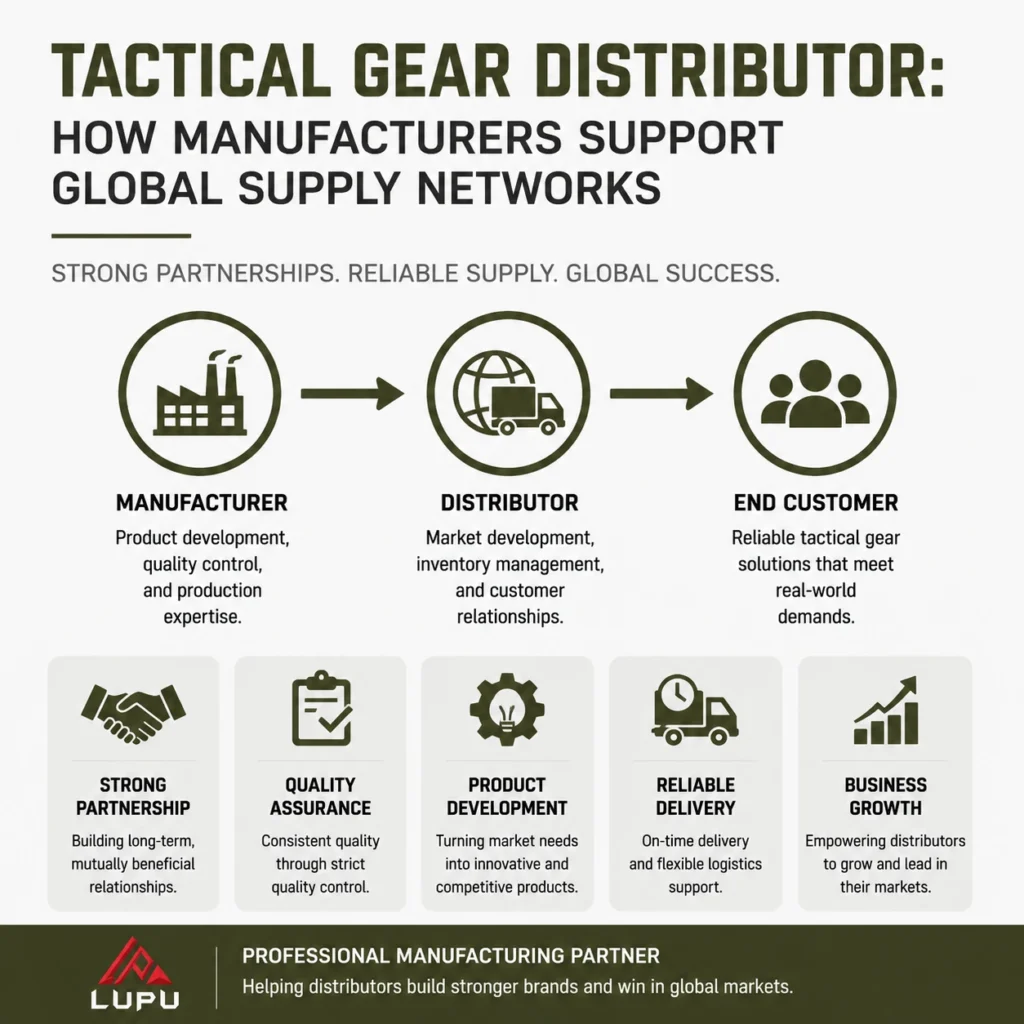
Traditionally, the relationship between distributors and manufacturers was straightforward:
Manufacturer → Product Supply → Distributor → End Customer
However, modern tactical equipment markets require a more collaborative approach:
Manufacturer + Distributor = Long-Term Market Partnership
Today, successful manufacturers do more than produce finished goods. They work with distributors to understand market requirements, improve product performance, and create solutions that match specific customer groups.
This partnership model enables distributors to compete through:
- Better product differentiation
- Faster market response
- Improved quality consistency
- More efficient supply management
Buyer Perspective: What Distributors Should Evaluate
When selecting a manufacturing partner, distributors should look beyond price.
Important evaluation factors include:
Manufacturing Capability
Can the supplier consistently produce products according to required specifications?
Product Development Experience
Can the manufacturer provide suggestions on materials, structure, and functionality?
Quality Management System
Does the supplier have reliable inspection processes?
Communication Efficiency
Can the manufacturer respond quickly and clearly during development and production?
Export Experience
Does the supplier understand international logistics and compliance requirements?
A strong manufacturing relationship reduces operational risks and creates opportunities for long-term growth.
Manufacturing Insight: The Role of Professional Suppliers
Experienced manufacturers understand that distributor success directly affects their own growth.
A professional supplier provides:
- Technical recommendations
- Product improvement suggestions
- Manufacturing solutions
- Production planning support
- Market-oriented product development
At LUPU Tactical Gear, we view distributors as long-term partners rather than individual transactions. Our goal is to help global partners build competitive tactical product lines.
2. Product Development Support: Helping Distributors Build Competitive Product Lines
From Standard Products to Market-Specific Solutions
One of the biggest advantages of working with an experienced Hersteller von taktischer Ausrüstung is product development support.
Many tactical gear distributors understand their markets but may not have manufacturing expertise. A professional manufacturer bridges this gap by transforming market requirements into practical products.
For example, a distributor may identify demand for:
- Lightweight tactical backpacks
- Durable outdoor equipment
- Custom-branded MOLLE gear
- Professional carrying solutions
The manufacturer then helps develop the product through:
- Material selection
- Structural optimization
- Functional design
- Prototype development
- Production planning
Buyer Perspective: Why Development Capability Matters
For distributors, product uniqueness creates competitive advantages.
A standard product available from many suppliers often leads to price competition.
A customized product allows distributors to:
- Build stronger brand identity
- Target specific customer groups
- Increase customer loyalty
- Create higher-value product offerings
Manufacturing Insight: Turning Ideas Into Production
Professional OEM manufacturers understand the relationship between design and manufacturing.
A successful product must balance:
- Functionality
- Production feasibility
- Cost control
- Dauerhaftigkeit
- Market expectations
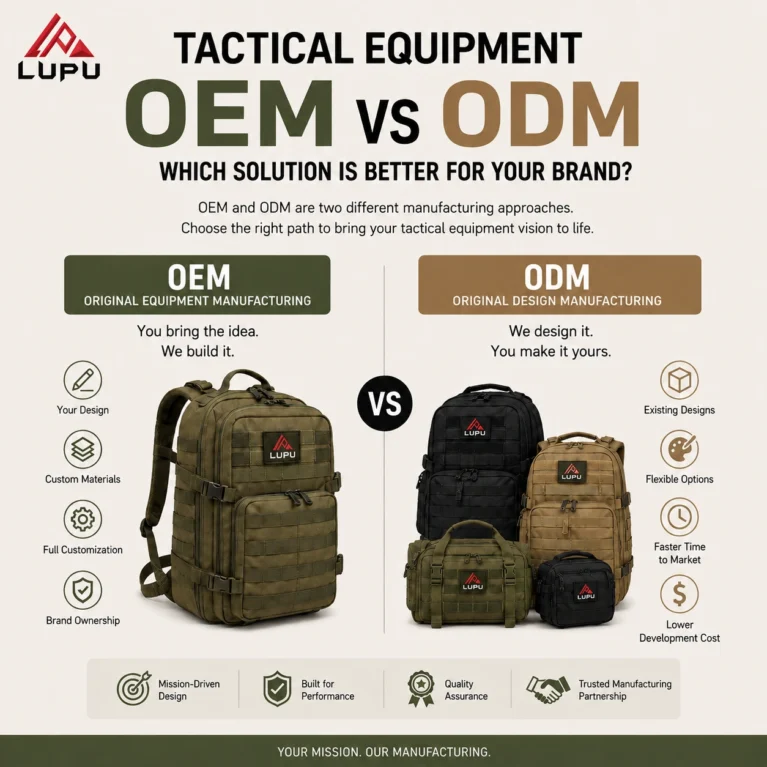
LUPU provides OEM & ODM tactical gear solutions, helping partners move from initial concepts to finished products through structured development processes.
3. Ensuring Stable Supply Through Professional Manufacturing Systems
Why Supply Chain Reliability Matters?
For every Tactical Gear Distributor, supply stability is a key factor in business success.
A distributor may have strong sales channels, but without reliable production support, growth becomes difficult.
Supply chain challenges can include:
- Material shortages
- Production delays
- Quality inconsistencies
- Unpredictable lead times
A professional manufacturing partner helps reduce these risks through organized production systems.
Buyer Perspective: Reducing Business Risk
Distributors should choose suppliers capable of supporting:
- Long-term production requirements
- Stable product availability
- Flexible order quantities
- Reliable delivery schedules
A dependable supplier allows distributors to maintain customer trust and avoid market disruption.
Manufacturing Insight: Building a Reliable Supply Network
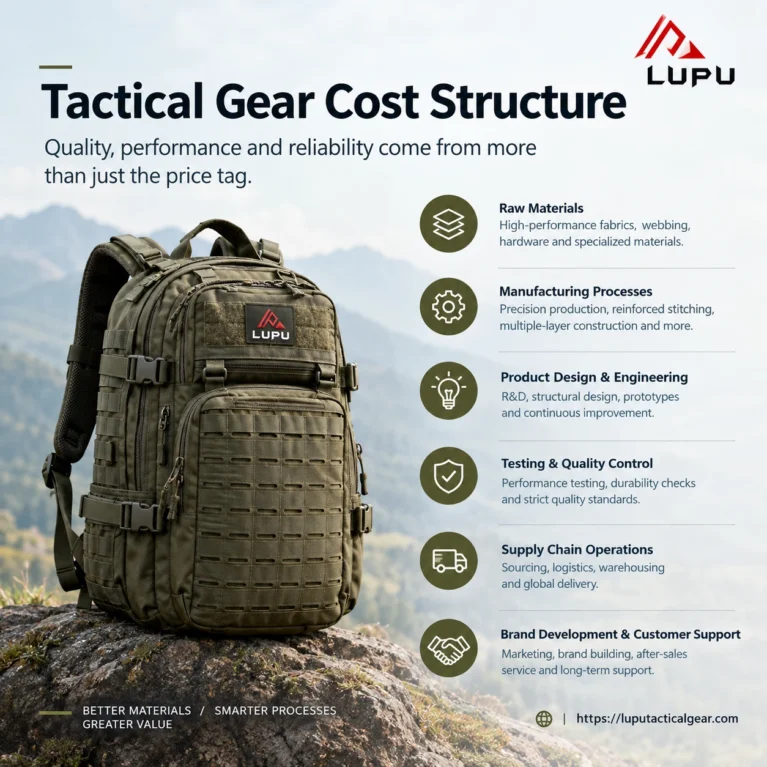
Professional manufacturers manage multiple supply chain elements:
Raw Material Management
Including:
- Fabrics
- Zippers
- Buckles
- Webbing
- Hardware components
Production Planning
Including:
- Capacity allocation
- Manufacturing schedules
- Quality checkpoints
Delivery Management
Including:
- Packaging preparation
- Export documentation
- Shipment coordination
A complete supply system ensures consistent product availability for global markets.
4. Quality Control: The Foundation of Distributor Success
Protecting Brand Reputation Through Manufacturing Excellence
In tactical equipment markets, product quality directly affects customer trust.
A distributor’s reputation depends heavily on whether products perform as expected.
Professional manufacturers implement quality control throughout the production process.
Buyer Perspective: Why Quality Matters?
Poor product quality can lead to:
- Customer complaints
- Returns
- Increased costs
- Brand reputation damage
Distributors should evaluate whether manufacturers have structured quality control procedures.
Manufacturing Insight: Multi-Level Quality Management
A professional tactical gear manufacturer typically applies:
Incoming Quality Control (IQC)
Inspection of:
- Fabric quality
- Color consistency
- Hardware components
- Material specifications
In-Process Quality Control (IPQC)
Monitoring:
- Stitching quality
- Product structure
- Assembly accuracy
- Functional performance
Final Quality Control (FQC)
Checking:
- Appearance
- Measurements
- Packaging
- Finished product consistency
At LUPU Tactical Gear, quality management is integrated throughout production to ensure reliable products for global partners.
5. Customization and Private Label Solutions for Global Distributors
Creating Differentiated Market Advantages
The tactical equipment market is becoming increasingly competitive. Tactical gear distributors need ways to distinguish their product offerings.
Private label and OEM solutions allow businesses to create unique product lines.
Customization options may include:
- Brand logo application
- Custom colors
- Material selection
- Product structure modifications
- Packaging design
- Functional upgrades
Buyer Perspective: Building a Stronger Brand
For distributors, customized tactical gear provides advantages:
- Better market positioning
- Reduced direct price competition
- Stronger customer recognition
- Greater product ownership
A benutzerdefinierte taktische Rucksack or equipment solution can become a valuable part of a tactical gear distributor’s brand portfolio.
Manufacturing Insight: Supporting OEM Development
OEM production requires more than manufacturing capacity.
A capable partner provides:
- Design communication
- Prototype development
- Sample improvement
- Production management
- Quality assurance
LUPU supports global distributors with custom tactical backpack and tactical equipment manufacturing solutions.
6. Managing Global Logistics and International Delivery Requirements
Supporting Worldwide Distribution Networks
Manufacturing is only one part of the supply chain.
For international distributors, efficient logistics management is equally important.
Professional manufacturers support:
- Export preparation
- Documentation management
- Packaging optimization
- Shipment coordination
Buyer Perspective: Selecting Internationally Experienced Suppliers
Distributors should consider whether manufacturers understand:
- International trade requirements
- Different market expectations
- Shipping procedures
- Delivery timelines
A supplier with export experience can reduce communication problems and improve delivery reliability.
Manufacturing Insight: Beyond Production
A global supplier must manage the complete process:
Product Development
↓
Manufacturing
↓
Inspection
↓
Packaging
↓
Export Preparation
↓
Shipment Support
This creates a smoother experience for international partners.
7. How Manufacturers Help Distributors Respond to Market Trends
Staying Competitive in a Changing Tactical Gear Industry
The tactical equipment market continues to evolve.
Current trends include:
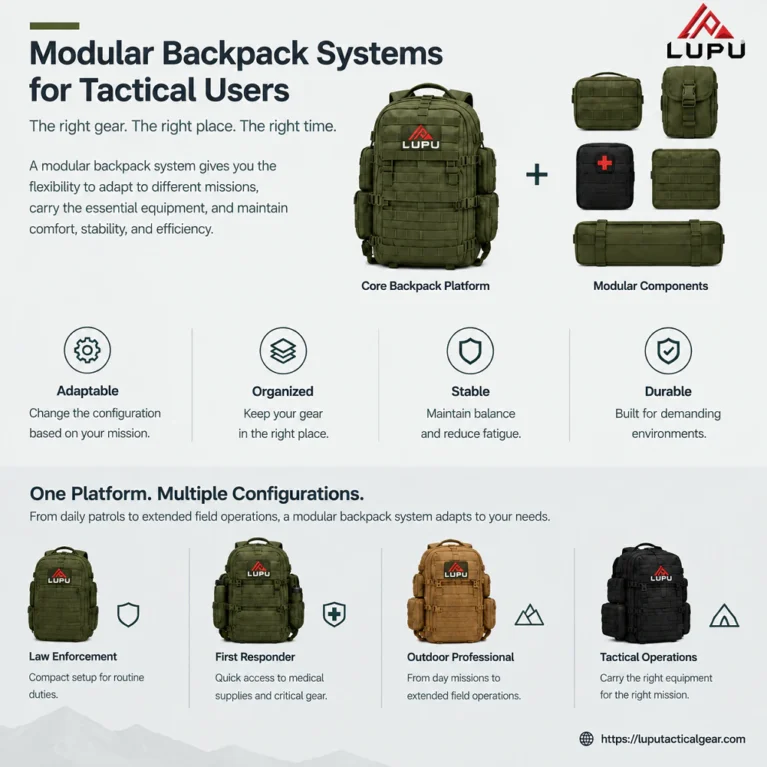
- Modular product systems
- Lightweight materials
- Multi-functional designs
- Custom branding
- Improved user comfort
Distributors who adapt quickly can capture new market opportunities.
Buyer Perspective
A strong manufacturing partner helps distributors:
- Launch new products faster
- Respond to customer feedback
- Improve existing product lines
- Explore new market segments
Manufacturing Insight
Manufacturers with strong development capabilities can transform market trends into practical products.
LUPU continuously focuses on improving tactical gear solutions based on customer requirements and industry developments.
8. Choosing the Right Tactical Gear Manufacturer as a Long-Term Partner
Key Evaluation Criteria for Distributors
Choosing a manufacturing partner is a strategic decision.
Tactical gear distributors should evaluate:
Manufacturing Experience
Does the supplier understand tactical equipment requirements?
Product Development Capability
Can they support customization and innovation?
Production Capacity
Can they handle future business growth?
Quality Management
Do they maintain consistent standards?
Communication Ability
Can they provide efficient project support?
Export Experience
Can they support global distribution?
Buyer Perspective
The best manufacturer is not necessarily the lowest-cost supplier.
The ideal partner provides:
- Reliability
- Expertise
- Communication
- Innovation
- Long-term support
Manufacturing Insight
Professional manufacturers focus on partnership development rather than short-term transactions.
A successful relationship is built through:
- Continuous improvement
- Transparent communication
- Shared business goals
9. How OEM Manufacturing Supports Distributor Growth
Turning Product Ideas Into Market Solutions
A professional OEM process allows distributors to develop products efficiently.
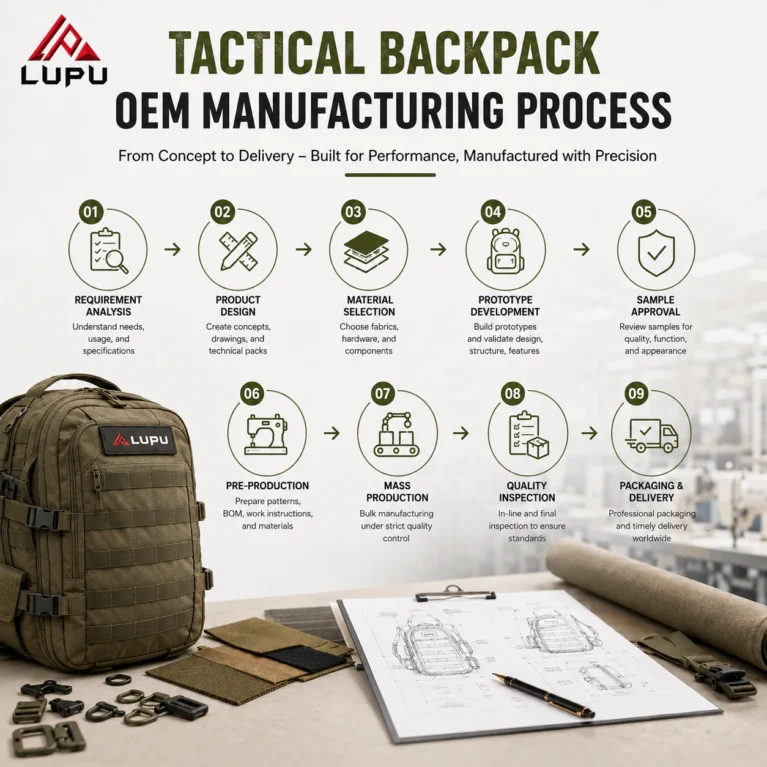
A typical workflow includes:
Step 1: Requirement Discussion
Understanding:
- Target market
- Product requirements
- Quantity expectations
Step 2: Product Development
Including:
- Design adjustments
- Material selection
- Prototype creation
Step 3: Sample Approval
Confirming:
- Appearance
- Function
- Quality standards
Step 4: Mass Production
Executing:
- Manufacturing
- Inspection
- Packaging
Step 5: Market Launch
Supporting distributor sales growth.
Buyer Perspective
A complete OEM process helps distributors reduce:
- Development risks
- Production problems
- Time-to-market challenges
Manufacturing Insight
Experienced OEM manufacturers provide the technical foundation needed to turn concepts into successful products.
Conclusion: Building Stronger Global Tactical Gear Supply Networks Together
The future of the tactical equipment industry depends on stronger cooperation between manufacturers and distributors.
A successful Tactical Gear Distributor requires more than access to products. They need a reliable manufacturing partner capable of supporting:
- Product development
- Stable production
- Quality assurance
- Custom solutions
- Global supply management
Choosing the right tactical gear manufacturer allows distributors to build stronger brands, improve customer satisfaction, and create sustainable market growth.
LUPU Tactical Gear specializes in OEM and ODM tactical equipment solutions, supporting global tactical gear distributors, wholesalers, and brands with professional manufacturing capabilities.
From tactical backpacks to customized gear solutions, LUPU works with partners worldwide to develop reliable products and build long-term supply networks.
Contact LUPU Tactical Gear to discuss your next tactical equipment project.