For professional procurement teams, sourcing tactical gear is about much more than comparing product prices. The right procurement decision requires a clear understanding of operational requirements, product construction, material quality, supplier capabilities, customization options, quality control, lead times, and long-term supply reliability.
A structured approach to tactical gear procurement can help buyers reduce sourcing risks, improve product consistency, and establish more reliable supplier relationships.
Whether you are sourcing tactical bags, vests, pouches, chest rigs, plate carriers, or other load-bearing equipment, the following guide outlines the key factors to consider when evaluating products and manufacturing partners.
1. Start With a Clear Procurement Requirement
Before contacting suppliers, procurement teams should define exactly what they need. A detailed product requirement makes it easier to compare quotations, evaluate samples, and avoid misunderstandings during production.
Define the Intended Application
The intended application should be the starting point for product selection.
Depending on the procurement project, tactical gear may be required for:
- Field and outdoor activities
- Professional training
- Equipment transportation
- Logistics and support applications
- Institutional or organizational use
- Outdoor and recreational environments
Different applications can require very different specifications. A lightweight pack designed for short-duration use, for example, may have different priorities from equipment intended for extended field use.
Define Functional Requirements
Once the application is established, identify the functions the equipment must provide.
Relevant considerations may include:
- Load capacity
- Overall weight
- Storage volume
- Adjustability
- Modularity
- Attachment options
- Accessibility
- Ventilation
- Weather resistance
- Ease of maintenance
- Compatibility with existing equipment
The goal is to distinguish required features from optional features. More features do not automatically mean a better product. A practical design should provide the functions users actually need without adding unnecessary weight, complexity, or cost.
Establish Quantities and Procurement Cycles
Procurement planning should also consider expected demand.
Define:
- Initial order quantity
- Forecasted annual demand
- Expected reorder frequency
- Seasonal demand
- Replacement requirements
- Target delivery schedule
This information helps suppliers assess production capacity and allows buyers to evaluate whether a tactical gear manufacturer can support the project beyond the first purchase.
2. How to Evaluate Tactical Gear Materials and Construction
Material selection is an important part of tactical gear procurement, but material specifications should never be considered in isolation.
Common Materials to Evaluate
Depending on the product, buyers may encounter materials such as:
- Nylon
- Polyester
- Oxford fabric
- High-density woven fabrics
- Breathable mesh
- Coated fabrics
Nylon is widely used in equipment bags, packs, vests, and pouches because of its combination of strength, flexibility, and abrasion resistance. However, the actual performance of a finished product depends on more than the fabric itself.
What Procurement Teams Should Compare
When evaluating materials, consider:
Fabric weight and construction:
A higher denier specification does not automatically mean a better product. The weave, coating, finishing process, and overall fabric quality also matter.
Abrasion and tear resistance:
Products intended for demanding environments should be evaluated for their resistance to repeated friction and mechanical stress.
Stitching and reinforcement:
Stress points should receive appropriate reinforcement. Pay particular attention to seams, handles, attachment points, strap connections, and areas that carry heavier loads.
Hardware:
Buckles, zippers, adjustment components, and other hardware should be evaluated for functional reliability and consistency.
Coatings and finishes:
Where water resistance is required, buyers should understand whether the fabric uses a coating or treatment and what level of performance can reasonably be expected.
Look Beyond the Material Specification
One common sourcing mistake is assuming that a material specification tells the entire quality story.
For example, two products may both use a similar fabric specification while showing significant differences in:
- Pattern construction
- Stitch density
- Reinforcement
- Seam finishing
- Hardware selection
- Assembly quality
- Quality-control procedures
For this reason, experienced procurement teams evaluate the complete product construction, not just the fabric label.
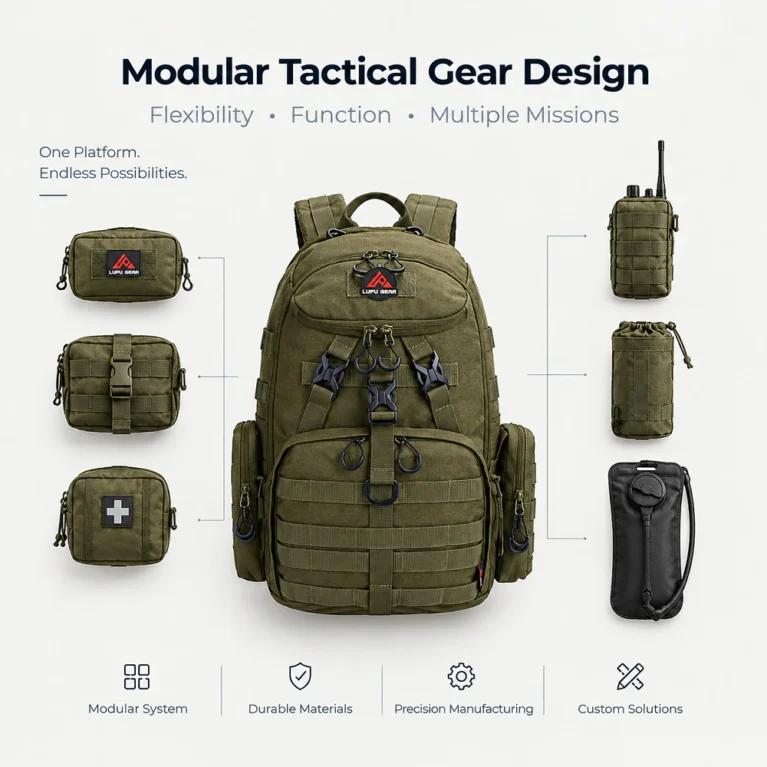
3. Assess Product Functionality and Modular Design
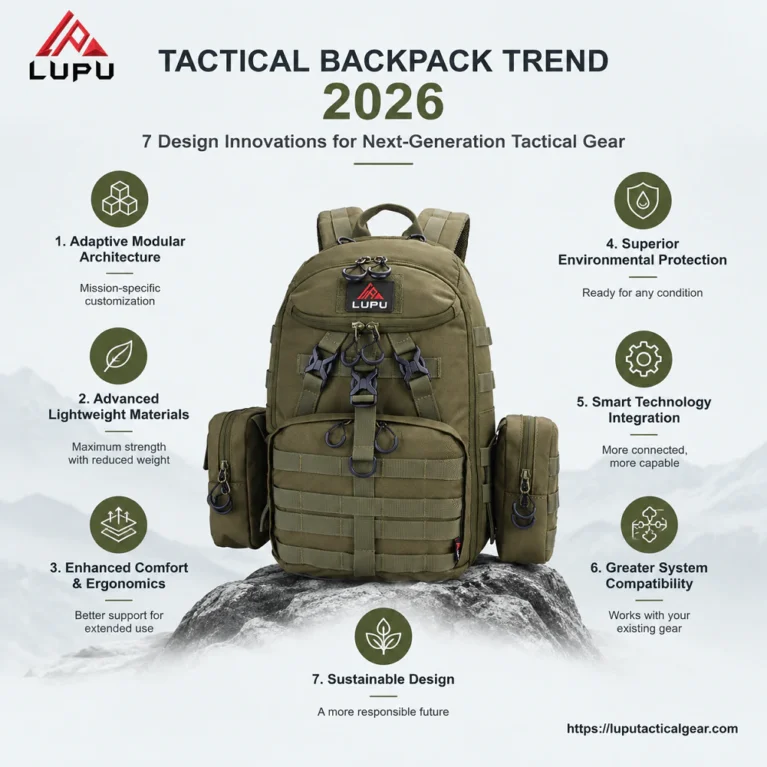
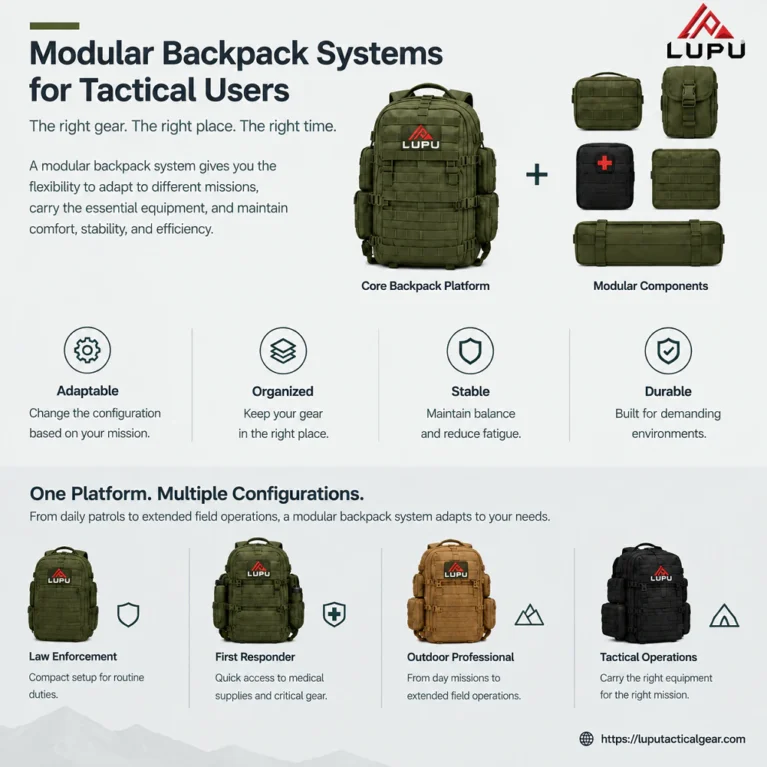
Modularity can be valuable when equipment needs to support different configurations or user requirements.
When reviewing a tactical product, consider how effectively its design supportspractical gear organization.
Key Evaluation Criteria
Depending on the product category, buyers may assess:
- MOLLE-compatible attachment systems
- Adjustable straps
- Modular pouches
- Attachment points
- Removable components
- Access to storage compartments
- Weight distribution
- Ergonomic design
- Configuration flexibility
A modular system should be evaluated for usability, not simply the number of attachment points it provides.
For example, attachment systems should be positioned where users can reasonably access them, while adjustable components should provide enough range to accommodate the intended user group.
Function Should Come Before Complexity
A well-designed product should make equipment easier to organize and access.
Procurement teams should therefore ask:
- Does the configuration support the intended use?
- Can users adjust the product without difficulty?
- Are important compartments easy to access?
- Does the design add unnecessary weight?
- Can modular components be replaced or reconfigured?
- Does the product remain comfortable when fully loaded?
These questions can reveal design issues that may not be obvious from a product specification sheet.
4. Supplier Evaluation: What Should Military Buyers Look For?
Selecting the right supplier is one of the most important decisions in tactical gear procurement.
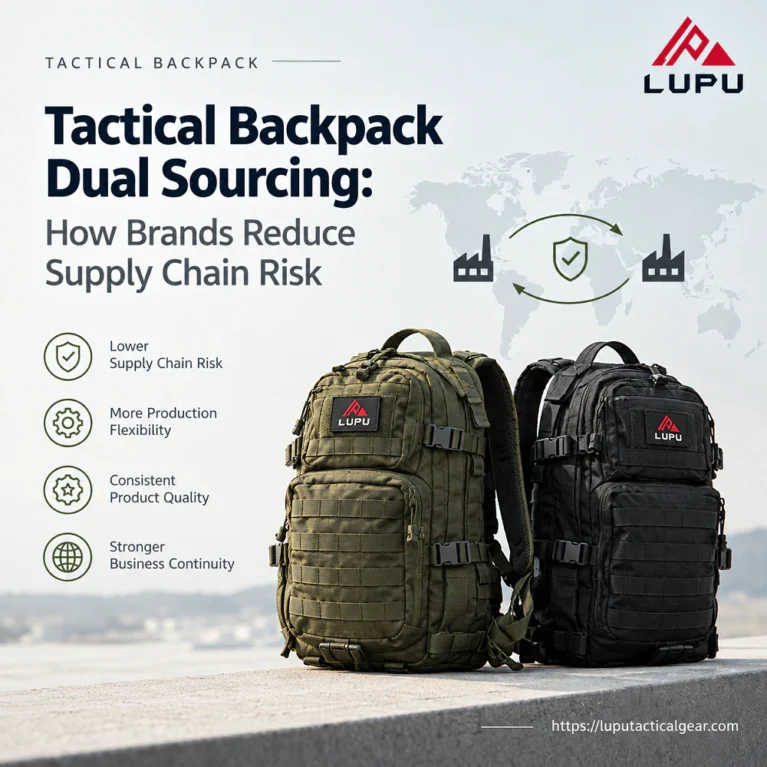
A manufacturer should be evaluated not only on the product it offers today, but also on its ability to maintain quality and supply consistency over time.
Manufacturing Experience
Consider the supplier’s experience with relevant product categories and manufacturing processes.
Useful questions include:
- How long has the company been manufacturing related products?
- Does it have experience with similar specifications?
- Can it develop samples or prototypes?
- Does it have established production processes?
- Can it support design revisions?
Relevant experience can reduce development time and help suppliers identify potential manufacturing challenges earlier in the process.
Quality Management
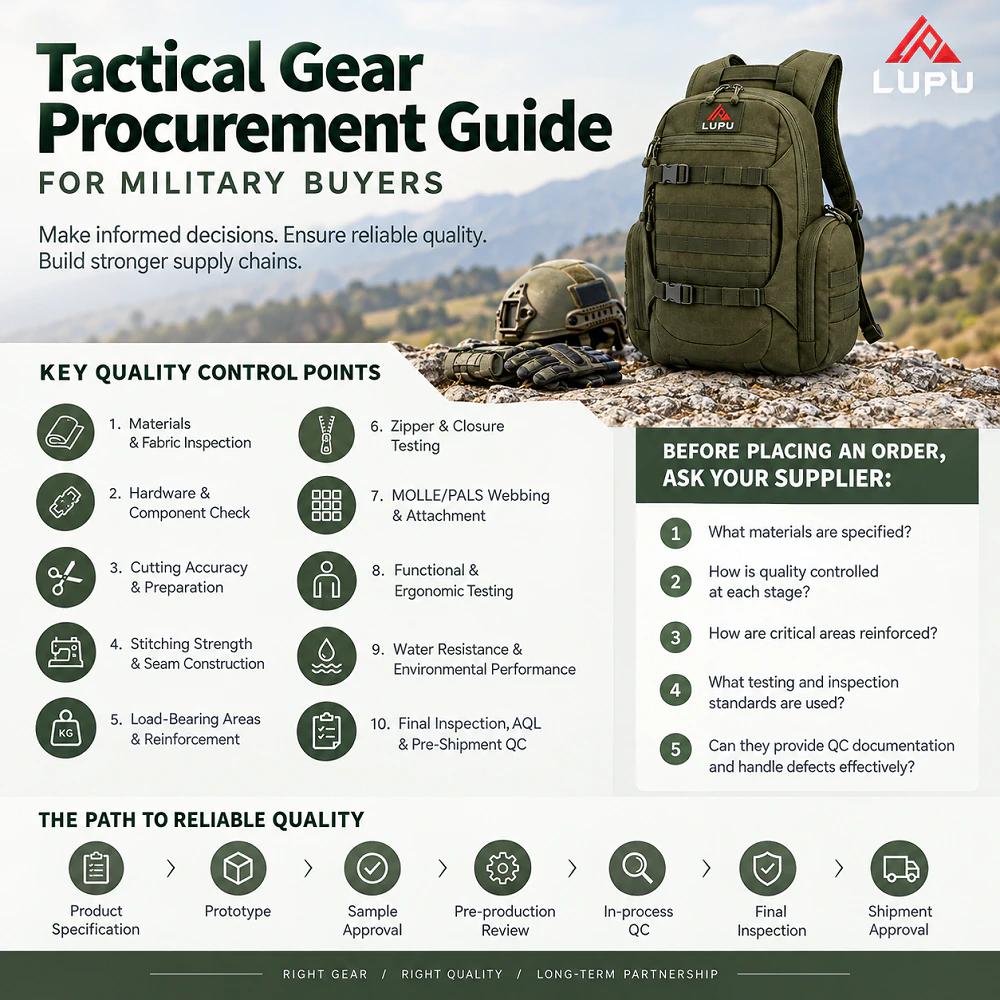
Ask suppliers to explain how quality is controlled from incoming materials through final inspection.
A structured quality process may include:
- Incoming material inspection
- Component verification
- Pre-production sample approval
- In-process inspection
- Functional checks
- Final inspection
- Packaging and quantity verification
The objective is not simply to discover defects at the end of production. Good quality management aims to prevent recurring problems throughout the manufacturing process.
Production Capacity
Capacity should be evaluated against your actual procurement requirements.
Consider:
Production lines
Workforce
Equipment
Monthly capacity
Peak-season capacity
Lead-time performance
Ability to support repeat orders
A supplier may be suitable for a small development order but unsuitable for a larger recurring program. Procurement teams should evaluate capacity based on the complete purchasing forecast rather than a single order.
Communication and Technical Support
Clear communication is particularly important for customized products.
A capable supplier should be able to discuss:
- Product specifications
- Materials
- Measurements
- Construction details
- Sample revisions
- Packaging
- Production schedules
- Inspection requirements
Good communication can prevent small specification differences from becoming expensive production problems.
5. OEM and ODM Capabilities for Custom Tactical Gear
Many professional buyers require products that are different from standard catalog designs. This is where OEM and ODM capabilities can become important.
What Is OEM?
Under an OEM arrangement, the buyer generally provides product specifications, design requirements, branding, or other defined parameters, while the manufacturer produces the product according to the agreed requirements.
OEM can be appropriate when the buyer already has:
- Product drawings
- Technical specifications
- Existing samples
- Established designs
- Defined materials and components
What Is ODM?
ODM involves a greater level of manufacturer participation in product development.
An experienced ODM supplier may contribute:
- Product concepts
- Structural design
- Material recommendations
- Prototype development
- Manufacturing solutions
- Design refinement
ODM can be useful for brands or distributors that have a market requirement but need manufacturing expertise to turn that requirement into a finished product.
Evaluate More Than Customization
A supplier’s ability to customize a product is only one part of the evaluation.
Also consider whether the supplier can maintain consistency when producing customized products at volume.
Potential customization areas include:
- Materials
- Colors
- Camouflage patterns
- Logos
- Hardware
- Pouch configurations
- Dimensions
- Packaging
- Structural details
The key question is not simply “Can you customize it?”
A more useful question is:
“Can you repeatedly manufacture the customized product to the approved specification?”
6. Quality Control and Product Inspection
Quality control should be established before production begins.
A clear inspection framework gives both the buyer and supplier a common reference for evaluating finished products.
Pre-Production
Before mass production, confirm:
- Approved materials
- Product dimensions
- Color or pattern
- Hardware
- Construction details
- Packaging requirements
- Approved sample
A production sample should represent the specification that will actually be manufactured.
During Production
In-process checks can focus on:
- Stitching
- Seam construction
- Dimensions
- Hardware installation
- Component placement
- Functional performance
- Assembly consistency
Monitoring production during manufacturing can help identify recurring issues before they affect the entire order.
Final Inspection
Before shipment, buyers may review:
- Overall appearance
- Measurements
- Functional components
- Stitching
- Hardware
- Quantity
- Packaging
- Labels and documentation
The specific inspection standard should be agreed upon in advance.
Documentation
Depending on the project, procurement teams may request:
- Product specifications
- Material information
- Inspection records
- Test documentation where applicable
- Packaging information
- Shipping documentation
Documentation requirements should reflect the actual procurement contract and destination-market requirements rather than relying on generic claims.
7. Compliance, Documentation, and Responsible Procurement
Compliance should be considered as part of procurement planning, not as an afterthought.
Requirements can vary according to:
- Product category
- Destination market
- End-user requirements
- Import regulations
- Contract specifications
- Material requirements
- Labeling requirements
Procurement teams should identify applicable requirements before placing an order and confirm which party is responsible for providing the necessary documentation.
Avoid Unsupported Certification Claims
Buyers and suppliers should be precise when discussing compliance.
For example, terms such as “military grade,” “military approved,” or “fully certified” should not be used as generic quality claims unless they refer to a specific, verifiable requirement or certification.
A better approach is to identify the exact standard, specification, test, or contractual requirement involved.
This improves transparency and makes supplier comparisons more meaningful.
8. Lead Times, MOQ, and Total Cost of Procurement
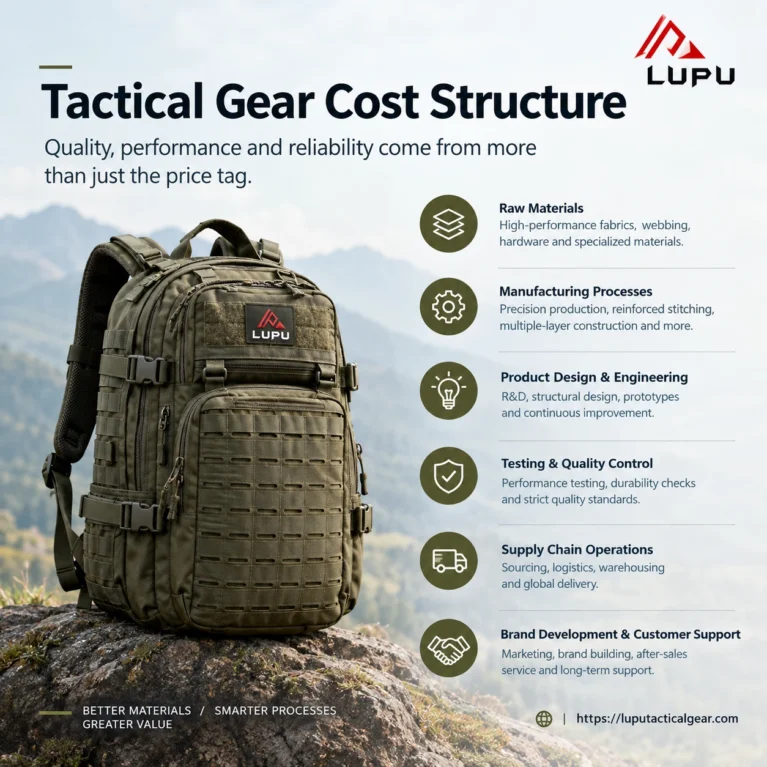
Unit price is important, but it should not be the only commercial consideration.
A procurement decision should account for the total cost associated with acquiring and maintaining the product.
Key Commercial Factors
Consider:
- Minimum order quantity (MOQ)
- Sample costs
- Development costs
- Tooling costs, if applicable
- Unit price
- Packaging
- Shipping
- Lead time
- Payment terms
- Reorder conditions
- Quality inspection costs
Look at Total Procurement Cost
A lower unit price may not result in a lower overall procurement cost if it comes with:
- Longer lead times
- Higher defect rates
- More frequent replacements
- Inconsistent production
- Higher logistics costs
- Difficult reorder processes
A more useful comparison is:
Total procurement cost = purchase cost + logistics + quality-related costs + replacement costs + inventory-related costs + supplier management costs
The exact calculation will vary by project, but the principle remains the same: evaluate the full purchasing cycle rather than the initial quotation alone.
9. How to Compare Multiple Tactical Gear Suppliers
Comparing suppliers using the same evaluation framework can make procurement decisions more objective.
A practical supplier evaluation matrix may include the following:
|
Evaluation Area |
Key Questions |
|
Product Quality |
Does the product meet the required specifications? |
|
Materials |
Are materials clearly defined and consistently sourced? |
|
Manufacturing |
Can the supplier maintain consistent production quality? |
|
Customization |
Can the supplier support required modifications? |
|
Production Capacity |
Can the supplier meet expected order volumes? |
|
Lead Time |
Are production schedules realistic and reliable? |
|
Quality Control |
Are inspection procedures clearly defined? |
|
Communication |
Can the supplier provide effective technical support? |
|
Cost |
Is the total procurement cost competitive? |
|
Long-Term Supply |
Can the supplier support repeat orders? |
Procurement teams can assign their own priorities and weighting to these criteria depending on the project.
For example, a highly customized development project may place greater emphasis on engineering and sampling capabilities, while a recurring supply program may place greater weight on production consistency, capacity, and delivery performance.
10. Common Tactical Gear Procurement Mistakes to Avoid
Even experienced buyers can encounter avoidable sourcing problems.
Mistake 1: Choosing Based Only on Price
Price is easy to compare, but product quality, lead time, consistency, and service can be more difficult to quantify.
A lower quotation may not remain lower after logistics, quality issues, and replacement costs are considered.
Mistake 2: Evaluating a Sample Without Evaluating Production Capability
A supplier may produce an acceptable sample but still struggle to maintain consistency during volume production.
Ask how the approved sample will be translated into production specifications and quality-control procedures.
Mistake 3: Focusing Only on Fabric Specifications
A fabric specification does not describe the entire finished product.
Construction, stitching, reinforcement, hardware, pattern design, and assembly quality all contribute to the final result.
Mistake 4: Ignoring Reorder Requirements
For recurring procurement, the first order is only the beginning.
Buyers should consider whether the supplier can reproduce the same product consistently months or years later.
Mistake 5: Not Defining Specifications Clearly
Unclear specifications create room for different interpretations.
Before production, confirm:
- Materials
- Dimensions
- Colors
- Components
- Construction
- Packaging
- Inspection requirements
- Approved sample
Clear documentation protects both parties.
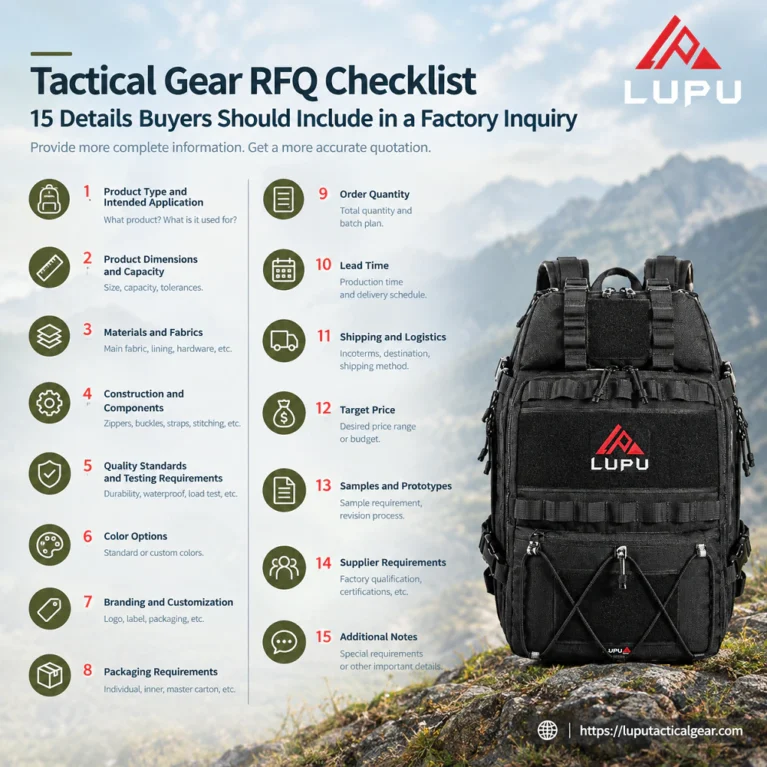
11. A Practical Tactical Gear Procurement Checklist
A standardized checklist can simplify the purchasing process.
Before Requesting a Quotation
☐ Define product application
☐ Establish technical requirements
☐ Determine estimated order quantity
☐ Identify customization requirements
☐ Define target delivery schedule
☐ Identify applicable documentation requirements
Before Placing an Order
☐ Review supplier capabilities
☐ Approve product samples
☐ Confirm materials
☐ Confirm dimensions
☐ Confirm colors and components
☐ Confirm quality-control requirements
☐ Confirm MOQ
☐ Confirm lead time
☐ Confirm commercial terms
Before Shipment
☐ Complete agreed final inspection
☐ Verify quantity
☐ Check product consistency
☐ Verify packaging
☐ Confirm labeling
☐ Review required shipping documentation
This checklist can also be adapted into an internal supplier evaluation form for procurement teams.
12. Frequently Asked Questions
What should military buyers consider when sourcing tactical gear?
The main considerations include intended application, product specifications, material quality, construction, supplier manufacturing capability, quality control, customization, lead time, documentation, total cost, and long-term supply reliability.
How do you evaluate a tactical gear supplier?
Evaluate the supplier across multiple areas rather than relying on price alone. Review manufacturing experience, product samples, quality-control procedures, production capacity, customization capabilities, lead-time performance, communication, and ability to support repeat orders.
What materials are commonly used in tactical gear?
Common materials include nylon, polyester, Oxford fabrics, coated fabrics, and breathable mesh. The appropriate material depends on the product’s intended use and required performance characteristics.
What is the difference between tactical gear OEM and ODM?
OEM generally means manufacturing according to buyer-defined specifications or designs. ODM typically involves greater manufacturer participation in product development, including design, engineering, material selection, and prototyping.
How can buyers verify tactical gear quality?
Start with an approved sample and clearly documented specifications. Then establish inspection criteria for materials, dimensions, stitching, hardware, construction, functionality, and packaging. For recurring orders, monitor production consistency over time.
What should be included in a tactical gear procurement checklist?
A useful checklist should cover product requirements, materials, customization, supplier capabilities, samples, quality control, MOQ, pricing, lead time, documentation, inspection, packaging, and reorder requirements.
How can procurement teams reduce long-term sourcing costs?
Look beyond the initial unit price. Consider total procurement costs, including logistics, quality-related costs, replacement requirements, inventory, lead times, and supplier management. A consistent supplier can sometimes provide greater long-term value than a supplier offering only a lower initial quotation.
13. Conclusion: Building a More Reliable Tactical Gear Procurement Strategy
Effective tactical gear procurement is not simply about finding a supplier with the lowest quotation or the largest product catalog.
It is about building a sourcing process that connects requirements, product design, materials, manufacturing, quality control, documentation, cost, and long-term supply.
For professional buyers, a reliable procurement strategy should answer several fundamental questions:
- Does the product meet the actual application requirements?
- Are the materials and construction appropriate?
- Can the supplier consistently reproduce the approved specification?
- Can the manufacturer support customization when required?
- Are quality-control procedures clearly defined?
- Can production capacity support both current and future demand?
- Are lead times and total procurement costs realistic?
- Can the supplier provide reliable long-term support?
A supplier that can answer these questions with clear specifications, samples, processes, and documentation is better positioned to support a professional procurement program.
For brands, distributors, institutional buyers, and professional sourcing teams, working with an experienced tactical gear manufacturer can also simplify product development, customization, quality management, and recurring supply.
The strongest procurement decisions are rarely based on one specification or one quotation. They come from evaluating the complete supplier and product lifecycle and selecting a partner that can consistently deliver against clearly defined requirements.