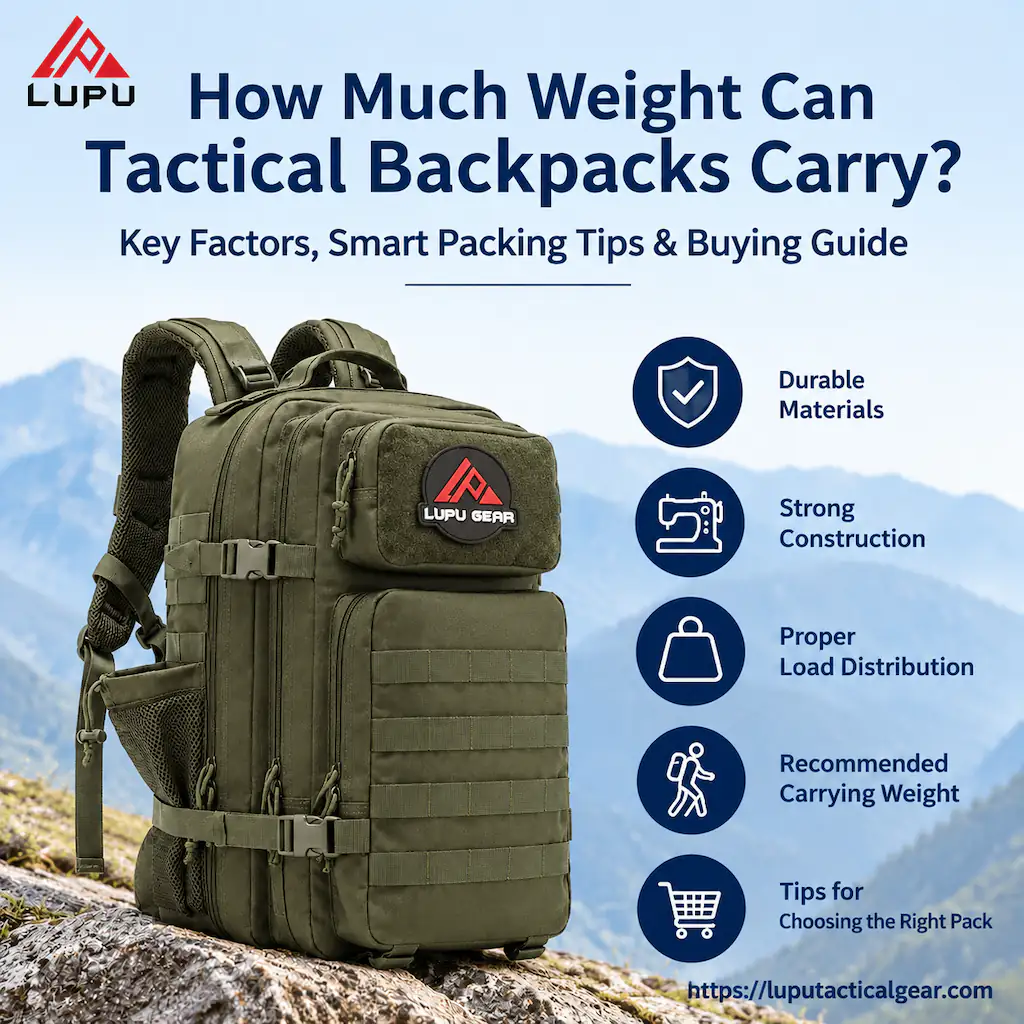
A tactical backpack may look rugged and spacious, but how much weight can it actually carry? Whether you are preparing for a camping trip, organizing outdoor equipment, hiking on challenging trails, or selecting a backpack for everyday use, understanding its load capacity is essential.
The tactical backpack load capacity depends on much more than its size or fabric specification. Material strength, stitching quality, shoulder strap construction, reinforcement, weight distribution, and overall manufacturing quality all influence how well a backpack performs under load.
From a backpack manufacturing perspective, one important principle is that a strong fabric does not automatically make a strong backpack. Every component must work together to support the intended load.
In this guide, we explain what determines tactical backpack load capacity, how construction affects carrying performance, how to distribute equipment properly, and what to consider when choosing a backpack for your requirements.
1. What Is the Load Capacity of a Tactical Backpack?
Tactical backpack load capacity refers to the amount of weight a backpack is designed and tested to carry under specified conditions without unacceptable structural damage or loss of function.
However, load capacity is often confused with storage capacity. These are two different measurements.
Storage Capacity vs. Weight Capacity
Storage capacity is generally measured in liters (L), indicating the approximate internal volume available for carrying equipment.
Weight capacity, on the other hand, refers to the load a backpack can support. It is measured in kilograms (kg) or pounds (lb).
For example, a 30L backpack may have less storage space than a 45L backpack, but this does not necessarily mean the 45L model can safely carry more weight.
A backpack’s practical load-bearing performance depends on factors such as:
- Fabric and reinforcement construction
- Shoulder strap attachment strength
- Stitching quality and seam design
- Back panel and suspension structure
- Hip belt and load distribution
- Zippers, buckles, and other hardware
A larger backpack simply provides more space. Its ability to carry heavier equipment depends on the strength and design of the complete structure.
Is There a Standard Weight Limit for Tactical Backpacks?
There is no single universal weight limit that applies to every tactical backpack.
A compact daypack designed for light everyday equipment has different structural requirements from a large outdoor backpack intended for extended trips.
Even backpacks with similar dimensions may have different load-bearing capabilities because manufacturers use different materials, patterns, stitching methods, reinforcement techniques, and suspension systems.
For this reason, buyers should not estimate a backpack’s maximum load based only on its appearance, capacity in liters, or fabric denier rating.
The most reliable reference is the manufacturer’s recommended load, supported by appropriate product-specific testing.
2. What Factors Affect Tactical Backpack Load Capacity?
The overall strength of a tactical backpack comes from the interaction of multiple components. A weakness in one critical area can affect the performance of the entire product.
Fabric Strength and Material Selection
Fabric is one of the first considerations in tactical backpack manufacturing. It influences abrasion resistance, tear resistance, flexibility, weight, and the backpack’s ability to withstand repeated outdoor use.
Common material options include:
- 600D Oxford fabric: A practical option for backpacks requiring a balance of durability, flexibility, and everyday functionality.
- 900D Oxford fabric: Commonly selected for products that require a heavier fabric construction and a more substantial feel.
- 500D Nylon: Widely used in tactical and outdoor equipment where a balance of strength, weight, and flexibility is important.
- 1000D Nylon: A heavier-duty nylon option often selected for applications requiring robust abrasion resistance and durable construction.
These specifications describe different fabric characteristics, but they do not establish the load capacity of a complete backpack.
Denier refers to the linear mass of the fibers used to make a material. It does not independently measure tear strength, tensile strength, abrasion resistance, or the strength of the finished product.
Fabric performance can also vary according to yarn quality, weave structure, coating, finishing, and manufacturing specifications.
From a manufacturing perspective, choosing the right material means considering the intended application, expected wear, product weight, construction requirements, and target price.
A heavier fabric is not automatically the best choice for every backpack. The objective is to select materials that provide the appropriate performance for the product’s intended use.
Stitching Quality and Seam Reinforcement
Stitching is one of the most important factors affecting tactical backpack durability.
Even high-quality fabric can fail if the seams connecting its components are poorly constructed.
Particular attention should be paid to high-stress areas, including:
- Shoulder strap attachment points
- Top and side carry handles
- Hip belt connections
- Main compartment seams
- MOLLE webbing attachment areas
- Bottom panel connections
These areas experience repeated tension, movement, and friction during normal use.
Tactical Gear manufacturers may use reinforcement techniques such as bartack stitching, additional fabric layers, reinforced seam construction, and suitable thread specifications to improve the strength of critical connections.
Stitching density, thread quality, seam allowance, needle selection, and sewing consistency all contribute to the finished result.
However, simply increasing the number of stitches does not guarantee a stronger seam. Poor stitch tension, unsuitable thread, incorrect needle selection, or excessive perforation can create additional weaknesses.
Good sewing workmanship requires the right combination of materials, machine settings, construction methods, and quality control.
Shoulder Straps, Hip Belts, and Load-Bearing Components
Shoulder straps are essential components of a backpack’s carrying system.
They connect the backpack body to the user and must withstand repeated pulling forces as the backpack moves during walking and other activities.
Important design considerations include:
- Reinforced attachment points
- Suitable webbing and stitching
- Adequate padding
- Adjustable strap length
- Comfortable shoulder contact surfaces
- Proper connection to the backpack body
A chest strap helps stabilize the shoulder straps and reduce unwanted movement.
An adjustable hip belt can transfer part of the load toward the hips when the backpack is designed with an appropriate supporting structure. This can reduce the amount of weight concentrated on the shoulders.
However, not every tactical backpack has a load-transfer system designed for heavy carrying. The presence of a waist belt alone does not prove that a backpack can support a particular weight.
The construction and integration of the complete carrying system are what matter.
Backpack Frame and Structural Support
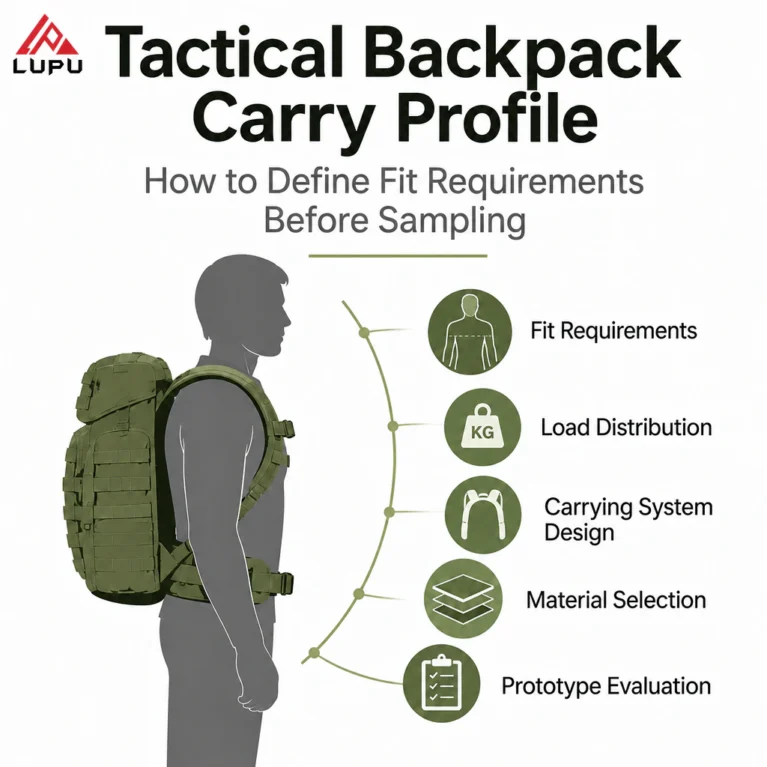
The back panel and suspension structure influence how a backpack carries its load.
Some backpacks use internal frames or structured support systems to help maintain their shape and distribute weight. Others use frameless designs that prioritize flexibility, compact storage, and simpler construction.
An internal frame can help stabilize heavier loads when properly designed and integrated with the shoulder straps and hip belt.
Frameless backpacks may be suitable for lighter or more flexible carrying requirements, depending on their construction.
Other important considerations include:
- Back panel stiffness
- Padding thickness and placement
- Structural support components
- Distance between the load and the user’s back
- Compatibility between the frame and hip belt
A well-designed suspension system should match the intended load and use of the backpack.
3. How Does Backpack Material and Construction Affect Load Capacity?
Material selection and construction methods must work together. A strong fabric cannot compensate for weak attachment points, and reinforced stitching cannot fully compensate for unsuitable materials.
Understanding this relationship is essential when evaluating a tactical backpack.
Comparing Common Tactical Backpack Fabrics
600D and 900D Oxford fabrics, along with 500D and 1000D nylon fabrics, are commonly considered for different tactical and outdoor backpack applications.
Their practical characteristics depend on the specific textile construction.
|
Material |
General Characteristics |
Common Applications |
|
600D Oxford |
Balanced weight and durability |
Everyday backpacks and outdoor bags |
|
900D Oxford |
Heavier fabric construction |
Tactical and utility backpacks |
|
500D Nylon |
Strength-to-weight balance and flexibility |
Tactical and outdoor equipment |
|
1000D Nylon |
Heavy-duty construction and abrasion resistance |
Rugged equipment and demanding applications |
These are general material descriptions, not a universal strength ranking.
For example, a well-constructed 500D nylon backpack may perform better than a poorly manufactured backpack made from a heavier fabric.
When comparing materials, buyers should consider the complete fabric specification, including yarn, weave, coating, finishing, and relevant test results.
The best material is the one that meets the backpack’s actual performance requirements without adding unnecessary weight or cost.
Reinforced Stitching and High-Stress Areas
A backpack experiences different forces depending on how it is carried and how its contents are distributed.
Shoulder strap connections experience repeated pulling forces. Carry handles are subjected to concentrated loads when users lift the backpack by hand. Bottom panels experience pressure and abrasion when the backpack is placed on the ground.
These areas require thoughtful construction.
Common reinforcement approaches include:
- Additional fabric layers at attachment points
- Reinforced stitching at shoulder strap connections
- Bartack stitching at selected stress points
- Strong webbing integrated into the backpack structure
- Reinforced bottom panels
- Suitable stitching patterns for different seam applications
The objective is to distribute forces across a suitable area rather than allowing excessive stress to concentrate at one small connection point.
Zippers, Buckles, Webbing, and MOLLE Components
The backpack’s hardware and attachment components also contribute to overall reliability.
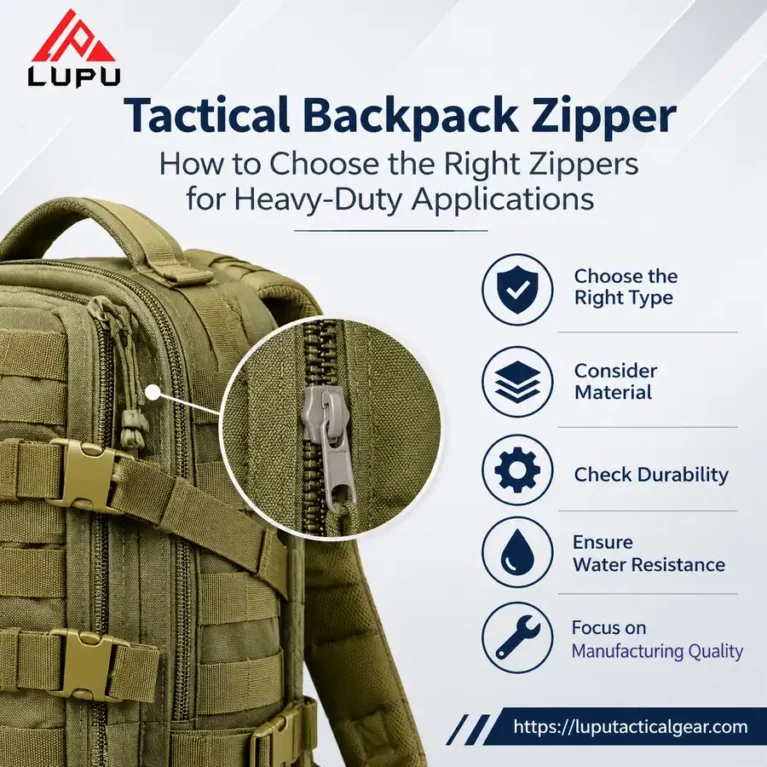
Zippers must function smoothly under normal use. Buckles should connect securely, while webbing should be appropriately integrated into the surrounding fabric.
MOLLE webbing provides modular attachment options for compatible accessories and additional equipment.
However, MOLLE compatibility should not be confused with increased overall load capacity.
External pouches and attached equipment add weight and can change how forces act on the backpack. The strength of the webbing, its attachment stitching, and the backpack’s underlying structure must all be considered.
Similarly, a strong buckle or zipper does not independently establish the carrying capacity of the complete backpack.
Why Manufacturing Quality Matters
Consistent manufacturing quality is essential for producing reliable tactical backpacks.
Important production considerations include:
- Material inspection:Check fabric specifications, surface condition, consistency, and suitability for the intended application.
- Pattern and cutting accuracy:Ensure that panels and reinforcement pieces are prepared according to the product design.
- Sewing consistency:Maintain appropriate stitch quality, seam construction, and thread tension.
- Reinforcement inspection:Pay particular attention to handles, straps, webbing, and other high-stress areas.
- Final quality control:Inspect the finished backpack for construction defects, hardware function, and overall workmanship.
A reliable backpack is the result of a complete manufacturing process, not simply the use of a particular fabric.
4. How Should You Distribute Weight Inside a Tactical Backpack?
Even a well-constructed backpack may feel uncomfortable or unstable if its contents are packed incorrectly.
Proper weight distribution helps improve balance, reduce unnecessary movement, and make equipment easier to access.
Place Heavier Items Close to Your Back
As a general packing principle, heavier items should be positioned close to the back panel and secured so they cannot shift during movement.
Keeping the center of the load close to the body can help reduce the leverage that pulls the backpack backward.
For hiking on uneven terrain, avoid placing heavy objects too high or too far away from the back, as this can make balance more difficult.
The exact arrangement should also account for the backpack’s design, the user’s body shape, and the terrain.
Organize Gear by Weight, Size, and Accessibility
A practical packing system separates equipment according to weight, size, and frequency of use.
Consider the following arrangement:
- Main compartment:Heavier, compact items positioned close to the back panel.
- Middle storage areas:Medium-weight equipment that needs protection and organization.
- Top compartment:Lightweight essentials that may need to be accessed quickly.
- Side pockets:Water bottles and other frequently used items.
- Hip belt pockets:Small essentials such as snacks, keys, or other compact accessories.
Avoid leaving empty spaces that allow heavy equipment to move excessively.
Using suitable organizers or packing bags can help keep contents stable and make it easier to locate specific items.
Secure External Loads Properly
MOLLE webbing and external attachment points can expand a tactical backpack’s storage options.
They allow users to attach compatible pouches and accessories according to their equipment requirements.
However, external attachments should be used thoughtfully.
Excessive external weight can pull the backpack away from the body, affect balance, and place additional stress on webbing and attachment seams.
Always ensure that attached equipment is secure and that the load remains stable during movement.
Avoid Overloading and Uneven Weight Distribution
Overloading can affect both comfort and structural performance.
Common warning signs include:
- Shoulder straps becoming excessively tight or uncomfortable
- Fabric stretching unusually around attachment points
- Visible seam separation
- Buckles or webbing becoming distorted
- The backpack leaning noticeably to one side
- Contents shifting during movement
- Difficulty maintaining a stable walking posture
If these signs appear, reduce the load and inspect the affected areas.
Do not assume that a backpack can safely carry more weight simply because it can physically be filled with additional equipment.
5. How Much Weight Should You Carry for Hiking and Outdoor Activities?
The appropriate carrying weight depends on more than the backpack itself.
Physical fitness, experience, terrain, distance, weather, and the type of equipment required all influence how much weight an individual can comfortably carry.
Match Your Load to the Activity
Different activities require different equipment.
Day hiking: A compact load may include water, food, weather protection, navigation essentials, and basic personal items.
Camping: Overnight equipment can include a sleeping system, shelter, cooking supplies, clothing, and additional food.
Extended outdoor trips: Longer journeys may require more supplies, replacement clothing, and additional equipment, making careful load planning particularly important.
Everyday use: A tactical backpack may carry personal belongings, electronics, documents, and other daily essentials.
The objective is to carry what the activity requires without adding unnecessary equipment.
Consider Your Physical Fitness and Experience
There is no single carrying weight that is suitable for everyone.
A load that feels manageable to an experienced hiker may be uncomfortable for someone who is new to carrying a backpack over long distances.
Consider your physical condition, experience, walking distance, terrain, and the amount of time you expect to carry the backpack.
When preparing for a demanding trip, start with a manageable load and gradually increase it as your fitness and experience develop.
If you experience persistent discomfort, numbness, or unusual pain, stop and reassess your load and backpack fit.
Prioritize Comfort, Stability, and Safety
A suitable backpack should distribute its load in a way that supports comfortable movement.
Adjust the shoulder straps so the backpack sits securely against your back. Use the chest strap to help stabilize the shoulder straps, and adjust the hip belt according to the backpack’s design.
Check that the load does not shift excessively when walking, climbing, or changing direction.
Most importantly, distinguish between a manufacturer’s tested maximum load and the weight you should personally carry.
A backpack’s structural capability does not mean that every user should carry that amount for an extended period.
6. How to Choose a Tactical Backpack for Your Gear Requirements
Choosing the right tactical backpack involves matching its capacity, materials, construction, and carrying system to your intended application.
Instead of focusing on a single specification, evaluate the complete product.
Choose the Right Backpack Capacity
Start by identifying what you need to carry and how long you will be away.
A smaller backpack may be suitable for daily essentials and short outdoor activities. A larger backpack may provide more room for camping equipment, clothing, and additional supplies.
Remember that storage volume and load capacity are separate considerations.
A 45L backpack provides more storage space than a 30L model, but its actual load-bearing capability still depends on its construction and manufacturer recommendations.
Evaluate Materials and Construction Quality
Look beyond the fabric label.
Check:
- Fabric type and specifications
- Seam construction and stitching consistency
- Shoulder strap attachment points
- Reinforced handles and webbing
- Bottom panel construction
- Zipper and buckle quality
- Overall finishing and workmanship
If possible, examine close-up product photographs and manufacturing details rather than relying entirely on general marketing descriptions.
Check the Carrying and Support System
A backpack should fit its intended use.
Consider whether it has:
- Padded shoulder straps
- Adjustable chest straps
- A supportive hip belt, where appropriate
- A suitable back panel
- Reinforced load-bearing connections
- A suspension system compatible with the intended load
Comfort and stability should be considered together with structural strength.
Look for Product-Specific Load Testing
Reliable load recommendations should be based on the performance of the complete backpack.
When evaluating a product, ask the manufacturer whether it has undergone appropriate testing and what conditions were used.
Useful questions include:
- Was the complete backpack tested under a defined load?
- Were shoulder strap connections and handles inspected?
- Were seams and reinforcement areas evaluated?
- Was the backpack checked for deformation or damage after testing?
- Are the recommended loading conditions documented?
Fabric tests, component tests, and complete backpack load tests evaluate different aspects of performance. They should not be treated as interchangeable.
A transparent manufacturer should be able to explain the basis of its product specifications and distinguish verified test results from general design expectations.
7. How Manufacturers Test Tactical Backpack Load Capacity
From a manufacturing perspective, evaluating a backpack’s load-bearing performance requires attention to the complete structure.
A fabric sample test alone cannot establish the load capacity of a finished backpack. The shoulder straps, seams, webbing, handles, bottom panel, and supporting components must also be considered.
A systematic evaluation can include the following stages.
Material and Seam Inspection
Before loading, inspect the fabric, stitching, seams, and reinforcement areas.
Look for inconsistent stitching, damaged fabric, loose threads, and construction defects that may affect performance.
Strap and Attachment Point Evaluation
Pay particular attention to the connections between the shoulder straps and backpack body.
Also inspect the handles, hip belt, MOLLE webbing, and other attachment points.
These areas should be evaluated according to the intended product design and applicable test procedures.
Controlled Load Testing
A controlled load test should use a defined loading procedure and documented conditions.
Depending on the test method, manufacturers may examine:
- Structural deformation
- Seam separation
- Strap attachment performance
- Webbing and buckle condition
- Bottom panel integrity
- Changes in overall functionality
The test load, duration, loading method, and acceptance criteria should be established before testing.
There is an important distinction between a test that evaluates whether a backpack can support a static load and one that examines its performance under repeated movement or dynamic loading.
The results should be recorded accurately and interpreted according to the actual test conditions.
Quality Control and Continuous Improvement
Testing should not end with a pass-or-fail result.
Findings can help manufacturers identify opportunities to improve:
- Material selection
- Pattern design
- Seam construction
- Reinforcement placement
- Shoulder strap attachment methods
- Hardware selection
- Production consistency
This process supports more informed product development and helps manufacturers establish appropriate specifications for different backpack models.
A load recommendation should always be based on relevant evidence rather than assumptions or marketing claims.
Frequently Asked Questions About Tactical Backpack Load Capacity
Does a 45L Tactical Backpack Carry More Weight Than a 30L Backpack?
Not necessarily.
A 45L backpack has greater storage volume, but its load-bearing capability depends on materials, construction, reinforcement, and the carrying system.
A well-designed 30L backpack may support its intended load more effectively than a poorly constructed 45L model.
Is 500D Nylon Strong Enough for a Tactical Backpack?
500D nylon is commonly used in tactical and outdoor equipment because it can offer a practical balance of strength, flexibility, and weight.
However, its suitability depends on the specific fabric construction and intended application.
The finished backpack’s stitching, reinforcement, straps, and overall design are equally important.
Does MOLLE Webbing Increase a Backpack’s Load Capacity?
No, not by itself.
MOLLE webbing provides modular attachment options for compatible accessories and pouches. It can expand storage flexibility, but it does not automatically increase the backpack’s overall load capacity.
The webbing, stitching, attachment points, and underlying backpack structure must all be suitable for the additional equipment.
Can a Tactical Backpack Be Used for Heavy Hiking Loads?
Some tactical backpacks may be suitable for hiking, depending on their suspension system, construction, capacity, and manufacturer load recommendations.
However, not every tactical backpack is designed for heavy hiking loads.
For extended trips, evaluate the back support, shoulder straps, hip belt, load stability, and overall comfort before choosing a model.
How Can I Tell If My Tactical Backpack Is Overloaded?
Common signs include excessive strain around seams, distorted straps, uncomfortable shoulder pressure, unstable movement, and visible deformation.
If any of these occur, reduce the load and inspect the backpack.
Always follow the manufacturer’s recommendations and avoid exceeding the product’s verified limits.
How Do Manufacturers Determine a Backpack’s Recommended Load?
Manufacturers should consider the complete backpack construction, including fabric, stitching, attachment points, straps, hardware, and support structure.
Product-specific testing can help evaluate how these components perform under defined conditions.
The recommended load should reflect the product’s design and relevant test results rather than a general assumption based on its volume or fabric denier.
Conclusion: Choose a Tactical Backpack Built for the Load
Understanding tactical backpack load capacity requires looking beyond the backpack’s size and material specifications.
Fabric selection, stitching quality, reinforcement, shoulder strap construction, back support, and weight distribution all influence how a backpack performs when carrying equipment.
A larger backpack does not automatically support a heavier load, and a higher fabric denier does not guarantee greater overall strength.
For buyers, the best approach is to evaluate the complete construction, understand the intended application, and follow product-specific load recommendations.
For manufacturers, reliable performance begins with appropriate material selection, thoughtful structural design, consistent workmanship, and documented quality control.
At LUPU, we focus on tactical backpack and outdoor bag manufacturing, combining practical product design with material selection and functional construction for different market requirements.
Whether you are developing a new backpack collection, sourcing products for wholesale distribution, or looking for private-label manufacturing, choosing the right manufacturing partner is an important part of building a reliable product line.
Looking for a tactical backpack manufacturer for your next project?
LUPU welcomes wholesale, bulk purchasing, and OEM/ODM inquiries.
Contact our team to discuss your product specifications, material preferences, design requirements, and custom tactical backpack solutions.
Website: www.luputacticalgear.com
LUPU | Tactical Backpack & Outdoor Bag Manufacturer