In today’s competitive tactical equipment market, a professional backpack is no longer defined only by its appearance, storage capacity, or rugged exterior. For military-style equipment brands, outdoor companies, security suppliers, and professional users, a high-performance backpack must deliver reliable functionality, long-term durability, carrying comfort, and adaptability in demanding environments.
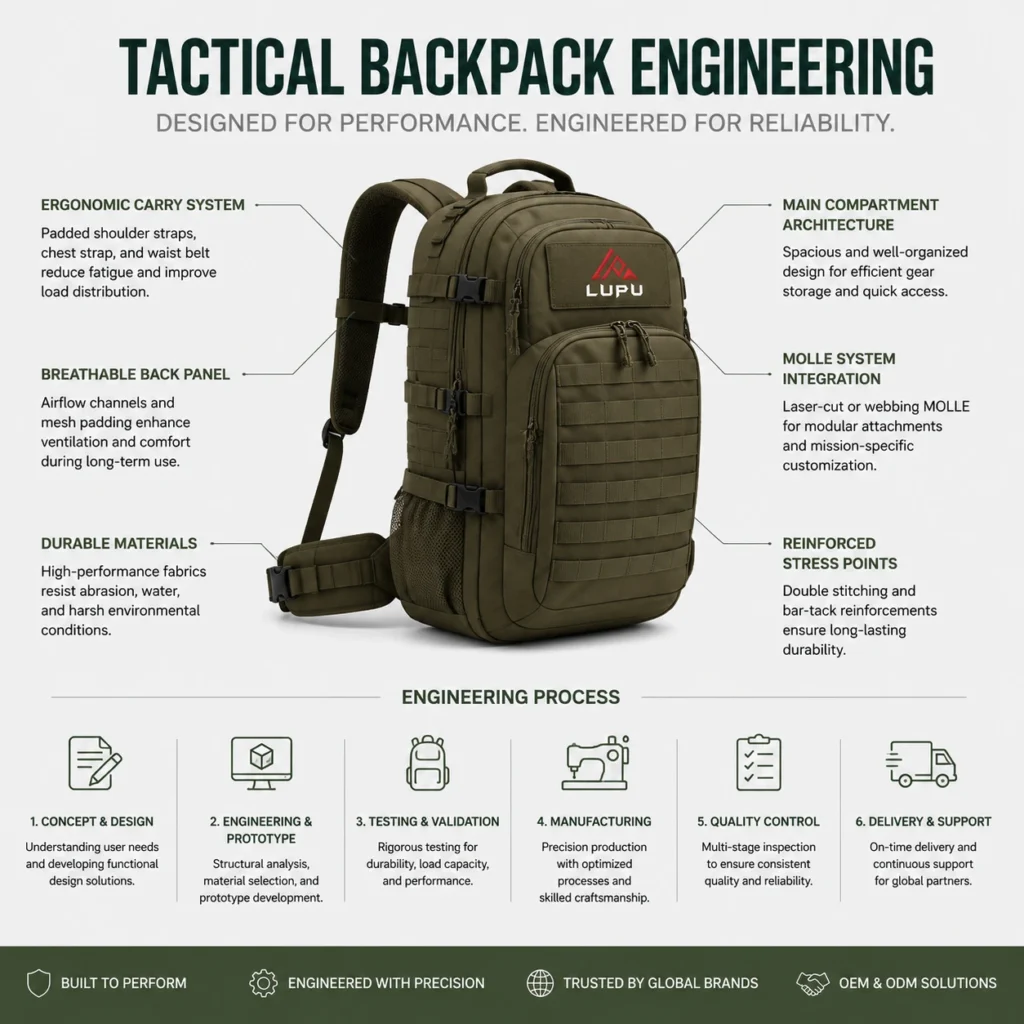
Behind every premium tactical backpack is a complex development process involving structural design, material science, ergonomic research, manufacturing expertise, and quality control. This is where Tactical Backpack Engineering becomes the foundation for creating products that perform consistently under real-world conditions.
For global tactical gear brands and distributors, understanding the engineering principles behind tactical backpacks helps them make better product decisions, select the right manufacturing partners, and develop products with stronger market competitiveness.
What Is Tactical Backpack Engineering?
Tactical Backpack Engineering refers to the systematic process of designing, developing, testing, and manufacturing tactical backpacks with optimized performance, durability, and user functionality.
Unlike standard backpacks designed mainly for everyday carrying, tactical backpacks are engineered for more demanding applications where reliability is critical. These applications may include outdoor exploration, professional equipment transportation, security operations, emergency response, training environments, and specialized commercial markets.
A complete tactical backpack engineering process typically includes:
- Structural design and load analysis
- Material selection
- Ergonomic carrying system development
- Modular attachment system integration
- Reinforcement design
- Component selection
- Prototype testing
- Manufacturing optimization
- Quality inspection
A successful tactical backpack is not created by simply adding MOLLE webbing or using heavy-duty fabric. It requires a complete engineering approach that balances performance, usability, production feasibility, and cost efficiency.
Tactical Backpack Design vs Tactical Backpack Engineering
Many people use the terms “design” and “engineering” interchangeably, but professional manufacturers understand the difference.
Product Design Focuses on Appearance and Function
Tactical backpack design usually focuses on:
- Exterior appearance
- Pocket arrangement
- Color selection
- Brand identity
- User preferences
Design determines how the product looks and how users interact with it.
Engineering Focuses on Performance and Reliability
Tactical backpack engineering focuses on:
- How weight is distributed
- How materials handle stress
- How components work together
- How the product performs after repeated use
- How efficiently it can be manufactured at scale
For brands developing tactical equipment products, engineering capability is often the difference between a backpack that looks professional and one that performs professionally.
Core Principles of Tactical Backpack Engineering
Load Distribution Engineering: Creating Better Carrying Performance
One of the most important aspects of tactical backpack engineering is managing how weight is transferred through the backpack system.
A poorly engineered backpack creates excessive pressure on:
- Shoulders
- Lower back
- Neck area
A professionally engineered tactical backpack distributes weight more effectively through:
- Shoulder strap positioning
- Chest strap adjustment
- Waist belt support
- Back panel structure
- Compression systems
Why Load Distribution Matters?
Professional users often carry equipment for extended periods. Even a small improvement in weight balance can significantly improve comfort and reduce fatigue.
Manufacturers analyze:
- Backpack center of gravity
- Equipment placement
- User movement patterns
- Carrying stability
This engineering approach allows tactical backpacks to maintain better balance during hiking, outdoor activities, and professional applications.
Ergonomic Tactical Backpack Engineering
Comfort is not only about adding more padding. True ergonomic performance comes from the relationship between multiple components.
Breathable Back Panel Design
A professional tactical backpack should provide:
- Air circulation
- Reduced heat buildup
- Improved ventilation
- Better contact support
Engineering solutions may include:
- Mesh materials
- Air channels
- Contoured padding structures
A well-designed back system improves user comfort during long-duration carrying.
Shoulder Strap Engineering
Shoulder straps must balance:
- Strength
- Flexibility
- Comfort
- Adjustment capability
Important engineering considerations include:
- Strap width
- Padding density
- Attachment reinforcement
- Adjustment range
For large-capacity tactical backpacks, shoulder strap engineering is especially important because heavy loads create greater stress on connection points.
Chest Strap and Waist Belt Systems
Additional support systems help stabilize the backpack.
Chest straps improve:
- Upper body stability
- Load control
- Movement efficiency
Waist belts help:
- Transfer weight from shoulders
- Improve balance
- Reduce pressure during extended carrying
These features are essential components of professional tactical backpack engineering.
Structural Engineering Behind Durable Tactical Backpacks
A tactical backpack must survive repeated use, environmental exposure, and heavy loading. Structural engineering determines how well the backpack performs over time.
Main Compartment Architecture
Storage design is a critical engineering consideration.
Professional tactical backpacks often include:
- Large main compartments
- Secondary storage areas
- Quick-access pockets
- Internal organization systems
The challenge is not simply adding more compartments. Poor compartment design can create:
- Uneven weight distribution
- Difficult access
- Reduced carrying efficiency
Experienced manufacturers consider:
- User workflow
- Equipment size
- Accessibility requirements
- Weight positioning
MOLLE System Engineering
The MOLLE system has become one of the most recognizable features of tactical equipment.
However, effective MOLLE integration requires precise engineering.
A professional MOLLE tactical backpack must consider:
- Webbing spacing
- Attachment strength
- Reinforcement areas
- Additional weight impact
Modern tactical backpack manufacturers also use laser-cut MOLLE systems to achieve:
- Reduced weight
- Cleaner appearance
- Improved modular flexibility
MOLLE design is not simply a visual feature. It is a functional system that requires engineering accuracy.
Reinforcement Engineering: Protecting High-Stress Areas
Certain areas of a tactical backpack experience significantly higher stress:
- Shoulder strap attachment points
- Carry handles
- Bottom panels
- Side compression areas
- Zipper zones
Professional manufacturing methods include:
- Reinforced stitching
- Double-layer fabric construction
- Bar-tack reinforcement
- Additional stress panels
These engineering solutions improve durability and reduce product failure risks.
Material Engineering in Tactical Backpack Manufacturing
Material selection directly affects product performance, lifespan, and market positioning.
A professional tactical backpack manufacturer evaluates materials based on:
- Abrasion resistance
- Weight
- Water resistance
- Tensile strength
- Cost efficiency
Choosing Tactical Backpack Fabrics
1000D Cordura Fabric
1000D Cordura is widely recognized for demanding tactical applications.
Advantages include:
- Excellent abrasion resistance
- High durability
- Professional appearance
- Long service life
It is often selected for premium tactical backpacks designed for heavy-duty applications.
Nylon Fabrics
Nylon remains one of the most common tactical backpack materials due to its balance of:
- Strength
- Flexibility
- Weight efficiency
Different denier levels allow manufacturers to optimize products for different markets.
Oxford Fabric Applications
900D Oxford and similar Oxford fabrics provide:
- Good durability
- Cost efficiency
- Attractive appearance
They are commonly used for commercial tactical backpacks, outdoor products, and customized brand solutions.
Waterproof and Weather Resistance Engineering
A common misconception is that waterproof performance depends only on fabric.
In reality, waterproof tactical backpack engineering involves multiple factors:
- Fabric coating
- Seam construction
- Zipper selection
- Manufacturing techniques
A professional manufacturer evaluates the complete product system rather than a single material component.
Manufacturing Engineering: Turning Concepts Into Products
Great product ideas require manufacturing expertise to become reliable commercial products.
Prototype Development Process
Professional tactical backpack development usually includes:
Step 1: Concept Review
The manufacturer evaluates:
- Product purpose
- Target market
- Required features
Step 2: Technical Development
Engineers create:
- Product specifications
- Material plans
- Structural solutions
Step 3: Prototype Production
Samples are developed for:
- Function testing
- Appearance evaluation
- User feedback
Step 4: Production Optimization
Before mass production, manufacturers improve:
- Manufacturing efficiency
- Cost control
- Quality consistency
Quality Control in Tactical Backpack Engineering
Quality control is a critical part of professional manufacturing.
A reliable tactical backpack manufacturer evaluates:
Material Inspection
Checking:
- Fabric quality
- Color consistency
- Material performance
Production Inspection
Monitoring:
- Stitching quality
- Component installation
- Assembly accuracy
Final Product Inspection
Testing:
- Functionality
- Appearance
- Packaging quality
Strong quality systems help brands maintain consistent product standards across large-volume orders.
Tactical Backpack Engineering for OEM and ODM Development
For brands entering the tactical equipment market, working with an experienced manufacturer provides significant advantages.
A professional OEM/ODM partner can support:
- Product concept development
- Custom tactical backpack design
- Material selection
- Prototype creation
- Mass production
- Packaging solutions
Customization Options
Brands can customize:
- Fabric selection
- Colors
- Logo branding
- Pocket configuration
- MOLLE layout
- Hardware components
- Packaging design
This allows companies to create differentiated products instead of competing only on price.
How to Choose a Tactical Backpack Manufacturer
When selecting a manufacturing partner, businesses should evaluate:
Engineering Capability
Does the manufacturer understand:
- Structural design?
- Material performance?
- Product optimization?
Production Experience
Consider:
- Factory capability
- Manufacturing processes
- Quality systems
Custom Development Ability
A strong partner should support:
- Prototype development
- Design improvements
- Production scaling
Supply Chain Reliability
Global buyers should look for manufacturers with:
- Stable material sourcing
- Export experience
- Consistent delivery performance
Future Trends in Tactical Backpack Engineering
The tactical equipment industry continues to evolve.
Future development trends include:
Lightweight Tactical Systems
Brands are increasingly seeking:
- Lower weight
- Higher strength
- Improved mobility
Advanced Modular Solutions
Future tactical backpacks will continue improving:
- Adaptability
- Custom attachment systems
- User-specific configurations
Sustainable Materials
More tactical gear manufacturers are exploring:
- Recycled fabrics
- Responsible production methods
- Environmentally conscious solutions
Advanced Manufacturing Technology
Technologies such as:
- Laser cutting
- Digital pattern development
- Automated inspection
will continue improving production efficiency and product consistency.
Conclusion: Engineering Creates Competitive Tactical Backpack Products
Tactical Backpack Engineering is the foundation behind every reliable, high-performance tactical backpack.
From ergonomic carrying systems and structural reinforcement to advanced materials and manufacturing control, every detail influences the final product’s performance and market value.
For tactical gear brands, distributors, and professional equipment companies, choosing a manufacturer with strong engineering capabilities is essential for developing products that meet customer expectations and succeed in competitive markets.
LUPU Tactical Gear combines professional design expertise, manufacturing experience, and OEM/ODM capabilities to help global brands develop reliable tactical backpacks and specialized equipment solutions.
Whether you need a custom tactical backpack, MOLLE backpack, or complete tactical gear product line, our experienced team can support your project from concept development to mass production.
Looking for a reliable tactical backpack manufacturing partner?
Contact LUPU Tactical Gear:
📩 Email: info@luputacticalgear.com