 A tactical backpack is not simply a container for equipment. For professionals who spend long hours carrying, accessing, and moving with essential gear, it is part of the load-carriage system that directly influences organization, mobility, fatigue, and operational efficiency.
That distinction becomes particularly important when equipment requirements change from one task to another.
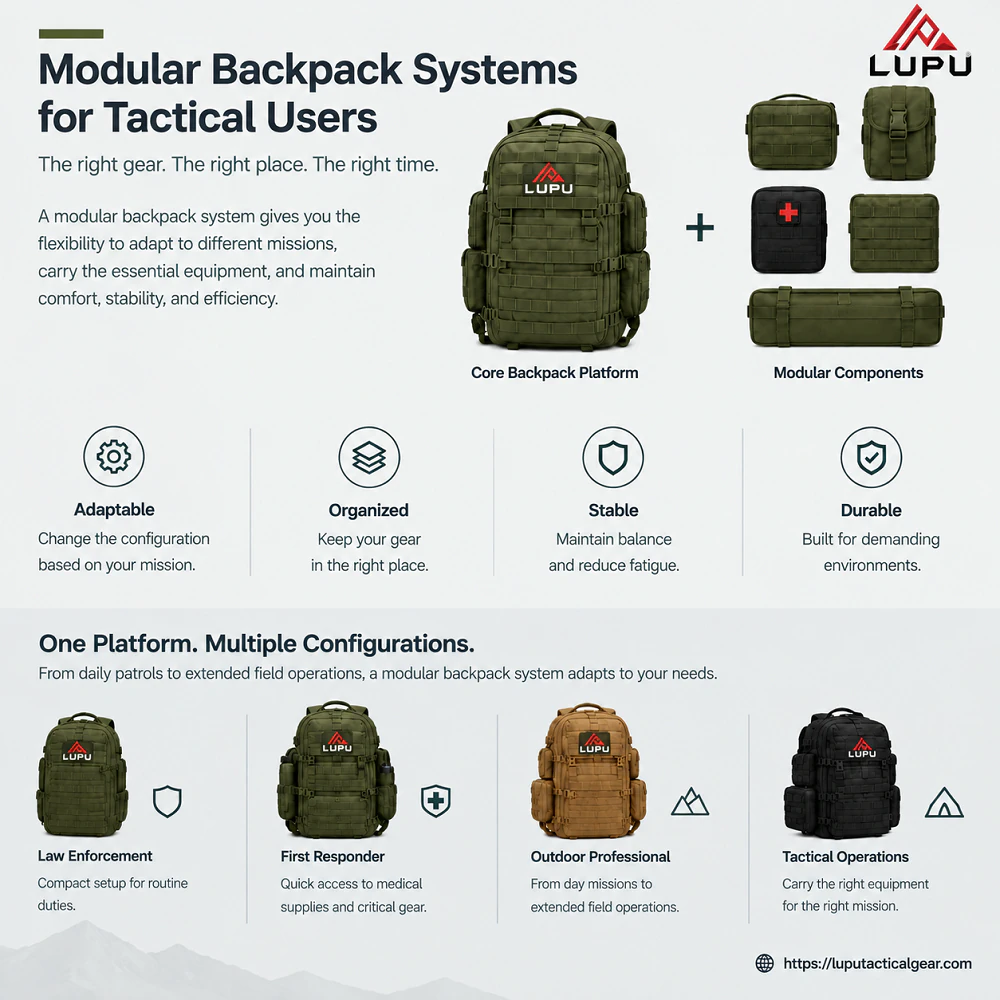
A law-enforcement professional may need a compact configuration for routine duties but additional medical, communications, or sustainment equipment for a longer assignment. A first responder may need rapid access to medical supplies in one environment and additional protective equipment in another. An outdoor professional may alternate between lightweight day missions and extended field operations.
A fixed backpack configuration cannot always accommodate these changing requirements efficiently.
This is where a modular backpack system has a significant advantage.
Rather than treating the backpack as a fixed piece of luggage, a modular system treats it as an adaptable load-management platform. The base pack provides the structural foundation, while compatible pouches, organizers, attachment panels, and other components allow the configuration to evolve according to the user’s requirements.
However, true modularity is frequently misunderstood.
A backpack covered with attachment webbing is not automatically a good modular backpack. More pouches do not necessarily create a better loadout. And maximum carrying capacity is rarely the same thing as maximum usefulness.
From a professional load-carriage perspective, the real value of modularity lies in controlled adaptability: carrying the right equipment, in the right location, at an appropriate weight, while maintaining comfort, accessibility, stability, and durability.
What Is a Modular Backpack System?
A modular backpack system is a backpack architecture designed to allow its storage and carrying configuration to be changed without replacing the entire pack.
At its most basic level, it normally consists of three elements:
- A core backpack platform
- An attachment or expansion interface
- Compatible modular components
Those components can include removable pouches, accessory panels, organizers, compression elements, or other compatible storage modules.
The important point is that modularity is a system-level design philosophy rather than a single feature.
Modularity Does Not Simply Mean “More Pouches“
This is one of the most common misconceptions in the tactical backpack market.
A backpack can have extensive MOLLE-style webbing and still have poor modularity.
Why?
Because effective modularity depends on how the attachment architecture interacts with the rest of the backpack.
Consider several questions:
- Are the attachment points positioned where they are actually useful?
- Can pouches be installed without interfering with zippers?
- Does additional equipment create excessive bulk?
- Can the load remain stable while moving?
- Are attachment points structurally reinforced?
- Can the user still access the main compartment efficiently?
- Does the configuration remain comfortable when fully loaded?
If the answer to these questions is no, additional attachment capacity becomes little more than decorative real estate.
From an engineering perspective, modularity should increase useful configuration options without creating unnecessary complexity.
That is the standard by which a professional modular backpack should be judged.
Modular Backpack vs. Traditional Backpack
A traditional backpack typically has a predetermined internal and external organization structure. That can be perfectly adequate when the user’s equipment requirements remain consistent.
A modular backpack system takes a different approach.
The basic platform remains consistent, while the external and organizational architecture can change.
This distinction becomes valuable when the user operates across multiple environments or task profiles.
The objective is not to make one backpack perform every imaginable function. The objective is to make one well-designed platform adaptable enough to cover a realistic range of requirements.
Why Tactical Users Need Mission-Specific Configuration?
The first principle of professional load carriage is simple:
The load should be built around the task—not the other way around.
Different missions require different equipment, and therefore different configurations.
A short-duration assignment may require only essential equipment and a compact load. A longer field task may require additional clothing, hydration, food, communications equipment, medical supplies, navigation tools, or other sustainment items.
Trying to use one fixed configuration for all of these situations creates two predictable problems.
The pack is either:
- too small when additional equipment is required, or
- unnecessarily large and overloaded when that equipment is not required.
Neither is ideal.
Different Missions Demand Different Loads
The same user can have dramatically different equipment requirements depending on:
- mission duration
- operating environment
- weather conditions
- expected mobility
- equipment volume
- accessibility requirements
- transportation method
- resupply availability
This is why experienced users rarely think about a backpack solely in terms of liters.
Capacity is only one variable.
A 30-liter pack that is intelligently organized and correctly configured can be more effective than a significantly larger backpack loaded with unnecessary equipment.
The key question is not:
“How much can this backpack carry?“
It is:
“How effectively can this backpack carry what I actually need?“
Configure for the Mission, Not the Maximum Possible Load
Modular architecture makes it possible to change the pack according to the task.
A user may remove external pouches when operating in a space-constrained environment, add organizational capacity when more equipment must be separated, or simplify the configuration when mobility and low bulk are more important.
This creates a useful distinction between capacity and configuration.
Capacity describes how much the pack can theoretically hold.
Configuration describes how intelligently that capacity is used.
For professional users, the second factor is often more important.
How Modular Backpack Systems Improve Load Management?
Load management is where modular backpack design moves beyond simple organization and becomes a serious piece of equipment engineering.
The human body does not experience backpack capacity in liters. It experiences:
- weight
- pressure
- leverage
- movement
- heat
- instability
- fatigue
A well-designed modular backpack system should therefore be evaluated according to how effectively it manages these factors.
Load Distribution Matters More Than Raw Capacity
The same total weight can feel dramatically different depending on where it is positioned.
Poorly distributed equipment can increase the leverage acting on the shoulders and back. It can also cause the pack to move independently from the user’s body, increasing instability during movement.
A professional load carriage system attempts to keep the load:
- balanced
- stable
- close to the user’s body
- appropriately compressed
- distributed according to the pack’s harness design
This is why simply adding more external tactical pouches is not necessarily an improvement.
External components increase configuration options, but they also move some of the load farther from the user’s center of gravity.
That can increase the mechanical demand placed on the wearer.
Keep Dense Equipment Close to the Body
As a general load-management principle, dense equipment should be positioned deliberately rather than randomly distributed throughout the pack.
When heavier items sit excessively far from the user’s back, they create greater leverage.
The result can be:
- increased shoulder pressure
- greater pack movement
- reduced stability
- accelerated fatigue
A good modular architecture should therefore allow the user to place equipment where it supports efficient load transfer rather than simply where there happens to be available space.
This is one reason internal compartment design remains just as important as external modularity.
External Pouches Are a Tool, Not a Requirement
External pouches are useful when they solve a specific organizational or accessibility problem.
They can be particularly valuable for separating equipment categories and keeping selected items outside the main compartment.
But every external component should justify its presence.
Ask:
Does this pouch improve access, organization, capacity, or configuration enough to justify its additional weight and bulk?
If not, it may be unnecessary.
This leads to an important professional principle:
Modularity should create options, not obligations.
Accessibility: Putting Critical Gear Where It Can Actually Be Reached
A backpack can have excellent capacity and still perform poorly if the user cannot efficiently reach the equipment inside it.
Organization is therefore inseparable from accessibility.
Not Every Item Belongs in the Main Compartment
A practical modular configuration should distinguish between different categories of equipment.
Immediate-Access Equipment
These are items that may need to be reached frequently or quickly.
They should not be buried beneath the entire load.
Secondary Equipment
These items are important but do not necessarily require immediate access. They can occupy dedicated compartments or modular pouches.
Reserve Equipment
Less frequently accessed equipment can remain deeper inside the main compartment.
This creates a hierarchy rather than a random collection of pockets.
Layered Accessibility
A useful way to evaluate backpack organization is to think in three layers:
Layer 1 — Immediate Access
Frequently accessed equipment.
Layer 2 — Secondary Access
Task-specific equipment that should remain organized and relatively accessible.
Layer 3 — Main Load
Bulkier or less frequently accessed equipment.
This approach reduces unnecessary searching and repacking.
A modular backpack system can support this hierarchy because the user can relocate organizational components as requirements change.
The result is not simply a more organized backpack.
It is a more predictable one.
And predictability is an underrated characteristic of professional equipment.
Adaptability Across Different Environments
One of the strongest arguments for modularity is environmental adaptability.
The ideal configuration for an urban environment may not be ideal for a remote field environment.
The equipment requirements, physical constraints, and desired pack profile can all change.
Urban Environments
Urban users may prioritize:
- compactness
- organization
- accessibility
- reduced external bulk
- compatibility with transportation
- lower snag potential
In these circumstances, excessive external equipment can become a disadvantage.
A modular system allows the user to remove components that are not needed.
Field and Outdoor Environments
Outdoor and field environments can create different requirements.
Users may need additional space for:
- hydration
- clothing layers
- navigation equipment
- food
- weather protection
- field-support equipment
A modular architecture can provide additional organization or expansion without requiring the user to maintain an entirely separate platform for every scenario.
Extended Operations
As duration increases, equipment requirements generally become more complex.
The challenge is not simply adding more storage.
It is maintaining an effective balance between:
capacity + accessibility + weight + stability + comfort
A backpack that can hold additional equipment but becomes unstable or excessively uncomfortable when expanded is not necessarily a successful design.
Modularity Can Improve Long-Term Equipment Economics
The financial value of a modular backpack system is often overlooked. A professional user does not evaluate equipment only by its purchase price, but by how effectively the system adapts as requirements evolve over time.
The more meaningful question is:
How useful will this equipment remain as requirements change?
Replace the Component, Not the Entire System
One of the potential advantages of a modular platform is component-level replacement.
If a particular pouch becomes worn or the user’s organizational requirements change, it may be possible to replace or modify that component without replacing the entire backpack.
This can extend the useful life of the core platform.
Reducing Equipment Redundancy
Without modularity, users may accumulate multiple backpacks:
- one for daily use
- one for field work
- one for extended loads
- one for specialized equipment
A modular platform cannot eliminate the need for specialized packs in every situation, but it can reduce unnecessary duplication where requirements overlap.
That creates a potentially more efficient equipment ecosystem.
Lifecycle Value vs. Initial Price
A cheap backpack that must be replaced whenever requirements change may ultimately cost more than a durable platform that can evolve over time.
For serious users, lifecycle value should therefore include:
- durability
- repairability
- component availability
- compatibility
- configuration flexibility
- long-term support
This is a much more meaningful evaluation than simply comparing retail prices.
Durability: Modularity Must Not Compromise Structural Integrity
This is where many modular backpack discussions become too superficial.
Adding attachment capability creates additional interfaces.
Those interfaces become potential stress points.
A serious modular backpack must therefore be engineered around structural integrity—not simply accessory compatibility.
Attachment Points Are Structural Components
External webbing, loops, buckles, and attachment panels can experience repeated loading and dynamic forces.
A well-designed system should consider:
- stitching quality
- reinforcement
- webbing construction
- stress concentration
- seam strength
- hardware durability
The attachment interface should be treated as part of the load-bearing architecture.
Fabric Selection Matters
Material selection should be evaluated according to the intended application rather than through simplistic claims that one fabric is universally superior.
Relevant considerations include:
- denier
- weave construction
- abrasion resistance
- tear resistance
- coating
- environmental exposure
- weight
- flexibility
A material optimized purely for low weight may not provide the same durability as a heavier construction.
Conversely, maximum fabric weight does not automatically create a superior backpack.
The correct question is:
Is the material appropriate for the expected load, environment, and service life?
Stitching and Stress Points
High-quality construction should pay particular attention to areas where loads concentrate.
These may include:
shoulder-strap attachment points
carry handles
modular attachment zones
compression points
bottom panels
major seams
A modular backpack system is only as reliable as the structural architecture supporting its modular components.
MOLLE and Other Attachment Interfaces: What Users Should Understand
MOLLE-compatible architecture has become closely associated with tactical backpacks, but users should understand what it does—and what it does not do.
What MOLLE Compatibility Provides
A MOLLE-style interface can provide a standardized method for attaching compatible pouches and accessories.
Its primary value is flexibility.
Users can potentially modify:
- storage capacity
- equipment organization
- external accessibility
- configuration layout
However, compatibility is only the beginning.
Compatibility Is Not the Same as Usability
A backpack can technically accept a large number of accessories while still being poorly designed.
For example:
- attachment points may interfere with zippers
- pouches may overlap access areas
- external loading may create excessive bulk
- poorly positioned accessories may make the pack uncomfortable
- additional weight may exceed what the harness can comfortably support
Therefore, modularity should always be evaluated at the system level.
Avoid the “MOLLE Everywhere“ Trap
More attachment webbing is not automatically better.
Every additional interface adds:
- weight
- manufacturing complexity
- potential snag points
- visual and physical bulk
The objective should be useful modularity, not maximum webbing coverage.
This is a critical distinction between tactical styling and serious load-carriage engineering.
Ergonomics: Modularity Must Work With the Human Body
The backpack ultimately interacts with one complex piece of equipment that cannot be replaced:
the human body.
No modular architecture can compensate for fundamentally poor ergonomics.
Shoulder and Back Comfort
A professional backpack should be evaluated according to:
- shoulder strap geometry
- padding
- back-panel construction
- ventilation
- adjustability
- torso compatibility
Comfort is not merely a luxury.
For extended carrying, discomfort can change how a user moves and how effectively they manage the load.
Stability During Movement
A properly configured backpack should remain relatively stable during normal movement.
Excessive movement can occur when:
- the load is poorly distributed
- the pack is under-compressed
- external pouches are heavily loaded
- the harness is incorrectly adjusted
A modular configuration therefore needs to be tested after every significant modification.
Adjustability Is Also Part of Modularity
True adaptability is not limited to external pouches.
It also includes the carrying system itself.
Depending on the backpack design, relevant features may include:
- adjustable shoulder straps
- sternum straps
- compression systems
- load-management adjustments
- hip-belt systems
- adjustable torso architecture
The more configurable the load, the more important proper fit becomes.
Weight Discipline: Modularity Should Not Become “Accessory Creep“
Here is one of the paradoxes of modular equipment:
The more configurable the system becomes, the easier it is to overconfigure.
Users naturally tend to add components because the attachment system makes them available.
One pouch becomes two.
Two become four.
Soon, the backpack carries equipment that has not been used for months.
This phenomenon can be described as accessory creep.
Why Accessory Creep Matters?
Every component adds something:
- weight
- bulk
- complexity
- potential snag points
The result can be a backpack that is technically highly capable but practically inefficient.
This is why experienced users regularly conduct configuration audits.
The Configuration Audit
Before a major use, ask:
- What equipment is actually required?
- What needs to be accessed most frequently?
- What can remain inside the main compartment?
- Which external components are unnecessary?
- Has the configuration become heavier than the task requires?
The objective is not maximum equipment.
It is minimum unnecessary equipment.
That distinction separates disciplined load management from simple gear accumulation.
How to Build an Effective Modular Backpack Configuration
A modular backpack should be configured systematically rather than assembled randomly. Building an effective modular backpack system requires a structured approach that begins with understanding the user’s mission requirements, equipment priorities, and carrying expectations.
Step 1: Define the Mission
Start with the task.
Consider:
- duration
- environment
- equipment requirements
- expected movement
- weather
- transportation constraints
Step 2: Establish the Base Load
Identify essential equipment first.
Do not begin by filling every pouch.
The base load defines the actual requirements of the backpack.
Step 3: Prioritize Accessibility
Determine which equipment should be immediately accessible and which can remain inside the main compartment.
Step 4: Balance the Load
Evaluate:
- left-to-right balance
- vertical distribution
- center of gravity
- external vs. internal loading
Step 5: Add Only Relevant Modules
Every additional pouch or accessory should have a clear purpose.
If the purpose is unclear, the component probably does not belong in the configuration.
Step 6: Test the Configuration
Do not evaluate a backpack only while it is sitting on a table.
Evaluate it while:
- walking
- bending
- climbing
- entering and exiting vehicles
- accessing compartments
- adjusting the harness
The goal is to discover interaction problems that are invisible during static inspection.
Step 7: Reconfigure as Requirements Change
A modular backpack should evolve with the user.
The configuration used six months ago may not be the most efficient configuration today.
What to Look for When Choosing a Modular Backpack System?
When evaluating a modular backpack system, look beyond appearance and attachment count.
1. Base Pack Construction
Inspect:
- fabric
- stitching
- seams
- zippers
- buckles
- reinforcement
- handle construction
The core backpack must be strong enough to support the intended configuration.
2. Modular Interface
Evaluate:
- attachment compatibility
- placement
- reinforcement
- spacing
- accessory ecosystem
The question is not how many accessories can technically be attached.
The question is whether those accessories can be used effectively.
3. Carrying System
Look at:
- adjustability
- shoulder strap design
- back-panel structure
- ventilation
- load stability
- torso compatibility
4. Internal Organization
External modularity receives most of the attention, but internal architecture is equally important.
Consider:
- compartment layout
- administrative organization
- hydration compatibility
- protective storage
- access pathways
5. External Profile
Evaluate the pack after adding the components you actually intend to use.
Look for:
- excessive bulk
- snag potential
- interference between components
- unstable external loads
6. Serviceability
Long-term value depends partly on whether the system can be maintained.
Consider:
- replaceable components
- repairability
- accessory availability
- hardware replacement
- long-term compatibility
A tactical backpack should be viewed as equipment with a service life, not disposable luggage.
Common Mistakes Tactical Users Make With Modular Backpacks
Mistake 1: Buying Based Only on Maximum Capacity
A large capacity can appear attractive, but unused volume frequently becomes an invitation to carry unnecessary equipment.
Better approach: Select capacity according to realistic requirements.
Mistake 2: Assuming More MOLLE Equals Better Design
Attachment quantity is only one component of modularity.
Better approach: Evaluate placement, structural integrity, accessibility, and ergonomics.
Mistake 3: Ignoring Weight Distribution
A perfectly organized collection of equipment can still create an inefficient load if weight is positioned poorly.
Better approach: Evaluate the complete loaded system rather than individual compartments.
Mistake 4: Overloading External Pouches
External expansion can increase accessibility but also increases profile and leverage.
Better approach: Use external pouches selectively.
Mistake 5: Choosing Accessories Before Choosing the Base Pack
A modular ecosystem is only useful when the base platform provides adequate structural and ergonomic support.
Better approach: Select the foundation first, then build the accessory configuration around it.
Mistake 6: Never Reconfiguring the Pack
A static configuration defeats much of the purpose of modularity.
Better approach: Periodically reassess the configuration according to actual use.
Modular Backpack System vs. Multiple Specialized Backpacks
The comparison between modular and fixed backpacks should not be reduced to “modular is always better.”
There are situations where a dedicated backpack remains the more appropriate solution.
For example, a highly specialized application may justify a purpose-built configuration that does one job exceptionally well.
However, users with changing requirements may benefit from a modular architecture.
|
Consideration |
Modular Backpack System |
Multiple Fixed Packs |
|
Configuration flexibility |
High |
Limited |
|
Equipment reuse |
High |
Lower |
|
Adaptability |
High |
Moderate |
|
Initial simplicity |
Moderate |
High |
|
Accessory ecosystem |
Important |
Less important |
|
Equipment redundancy |
Potentially lower |
Potentially higher |
|
Configuration learning curve |
Moderate |
Lower |
The important conclusion is not that every user should abandon specialized packs.
It is that modularity becomes particularly valuable when requirements change frequently.
The more variable the user’s equipment profile, the greater the potential value of an adaptable platform.
The Future of Modular Tactical Backpack Design
The next generation of tactical backpacks is unlikely to be defined simply by adding more attachment webbing.
The more important trend is integration.
Future development is likely to focus on the relationship between:
material efficiency + load transfer + modularity + ergonomics + durability
Potential development areas include:
- lighter structural materials
- more efficient load-transfer systems
- lower-profile attachment interfaces
- improved back-panel ergonomics
- better internal organization
- enhanced weather resistance
- more standardized component compatibility
- repairable and replaceable modular components
This suggests an important shift in design philosophy.
The tactical backpack of the future should not simply be viewed as:
“a backpack with MOLLE.”
It is better understood as:
“an adaptable load-management platform.”
That distinction matters.
The former emphasizes attachment capacity.
The latter emphasizes the relationship between the user, the equipment, and the task.
Conclusion: The Real Value of a Modular Backpack System
The importance of a modular backpack system is not that it allows users to attach more equipment.
Its real value is that it allows users to make better decisions about the equipment they carry.
A well-designed modular system can provide greater flexibility in:
- capacity
- organization
- accessibility
- load distribution
- environmental adaptation
- equipment lifecycle
- long-term configuration
But modularity must be disciplined.
A backpack overloaded with accessories is not necessarily more capable. A pack covered with attachment webbing is not necessarily better engineered. And the largest possible capacity is not necessarily the most useful capacity.
From a professional load-carriage perspective, the strongest modular backpack is the one that creates meaningful configuration choices without sacrificing structural integrity, ergonomics, stability, or weight discipline.
The fundamental principle is therefore straightforward:
The best modular backpack system is not the one that carries the most. It is the one that adapts most intelligently to the user’s requirements.
For tactical users, that distinction can determine whether a backpack is merely a piece of gear—or a genuinely effective part of a complete load-management system.
Build a Tactical Backpack Around Your Mission
Every mission has different requirements. Our custom tactical backpack solutions let you choose the capacity, compartments, materials, and modular features that fit your specific needs.
Configure your pack. Carry with purpose.