The tactical backpack industry has a strange obsession with extremes.
Consumers are constantly told that:
- heavier equals tougher,
- thicker equals better,
- and “military-grade”automatically means superior.
That mindset helped turn Cordura 1000D into a kind of mythological benchmark inside tactical gear culture. For years, backpack brands marketed 1000D nylon as the ultimate proof of ruggedness, while 500D was often framed as a compromise.
But real-world load carriage tells a far more complicated story.
Because once a backpack leaves product photography and enters sustained movement — hiking, vehicle operations, travel, patrol work, search and rescue, or daily carry — fabric performance becomes less about brute durability and more about system efficiency.
And that is where the entire 500D vs 1000D Cordura debate becomes genuinely important.
The question is no longer:
“Which fabric is tougher?”
The real question is:
“Which fabric performs better for the way humans actually move?”
The answer depends on biomechanics, fatigue management, environmental exposure, mission profile, and long-duration comfort — not internet mythology.
This article breaks down the real differences between 500D and 1000D Cordura from an operational perspective, including:
- durability,
- weight,
- mobility,
- abrasion resistance,
- EDC practicality,
- military applications,
- thermal performance,
- and modern tactical backpack engineering.
Understanding Cordura Beyond Marketing
What Is Cordura Fabric?
Cordura is not a single fabric.
It is a family of performance textiles engineered primarily around:
- abrasion resistance,
- tear strength,
- long-term wear durability,
- and heavy-use reliability.
Originally developed for military and industrial applications, Cordura became dominant in tactical backpack manufacturing because it solved a specific problem:
repeated abuse under load.
Unlike ordinary nylon, Cordura fabrics are engineered using high-tenacity yarn structures and specialized weaving techniques that improve resistance to:
- friction,
- tearing,
- punctures,
- and long-term material fatigue.
Over time, Cordura evolved into a branding shorthand for “rugged gear,” especially inside military and tactical communities.
But this created a major misunderstanding:
many consumers now treat denier numbers as the sole indicator of quality.
That is inaccurate.
What Does “500D“ e “1000D“ Actually Mean?
The “D” stands for denier.
Denier measures the weight of yarn fibers:
- higher denier = thicker yarn,
- lower denier = thinner yarn.
In simple terms:
- 500D Cordura uses lighter yarns,
- 1000D Cordura uses heavier yarns.
But this is where marketing oversimplifies reality.
Denier alone does NOT determine:
- total durability,
- real-world longevity,
- backpack comfort,
- or overall performance.
Because backpack performance depends on an entire system:
- fabric weave,
- coatings,
- stitching quality,
- pattern engineering,
- reinforcement placement,
- frame architecture,
- hardware quality,
- and load distribution.
A poorly engineered 1000D backpack can perform worse than a well-designed 500D system.
Physics still matters more than aesthetics.
500D vs 1000D Cordura: The Core Difference
At the highest level:
|
Caratteristica |
500D Cordura |
Cordura 1000D |
|
Peso |
Lighter |
Heavier |
|
Flexibility |
Higher |
Lower |
|
Abrasion Resistance |
Excellent |
Extreme |
|
Water Retention |
Lower |
Higher |
|
Drying Speed |
Faster |
Slower |
|
Comfort During Movement |
Better |
More rigid |
|
Structural Rigidity |
Moderato |
Higher |
|
Heat Retention |
Lower |
Higher |
|
Urban EDC Suitability |
Excellent |
Often excessive |
|
Heavy Dragging Environments |
Moderato |
Superior |
The important insight is this:
1000D is not automatically “better.”
It is simply optimized for different priorities.
Is 500D Cordura Durable Enough?
This is one of the most common misconceptions in tactical gear culture.
The short answer is:
Yes — for most users, 500D Cordura is absolutely durable enough.
In fact, many people dramatically overestimate the level of abuse their backpacks will actually experience.
Most real-world users are not:
- dragging packs across concrete daily,
- crawling through rock fields,
- conducting military breaching operations,
- or hauling overloaded combat equipment continuously.
Instead, most tactical backpack users operate in:
- urban environments,
- travel scenarios,
- EDC setups,
- vehicle-based movement,
- range use,
- hiking,
- or moderate outdoor conditions.
In these environments, 500D performs exceptionally well.
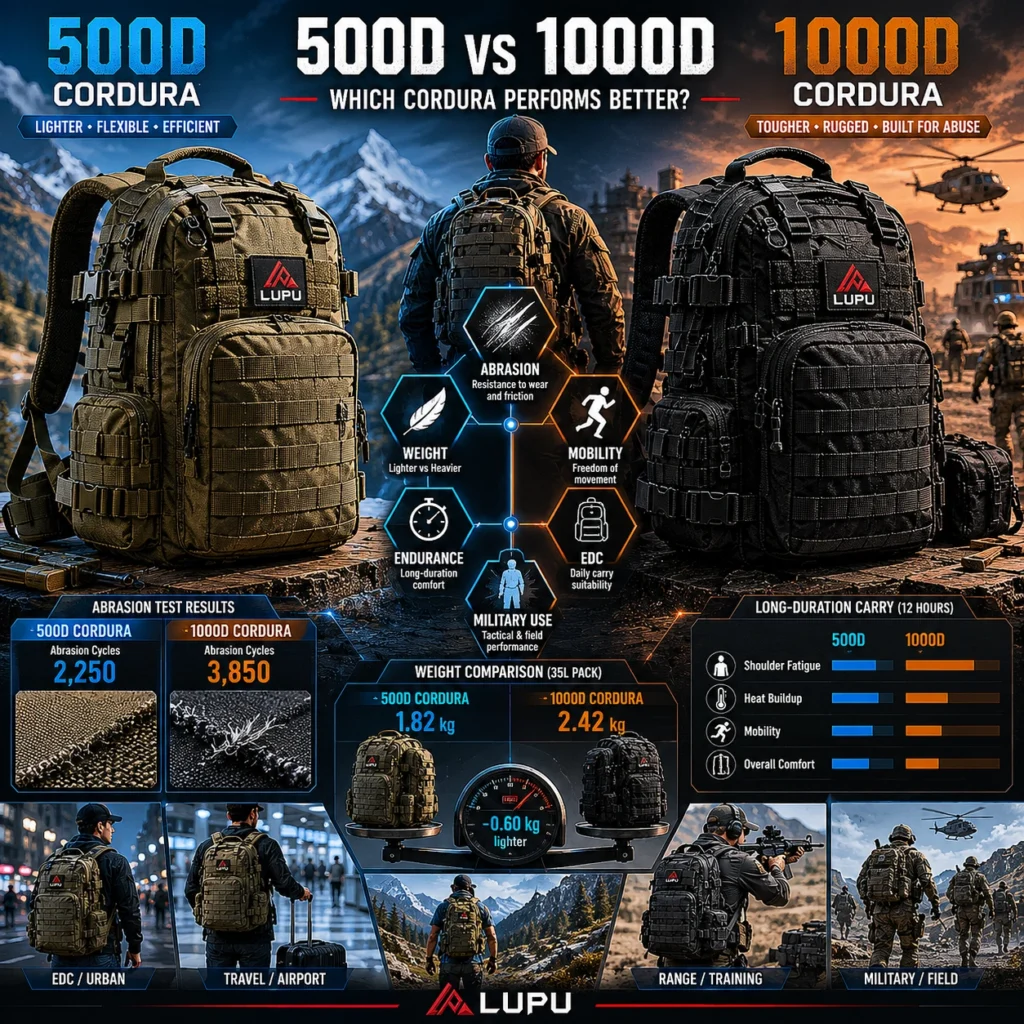
500D vs 1000D Cordura Abrasion Comparison Data
| Fabric | Abrasion Cycles |
| 500D Cordura | 1,800–2,500 |
| Cordura 1000D | 13000–4500 |
Why Many Professionals Prefer 500D?
One of the biggest surprises for civilian buyers is discovering how many experienced users quietly prefer lighter systems.
Perché?
Because operational effectiveness is not just about survivability.
It is about endurance.
500D offers major advantages:
- lower pack weight,
- better flexibility,
- improved mobility,
- reduced fatigue,
- lower heat accumulation,
- easier packing behavior,
- and faster movement efficiency.
This becomes increasingly important during:
- long-duration movement,
- vehicle ingress and egress,
- urban patrol work,
- travel,
- and extended carry times.
The body notices every unnecessary gram.
And fatigue compounds over time.
A backpack that feels “rugged” in a showroom may become exhausting after 10 hours of movement.
Is 1000D Cordura Worth It?
Yes — but only for specific operational requirements.
1000D Cordura excels in environments involving:
- extreme abrasion,
- heavy hauling,
- dragging exposure,
- sharp terrain,
- long-term field abuse,
- and repeated hard-contact stress.
This is why older military load systems often relied heavily on 1000D.
In harsh combat environments, equipment may experience:
- rocks,
- concrete,
- vehicle floors,
- weapons abrasion,
- repeated impact,
- and constant friction.
Under these conditions, 1000D provides genuine advantages.
Its thicker yarn structure improves:
- abrasion lifespan,
- puncture resistance,
- and structural rigidity.
But those benefits come with serious tradeoffs.
The Hidden Cost of 1000D
The tactical industry rarely discusses the downside of heavy fabrics.
But the disadvantages are substantial.
1. Increased Weight
Heavier fabric increases total system mass before gear is even added.
That matters more than most people realize.
Because:
- pack weight compounds,
- fatigue accumulates,
- and energy expenditure rises continuously over time.
The backpack itself becomes part of the problem.
2. Reduced Flexibility
1000D is noticeably stiffer.
That stiffness can:
- reduce comfort,
- interfere with body movement,
- create pressure points,
- and limit dynamic mobility.
In fast-moving environments, excessive rigidity becomes inefficient.
3. Greater Heat Retention
This is massively overlooked.
Heavy fabrics trap:
- heat,
- sweat,
- and moisture.
That increases:
- friction,
- discomfort,
- skin irritation,
- and thermal fatigue.
Over long durations, thermal inefficiency directly impacts endurance.
500D vs 1000D Weight Difference
This is one of the most important parts of the discussion.
Because the real enemy in load carriage is not just weight.
It is time under weight.
A few hundred grams may seem irrelevant in a product description.
But after:
- 8 hours,
- 12 hours,
- or multiple days of movement,
small weight differences become cumulative physiological stress.
500D vs 1000D Cordura Weight Chart
| Fabric | Avg Weight per Yard |
| 500D Cordura | ~7 oz |
| Cordura 1000D | ~11 oz |
Why Lightweight Systems Often Perform Better?
Modern backpack engineering increasingly prioritizes:
- energy conservation,
- movement efficiency,
- mobility,
- and fatigue reduction.
This philosophy came largely from:
- alpine climbing,
- mountaineering,
- expedition systems,
- and endurance-focused outdoor design.
These industries learned something tactical marketing often ignores:
sustainable movement matters more than visual ruggedness.
That is why many modern tactical systems now migrate toward:
- 500D architectures,
- hybrid laminates,
- laser-cut composites,
- and lighter textile systems.
The future of tactical gear is becoming lighter — not heavier.
Long-Duration Carry Analysis
Test Scenario:
- 8-hour urban carry
- 12-hour hiking
- stair climbing
- vehicle ingress/egress
500D vs 1000D Cordura long-duration carry test
| Test | 500D Cordura | Cordura 1000D |
| Shoulder fatigue | Lower | Higher |
| Heat buildup | Lower | Higher |
| Mobilità | Better | Reduced |
After 10 hours of continuous urban movement, the 1000D system generated noticeably more shoulder fatigue and back heat accumulation than the equivalent 500D setup.
Which Cordura Is Better for EDC?
For most users:
500D is the superior EDC fabric.
This surprises many buyers because tactical culture often glorifies overbuilt systems.
But urban EDC rarely requires:
- extreme abrasion resistance,
- drag durability,
- or combat-level punishment.
Most EDC users carry:
- laptops,
- chargers,
- gym gear,
- office supplies,
- cameras,
- or travel essentials.
In these situations, 500D provides:
- more comfort,
- better flexibility,
- lighter carry,
- improved aesthetics,
- and better daily usability.
Why 1000D Is Often Excessive for EDC?
A heavy backpack paired with a lightweight urban loadout creates inefficiency.
The user ends up carrying:
- extra fabric weight,
- unnecessary stiffness,
- additional heat,
- and reduced comfort
without gaining meaningful advantages.
This is one reason many experienced users eventually move away from ultra-heavy tactical systems for daily carry.
Military Backpack Fabric Comparison
Civilian tactical culture often misunderstands military equipment selection.
Military procurement does not necessarily prioritize:
- comfort,
- ergonomics,
- or elite user experience.
It often prioritizes:
- cost efficiency,
- mass production,
- repairability,
- logistics,
- and supply-chain standardization.
Historically, 1000D was favored because:
- it survived abuse,
- simplified replacement cycles,
- and tolerated rough field handling.
But modern military load carriage philosophy is changing.
“Modern tactical systems increasingly prioritize mobility and fatigue reduction over brute abrasion resistance.”
— Former Load Systems Engineer
Why Modern Tactical Systems Are Getting Lighter?
Contemporary military and professional load systems increasingly emphasize:
- mobility,
- endurance,
- reduced fatigue,
- and human performance optimization.
This has accelerated adoption of:
- 500D constructions,
- laminate composites,
- laser-cut systems,
- and lighter hybrid fabrics.
Because operational reality revealed something important:
the human body breaks down faster than modern textiles.
Reducing fatigue often improves mission effectiveness more than maximizing fabric thickness.
Best Fabric for Tactical Backpacks
There is no universally “best” tactical backpack fabric.
There is only:
the best fabric for a specific mission profile.
Best for Urban EDC
Winner: 500D Cordura
Perché:
- lighter,
- more comfortable,
- more flexible,
- better for commuting,
- easier for travel.
Best for Long-Duration Movement
Winner: Usually 500D or hybrid systems
Because:
- reduced fatigue matters more,
- energy efficiency becomes critical,
- mobility improves operational endurance.
Best for Extreme Abrasion
Winner: 1000D Cordura
Best for:
- military abuse,
- dragging exposure,
- heavy hauling,
- rough terrain,
- industrial conditions.
Best for Vehicle Operations
Winner: 500D
Perché:
- less bulk,
- easier movement,
- reduced snag risk,
- better flexibility in confined spaces.
Best for Search and Rescue
Winner: Often 500D or mixed-fabric systems
Because SAR emphasizes:
- long-duration movement,
- mobility,
- medical access,
- fatigue management.
The Tactical Industry‘s Biggest Myth
The biggest myth in tactical gear is simple:
heavier does not automatically mean better.
The industry spent years teaching consumers to associate:
- thick fabric,
- oversized packs,
- MOLLE system saturation,
- and brute ruggedness
with superior performance.
But sustained movement exposes poor engineering quickly.
The body does not care about marketing.
It only experiences:
- weight,
- pressure,
- heat,
- friction,
- and fatigue.
And fatigue is cumulative.
Why Outdoor Brands Often Understand Load Carriage Better?
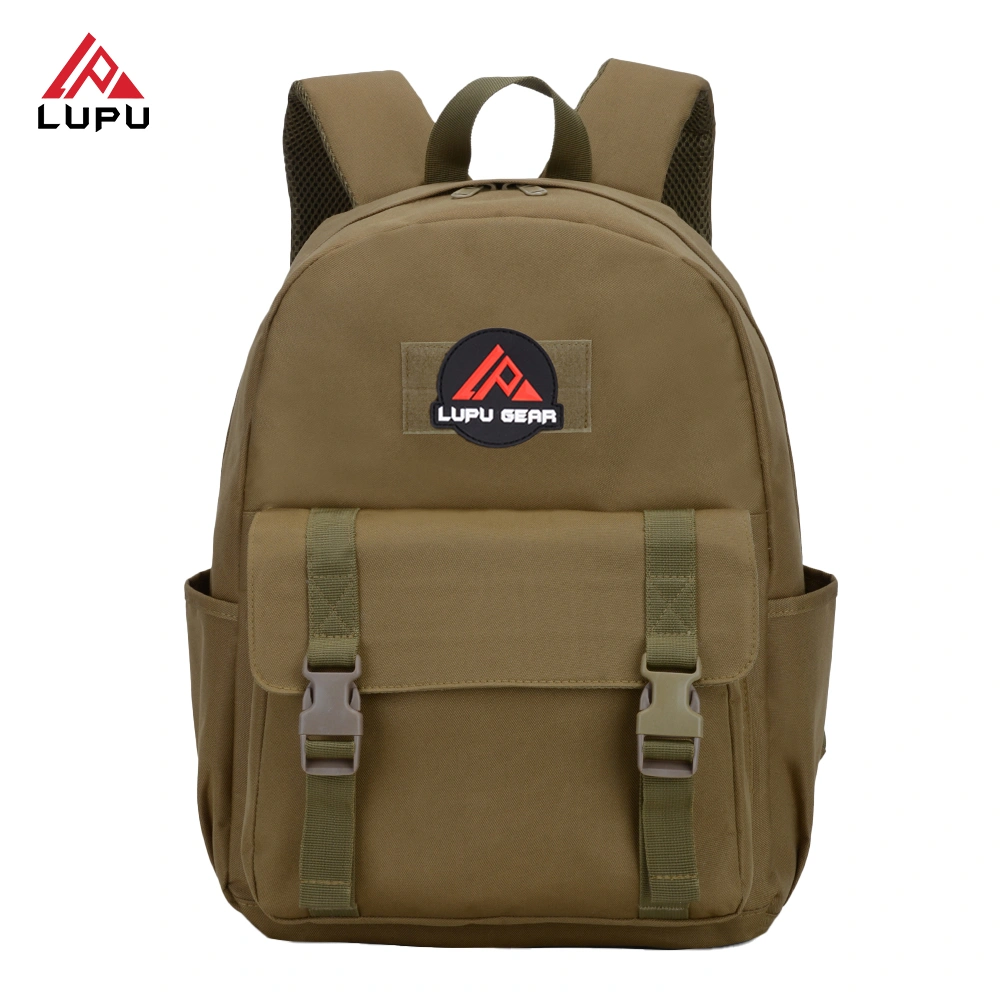
Ironically, mountaineering and alpine brands frequently understand load carriage more deeply than tactical brands.
Perché?
Because mountain environments punish inefficiency immediately.
Outdoor engineering evolved around:
- endurance,
- energy conservation,
- movement economy,
- thermal regulation,
- and biomechanical efficiency.
These principles are now influencing modern tactical design heavily.
The future of tactical backpacks increasingly resembles:
- advanced outdoor systems,
- hybrid laminate architectures,
- and lightweight expedition engineering.
Not old-school “operator cosplay.”
Final Verdict — 500D vs 1000D Cordura
The answer depends entirely on your real-world use case.
Choose 500D Cordura if you prioritize:
- mobility,
- EDC,
- lightweight carry,
- travel,
- comfort,
- long-duration movement,
- urban operations,
- and reduced fatigue.
Choose Cordura 1000D if you truly need:
- maximum abrasion resistance,
- heavy hauling durability,
- drag survivability,
- harsh terrain protection,
- or industrial-level abuse tolerance.
For most modern users, however:
500D offers the better balance.
Because modern tactical performance is increasingly about:
- endurance,
- efficiency,
- mobility,
- and sustainable movement.
Not theatrical ruggedness.
The best tactical backpack is rarely the heaviest one.
It is usually the one that disappears while you move.
FAQ — 500D vs 1000D Cordura
Is 500D Cordura strong enough for tactical backpacks?
Yes. For most users, 500D Cordura provides more than enough durability for:
- EDC,
- hiking,
- travel,
- patrol use,
- and general tactical applications.
It balances durability with lower weight and better comfort.
Does 1000D Cordura last longer?
In high-abrasion environments, yes.
1000D generally offers:
- better abrasion resistance,
- improved puncture resistance,
- and longer lifespan under extreme abuse.
But that extra durability often comes with:
- more weight,
- greater stiffness,
- and reduced comfort.
Which Cordura fabric is more waterproof?
Neither fabric is inherently waterproof.
Water resistance depends more on:
- coatings,
- laminates,
- seam construction,
- and DWR treatments.
However, 500D often dries faster because it retains less moisture.
Is 500D Cordura better for EDC?
In most cases, yes.
500D is usually better for EDC because it is:
- lighter,
- more flexible,
- more comfortable,
- and better suited for daily urban movement.
Why do some military packs use 500D instead of 1000D?
Modern military systems increasingly prioritize:
- mobility,
- endurance,
- and fatigue reduction.
Lighter fabrics improve human performance during sustained movement.
What is the best tactical backpack fabric today?
There is no universal answer.
The best tactical backpack fabric depends on:
- mission type,
- environment,
- carry duration,
- load weight,
- and mobility requirements.
For many users, modern 500D and hybrid systems provide the best overall balance.
Correlato:
Top 50: Elenco globale delle marche di attrezzi tattici