Introduction: Understanding the Complex World Behind Tactical Equipment Production
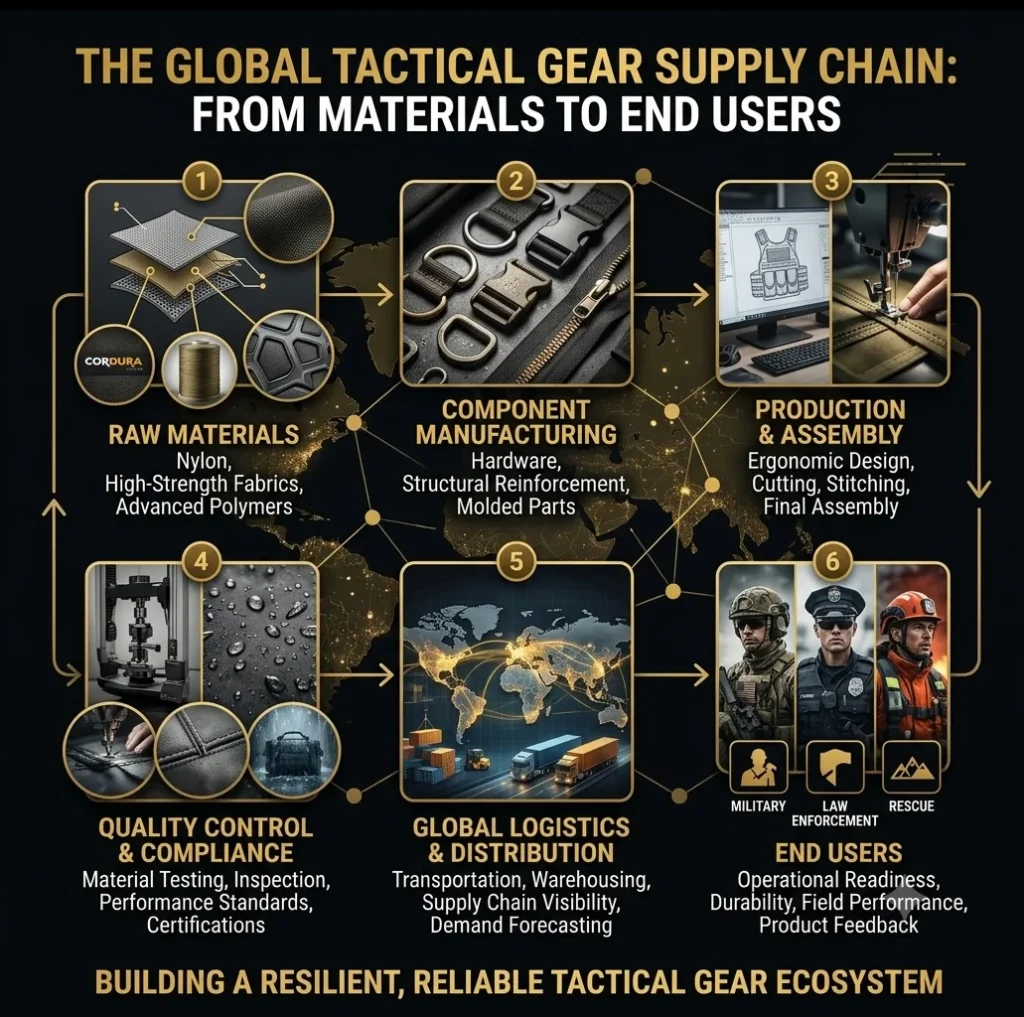
The modern tactical equipment industry depends on a highly specialized and interconnected global network. Behind every tactical vest, load-bearing system, backpack, protective accessory, or mission-oriented garment exists a complex ecosystem of suppliers, manufacturers, testing facilities, logistics providers, and distribution partners.
This ecosystem is known as the tactical gear supply chain.
Unlike conventional consumer product supply chains, tactical equipment production requires a much higher level of precision, reliability, and performance control. Tactical products are often designed for demanding environments where durability, material strength, and operational consistency are critical factors.
A failure in any stage of the tactical gear supply chain—from raw material sourcing to manufacturing processes or logistics management—can affect product quality, delivery schedules, and customer confidence.
For manufacturers and procurement organizations, understanding how the tactical gear supply chain operates is essential for improving efficiency, reducing risks, and maintaining competitive advantages in an increasingly complex global market.
This article provides a comprehensive analysis of the tactical gear supply chain, including:
- Raw material sourcing
- Component manufacturing
- Tactical gear production processes
- Quality control systems
- Compliance requirements
- Global logistics networks
- Supply chain challenges
- Technology trends
- Future development strategies
1. What Is a Tactical Gear Supply Chain?
A tactical gear supply chain refers to the complete network of activities, organizations, and processes involved in creating and delivering tactical equipment from initial material sourcing to the final user.
The supply chain typically follows this structure:
Raw Materials → Component Manufacturing → Product Development → Production → Quality Inspection → Warehousing → Distribution → End Users
Each stage plays an important role in determining the performance, reliability, and commercial success of tactical products.
Unlike ordinary consumer goods, tactical equipment requires specialized manufacturing capabilities because products must often meet strict requirements related to:
- Durata
- Environmental resistance
- Load-bearing performance
- User mobility
- Product lifespan
- Functional reliability
For this reason, an effective tactical gear supply chain is not simply a manufacturing process. It is a strategic system that combines engineering expertise, supplier management, quality assurance, and logistics coordination.
Why Tactical Gear Supply Chains Are Different from Traditional Supply Chains
Many consumer products are primarily optimized around cost efficiency and production volume. Tactical equipment follows a different philosophy.
The priority is usually:
Performance → Reliability → Safety → Consistency → Cost Optimization
rather than simply minimizing production costs.
A professional tactical equipment supply chain must consider several unique factors:
a. Specialized Material Requirements
Tactical gear products often require advanced materials with specific characteristics, including:
- High tensile strength
- Abrasion resistance
- Lightweight construction
- Weather resistance
- Long-term durability
Material selection directly influences product performance.
For example, a tactical backpack designed for harsh environments requires different fabric specifications compared with a standard outdoor backpack.
b. Strict Quality Expectations
Tactical equipment buyers typically expect consistent performance across large production batches.
Quality issues such as:
- Weak stitching
- Poor hardware performance
- Incorrect dimensions
- Material inconsistency
can significantly impact product reputation and customer relationships.
Therefore, quality management is a core element of successful tactical gear supply chain management.
c. Complex Supplier Networks
A single tactical product may involve dozens of suppliers.
For example, manufacturing a tactical load-bearing system may require:
- Fabric suppliers
- Webbing manufacturers
- Hardware suppliers
- Plastic component producers
- Packaging providers
- Testing laboratories
Managing these interconnected suppliers requires advanced coordination and long-term strategic planning.
2. Raw Material Sourcing: The Foundation of the Tactical Gear Supply Chain
Every successful tactical product begins with material selection.
The first stage of the tactical gear supply chain focuses on identifying, sourcing, and validating materials that meet performance requirements.
Poor material selection can create problems throughout the entire production process, including:
- Reduced durability
- Higher defect rates
- Customer complaints
- Increased replacement costs
For this reason, professional manufacturers treat material sourcing as a strategic function rather than a simple purchasing activity.
High-Performance Materials Used in Tactical Equipment
Advanced Tactical Fabrics
Fabric selection is one of the most important decisions in tactical gear manufacturing.
Common materials include:
Nylon-Based Materials
Nylon remains widely used because of its:
- High strength-to-weight ratio
- Excellent abrasion resistance
- Long service life
- Flexible performance characteristics
It is commonly found in:
- Zaini tattici
- Plate carriers
- Equipment pouches
- Load-bearing systems
Polyester and Composite Fabrics
Modern tactical products may also use engineered polyester blends designed for:
- Environmental stability
- Color retention
- Moisture resistance
- Cost efficiency
Ripstop Materials
Ripstop construction uses reinforced weaving techniques to prevent small tears from expanding.
Benefits include:
- Improved durability
- Reduced material failure
- Longer product lifespan
Protective and Reinforced Materials
Some tactical applications require additional protective performance.
Materials may include:
- Reinforced polymers
- Composite structures
- High-strength fiber systems
The selection of these materials depends on:
- Intended application
- Performance requirements
- Weight limitations
- Regulatory considerations
Challenges in Tactical Material Sourcing
Managing materials within a global tactical gear supply chain presents several challenges.
Supply Availability
Specialized materials often come from limited suppliers.
This creates risks such as:
- Production delays
- Increased costs
- Limited manufacturing flexibility
Price Volatility
Raw material prices can fluctuate due to:
- Energy costs
- Transportation expenses
- Market demand
- Global economic conditions
Manufacturers must balance cost control with maintaining material quality.
Supplier Reliability
A strong supplier network requires evaluation of:
- Production capacity
- Quality consistency
- Delivery performance
- Technical capabilities
Professional companies often develop long-term partnerships with qualified suppliers to improve supply chain stability.
3. Component Manufacturing: The Hidden Infrastructure of Tactical Equipment Production
While finished tactical products receive most attention, many critical elements are produced separately through specialized component supply networks.
The component layer represents one of the most important but often overlooked parts of the tactical gear supply chain.
A tactical product may appear simple from the outside, but its performance depends on dozens of smaller components working together.
Essential Tactical Gear Components
Hardware Components
Examples include:
- Buckles
- Fasteners
- Adjusters
- Zippers
- Metal accessories
These components must withstand repeated use and environmental stress.
Webbing and Reinforcement Components
Webbing systems provide:
- Load distribution
- Structural support
- Attachment capability
Poor-quality webbing can reduce the overall strength of tactical equipment.
Polymer Components
Modern tactical equipment frequently incorporates engineered polymer parts because they provide:
- Lightweight construction
- Impact resistance
- Manufacturing flexibility
The Importance of Component Supplier Management
A reliable tactical gear supply chain depends heavily on effective supplier coordination.
Manufacturers must ensure:
- Component specifications are consistent
- Production schedules are synchronized
- Quality standards are maintained
- Supply risks are controlled
Even a small component failure can affect the performance of the entire product.
For this reason, advanced manufacturers implement supplier qualification programs, incoming inspection procedures, and continuous quality monitoring.
4. Tactical Gear Manufacturing Process Explained
The manufacturing stage is where design concepts, engineering specifications, and raw materials are transformed into functional tactical equipment.
Within the tactical gear supply chain, manufacturing represents the critical connection between material suppliers and end users. A highly efficient production system requires a combination of skilled craftsmanship, advanced equipment, process control, and continuous quality improvement.
Unlike standard textile manufacturing, tactical gear production requires specialized techniques because products must often withstand:
- Heavy mechanical stress
- Extreme weather conditions
- Frequent operational use
- Long-term field exposure
A professional produttore di attrezzi tattici must maintain strict control over every production stage to ensure consistency and reliability.
Product Design and Engineering: The Starting Point of Manufacturing
Before production begins, tactical equipment goes through a detailed design and engineering process.
This stage determines:
- Product structure
- Material selection
- Functional requirements
- Manufacturing methods
- Testing procedures
A successful design must balance multiple factors:
Performance Requirements
Tactical equipment must provide:
- Strength
- Flexibility
- Durata
- User comfort
- Functional accessibility
For example, a tactical load-bearing platform must support equipment weight while allowing users to maintain mobility.
Ergonomic Considerations
Modern tactical gear development increasingly focuses on human-centered design.
Manufacturers evaluate:
- Weight distribution
- Adjustment systems
- Movement limitations
- User interaction
The goal is to create equipment that performs effectively without restricting operational capability.
Prototype Development and Testing
Before mass production, manufacturers typically develop prototypes to evaluate:
- Design functionality
- Material performance
- User feedback
- Manufacturing feasibility
Prototype testing helps identify potential issues before they enter the larger tactical gear supply chain.
Fabric Preparation and Cutting Process
After design approval, materials enter the production phase.
Fabric preparation includes:
- Material inspection
- Pattern preparation
- Cutting optimization
- Component classification
Modern manufacturers often use digital cutting systems to improve:
- Cutting accuracy
- Material utilization
- Production efficiency
Reducing material waste is becoming increasingly important as companies focus on cost control and sustainable manufacturing practices.
Sewing and Assembly: Where Manufacturing Expertise Matters
The assembly stage is one of the most technically demanding parts of tactical gear production.
Tactical products require specialized construction methods, including:
Reinforced Stitching Techniques
Common approaches include:
- Double stitching
- Box stitching
- Bar-tack reinforcement
- Load-bearing seam reinforcement
These techniques improve resistance against:
- Pull forces
- Repeated stress
- Heavy equipment loads
Modular Construction
Many modern tactical products use modular designs that allow users to:
- Adjust configurations
- Add accessories
- Replace components
- Customize equipment setups
Modularity improves product flexibility and extends equipment lifespan.
Hardware Integration and Final Assembly
During final assembly, manufacturers install:
- Buckles
- Adjustment systems
- Attachment points
- Protective components
- Functional accessories
This stage requires precise inspection because incorrect installation can affect product performance.
A reliable tactical gear supply chain depends on accurate coordination between:
- Component suppliers
- Production teams
- Quality control departments
5. Quality Control in the Tactical Gear Supply Chain
Quality control is one of the most important elements of the entire tactical gear supply chain.
In tactical applications, product failure can create serious operational challenges. Therefore, professional manufacturers implement comprehensive quality management systems throughout the entire production lifecycle.
Quality control is not limited to final inspection. It begins with supplier selection and continues through:
- Material testing
- Production monitoring
- Assembly inspection
- Final product evaluation
Material Quality Testing
The first level of quality assurance occurs when materials enter the manufacturing facility.
Manufacturers evaluate:
Physical Properties
Testing may include:
- Tensile strength
- Tear resistance
- Abrasion resistance
- Fabric consistency
These tests ensure materials meet required performance specifications.
Environmental Performance
Depending on product requirements, materials may be evaluated for resistance against:
- Moisture
- Temperature variation
- UV exposure
- Repeated environmental stress
Production Quality Control
During manufacturing, quality teams monitor multiple production checkpoints.
Important inspection areas include:
Stitching Quality
Inspectors evaluate:
- Stitch density
- Seam strength
- Alignment accuracy
- Reinforcement points
Poor stitching is one of the most common causes of tactical equipment failure.
Dimensional Accuracy
Manufacturers verify:
- Product measurements
- Component positioning
- Attachment compatibility
Precision is especially important for modular tactical systems.
Hardware Performance
Hardware components are tested for:
- Functional operation
- Structural strength
- Long-term durability
A high-quality product requires every individual component to perform consistently.
Final Product Inspection
Before products enter distribution channels, final inspections confirm:
- Appearance standards
- Functional performance
- Packaging accuracy
- Documentation completeness
A mature tactical gear supply chain management system ensures quality is built into every stage instead of relying only on final inspection.
6. Compliance and Regulatory Requirements in the Tactical Gear Supply Chain
As tactical equipment markets become increasingly global, compliance management has become a critical factor in supply chain operations.
A professional tactical gear supply chain must satisfy multiple requirements related to:
- Product specifications
- Manufacturing standards
- Documentation
- International trade regulations
- Customer procurement requirements
Understanding Procurement Requirements
Many tactical equipment buyers have strict purchasing criteria.
These may include:
- Material specifications
- Production standards
- Quality documentation
- Traceability requirements
Manufacturers supplying professional organizations must demonstrate consistent production capability and reliable quality systems.
Country-of-Origin and International Trade Considerations
Global tactical equipment production often involves multiple countries.
This creates supply chain considerations related to:
- Import regulations
- Export requirements
- Customs documentation
- Trade policies
Companies must maintain accurate documentation throughout the tactical gear supply chain to prevent delays and compliance issues.
Supplier Verification and Transparency
Modern buyers increasingly require visibility into supplier networks.
Effective supplier management includes:
- Factory capability assessment
- Production audits
- Quality reviews
- Ethical sourcing evaluation
Transparency strengthens trust between manufacturers, distributors, and customers.
Ethical Manufacturing and Sustainability
Sustainability has become an increasingly important topic within global manufacturing.
Companies are improving their supply chains through:
- Responsible material sourcing
- Waste reduction programs
- Energy-efficient production
- Improved manufacturing processes
A sustainable tactical gear supply chain focuses not only on short-term production efficiency but also long-term business resilience.
7. Global Tactical Gear Supply Chain Network
The modern tactical equipment industry operates through a distributed global manufacturing ecosystem.
Different regions contribute unique capabilities based on:
- Manufacturing expertise
- Material availability
- Labor capabilities
- Technology infrastructure
Understanding global supply chain structures helps companies build more resilient sourcing strategies.
North American Tactical Gear Manufacturing
North America remains an important market for tactical equipment development and production.
Key strengths include:
Advanced Manufacturing Capability
Manufacturers benefit from:
- Engineering expertise
- Established defense industry connections
- Strong quality management systems
Compliance-Oriented Production
Many North American suppliers focus on:
- Documentation accuracy
- Quality assurance
- Regulatory alignment
These capabilities make the region valuable for specialized tactical equipment programs.
Asia-Pacific Manufacturing Networks
The Asia-Pacific region plays a major role in global tactical equipment production.
Advantages include:
Large-Scale Manufacturing Capacity
The region provides:
- Extensive textile manufacturing infrastructure
- Experienced production workforce
- Efficient manufacturing systems
Supply Chain Integration
Many suppliers operate integrated production networks covering:
- Fabric production
- Component manufacturing
- Assembly operations
- Packaging
This integration can improve production efficiency and scalability.
European Tactical Equipment Manufacturing
European manufacturers are recognized for:
- Engineering innovation
- Specialized production
- Technical expertise
The region often focuses on:
- Premium tactical products
- Advanced materials
- Specialized applications
Building a Balanced Global Tactical Gear Supply Chain
Successful companies increasingly avoid dependence on a single manufacturing location.
Modern strategies include:
- Multi-region sourcing
- Supplier diversification
- Regional inventory planning
- Risk management systems
A resilient tactical gear supply chain requires flexibility, visibility, and long-term strategic planning.
8. Logistics and Distribution: Moving Tactical Gear Across Global Markets
The logistics stage represents the final operational link between manufacturers and end users within the tactical gear supply chain.
Even when products are manufactured to the highest standards, inefficient logistics management can create significant challenges, including:
- Delivery delays
- Increased operational costs
- Inventory shortages
- Customer dissatisfaction
A professional tactical equipment supply chain requires coordinated logistics planning to ensure products reach customers efficiently and reliably.
Global Transportation Networks in Tactical Equipment Distribution
Tactical gear manufacturers often serve customers across multiple regions, including:
- Government procurement organizations
- Law enforcement suppliers
- Outdoor equipment distributors
- Commercial retailers
- Professional users
To support these markets, companies must manage multiple transportation methods:
Ocean Freight
Ocean transportation remains one of the most common methods for large-volume shipments because it provides:
- Lower transportation costs
- High cargo capacity
- International connectivity
However, it requires careful planning because shipping timelines can be affected by:
- Port congestion
- Weather conditions
- Customs procedures
- Global trade disruptions
Air Freight
Air transportation provides faster delivery solutions for:
Urgent orders
High-value equipment
Time-sensitive projects
The primary challenge is higher transportation cost, making it more suitable for specific supply chain scenarios.
Inventory Management in the Tactical Gear Supply Chain
Effective inventory management is essential for balancing availability and cost.
Poor inventory planning can result in:
- Excess stock
- Storage expenses
- Product aging
- Cash flow pressure
On the other hand, insufficient inventory may cause:
- Customer delays
- Lost sales opportunities
- Production disruptions
Modern companies increasingly use data-driven inventory systems to improve forecasting accuracy.
Digital Supply Chain Visibility
Technology has transformed how companies manage tactical equipment distribution.
Modern supply chain systems provide visibility into:
- Production status
- Inventory levels
- Shipment tracking
- Supplier performance
Improved visibility allows companies to respond faster to unexpected disruptions.
For global manufacturers, supply chain transparency has become a competitive advantage.
9. Major Challenges Facing the Tactical Gear Supply Chain
The modern tactical gear supply chain operates in a highly competitive and unpredictable environment.
Companies must manage several challenges while maintaining product quality and delivery reliability.
Supply Chain Disruptions and Global Uncertainty
Recent years have demonstrated how vulnerable global manufacturing networks can become.
Common disruption factors include:
- Transportation interruptions
- Material shortages
- Regional instability
- Economic fluctuations
- Trade policy changes
For tactical equipment manufacturers, these disruptions can affect:
- Production schedules
- Customer commitments
- Manufacturing costs
Supplier Dependency Risks
One of the biggest challenges in supply chain management is excessive dependence on limited suppliers.
For example, relying on a single supplier for critical materials or components can create significant risks.
Potential consequences include:
- Production delays
- Increased costs
- Limited negotiation flexibility
A resilient tactical gear supply chain should include:
- Multiple qualified suppliers
- Alternative sourcing strategies
- Long-term supplier relationships
Balancing Cost Efficiency and Product Performance
Cost management is important, but tactical equipment cannot be evaluated only through production price.
The lowest-cost solution may create problems related to:
- Material reliability
- Product durability
- Quality consistency
Professional manufacturers focus on total value rather than short-term cost reduction.
A successful strategy balances:
Cost Efficiency + Quality Control + Long-Term Reliability
Increasing Customer Expectations
Modern buyers expect more than functional products.
They increasingly demand:
- Faster delivery
- Greater customization
- Transparent sourcing
- Consistent quality
- Responsive communication
These expectations require companies to continuously improve their tactical gear supply chain management strategies.
10. Technology Transforming the Tactical Gear Supply Chain
Technology is becoming one of the most important drivers of supply chain improvement.
Digital transformation allows companies to increase efficiency, reduce risks, and improve decision-making.
Digital Supply Chain Management Systems
Enterprise management platforms help manufacturers coordinate:
- Purchasing
- Production planning
- Inventory control
- Supplier communication
- Order fulfillment
These systems provide a centralized view of operations across the entire tactical gear supply chain.
Artificial Intelligence and Predictive Analytics
Artificial intelligence is creating new opportunities for supply chain optimization.
AI-powered systems can support:
Demand Forecasting
Companies can analyze:
- Historical sales data
- Market trends
- Customer demand patterns
This helps improve production planning and inventory management.
Risk Prediction
Advanced analytics can identify potential risks such as:
- Supplier delays
- Material shortages
- Market fluctuations
Early detection allows companies to develop preventive strategies.
Automation in Tactical Gear Manufacturing
Automation technologies are improving manufacturing efficiency.
Examples include:
- Digital cutting systems
- Automated inspection equipment
- Smart production monitoring
- Computer-assisted manufacturing
Automation helps manufacturers achieve:
- Higher consistency
- Reduced waste
- Faster production cycles
Data-Driven Quality Management
Modern quality systems increasingly rely on real-time production data.
Manufacturers can monitor:
- Defect rates
- Production efficiency
- Material performance
- Supplier quality trends
This approach moves quality control from reactive inspection toward proactive prevention.
11. Future Trends Shaping the Tactical Gear Supply Chain
The future of the tactical gear supply chain will be defined by resilience, innovation, and adaptability.
Companies that successfully integrate technology, sustainability, and strategic sourcing will have stronger competitive advantages.
Building More Resilient Supply Networks
Supply chain resilience has become a major priority for manufacturers.
Future strategies include:
Supplier Diversification
Companies are increasingly developing multiple sourcing options to reduce dependency risks.
Benefits include:
- Greater flexibility
- Improved continuity
- Reduced disruption impact
Regional Manufacturing Strategies
Some companies are moving toward more localized production networks.
Advantages include:
- Shorter transportation distances
- Faster response times
- Reduced geopolitical exposure
Strategic Inventory Planning
Future supply chains will increasingly use:
- Predictive analytics
- Demand forecasting
- Flexible inventory models
This allows companies to maintain availability without excessive stock levels.
Sustainability in Tactical Equipment Production
Environmental responsibility is becoming an important consideration in global manufacturing.
Future tactical gear supply chains will increasingly focus on:
- Sustainable materials
- Reduced production waste
- Energy-efficient manufacturing
- Responsible sourcing
Sustainability is not only an environmental goal—it can also improve operational efficiency and long-term business stability.
Customization and Flexible Manufacturing
Customer demand is shifting toward more specialized equipment solutions.
Future manufacturing trends include:
- Smaller production batches
- Faster customization
- Modular product systems
- User-specific configurations
Flexible production capabilities will become increasingly important for companies competing in specialized tactical markets.
12. How Companies Can Build a Stronger Tactical Gear Supply Chain?
Developing a reliable tactical gear supply chain requires strategic planning across sourcing, manufacturing, quality management, and logistics.
a. Select Suppliers Based on Capability, Not Only Cost
A strong supplier evaluation process should consider:
- Manufacturing experience
- Quality systems
- Production capacity
- Technical expertise
- Delivery reliability
Choosing the right suppliers creates the foundation for long-term success.
b. Improve Supply Chain Transparency
Companies should develop better visibility into:
- Supplier networks
- Material sources
- Production progress
- Inventory conditions
Greater transparency enables faster decision-making and reduces operational risks.
c. Invest in Quality Systems
Quality should be integrated throughout the entire supply chain.
Effective strategies include:
- Supplier audits
- Incoming material inspections
- Production monitoring
- Final product testing
A quality-focused approach strengthens customer trust and brand reputation.
d. Adopt Digital Supply Chain Technologies
Technology investments can improve:
- Forecast accuracy
- Production efficiency
- Inventory management
- Risk detection
Companies that embrace digital transformation will be better positioned for future market changes.
Conclusion: Why the Tactical Gear Supply Chain Defines Industry Success
The tactical gear supply chain is the foundation behind every reliable tactical product.
From advanced material sourcing and component manufacturing to production, quality control, logistics, and global distribution, every stage contributes to the final performance of tactical equipment.
A successful supply chain is not built solely on manufacturing capacity. It requires:
- Reliable supplier partnerships
- Strong quality management
- Advanced technology adoption
- Strategic risk management
- Continuous improvement
As the tactical equipment market continues to evolve, companies with resilient, transparent, and innovative supply chains will be better prepared to meet increasing customer expectations.
The future of tactical equipment will not only depend on better products—it will depend on smarter, stronger, and more adaptable tactical gear supply chains.
Build a More Reliable Tactical Gear Supply Chain with the Right Manufacturing Partner
A successful tactical gear supply chain depends on more than production capacity—it requires reliable materials, consistent quality control, manufacturing expertise, and long-term supply chain stability.
Whether you are developing a new tactical product line, expanding production capacity, or searching for a dependable manufacturing partner, working with an experienced supplier can help reduce risks and improve operational efficiency.
Contact our team (info@luputacticalgear.com) today to discuss your tactical gear manufacturing requirements and explore how we can support your supply chain goals.
Frequently Asked Questions (FAQ)
What is a tactical gear supply chain?
A tactical gear supply chain is the complete network involved in sourcing materials, manufacturing tactical equipment, controlling quality, managing logistics, and delivering products to end users.
It connects suppliers, manufacturers, distributors, and customers through a coordinated production and delivery system.
How does the tactical gear supply chain work?
The process generally follows these stages:
- Raw material sourcing
- Component manufacturing
- Product design and engineering
- Tactical gear production
- Quality inspection
- Warehousing and logistics
- Distribution to end users
Each stage contributes to product reliability and supply chain performance.
Why is tactical gear supply chain management important?
Effective tactical gear supply chain management helps companies:
- Maintain consistent product quality
- Reduce production risks
- Improve delivery performance
- Control operational costs
- Build stronger supplier relationships
What materials are commonly used in tactical gear production?
Common materials include:
- High-strength nylon
- Polyester blends
- Ripstop fabrics
- Reinforced textiles
- Engineered polymers
- Specialized composite materials
Material selection depends on product requirements and intended applications.
What are the biggest challenges in the tactical gear supply chain?
Major challenges include:
- Material availability
- Supplier dependency
- Global logistics disruptions
- Rising production costs
- Increasing customer expectations
Companies must continuously improve supply chain resilience to remain competitive.
How is technology changing the tactical gear supply chain?
Technology is improving the industry through:
- Digital inventory management
- Artificial intelligence forecasting
- Automated manufacturing
- Real-time quality monitoring
- Data-driven decision-making
These innovations help companies create more efficient and reliable supply networks.