Requesting a quotation from a tactical gear manufacturer may look simple: send a product picture, state the quantity, and ask for a price.
In practice, that approach often produces an incomplete quotation, multiple rounds of clarification, unexpected sample revisions, or a final production cost that is higher than the original estimate.
The reason is straightforward: a factory can only quote accurately when it has enough information to understand what needs to be manufactured, how it should be constructed, what quality level is required, how many units are needed, and when they must be delivered.
This is why a well-prepared RFQ is much more than a request for a unit price. It is the technical and commercial starting point for the entire OEM manufacturing project.
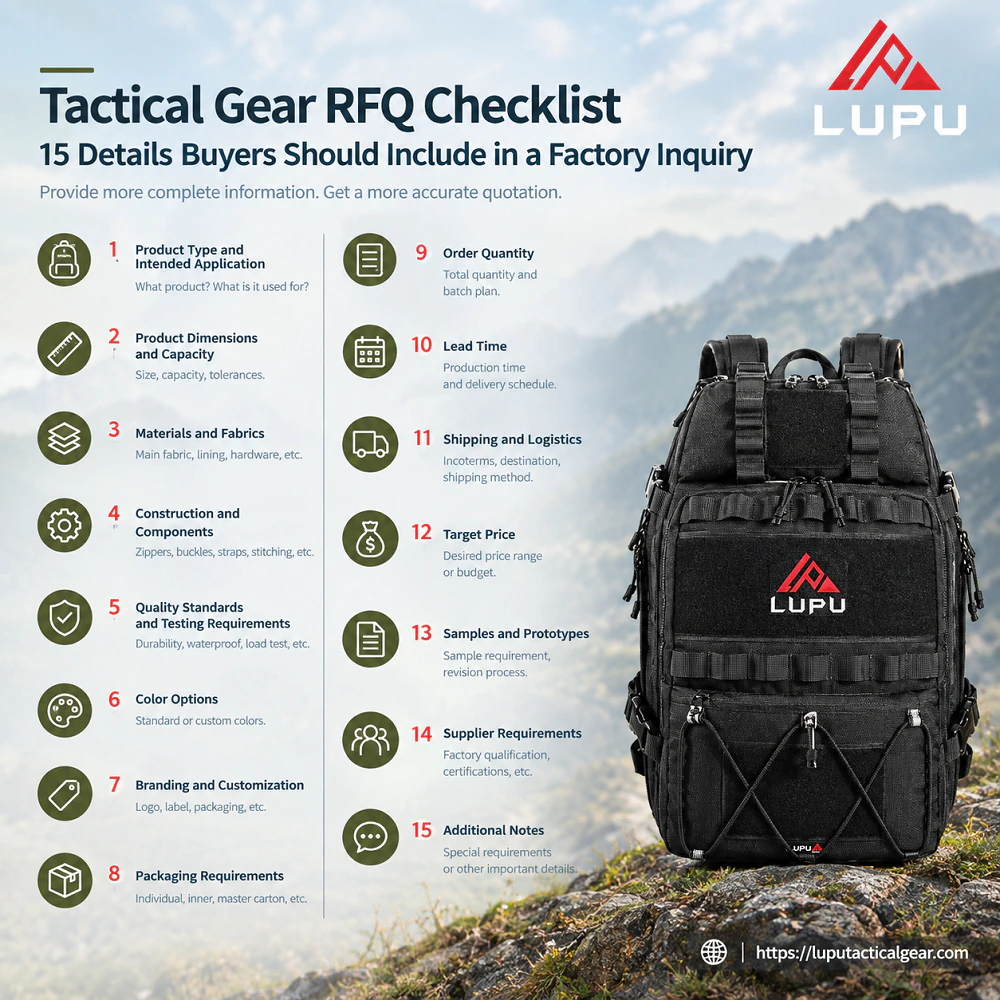
Diese Tactical Gear RFQ Checklist covers the 15 details buyers should provide when sending an inquiry to a tactical gear manufacturer. Whether you are developing a tactical backpack, chest rig, pouch, medical bag, tactical belt, or another customized product, these details can help your factory partner understand the project faster and provide a quotation that is much easier to evaluate.
What Is an RFQ for Tactical Gear?
RFQ stands for Request for Quotation.
In manufacturing, an RFQ is a structured inquiry that asks a supplier to evaluate a product and provide commercial information based on defined requirements.
There is an important difference between a general product inquiry and a proper manufacturing RFQ.
A general inquiry might say:
“Please quote 1,000 tactical backpacks.”
A useful RFQ would tell the manufacturer:
- What type of backpack is required
- What it will be used for
- What dimensions and capacity are required
- Which materials should be used
- What components and construction methods are expected
- How the product should be branded
- What quality and testing requirements apply
- How many units are required
- Where and when the goods need to be delivered
The difference is not simply the amount of information.
It is the quality and manufacturing relevance of the information.
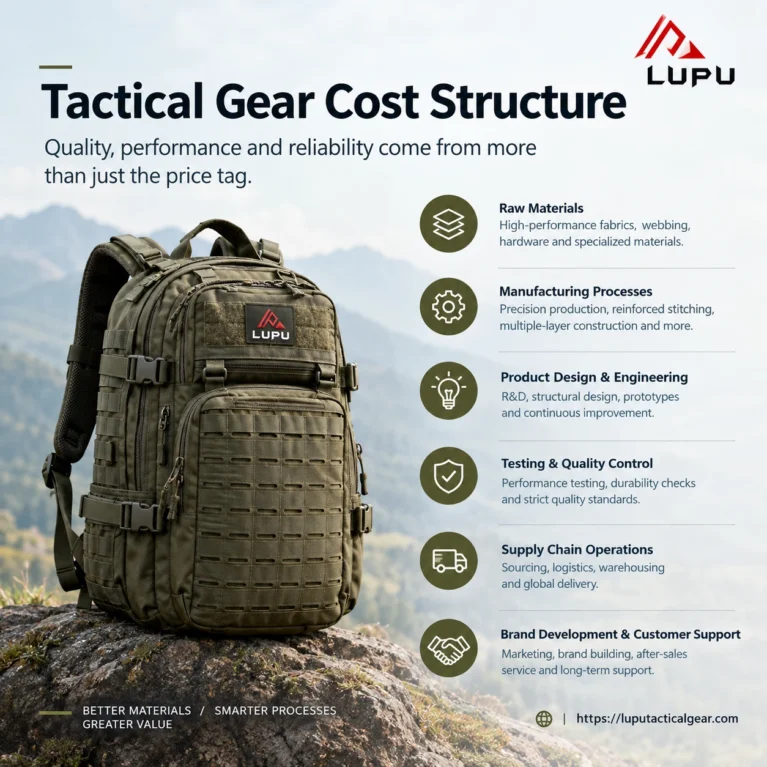
A factory does not calculate the cost of a tactical product from its appearance alone. The quotation is affected by material selection, construction complexity, component quality, labor, packaging, customization, testing, order volume, and production requirements.
For this reason, a detailed RFQ helps create a common technical understanding before price becomes the main discussion.
Tactical Gear RFQ Checklist: 15 Details Buyers Should Include
A strong RFQ should answer five fundamental questions:
What are you buying?
How should it be made?
How will quality be measured?
How many do you need?
When and where do you need them?
The following 15 items provide a practical framework.
1. Product Type and Intended Application
Start by identifying exactly what you want to manufacture.
Do not rely only on a photograph.
State whether the product is a:
- Tactical backpack
- Chest rig
- Tactical pouch
- Medical bag
- Tactical duffel bag
- Tactical belt
- Tactical vest
- Tactical dog harness
- Other specialized tactical equipment
Then explain the intended application.
For example:
- Outdoor use
- Hunting
- Law enforcement
- Training
- Professional equipment
- EDC
- Security applications
- Commercial retail
The intended application matters because the same product category can have very different specifications depending on its end use.
A backpack designed for commercial outdoor consumers may have very different requirements from a product intended for professional users. Load distribution, reinforcement, component selection, accessibility, adjustability, and durability can all change.
From a manufacturer’s perspective, “What is the product used for?” is often as important as “What is the product?”
If your application is clearly defined at the beginning, the factory has a better foundation for evaluating your specifications instead of making assumptions.
2. Product Dimensions and Capacity
Dimensions are one of the most important parts of an RFQ.
Provide precise measurements whenever possible, including:
- Overall length
- Overall width
- Overall height
- Main compartment dimensions
- Pocket dimensions
- Strap dimensions
- Panel dimensions
- Product capacity
- Relevant dimensional tolerances
For backpacks and other carrying products, also clarify how capacity is defined.
For example, saying that a backpack should have a capacity of approximately 30 liters provides useful direction, but it is still not a substitute for a dimensional drawing.
Two products can both be described as “30L tactical backpacks” while having completely different structures, proportions, pocket layouts, and material consumption.
A manufacturing RFQ should therefore combine capacity with physical dimensions and construction requirements.
If you already have a technical drawing, include it.
A drawing with dimensions is considerably more useful to a factorythan a product photograph with no measurements.
3. Material Specifications
“High-quality nylon” is not a sufficient material specification for a professional RFQ.
The material section should be as specific as your project requires.
Depending on the product, you may need to identify:
- Fabric type
- Fiber composition
- Denier
- Fabric weight
- Coating
- Backing
- Finish
- Color
- Performance requirements
- Preferred material source or grade
For example, a buyer may specify a particular nylon construction rather than simply requesting “durable fabric.”
Material selection directly affects:
- Unit cost
- Product weight
- Abrasion resistance
- Hand feel
- Appearance
- Sewing behavior
- Availability
- Production lead time
It can also affect the quotation in ways that are not immediately visible from a finished product photograph.
This is one reason professional buyers should avoid leaving critical material decisions completely undefined unless they are specifically asking the factory to recommend suitable alternatives.
If you are open to equivalent materials, say so clearly.
A useful RFQ can state:
Preferred material: [specified material]
Acceptable alternative: equivalent performance material subject to approval
That gives the manufacturer room to optimize the construction without silently changing the specification.
4. Color and Color-Matching Requirements
Color should be treated as a specification, not simply a visual preference.
Clearly identify:
- Standard color
- Custom color
- Pantone reference, where applicable
- Camouflage pattern
- Webbing color
- Hardware color
- Lining color
- Color requirements for different components
This becomes particularly important when multiple materials are used in the same product.
For example, the fabric, webbing, zipper tape, binding, hook-and-loop material, and hardware may all be visually different even when the product is described simply as “black.”
If color consistency is important to your brand, specify how color should be controlled and approved.
It is usually more efficient to establish the color standard during sample development than to discover a disagreement after bulk production has started.
For custom colors, also remember that material availability and minimum production quantities can affect the project.
5. Hardware and Component Requirements
The hardware and small components of tactical equipment can have a major effect on product performance, appearance, and cost.
Your RFQ should identify important components such as:
- Buckles
- Zippers
- Sliders
- D-rings
- Hooks
- Fasteners
- Adjustment hardware
- Webbing
- Cord
- Cord locks
- Hook-and-loop components
Where a specific brand, material, finish, or performance level is required, state it.
If you do not require a particular supplier or brand, define the performance expectation instead.
For example, rather than writing:
“Use a strong buckle.”
you can specify:
“Use a heavy-duty buckle suitable for the intended load and application; factory to propose component specification for approval.”
This distinction matters.
A supplier may interpret vague component language differently from the buyer.
The more important a component is to product function, the less you should leave to assumption.
6. Construction and Stitching Requirements
A tactical product is not defined only by its fabric.
Construction quality plays a major role in durability.
For customized products, your RFQ should identify important construction requirements such as:
- Seam construction
- Stitching method
- Stitch density where relevant
- Bar-tack locations
- Reinforcement areas
- Binding
- Load-bearing points
- Stress-point construction
- Seam allowance where critical
- Reinforced attachment areas
This is particularly important around handles, shoulder straps, MOLLE panels, attachment points, and other areas exposed to repeated stress.
A common mistake is to specify a high-performance fabric but provide very little information about construction.
That can produce a product that looks correct but does not behave as expected under actual use.
From a manufacturing standpoint, material performance and construction performance must be considered together.
A good RFQ therefore describes not only the raw materials, but also the areas where structural integrity matters most.
7. Functional and Attachment Features
Next, define what the product needs to do.
This is different from simply describing what the product looks like.
Depending on the product, functional requirements may include:
- MOLLE compatibility
- Hook-and-loop panels
- Hydration compatibility
- Compression straps
- Adjustable harness systems
- Quick-access compartments
- Laptop or equipment compartments
- External attachment points
- Concealed compartments
- Modular components
- Quick-release mechanisms
Also explain any functional relationship between components.
For example, if an external attachment system must accommodate a specific pouch or accessory, explain the compatibility requirement rather than assuming the factory will infer it from a photograph.
This is especially important when developing customized tactical equipment.
A product image tells a manufacturer where something appears to be.
A functional specification explains what that component must accomplish.
Those are not the same thing.
8. Branding and Customization Requirements
If the product is private label or OEM, branding needs to be defined before quotation.
Include details such as:
- Logo location
- Logo size
- Embroidery
- Screen printing
- Woven labels
- Rubber or PVC patches
- Custom zipper pulls
- Custom webbing
- Hangtags
- Packaging graphics
- Other proprietary details
Also specify whether you will provide production-ready artwork.
For example, you may already have vector artwork for a logo but still need the manufacturer to prepare embroidery files or a custom patch specification.
Customization can affect:
- Sampling cost
- Tooling
- MOQ
- Unit cost
- Development time
- Production lead time
A factory cannot accurately account for these elements if the RFQ simply states “add our logo.”
The same applies to custom hardware.
A custom zipper pull, buckle, molded component, or branded label may require additional development work that should be identified before production planning begins.
9. Packaging and Labeling Requirements
Packaging is frequently overlooked during the quotation stage.
That is a mistake because packaging can affect both cost and shipping efficiency.
Your RFQ should state whether you require:
- Individual polybags
- Individual boxes
- Retail packaging
- Hangtags
- Barcode labels
- SKU labels
- Carton markings
- Shipping marks
- Country-of-origin markings
- Special packing instructions
Also specify whether the packaging is part of the retail product or simply intended to protect the goods during transportation.
For example, a wholesale tactical product shipped in bulk may require a very different packaging configuration from a product intended to enter a retail store directly.
Packaging dimensions can also affect carton utilization and shipping costs.
The earlier these requirements are defined, the less likely you are to discover packaging-related cost changes near shipment.
10. Quality Standards and Inspection Requirements
One of the most important rules in manufacturing is this:
“High quality” is not a measurable specification.
Every buyer considers quality important, but the factory needs to understand exactly what quality means for the project.
Your RFQ can identify requirements such as:
- Appearance standards
- Dimensional tolerances
- Stitching standards
- Functional inspection
- Defect classification
- Sampling inspection
- AQL requirements where applicable
- Pre-shipment inspection
- Customer-specific inspection procedures
The goal is to turn subjective expectations into measurable acceptance criteria.
For example, instead of saying:
“The stitching must be perfect.”
define the areas that require inspection and the acceptable conditions.
For a professional B2B order, quality should ideally be discussed before production rather than only after the goods are completed.
This gives the buyer and manufacturer a common reference for production approval.
11. Testing and Performance Requirements
Some tactical gear projects require more than visual inspection.
If testing is required, state it clearly in the RFQ.
Depending on the product, this could include:
- Abrasion resistance
- Colorfastness
- Seam strength
- Load testing
- Water resistance
- Zipper performance
- Material performance testing
- Other customer-specific testing
But simply writing “must pass testing” is still incomplete.
A useful test requirement has three components:
Test required → Test method or standard → Acceptance criteria
This distinction is critical.
For example, if you require load testing, explain what function is being evaluated and what result is considered acceptable.
Do not assume that the factory and buyer have exactly the same interpretation of “heavy duty,” “water resistant,” or “professional grade.”
Testing requirements should be connected to the real application of the product.
12. Compliance and Market Requirements
The destination market should be identified as early as possible.
Different markets, customers, retailers, and product categories may have their own requirements concerning:
- Product labeling
- Material restrictions
- Chemical compliance
- Packaging
- Documentation
- Customer-specific standards
- Import requirements
- Retailer requirements
Your factory needs this information before final material and component decisions are made.
A specification that looks acceptable at the product-design level may require modification when the intended market or customer compliance requirements are considered.
This is why “Where will the product be sold?” belongs in a professional RFQ.
For B2B buyers, compliance should not be treated as paperwork that appears at the end of the project. It should be part of the product definition from the beginning.
13. Quantity, MOQ, and Order Forecast
Every quotation needs a realistic understandingof volume.
At minimum, provide:
- Sample quantity
- Initial order quantity
- Quantity per SKU
- Quantity per color
- Expected repeat-order volume
- Approximate annual demand, if available
There is an important distinction between initial order quantity and long-term potential.
A buyer might initially require 500 units but expect the product to become a major item with several thousand units per year.
That information can help the factory evaluate material sourcing, production planning, component procurement, and future pricing structure.
Do not exaggerate forecasts simply to obtain a lower quotation.
A realistic forecast is much more useful than an inflated number that never becomes an order.
Also understand that MOQ can be affected by more than the finished-product quantity.
Custom colors, custom hardware, special materials, packaging, and other components can introduce separate minimum quantities.
A detailed RFQ allows the factory to identify those conditions before they become surprises.
14. Target Price, Commercial Terms, and Shipping Requirements
Price is obviously important, but how you request the price matters.
Where appropriate, identify:
- Currency
- Requested Incoterm
- Destination port or location
- Payment expectations
- Tooling cost expectations
- Packaging expectations
- Whether sample costs should be quoted separately
- Target price or target price range, if you choose to provide one
Some buyers prefer not to disclose a target price because they want the factory to provide an independent quotation.
Others provide a target price because it helps the manufacturer understand the commercial positioning of the product.
Neither approach is automatically correct.
The important thing is to be transparent about the commercial framework.
More importantly, compare quotations on the same basis.
A factory quoting a lower unit price may be using:
- A different material
- Lower-cost hardware
- Different packaging
- Different construction
- Lower testing requirements
- Different commercial terms
In other words:
A cheaper quotation is not necessarily a cheaper equivalent product.
An RFQ should create an apples-to-apples comparison.
15. Sampling, Production, and Delivery Timeline
Finally, tell the factory when you need the product.
Your timeline should ideally include:
- RFQ submission
- Sample request date
- Sample approval target
- Production start target
- Required shipment date
- Launch date, if relevant
Be realistic.
A manufacturer must consider material availability, custom component development, sample revisions, production scheduling, quality inspection, and shipping.
A common procurement mistake is to define the final delivery date without allowing enough time for sample approval and production preparation.
For customized tactical products, the timeline should be treated as a sequence:
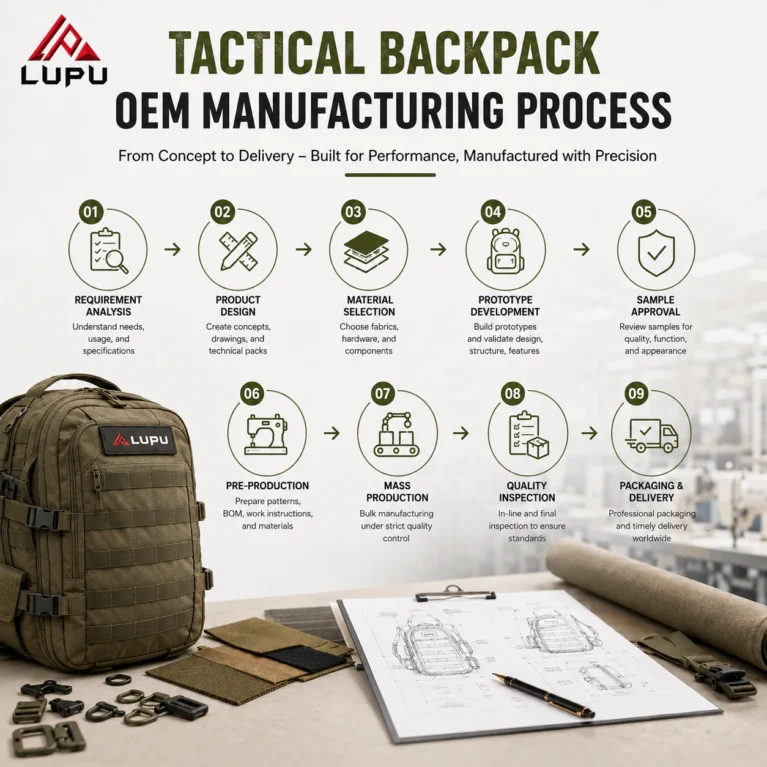
RFQ → Quotation → Development → Sample → Sample Approval → Material Preparation → Mass Production → Inspection → Shipment
When one stage changes, the following stages may also move.
Therefore, the best time to discuss the timeline is before the purchase order is issued.
What Buyers Should Attach to a Tactical Gear RFQ?
A detailed written description is valuable, but supporting files can make the RFQ substantially clearer.
Technical Drawings
A technical drawing can communicate information that is difficult to explain with words.
Include dimensions, component locations, seam positions, pockets, attachment points, and other construction details where relevant.
The more customized the product, the more valuable a proper drawing becomes.
Reference Images
Reference images are useful, but they should be treated as communication tools rather than complete technical specifications.
When using images, annotate them.
Point out:
- Required pocket positions
- Material areas
- Hardware
- Nähen
- Branding
- Functional features
- Changes from the reference product
A single annotated image can eliminate several rounds of clarification.
Tech Pack
For a complex OEM project, a tech pack can bring the entire RFQ together.
A good tech pack can include:
- Product drawings
- Bill of materials
- Material specifications
- Measurements
- Color references
- Component specifications
- Artwork
- Construction details
- Packaging
- Quality requirements
For larger projects with multiple SKUs or several product revisions, a well-maintained tech pack becomes an important reference throughout development and production.
Existing Physical Sample
When available, a physical sample can be extremely useful.
A sample allows the manufacturer to evaluate:
- Construction
- Material thickness
- Hardware
- Nähen
- Dimensions
- Functional details
- Overall workmanship
However, the sample should still be accompanied by written specifications.
The sample may represent what you currently have, while the RFQ defines what the manufacturer is expected to produce.
Those two things are not always identical.
Common RFQ Mistakes That Cause Pricing and Production Problems
Even experienced buyers can create problems when an RFQ is incomplete.
Here are some of the most common.
Asking Only for a Unit Price
A message such as:
“What is your best price for 1,000 units?”
does not provide enough technical information for a meaningful manufacturing quotation.
The price is only useful when the specification behind it is clear.
Using Vague Material Terms
Terms such as:
- “Premium nylon”
- “Heavy-duty fabric”
- “Military quality”
- “Strong buckle”
- “Waterproof material”
sound professional but are technically ambiguous.
Two factories can interpret the same phrase in completely different ways.
When performance matters, define the actual requirement.
Omitting the Intended Market
A factory may need to understand whether the product is destined for:
- North America
- Europe
- Other export markets
- Direct commercial distribution
- A specific retail customer
- Professional institutional use
Market information can affect compliance, labeling, packaging, and material decisions.
Changing Specifications After Quotation
A buyer may initially request one material, then change the fabric after seeing the quotation.
Later, the buyer may add another pocket, change the hardware, modify the packaging, and adjust the dimensions.
At that point, the original quotation is no longer a meaningful reference.
Major specification changes should trigger a quotation review.
This protects both the buyer and manufacturer from working against an outdated commercial assumption.
Comparing Quotes Based Only on Unit Price
This is one of the most common B2B purchasing mistakes.
Before comparing prices, confirm that the quotations use the same:
- Product dimensions
- Materials
- Components
- Construction
- Branding
- Packaging
- Quality requirements
- Testing requirements
- Quantity
- Commercial terms
Only then does a price comparison become useful.
How to Make a Tactical Gear RFQ Easier for a Factory to Quote?
The best RFQ is not necessarily the longest document.
It is the document that provides the right information in the right order.
A practical process is:
Step 1: Define the product
Explain what the product is and what it is intended to do.
Step 2: Lock the critical specifications
Define dimensions, materials, components, construction, colors, and functional requirements.
Step 3: Prepare supporting files
Attach drawings, photographs, tech packs, artwork, and samples where available.
Step 4: Define quantity and forecast
Separate sample quantities, initial order quantities, and expected future volume.
Step 5: Define quality and testing
Specify measurable quality requirements instead of relying on vague descriptions.
Step 6: Clarify customization
Identify logos, labels, packaging, custom hardware, and other OEM requirements.
Step 7: Define the timeline
State sample deadlines, production targets, and required shipping dates.
Step 8: Send the same specification to qualified manufacturers
For a meaningful comparison, give each factory the same core information.
Step 9: Compare the responses technically and commercially
Do not evaluate the price before verifying what is actually being quoted.
How Buyers Should Compare Factory Quotations?
Once your RFQ has been sent to a tactical backpack manufacturer or other qualified tactical gear supplier, the next challenge is evaluating the responses.
Do not create a supplier ranking based on unit price alone.
Instead, compare:
|
Evaluation Area |
What to Check |
|
Specification |
Does the supplier understand the requested product? |
|
Materials |
Are the quoted materials identical or equivalent? |
|
Components |
Are the hardware and zippers clearly defined? |
|
Construction |
Does the quotation reflect the required construction? |
|
Customization |
Are branding and custom components included? |
|
MOQ |
Does the supplier meet your required quantity? |
|
Sample |
Can the supplier support the development process? |
|
Quality |
Are inspection requirements understood? |
|
Testing |
Can required testing be supported? |
|
Vorlaufzeit |
Is the production schedule realistic? |
|
Packaging |
Is the quoted packaging correct? |
|
Commercial Terms |
Are the Incoterm and payment conditions comparable? |
|
Communication |
Are questions answered clearly and technically? |
A good manufacturer does not simply provide a number.
The quotation process itself can reveal how carefully a supplier understands your project.
If a supplier identifies a specification problem, points out a potential production issue, or suggests a cost-saving alternative without reducing the required performance, that can be a valuable sign of manufacturing competence.
A Practical Tactical Gear RFQ Template
The following template can be copied and adapted for a factory inquiry.
Product:
[Product name / SKU]
Intended Application:
[How and where the product will be used]
Dimensions:
[Overall dimensions / key measurements / capacity]
Material:
[Fabric specification / denier / coating / lining]
Color:
[Color name / Pantone / camouflage pattern]
Hardware:
[Buckles / zippers / sliders / hooks / other components]
Construction:
[Stitching / reinforcement / attachment requirements]
Functional Features:
[MOLLE / compartments / hydration / adjustment / other requirements]
Branding:
[Logo / label / embroidery / patch / artwork]
Packaging:
[Polybag / box / hangtag / barcode / carton requirements]
Quality Requirements:
[Appearance / dimensional tolerance / AQL / inspection requirements]
Testing Requirements:
[Required test / method / acceptance criteria]
Compliance Requirements:
[Target market / customer requirements / labeling requirements]
Sample Quantity:
[Number of samples]
Initial Order Quantity:
[Number of units]
Forecasted Annual Volume:
[Estimated future demand]
Target Price:
[Target price or “please quote”]
Commercial Terms:
[Requested currency / Incoterm / payment expectations]
Sample Deadline:
[Date]
Production Start Target:
[Date]
Required Delivery Date:
[Date]
Shipping Destination:
[Port / country / location]
Attachments:
[Tech pack / drawings / images / artwork / reference sample]
This format gives the manufacturer a much clearer basis for evaluating the project.
Frequently Asked Questions About Tactical Gear RFQs
What should I include in a tactical gear RFQ?
At minimum, provide the product type, application, dimensions, materials, color, components, construction requirements, functional features, branding, packaging, quality requirements, testing requirements, quantity, commercial terms, and timeline.
The more customized or performance-sensitive the product is, the more important detailed specifications become.
Do I need a tech pack to request a tactical gear quotation?
Not every project requires a formal tech pack.
For a relatively simple product, detailed drawings, specifications, reference photographs, and a clear written description may be sufficient for an initial quotation.
For a complex OEM product, however, a tech pack can significantly reduce ambiguity and make the development process more efficient.
The key question is not whether you have a document called a “tech pack.”
The key question is whether the factory has enough information to understand the product without making critical assumptions.
Should I include a target price in an RFQ?
That depends on your purchasing strategy.
Providing a target price can help a factory determine whether the project is commercially realistic and where cost optimization may be required.
Not providing a target price allows the supplier to provide an independent quotation based on the actual specification.
Either approach can work.
What matters most is that the product specification is clear enough for the factory to calculate a meaningful quotation.
How many factories should I send the same RFQ to?
There is no universal number.
The objective should not be to send an incomplete RFQ to as many factories as possible.
Instead, identify manufacturers that have the relevant product capabilities, OEM experience, production capacity, quality systems, and target-market experience.
Then provide qualified suppliers with the same core specification so that their responses can be compared fairly.
How can I compare tactical gear factory quotations fairly?
First make sure that the quotations are based on the same specification.
Then compare materials, components, construction, customization, testing, packaging, MOQ, lead time, commercial terms, and quality requirements.
Only after those elements are aligned does unit price become a meaningful comparison.
Final Takeaway: A Better RFQ Leads to a Better Manufacturing Project
A successful tactical gear RFQ should do more than ask a factory for a price.
It should establish a common technical and commercial understanding between buyer and manufacturer.
The manufacturer needs to know:
What should be produced?
How should it be constructed?
What materials and components should be used?
What performance and quality level is expected?
How many units are required?
What market will the product enter?
When does the buyer need delivery?
When these questions are answered clearly, the quotation process becomes more efficient and the risk of misunderstanding becomes much lower.
A well-prepared Tactical Gear RFQ Checklist can help buyers:
- Receive more accurate quotations
- Reduce unnecessary clarification rounds
- Improve sample development
- Compare suppliers on an apples-to-apples basis
- Control unexpected cost changes
- Establish measurable quality expectations
- Reduce production and delivery risks
- Choose a manufacturing partner based on capability rather than price alone
For OEM and private-label tactical gear projects, the RFQ is often the first real test of the relationship between buyer and manufacturer.
A strong RFQ does not simply help a factory quote faster.
It helps both sides start the project with the same understanding of the product, the same expectations for quality, and the same definition of success.
Need a quotation for a customized tactical gear project? Prepare your product specifications, drawings or reference images, estimated quantity, quality requirements, and target timeline, then send them to an experienced Hersteller von taktischer Ausrüstung for technical evaluation and quotation.