A tactical backpack is often evaluated by its storage capacity, fabric durability, MOLLE compatibility, and overall construction. However, one critical component is sometimes overlooked during product development: the back panel.
The back panel is the primary interface between a backpack and the user’s back. Its construction influences how the pack sits against the body, how pressure is distributed, how much air can circulate between contact areas, and how effectively the carrying system maintains stability under load.
Für Marken für taktische Ausrüstung and product developers, designing effective Tactical Pack Back Panels requires more than adding foam padding or breathable mesh. It involves coordinating several engineering considerations, including ventilation channel geometry, cushioning materials, structural reinforcement, shoulder strap positioning, and waist belt integration.
A back panel that feels comfortable when empty may behave very differently when the backpack is fully loaded. Similarly, a highly ventilated design may not provide sufficient structural support for a pack intended to carry heavier equipment.
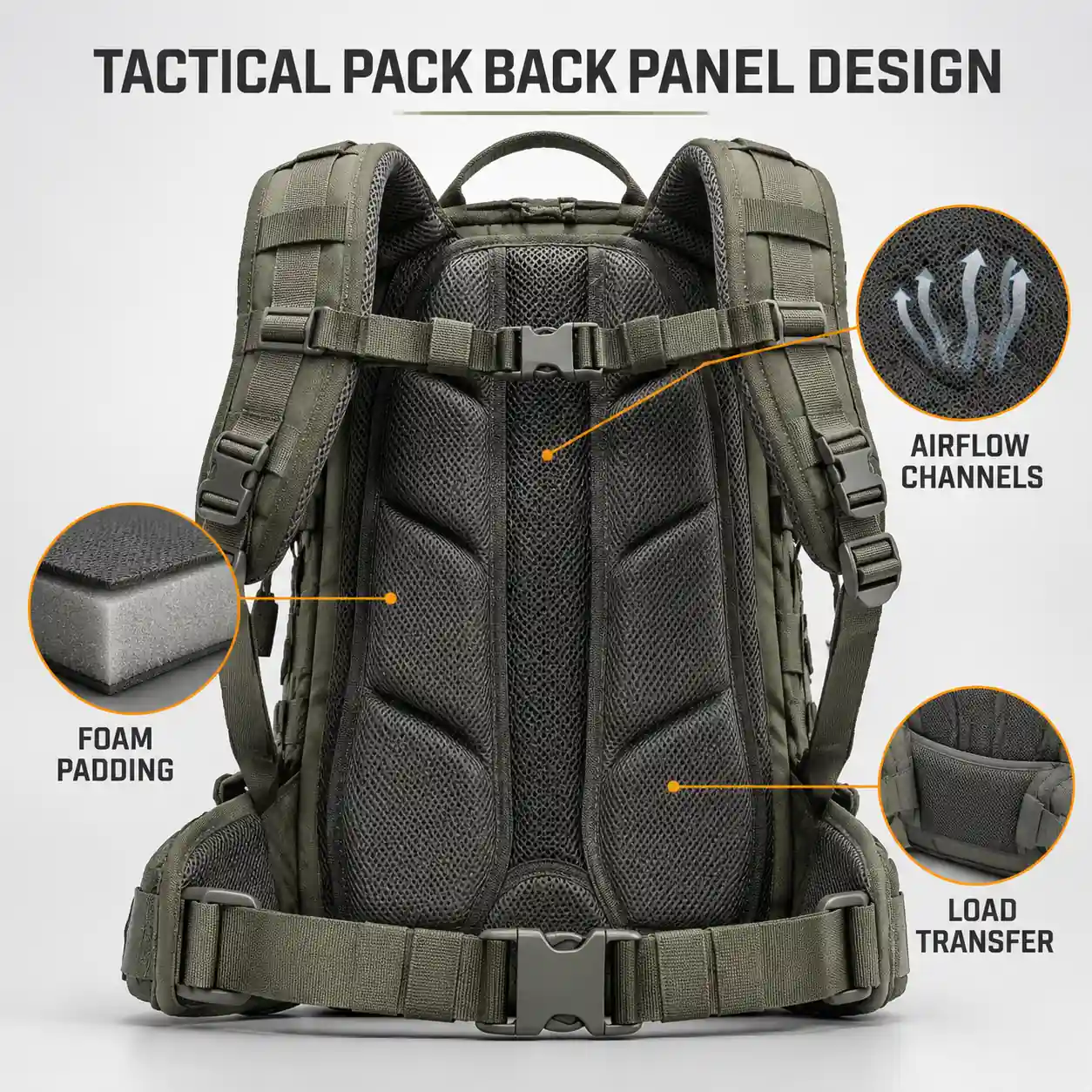
This guide examines the main construction principles behind tactical pack back panels, explains the functions of airflow channels and padding, and explores how back panel design contributes to load transfer and overall product performance.
1. Understanding the Structure of Tactical Pack Back Panels
A tactical backpack back panel is not simply a padded fabric surface. It is a layered construction that combines cushioning, contact materials, reinforcement, and attachment structures.
The exact configuration depends on the backpack’s capacity, intended application, load requirements, and overall carrying system.
1.1 The Main Components of a Back Panel
Most padded tactical pack back panels incorporate several functional components.
Outer fabric and reinforcement layers
The outer fabric provides a finished surface and helps protect the internal components. Depending on the construction, reinforcement materials may also be incorporated around high-stress areas, attachment points, and structural connections.
Material selection should consider abrasion resistance, flexibility, weight, and compatibility with the other layers.
Schaumstoffpolsterung
Foam provides cushioning between the backpack and the user’s back. Its thickness, density, firmness, and shape influence the contact characteristics of the panel.
Different sections may require different cushioning properties. For example, a panel designed for a compact daypack may use a relatively simple foam construction, while a larger backpack may require more structured support.
Mesh or spacer fabric
Mesh materials are commonly used on contact surfaces to improve ventilation and provide a suitable textile interface against clothing.
Spacer fabrics can create additional separation between the backpack and the user’s back. Their performance depends on construction, thickness, compression behavior, and material properties.
Structural support elements
Some backpacks incorporate internal reinforcement panels, support sheets, frame components, or other structural elements.
These components help maintain the intended pack shape and support the carrying system. Their necessity depends on the product’s load requirements and design architecture.
Ventilation channels and contact zones
Raised padding sections and recessed channels can create pathways for air movement. The arrangement of these features determines where the backpack contacts the body and where additional space is available for ventilation.
1.2 Common Back Panel Construction Approaches
There is no single back panel construction that is suitable for every tactical backpack.
Common approaches include:
- Flat padded panels:Relatively straightforward construction with a continuous padded contact surface.
- Contoured foam panels:Shaped padding designed to follow the intended back contact geometry.
- Channel-based ventilation panels:Raised sections and recessed areas designed to create airflow pathways.
- Structured back panels:Reinforced constructions intended to help maintain pack shape and support the carrying system.
- Hybrid back panels:Combinations of foam, mesh, reinforcement, and shaped contact zones.
The choice should be based on actual product requirements rather than appearance alone.
1.3 How Back Panel Construction Influences Pack Performance
Back panel construction affects several aspects of the finished backpack:
|
Design factor |
Potential influence |
|
Contact surface |
Influences how the backpack rests against the user’s back |
|
Padding configuration |
Affects cushioning and localized pressure |
|
Airflow channel layout |
Creates opportunities for air circulation |
|
Structural reinforcement |
Helps maintain pack shape and support attachment areas |
|
Shoulder strap integration |
Influences fit and carrying stability |
|
Waist belt integration |
Supports the overall load-bearing system |
These factors are interconnected. Changing the thickness of the padding, for example, may affect the pack’s internal dimensions, contact geometry, ventilation channels, and shoulder strap positioning.
For this reason, back panel design should be developed as part of the complete backpack structure.
2. Airflow Channels: Improving Ventilation and Moisture Management
Heat and moisture buildup are common considerations in backpack design, particularly when a pack is worn for extended periods or during physically demanding activities.
A backpack positioned directly against the user’s back can restrict air movement across the contact area. This may increase the feeling of heat and moisture accumulation.
Airflow channels are one design approach used to address this challenge.
2.1 Why Airflow Matters in Tactical Backpack Design
When a backpack is worn, the back panel and the user’s clothing create a contact interface. Depending on the panel geometry, portions of this interface may have limited air circulation.
The situation can become more noticeable when:
- The backpack is worn for extended periods.
- The user is moving continuously.
- The environment is hot or humid.
- The backpack carries a substantial load.
- The back panel has a large, relatively flat contact surface.
Ventilation design aims to create opportunities for air movement without sacrificing the support and stability required by the backpack.
It is important to understand that airflow channels do not eliminate heat or perspiration. Their purpose is to improve the conditions for air circulation around the back panel.
2.2 How Airflow Channels Work
Airflow channels are generally created through the geometry of the padding and contact surface.
Raised foam sections can form contact zones, while recessed sections create spaces between the backpack and the user’s back.
Several design variables influence how these channels function.
Channel depth
Channel depth affects the available space between contact zones. A deeper channel may create more separation, but excessive recessing can reduce the supporting contact area.
Channel width
Channel width determines the space available for air movement. However, channel width must be considered together with the dimensions and arrangement of the surrounding padding.
Channel direction
Different layouts can be used depending on the overall panel geometry:
- Vertical channels provide pathways running along the length of the back panel.
- Horizontal channels create crosswise recessed areas.
- Multi-directional layouts combine different channel orientations.
Channel spacing
The distance between raised contact zones affects how the panel distributes contact pressure and maintains support.
A well-designed layout should balance ventilation opportunities with a stable contact surface.
2.3 Materials Used in Ventilated Back Panels
Material selection is just as important as channel geometry.
Common materials include:
Open-cell foam
Open-cell foam has a cellular structure that can allow air and moisture movement through the material. Its cushioning behavior and durability depend on the formulation, density, and construction.
Closed-cell foam
Closed-cell foam generally provides a more enclosed cellular structure and can offer useful cushioning and structural characteristics. It is often selected where water absorption, resilience, or support requirements influence material choice.
Spacer mesh
Spacer mesh uses a three-dimensional textile construction that creates separation between fabric surfaces. It can provide a combination of cushioning, ventilation opportunities, and textile durability.
Breathable lining fabrics
The lining or contact fabric should be selected according to its intended use, abrasion exposure, moisture behavior, and compatibility with the underlying foam.
Perforated or molded cushioning materials
Some designs use perforations, molded recesses, or shaped foam sections to create additional ventilation pathways.
No material should be selected based on the label “breathable” alone. Its performance must be considered within the complete back panel construction.
2.4 Ventilation Design: Common Trade-Offs
A common mistake in product development is assuming that more ventilation automatically produces a better back panel.
In reality, ventilation must be balanced against several other requirements.
- Excessive channel depth may reduce the supporting contact area.
- Large recessed sections may affect cushioning distribution.
- Thin mesh may be vulnerable to abrasion.
- Highly flexible materials may not maintain their intended geometry under compression.
- Complex molded structures may increase manufacturing requirements.
The objective is not to maximize the number of channels. It is to develop a ventilation layout appropriate for the backpack’s size, intended load, and carrying system.
3. Back Panel Padding: Balancing Cushioning and Structural Support
Padding is one of the most visible features of tactical pack back panels, but selecting the correct foam involves more than choosing the thickest or softest available material.
A functional padding system should provide appropriate cushioning while maintaining the shape and support characteristics required by the backpack.
3.1 The Role of Padding in Tactical Packs
Padding creates a buffer between the backpack structure and the user’s body.
Its main functions include:
- Reducing concentrated contact pressure.
- Improving the contact interface.
- Supporting the intended back panel geometry.
- Helping maintain a consistent relationship between the backpack and the user.
- Providing cushioning around areas where structural components may otherwise create uncomfortable contact.
However, padding alone does not determine carrying comfort.
A backpack’s fit, center of gravity, shoulder strap design, waist belt configuration, and internal load arrangement all contribute to the overall carrying experience.
3.2 Common Padding Materials and Their Characteristics
Different foam materials offer different combinations of cushioning, resilience, weight, and structural behavior.
EVA Foam
Ethylene-vinyl acetate (EVA) foam is commonly used in bags and outdoor equipment because it is available in different densities and firmness levels.
Its properties can be adjusted according to the intended application, making it useful for shaped padding and structured cushioning components.
PU Foam
Polyurethane foam is available in a range of formulations with different cushioning and compression characteristics.
Depending on the formulation, it can be used in applications where a softer or more compliant contact surface is required.
PE Foam
Polyethylene foam can provide relatively firm support and dimensional stability. It may be suitable for applications where the back panel requires a more structured feel.
Layered Foam Construction
Some back panels combine multiple foam materials.
For example, a softer contact layer may be combined with a firmer supporting layer. This approach allows the designer to address different functional requirements within the same panel.
The final construction should be evaluated as a complete system rather than judging each material independently.
3.3 Foam Density, Thickness, and Firmness
Three variables deserve particular attention during foam selection.
Density
Density describes the mass of foam per unit volume. It is an important material specification, but it should not be treated as a direct measurement of comfort or firmness.
Two foam materials with similar density may have different compression behavior depending on their formulation and cellular structure.
Thickness
Thickness influences the depth of cushioning and the overall profile of the back panel.
Increasing thickness may provide more cushioning material, but it can also:
- Increase the backpack’s external dimensions.
- Reduce available internal space.
- Change the contact geometry.
- Affect shoulder strap positioning.
- Increase material consumption and production complexity.
Firmness
Firmness influences how the foam responds when compressed.
A very soft foam may compress significantly under load, while a firmer material may maintain its shape more effectively.
The appropriate balance depends on the intended load range, panel design, and other structural components.
3.4 Padding Placement and Pressure Distribution
Padding should be positioned according to the geometry and functional requirements of the backpack.
Important areas may include:
- Upper back contact zones.
- Central back support areas.
- Lower back contact zones.
- Areas adjacent to shoulder strap attachment points.
- Sections where the panel connects with a waist belt.
The objective is to avoid unnecessary pressure concentration while maintaining a stable contact interface.
For larger backpacks, the padding layout should also be evaluated under representative loading conditions. A panel that performs well when empty may compress differently once the backpack carries equipment.
4. Load Transfer: How Back Panel Design Works With the Carrying System
Load transfer is one of the most important considerations in larger tactical backpacks.
A well-designed carrying system should manage the relationship between the backpack’s load, the user’s body, and the structural components connecting them.
The back panel plays an important role, but it should not be viewed as an independent load-transfer mechanism.
4.1 Understanding Load Transfer in a Tactical Backpack
When a backpack is loaded, its weight is supported through a combination of structural and body-contact components.
The main elements may include:
- Back panel.
- Shoulder straps.
- Sternum strap.
- Waist belt.
- Internal support structures, where applicable.
The way these components are connected influences how the backpack sits against the body and how its load is supported.
For smaller daypacks, the shoulder straps may carry most of the load. Larger backpacks with appropriately designed and fitted waist belts may transfer part of the load toward the hips.
The exact behavior depends on the pack’s construction, fit, and loading configuration.
4.2 The Relationship Between Back Panel and Shoulder Straps
Shoulder straps are directly connected to the back panel and form a critical part of the carrying system.
Their position, geometry, padding, and attachment strength influence how the backpack fits and remains stable.
During product development, Hersteller taktischer Ausrüstung should consider:
- Shoulder strap attachment height.
- Strap angle and spacing.
- Reinforcement around attachment points.
- Compatibility between strap geometry and back panel contour.
- Adjustment range for different user profiles.
If the shoulder straps are positioned incorrectly, even a well-padded back panel may fail to provide the intended fit.
For this reason, shoulder strap development and back panel design should be evaluated together.
4.3 The Role of Waist Belts in Load Distribution
A waist belt can help transfer part of a backpack’s load toward the hips when it is appropriately designed, fitted, and connected to the pack structure.
Its effectiveness depends on more than the presence of a belt.
Zu den wichtigen Aspekten gehören:
- Belt width and padding.
- Adjustment range.
- Attachment position.
- Structural reinforcement.
- Compatibility with the back panel.
- The intended backpack load.
A waist belt that is attached only to a lightly reinforced fabric section may not provide the structural support required by the intended application.
The attachment area should therefore be designed with the expected forces and product specifications in mind.
4.4 Internal Support and Structural Reinforcement
Some taktische Rucksäcke use additional structural components to help maintain their shape and support heavier loads.
Beispiele hierfür sind:
HDPE support sheets
High-density polyethylene sheets may be used as internal support elements. They can help maintain the shape of the backpack and provide a more structured back panel.
Frame stays
Frame stays or similar support components may be incorporated into designs requiring additional structural support.
Reinforcement panels
Additional fabric layers or reinforcement materials can be used around high-stress attachment areas.
The choice depends on the intended carrying system. A compact tactical daypack does not necessarily require the same structural construction as a large-capacity backpack.
4.5 Load Stability and Back Panel Geometry
A stable backpack should maintain an appropriate relationship with the user’s back during movement.
Several design factors influence this:
- Pack depth and overall geometry.
- Position of heavier equipment.
- Back panel contour.
- Shoulder strap adjustment.
- Waist belt configuration.
- Internal organization and load placement.
Heavier items generally benefit from being positioned close to the user’s back, subject to the backpack’s intended loading instructions and product design.
This can help reduce excessive movement and maintain a more controlled carrying position.
Back panel design should therefore be considered together with internal compartment layout and the intended equipment configuration.
5. Choosing the Right Back Panel Design for Different Tactical Pack Applications
Different tactical backpacks have different structural requirements. A back panel suitable for a compact daypack may not be appropriate for a larger pack designed to carry heavier equipment.
5.1 Compact Tactical Daypacks
Compact daypacks generally prioritize:
- Relatively lightweight construction.
- Practical cushioning.
- Low-profile padding.
- Freedom of movement.
- Simple ventilation features.
Because these packs are typically designed around more limited carrying requirements, a complicated structural support system may not be necessary.
The back panel should remain comfortable and stable without adding unnecessary weight or bulk.
5.2 Medium-Capacity Tactical Backpacks
Medium-capacity backpacks often require a more balanced combination of cushioning, ventilation, and structural stability.
Design considerations may include:
- More developed padding layouts.
- Clearly defined airflow channels.
- Reinforced shoulder strap attachment areas.
- Adjustable sternum straps.
- Compatibility with a waist belt.
- Appropriate internal support.
The back panel should be designed around the intended carrying configuration rather than capacity alone.
5.3 Large-Capacity Tactical Packs
Large-capacity backpacks place greater demands on the carrying system, especially when they are intended for heavier equipment.
Zu den wichtigen Aspekten gehören:
- More structured back panel construction.
- Appropriate internal reinforcement.
- Properly integrated waist belt systems.
- Reinforced shoulder strap connections.
- Padding designed around the intended load.
- Stable pack geometry.
Ventilation remains important, but structural support and load stability may become more demanding design priorities.
5.4 Specialized Tactical and Outdoor Applications
Environmental conditions and usage patterns also influence back panel specifications.
Zum Beispiel:
- Warm environments may increase the importance of ventilation features.
- Extended carrying periods may require careful attention to cushioning and fit.
- Equipment-heavy applications may require additional structural support.
- High-movement activities may place greater emphasis on pack stability.
There is no universal back panel specification for all tactical applications. Product development should begin with a clear understanding of the intended user and operating conditions.
6. Manufacturing Considerations: Turning Back Panel Design Into a Reliable Product
A back panel can look well designed in a technical drawing but still present challenges during actual production.
The manufacturing process must translate the design into consistent components that maintain their intended dimensions, material properties, and assembly quality.
6.1 Material Selection and Component Compatibility
Before production, manufacturers should evaluate the compatibility of the main back panel components.
These may include:
- Outer fabric.
- Foam materials.
- Spacer mesh.
- Contact fabrics.
- Reinforcement materials.
- Structural support sheets.
- Stitching materials.
The materials should work together in terms of thickness, flexibility, abrasion resistance, and assembly requirements.
For example, a thick foam component may require a different construction approach from a thin, flexible padding layer.
Similarly, mesh selection should consider both ventilation requirements and the friction exposure associated with repeated use.
6.2 Foam Cutting, Shaping, and Assembly
Foam processing affects the consistency of the finished back panel.
Important manufacturing considerations include:
Dimensional accuracy
Foam sections should follow the approved dimensions and shape specifications.
Thickness consistency
Variations in thickness can influence the contact surface and overall panel geometry.
Channel consistency
Where molded or shaped channels are used, their dimensions and positions should remain consistent with the approved design.
Layer alignment
When multiple foam and fabric layers are combined, alignment is important for maintaining the intended construction.
Assembly quality
The assembly process should prevent unnecessary movement, folding, or distortion of the internal components.
These details may appear small, but they can influence the appearance and functional consistency of the finished backpack.
6.3 Stitching and Reinforcement
Back panels are connected to other important parts of the carrying system.
The attachment areas for shoulder straps, waist belts, and structural components should receive appropriate attention during product development.
Manufacturing considerations include:
- Stitch consistency.
- Seam construction.
- Reinforcement placement.
- Attachment point alignment.
- Appropriate stitching around layered materials.
- Secure finishing of fabric and mesh edges.
The reinforcement method should be selected according to the intended application and the approved construction specifications.
6.4 Quality Control During Production
Back panel inspection should cover both appearance and construction.
A practical quality control checklist may include:
|
Inspection item |
What to check |
|
Dimensions |
Overall panel size and component alignment |
|
Foam construction |
Thickness, placement, and consistency |
|
Surface materials |
Fabric condition, mesh quality, and finishing |
|
Ventilation features |
Channel layout and shape consistency |
|
Nähen |
Seam quality and visible defects |
|
Shoulder strap connections |
Alignment and reinforcement |
|
Befestigungen am Hüftgurt |
Attachment construction and finishing |
|
Finished assembly |
Symmetry, shape, and overall workmanship |
Inspection standards should be defined according to the approved product specifications.
Where a particular performance claim is made, the manufacturer should use an appropriate test method and retain supporting records rather than relying solely on visual inspection.
7. How to Evaluate Tactical Pack Back Panel Performance
For product developers and tactical gear buyers, back panel evaluation should involve more than checking whether the padding feels soft.
A systematic evaluation should consider ventilation, cushioning, structural support, and durability.
7.1 Ventilation Evaluation
Review the airflow channel arrangement and the materials used on the contact surface.
Questions to consider include:
- Are the channels positioned consistently?
- Is the mesh appropriate for the intended application?
- Do the recessed sections provide the intended separation?
- Does the ventilation design compromise the supporting contact areas?
Where possible, evaluate the complete backpack under representative wearing conditions.
7.2 Cushioning and Compression Evaluation
Evaluate the foam materials according to their specified characteristics.
Consider:
- Foam thickness.
- Density.
- Firmness.
- Compression behavior.
- Recovery after compression.
- Consistency between samples.
It is important to distinguish material specifications from actual wearing comfort. The complete backpack should be evaluated with its intended load and carrying configuration.
7.3 Structural and Load-Bearing Evaluation
Inspect the areas connecting the back panel to the carrying system.
Particular attention should be given to:
- Shoulder strap attachment points.
- Waist belt connections.
- Reinforcement construction.
- Internal support components.
- Overall pack shape under the intended load.
Testing should follow a defined procedure based on the product’s intended application.
7.4 Wear and Durability Evaluation
The back panel experiences repeated contact with clothing, body movement, and environmental exposure.
Relevant inspection and testing considerations may include:
- Mesh abrasion resistance.
- Stitching and seam integrity.
- Foam deformation.
- Material separation.
- Attachment point durability.
- Shape retention after repeated use.
Results should be interpreted according to the actual test conditions. A performance statement should not be generalized beyond what the evidence supports.
8. Common Back Panel Design Mistakes to Avoid
Several design decisions can reduce the effectiveness of an otherwise well-constructed tactical backpack.
Mistake 1: Assuming Thicker Foam Always Means Better Comfort
More foam does not automatically produce better carrying performance.
Excessive thickness may change the pack’s profile, reduce internal space, and affect shoulder strap geometry.
The correct approach is to select foam according to the intended cushioning and support requirements.
Mistake 2: Designing Ventilation Channels Without Considering Support
A ventilation layout that creates too much separation may reduce the available contact area.
Channel geometry should be evaluated together with padding distribution and pack stability.
Mistake 3: Selecting Mesh Based Only on Appearance
Not all mesh materials offer the same abrasion resistance, flexibility, or structural behavior.
Material selection should reflect the actual contact conditions and expected product lifespan.
Mistake 4: Ignoring Shoulder Strap and Waist Belt Integration
The back panel cannot compensate for poor carrying system geometry.
Strap positioning, attachment strength, and belt integration must be considered during the early design stages.
Mistake 5: Failing to Reinforce Load-Bearing Attachment Points
Shoulder straps and waist belts connect to areas that may experience repeated loading.
Insufficient reinforcement or inconsistent stitching can affect long-term construction reliability.
Mistake 6: Evaluating Comfort Without Testing the Loaded Backpack
An empty backpack does not represent its intended operating condition.
Back panel cushioning, contact pressure, and pack stability should be reviewed with a representative load.
9. OEM Tactical Backpack Development: Customizing Back Panel Specifications
For tactical gear brands, back panel customization can be an important part of product differentiation.
An OEM manufacturer should work with the brand to translate the intended application into practical construction specifications.
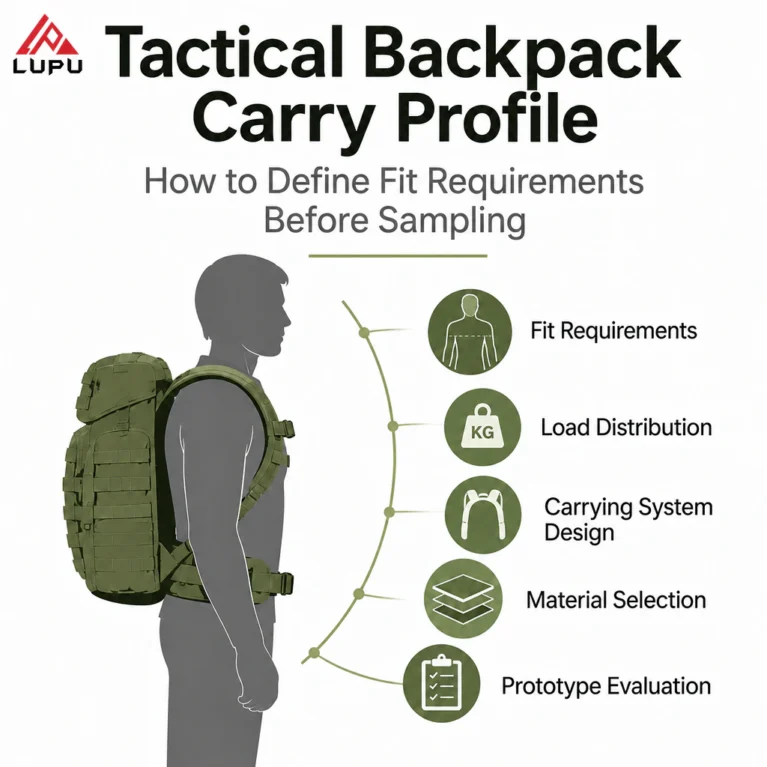
9.1 Defining Product Requirements Before Sampling
Before beginning prototype development, brands should provide as much relevant information as possible.
Important details include:
- Backpack capacity.
- Intended application.
- Target load range.
- User profile and fit requirements.
- Preferred back panel construction.
- Foam material and thickness preferences.
- Ventilation requirements.
- Shoulder strap configuration.
- Waist belt requirements.
- Desired product weight and dimensions.
Clear specifications help reduce unnecessary revisions during sample development.
9.2 Working With an OEM Manufacturer on Back Panel Development
A structured development process generally includes the following stages.
Step 1: Confirm product requirements
Review the backpack’s intended use, carrying requirements, dimensions, and design references.
Step 2: Review material and construction options
Evaluate suitable foam, mesh, fabric, reinforcement, and support components.
Step 3: Develop the initial prototype
Translate the agreed specifications into a physical sample.
Step 4: Evaluate fit and construction
Review back panel shape, padding arrangement, ventilation channels, strap positioning, and overall assembly.
Step 5: Adjust the design
Make necessary revisions based on sample evaluation and feedback.
Step 6: Approve the pre-production sample
Confirm the final construction, materials, dimensions, and finishing details.
Step 7: Establish production and inspection specifications
Document the approved configuration so that production and quality control follow the same requirements.
9.3 Why Early Back Panel Decisions Matter
Back panel design influences several aspects of the finished product.
Decisions made during the early development stage can affect:
- Overall backpack weight.
- Internal storage dimensions.
- Material consumption.
- Production complexity.
- Component compatibility.
- Carrying performance.
- Manufacturing consistency.
For this reason, back panel requirements should be discussed before the product reaches the final sampling stage.
A well-defined specification also makes communication between the brand, product developer, and manufacturer more efficient.
10. Frequently Asked Questions
Q1. What makes a tactical backpack back panel breathable?
A breathable back panel generally combines appropriate surface materials, ventilation channels, and a suitable contact geometry.
Raised padding sections and recessed channels can create space for air movement, while spacer mesh and breathable fabrics can contribute to moisture and heat management.
The overall result depends on the complete construction rather than one individual material.
Q2. Which foam is best for tactical pack back panels?
There is no universally best foam.
EVA, PU, and PE foam offer different characteristics in terms of cushioning, firmness, resilience, and structural support.
The appropriate material depends on the backpack’s intended load, back panel geometry, required cushioning, and manufacturing specifications.
Q3. Do thicker tactical pack back panels provide better comfort?
Not necessarily.
Thickness is only one part of foam selection. Density, firmness, compression behavior, contact geometry, and carrying system design also influence the wearing experience.
A thicker panel may add unnecessary bulk if it is not properly integrated into the backpack structure.
Q4. How do back panels help distribute backpack weight?
Back panels contribute to the relationship between the backpack and the user’s body.
However, load distribution involves the entire carrying system, including shoulder straps, waist belts, and internal support components where applicable.
The back panel should therefore be designed together with these components.
Q5. Are ventilated back panels suitable for heavy tactical backpacks?
They can be suitable, provided that ventilation features are balanced with the structural requirements of the backpack.
For heavier load configurations, the design should pay particular attention to reinforcement, support, attachment strength, and pack stability.
Ventilation should not come at the expense of necessary structural performance.
Q6. Can tactical pack back panels be customized for OEM projects?
Yes. Depending on the manufacturer’s capabilities and the product specifications, customization may include:
- Foam material and thickness.
- Padding layout.
- Airflow channel geometry.
- Mesh material.
- Reinforcement construction.
- Structural support components.
- Shoulder strap integration.
- Waist belt attachment configuration.
The final design should be confirmed through sample development and specification approval.
11. Conclusion: Back Panel Engineering Is a System-Level Design Decision
Tactical pack back panels play an important role in the overall performance of a backpack.
Airflow channels create opportunities for ventilation, foam padding provides cushioning, and structural components help maintain the intended relationship between the backpack and the user’s body.
However, none of these elements should be designed independently.
A successful back panel requires coordination between material selection, padding geometry, ventilation layout, shoulder strap positioning, waist belt integration, and structural reinforcement.
For tactical gear brands, the most effective approach is to define back panel requirements early, develop prototypes around the intended application, and establish clear manufacturing and quality control specifications before mass production.
A well-engineered back panel is not simply a comfort feature. It is an essential part of the backpack’s complete carrying system.
Developing a benutzerdefinierte taktische Rucksack for your brand?
LUPU Tactical Gear supports OEM and ODM development for tactical backpacks and related equipment, with customization options covering materials, back panel construction, padding, ventilation features, structural components, colors, and branding.
Contact our team at info@luputacticalgear.com to discuss your product requirements and manufacturing project.