Introduction: Why Choosing the Right Law Enforcement Tactical Gear Supplier Matters
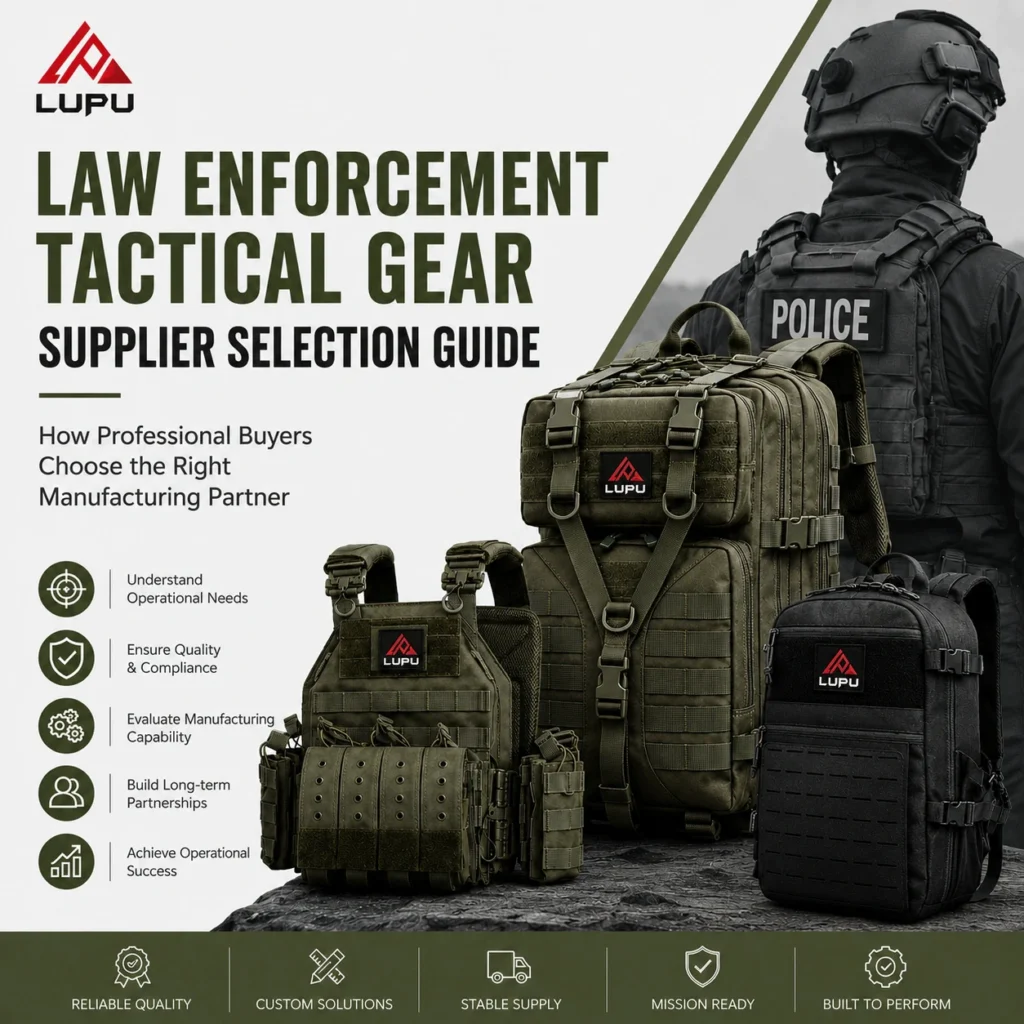
In law enforcement operations, tactical equipment is not simply a product purchased from a catalog. It is a mission-support tool designed to help professionals perform effectively in demanding environments.
A tactical backpack carried during extended patrol operations, a tactical vest used by specialized units, or an equipment pouch deployed during emergency response situations must provide consistent performance under pressure.
Unlike ordinary consumer gear, law enforcement equipment is expected to withstand:
- Daily operational use
- Heavy equipment loads
- Harsh environmental conditions
- Repeated deployment cycles
- Long-term field exposure
For this reason, selecting the right Law Enforcement Tactical Gear Supplier requires a much deeper evaluation process than comparing product appearance, unit pricing, or delivery time.
Professional buyers must evaluate whether a supplier has the capability to provide:
- Reliable tactical equipment design
- Appropriate material selection
- Consistent manufacturing quality
- Custom development support
- Stable production capacity
- Long-term supply reliability
A supplier that fails to understand operational requirements may deliver products that appear suitable but perform poorly in real-world conditions.
On the other hand, an experienced tactical equipment manufacturer can help organizations develop solutions that improve:
- User efficiency
- Equipment organization
- Operational readiness
- Product lifecycle value
The Difference Between Buying Tactical Gear and Building a Tactical Equipment Solution
Many organizations approach procurement with a simple question:
“Can this supplier provide the equipment we need?”
However, professional procurement teams ask a more important question:
“Does this supplier understand how the equipment will be used, and can they support our long-term operational requirements?”
This difference separates ordinary suppliers from professional tactical equipment partners.
A qualified Law Enforcement Tactical Gear Supplier should not only manufacture products but also contribute expertise throughout the entire development process, including:
- Requirement analysis
- Product engineering
- Prototype development
- Manufacturing optimization
- Quality verification
- Continuous improvement
For police departments, security organizations, government agencies, and tactical distributors, choosing the right supplier is ultimately a decision about operational reliability.
The right manufacturing partner does more than deliver equipment.
They provide confidence that every product has been designed, manufactured, and tested with professional requirements in mind.
Understanding the Role of a Professional Law Enforcement Tactical Gear Supplier
A professional tactical equipment supplier plays a much broader role than a traditional product vendor.
In the law enforcement industry, equipment requirements are often complex because users operate in different environments, perform different missions, and carry different equipment configurations.
A professional Law Enforcement Tactical Gear Supplier must understand the relationship between:
- Mission requirements
- Product design
- Material performance
- Manufacturing processes
- Field usability
The supplier’s responsibility begins long before production and continues long after delivery.
A complete supplier partnership typically includes three essential capabilities:
- Product development capability
- Manufacturing expertise
- Long-term supply support
1. Product Development Capability: Transforming Operational Needs Into Functional Equipment
The first responsibility of a professional tactical supplier is understanding the operational requirement behind the product.
Law enforcement organizations rarely need equipment simply because it exists.
They need equipment because it solves a specific operational challenge.
For example:
A patrol officer may require a backpack optimized for:
- Daily equipment organization
- Comfortable transportation
- Quick access to essential items
A tactical response unit may require a different configuration focused on:
- Increased load capacity
- Modular attachment systems
- Rapid deployment capability
- Enhanced durability
A professional supplier should be able to analyze these differences and provide technical recommendations.
Requirement Analysis Before Product Development
Before manufacturing begins, experienced suppliers should evaluate several key factors:
Mission Environment
Where will the equipment be used?
Possible environments include:
- Urban operations
- Outdoor environments
- Tactical deployment
- Emergency response
- Training scenarios
Each environment creates different engineering requirements.
For example:
A backpack designed for urban patrol may prioritize accessibility and organization.
A field deployment backpack may require:
- Greater structural reinforcement
- Weather resistance
- Increased carrying capacity
User Profile
Professional equipment design must consider the actual user.
Important questions include:
- Who will carry the equipment?
- How long will it be worn?
- What equipment must be stored?
- How quickly must items be accessed?
Equipment designed without understanding user workflow often creates unnecessary operational limitations.
Equipment Integration Requirements
Modern law enforcement equipment rarely operates independently.
A professional supplier should understand compatibility requirements with:
- MOLLE attachment systems
- Taktische Schutzwesten
- Duty equipment
- Communication devices
- Medical equipment
- Protective equipment
Small design decisions can significantly affect operational efficiency.
For example:
- Incorrect pocket placement may slow equipment access.
- Poor weight distribution may increase user fatigue.
- Weak attachment points may reduce equipment reliability.
A professional supplier evaluates the complete operational system, not just the individual product.
Prototype Development and Product Validation
Professional tactical equipment should not move directly from concept to mass production.
A reliable supplier should support a structured development process:
Concept Evaluation
The supplier reviews:
- Intended application
- Required functions
- Equipment configuration
- User expectations
Prototype Development
Initial samples allow buyers to evaluate:
- Ergonomics
- Storage organization
- Carrying comfort
- Material selection
- Structural design
Testing and Improvement
Feedback from prototype evaluation should be used to improve:
- Design details
- Reinforcement areas
- Component selection
- Production methods
This process reduces procurement risk and improves final product performance.
Material and Engineering Recommendations
A professional supplier should provide technical guidance rather than simply follow specifications.
Material selection is one of the most important decisions in tactical equipment development.
Different applications require different material characteristics.
Important considerations include:
Dauerhaftigkeit
Can the material withstand:
- Abrasion
- Heavy loads
- Repeated use?
Weight Efficiency
Does the material provide sufficient strength without unnecessary weight?
Environmental Resistance
Can the equipment perform under:
- Rain
- Dust
- Heat
- Cold environments?
A knowledgeable Law Enforcement Tactical Gear Supplier understands that material selection is a balance between performance, durability, weight, and cost.
The objective is not selecting the most expensive material.
The objective is selecting the most suitable material for the mission.
2. Manufacturing Expertise: The Foundation of Reliable Tactical Equipment
Product design alone does not guarantee performance.
Manufacturing capability determines whether a design can consistently meet professional requirements.
A factory producing ordinary bags may understand basic sewing and assembly.
However, professional tactical equipment manufacturing requires additional expertise in:
- Load-bearing structures
- Reinforced construction
- Heavy-duty stitching
- Component integration
- Production consistency
Tactical Manufacturing Requires Specialized Knowledge
Law enforcement equipment commonly experiences stress in specific areas:
- Shoulder straps
- Carry handles
- Attachment points
- Bottom panels
- Closure systems
A professional Hersteller von taktischer Ausrüstung understands these stress points and applies appropriate engineering solutions.
Examples include:
- Reinforced stitching patterns
- Additional load-bearing layers
- Strengthened connection points
- Improved structural support
These details may not always be visible, but they determine long-term reliability.
Production Quality and Manufacturing Consistency
For professional procurement projects, consistency is critical.
A supplier must ensure that every production batch maintains:
- Same dimensions
- Same material performance
- Same construction standards
- Same functional reliability
Large organizations cannot rely on inconsistent production.
Whether ordering hundreds or thousands of units, every piece of equipment should meet the approved specifications.
3. Long-Term Supply Support: Building a Reliable Equipment Partnership
Law enforcement organizations typically require more than a single purchase.
They need suppliers capable of supporting long-term cooperation.
A professional Lieferant für taktische Ausrüstung should provide:
Stable Production Capability
Including:
- Repeat order management
- Production planning
- Capacity control
- Supply continuity
This is especially important for:
- Government contracts
- Department-wide equipment programs
- Distributor partnerships
Continuous Improvement Capability
Professional suppliers should continue improving products based on:
- User feedback
- Field experience
- New materials
- Updated requirements
Equipment needs change over time.
A strong supplier relationship allows products to evolve with operational demands.
Technical Communication and Problem Solving
Long-term partnerships depend on effective communication.
A professional supplier should be able to:
- Understand technical requirements
- Provide engineering feedback
- Solve production challenges
- Recommend improvements
The strongest supplier relationships are collaborative.
The manufacturer becomes an extension of the customer’s equipment development team.
Why Professional Buyers Should Look Beyond the Supplier‘s Product Catalog?
A product catalog only shows what a supplier currently produces.
It does not reveal:
- Engineering capability
- Manufacturing depth
- Quality management
- Problem-solving ability
For professional law enforcement procurement, the real value of a supplier lies in their ability to support the entire equipment lifecycle.
The question is not:
“Can this company manufacture a taktischer Rucksack?”
The better question is:
“Can this company help us develop, manufacture, and continuously improve equipment designed for professional operations?”
That is the fundamental difference between a general tactical gear seller and a professional Law Enforcement Tactical Gear Supplier.
Key Factors to Evaluate a Law Enforcement Tactical Gear Supplier
Selecting a reliable Law Enforcement Tactical Gear Supplier requires a structured evaluation process.
Professional buyers should not judge suppliers only by product availability or quotation prices. Tactical equipment procurement involves operational reliability, product consistency, and long-term supply stability.
A qualified supplier should be evaluated across several key areas:
- Manufacturing capability
- Engineering and product development expertise
- Material knowledge
- Quality management systems
- Customization capability
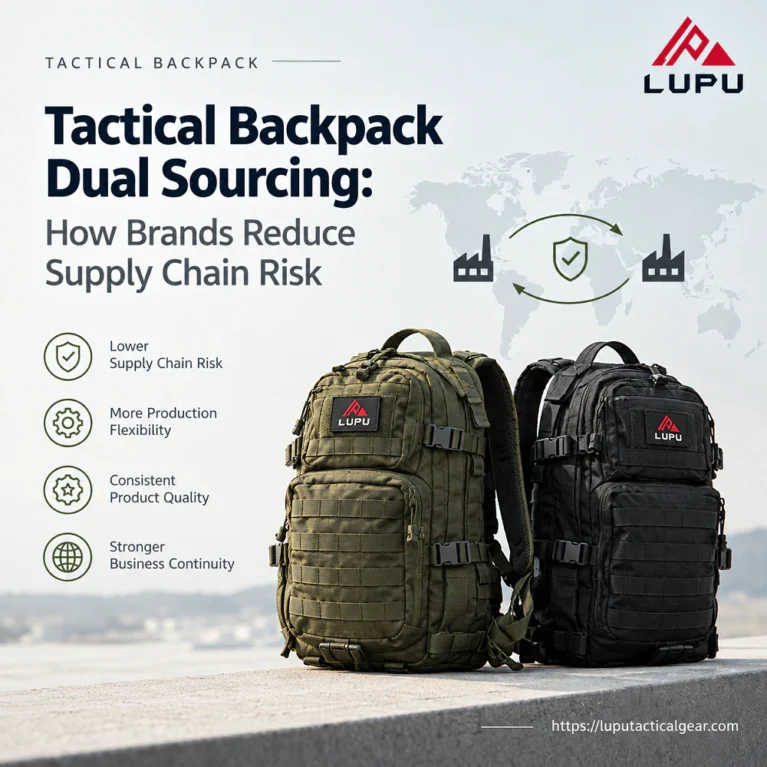
- Supply chain reliability
Each factor provides important information about whether a supplier can support professional law enforcement requirements.
1. Manufacturing Capability and Tactical Production Experience
The first evaluation factor is whether the supplier has genuine tactical manufacturing experience.
Tactical equipment manufacturing is highly specialized.
A company experienced in producing commercial backpacks may understand basic sewing and assembly, but professional law enforcement equipment requires a deeper understanding of:
- Load-bearing structures
- Reinforced construction
- Field durability
- Operational usability
- Long-term performance
When evaluating a supplier, buyers should consider:
Does the Supplier Manufacture Tactical Equipment Directly?
A direct manufacturer typically has better control over:
- Production processes
- Material selection
- Quality inspection
- Product improvement
Companies that only trade finished products may have limited ability to modify designs or solve manufacturing challenges.
Does the Supplier Understand Professional Applications?
An experienced tactical manufacturer should understand how products are used in:
- Patrol operations
- Tactical deployments
- Emergency response
- Security missions
This knowledge allows suppliers to provide more meaningful recommendations.
For example, a professional supplier should understand why a law enforcement backpack may require:
- Reinforced shoulder straps
- Rapid-access compartments
- Modular attachment capability
- Improved weight distribution
2. Engineering and Product Development Capability
A professional Law Enforcement Tactical Gear Supplier should have engineering capability beyond basic manufacturing.
Product development requires the ability to transform operational requirements into practical solutions.
Important capabilities include:
- Technical design support
- Prototype development
- Structural optimization
- Material recommendations
- Production improvement
Design Support
Experienced suppliers should help buyers evaluate:
- Product structure
- Functional layout
- Carrying system
- Equipment organization
A good design is not only visually appealing.
It must improve usability in real operational environments.
Prototype Development
Before large-scale production, prototypes allow buyers and manufacturers to verify:
- Ergonomics
- Accessibility
- Dauerhaftigkeit
- Functionality
The prototype stage is where professional suppliers demonstrate their technical value.
A supplier that can identify design weaknesses before production helps reduce:
- Manufacturing risks
- Costly modifications
- Product failures
3. Material Expertise and Performance Understanding
Materials are the foundation of tactical equipment performance.
A professional supplier should understand how different materials influence:
- Dauerhaftigkeit
- Gewicht
- Comfort
- Weather resistance
- Service life
Important material considerations include:
Fabric Selection
Common evaluation factors:
- Abrasion resistance
- Tensile strength
- Water resistance
- Weight efficiency
The correct fabric depends on the intended application.
For example:
A lightweight patrol backpack and a heavy-duty tactical deployment pack may require completely different material solutions.
Hardware Component Quality
Small components often determine overall equipment reliability.
Important components include:
- Buckles
- Zippers
- Webbing
- Hook-and-loop systems
- Adjustment hardware
Professional suppliers evaluate not only the main fabric but the complete product system.
4. Quality Management Capability
Quality control is one of the most important indicators of supplier reliability.
A professional tactical manufacturer should have a structured quality management process covering:
- Incoming materials
- Production processes
- Final inspection
- Packaging verification
Quality should not be treated as a final inspection activity.
It should exist throughout the entire manufacturing process.
5. Customization and OEM Capability
Many professional organizations require equipment adapted to specific operational needs.
A capable supplier should support customization in:
- Product structure
- Materials
- Function configuration
- Branding
- Packaging
For example, a department may require:
- Specific storage compartments
- Special attachment systems
- Unique color requirements
- Department identification features
A supplier with strong OEM capability can transform these requirements into practical manufacturing solutions.
Quality Control Standards Every Buyer Should Verify
Quality control is where professional tactical manufacturers demonstrate their real capability.
For law enforcement equipment, quality cannot depend on random inspection or visual appearance alone.
A reliable Law Enforcement Tactical Gear Supplier should have a complete quality management system.
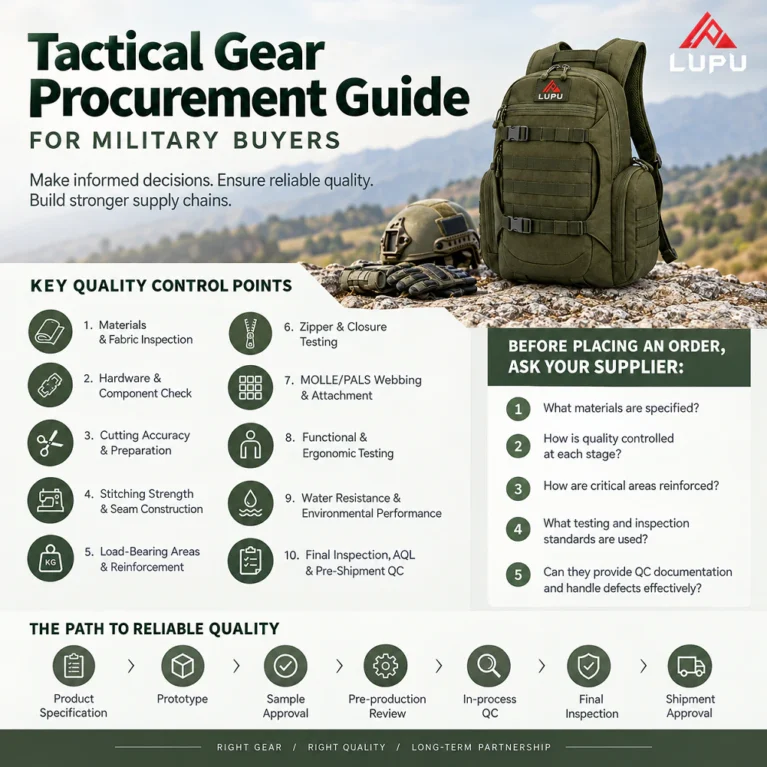
1. Material Inspection Before Production
Quality begins before manufacturing starts.
Professional suppliers should inspect incoming materials including:
- Fabrics
- Webbing
- Buckles
- Zippers
- Hardware components
Important checks include:
- Material consistency
- Color accuracy
- Physical condition
- Performance specifications
Using inconsistent materials can create unpredictable product performance.
2. Production Process Control
Manufacturing quality depends heavily on production discipline.
Important production checkpoints include:
Cutting Accuracy
Incorrect cutting can affect:
- Product dimensions
- Assembly accuracy
- Structural performance
Professional factories use controlled cutting processes to maintain consistency.
Sewing Quality
Tactical equipment requires stronger construction methods than ordinary bags.
Critical areas include:
- Shoulder straps
- Carry handles
- MOLLE attachment points
- Load-bearing seams
Important inspection factors:
- Stitch density
- Seam strength
- Reinforcement quality
Assembly Verification
During assembly, suppliers should verify:
- Component placement
- Hardware installation
- Functional operation
Small mistakes during assembly can affect field performance.
3. Final Product Testing and Inspection
Before shipment, professional suppliers should perform final inspections.
Evaluation areas include:
Appearance Inspection
Checking:
- Stitching quality
- Surface condition
- Product consistency
Functional Inspection
Checking:
- Zippers
- Buckles
- Adjustment systems
- Attachment points
Specification Verification
Confirming:
- Dimensions
- Gewicht
- Configuration requirements
For professional procurement projects, final inspection protects both supplier and buyer.
4. Documentation and Traceability
A mature supplier should maintain production records.
Documentation helps with:
- Quality tracking
- Repeat orders
- Product improvement
- Problem analysis
For organizations managing large equipment programs, traceability improves long-term reliability.
Evaluating Supplier Customization Capability for Law Enforcement Applications
Customization is one of the most valuable capabilities a professional tactical supplier can provide.
Law enforcement organizations often have unique requirements based on:
- Mission type
- Department procedures
- Equipment systems
- User preferences
A capable Law Enforcement Tactical Gear Supplier should support the complete customization process.
1. Requirement Analysis
Customization begins with understanding the user’s operational needs.
A professional supplier should evaluate:
- Intended users
- Equipment carried
- Usage environment
- Required functions
This prevents unnecessary features and ensures practical design.
2. Product Design and Engineering
After requirements are defined, suppliers should provide:
- Product concepts
- Structural recommendations
- Material suggestions
- Functional improvements
The goal is to create equipment that solves operational problems.
3. Prototype Development
Before mass production, prototypes allow testing of:
- Carry comfort
- Equipment accessibility
- Weight distribution
- Dauerhaftigkeit
Professional buyers should always evaluate samples before committing to large orders.
4. Custom Tactical Backpack Development
For many law enforcement applications, tactical backpacks require specialized solutions.
Possible customization areas include:
Internal Organization
Examples:
- Communication equipment compartments
- Medical storage sections
- Documentation areas
- Equipment separation systems
Carrying System
Including:
- Adjustable shoulder straps
- Reinforced handles
- Improved back support
External Configuration
Including:
- MOLLE compatibility
- Modular attachment points
- Weather protection features
5. Custom Tactical Vest Development
Tactical vests require careful consideration of:
- Weight distribution
- Mobility
- Attachment systems
- User comfort
A professional supplier should understand:
- Operational movement
- Equipment accessibility
- Long-term wearing requirements
Common Mistakes When Choosing a Law Enforcement Tactical Gear Supplier
Even experienced buyers can make mistakes during supplier selection.
Understanding common mistakes helps organizations avoid unnecessary risks.
Mistake 1: Selecting a Supplier Based Only on Price
Price is important, but it should not be the only decision factor.
Low-cost equipment may create hidden costs:
- Faster replacement cycles
- Increased maintenance
- Reduced operational reliability
Professional buyers should evaluate total lifecycle value rather than initial purchase price.
Mistake 2: Choosing a Supplier Without Manufacturing Capability
Some companies sell tactical equipment but do not control production.
Potential problems include:
- Limited customization ability
- Weak quality control
- Poor technical communication
- Unstable supply
Direct manufacturing capability usually provides better control over product quality and development.
Mistake 3: Ignoring Prototype Evaluation
A product may appear suitable on paper but perform differently in practical use.
Professional buyers should evaluate:
- Physical samples
- Material performance
- Functional design
- User feedback
Prototype testing reduces procurement risks.
Mistake 4: Failing to Evaluate Long-Term Support
Equipment programs often require years of support.
Buyers should consider:
- Replacement availability
- Repeat production capability
- Product improvement support
A supplier relationship should extend beyond the first shipment.
OEM vs Standard Tactical Equipment: Which Solution Is Better?
One of the most important decisions for professional buyers is choosing between standard products and customized solutions.
Both approaches have advantages.
The correct choice depends on operational requirements.
Standard Tactical Equipment
Advantages:
- Faster availability
- Lower development cost
- Suitable for common applications
Standard products are often appropriate when:
- Requirements are already satisfied
- Large customization is unnecessary
- Immediate supply is needed
Customized Tactical Equipment (OEM)
OEM solutions provide greater flexibility.
Advantages include:
- Mission-specific design
- Improved workflow integration
- Department-specific requirements
- Stronger product differentiation
Customized equipment is especially valuable for:
- Law enforcement programs
- Security organizations
- Tactical brands
- Professional distributors
When Should Buyers Choose OEM Solutions?
OEM development is recommended when organizations require:
- Unique equipment configurations
- Special operational features
- Long-term product standardization
A professional Law Enforcement Tactical Gear Supplier with OEM capability can help transform operational requirements into reliable equipment solutions.
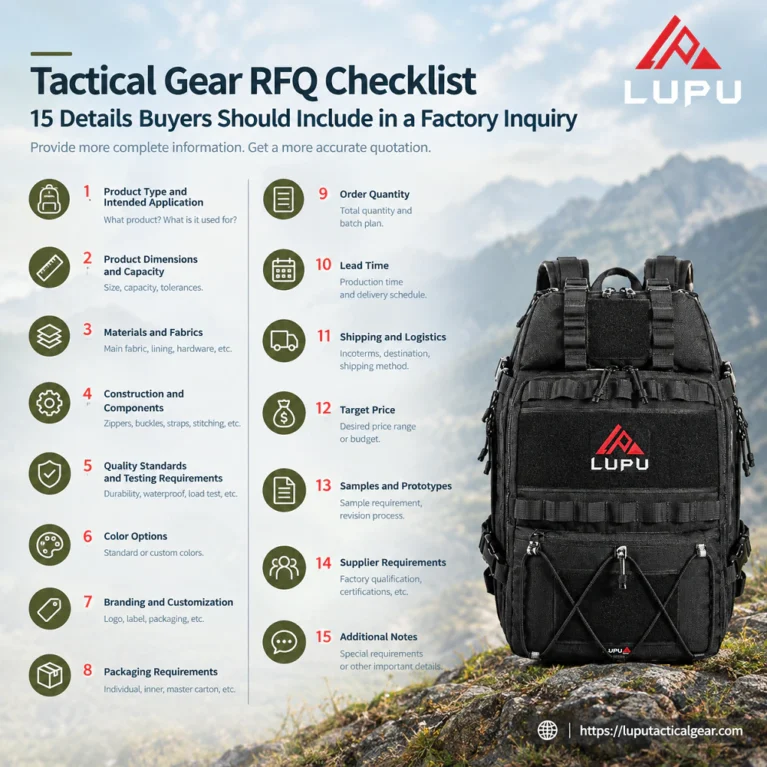
Questions to Ask Before Partnering With a Tactical Gear Supplier
Before selecting a supplier, professional buyers should conduct a structured evaluation.
The following questions help identify whether a supplier has the required capability.
Manufacturing Capability Questions
Ask:
- Do you manufacture tactical equipment directly?
- How many years of tactical production experience do you have?
- What product categories do you specialize in?
- Can you support repeat production?
Product Development Questions
Ask:
- Can you develop custom tactical products?
- Do you provide prototype samples?
- Can you recommend materials and structures?
- Can your engineering team support improvements?
Quality Control Questions
Ask:
- What quality inspection processes do you use?
- How do you control material consistency?
- How do you ensure production accuracy?
- Can you provide quality documentation?
Supply Chain Questions
Ask:
- Can you support long-term supply agreements?
- How do you manage production capacity?
- How do you handle repeat orders?
- How do you maintain consistency over time?
Final Evaluation Principle
The best supplier is not necessarily the company offering the lowest quotation.
The best supplier is the company that can provide:
- Technical expertise
- Manufacturing reliability
- Product customization
- Quality consistency
- Long-term cooperation
For professional organizations, choosing a Law Enforcement Tactical Gear Supplier means choosing a partner responsible for equipment performance, operational confidence, and long-term success.
Why Long-Term Supplier Partnerships Matter in Law Enforcement Equipment
For professional organizations, selecting a Law Enforcement Tactical Gear Supplier should not be viewed as a single purchasing transaction.
Law enforcement equipment programs often continue for years. Organizations require suppliers that can maintain product consistency, support future requirements, and provide reliable solutions as operational needs evolve.
A supplier relationship built around long-term cooperation creates advantages beyond the initial order.
It improves:
- Procurement efficiency
- Equipment standardization
- Product consistency
- Communication efficiency
- Long-term cost control
A professional supplier becomes an important part of the organization’s equipment management strategy.
1. Consistent Product Quality Over Time
One of the biggest challenges in tactical equipment procurement is maintaining consistency across multiple orders.
For example, an organization may purchase tactical backpacks or tactical vests over several years.
Without a stable manufacturing partner, problems may occur:
- Material differences between production batches
- Changes in product construction
- Inconsistent performance
- Difficulties with replacement products
A professional supplier with mature manufacturing systems can maintain:
- Approved material specifications
- Production standards
- Quality inspection procedures
- Product configuration records
This consistency is especially important for:
- Police departments
- Government agencies
- Security organizations
- Tactical equipment distributors
2. Easier Equipment Standardization
Large organizations often require standardized equipment across teams or departments.
Standardization provides benefits such as:
- Simplified training
- Easier equipment management
- Faster replacement procedures
- Improved user familiarity
A long-term supplier can help maintain standardized product solutions while allowing controlled improvements.
For example:
A law enforcement agency may establish a standard tactical backpack configuration and later request:
- Improved materials
- Updated hardware
- Better internal organization
A reliable supplier can implement these improvements without completely redesigning the product.
3. Faster Communication and Problem Solving
Professional equipment development requires effective communication.
During long-term cooperation, suppliers gain a deeper understanding of:
- Customer requirements
- Product expectations
- Operational challenges
- Quality standards
This reduces communication time and improves problem resolution.
A supplier who understands the customer’s operational environment can provide better recommendations than a company handling each order as an isolated transaction.
4. Continuous Product Improvement
The best tactical equipment suppliers continuously improve their products.
Improvement may come from:
- User feedback
- Manufacturing experience
- Material innovation
- New operational requirements
A strong partnership allows suppliers and customers to work together to improve:
- Product durability
- Equipment organization
- User comfort
- Manufacturing efficiency
This continuous improvement approach creates long-term value for both parties.
Future Trends in Law Enforcement Tactical Equipment Supply
The tactical equipment industry continues to evolve as operational requirements become more demanding.
Future-focused buyers are increasingly evaluating suppliers not only based on current products but also on their ability to adapt to changing industry needs.
Several important trends are shaping the future of professional tactical equipment manufacturing.
1. Lightweight Tactical Equipment Development
Weight reduction is becoming an increasingly important consideration in tactical equipment design.
Modern users often carry:
- Communication equipment
- Medical supplies
- Protective equipment
- Mission-specific tools
- Documentation systems
Excessive weight can reduce mobility and increase fatigue.
Future tactical equipment development will continue focusing on:
- High-strength lightweight materials
- Improved ergonomic designs
- Better weight distribution
- Reduced unnecessary components
A professional Law Enforcement Tactical Gear Supplier should understand that lightweight design is not simply about reducing material.
It requires balancing:
- Strength
- Dauerhaftigkeit
- Functionality
- User comfort
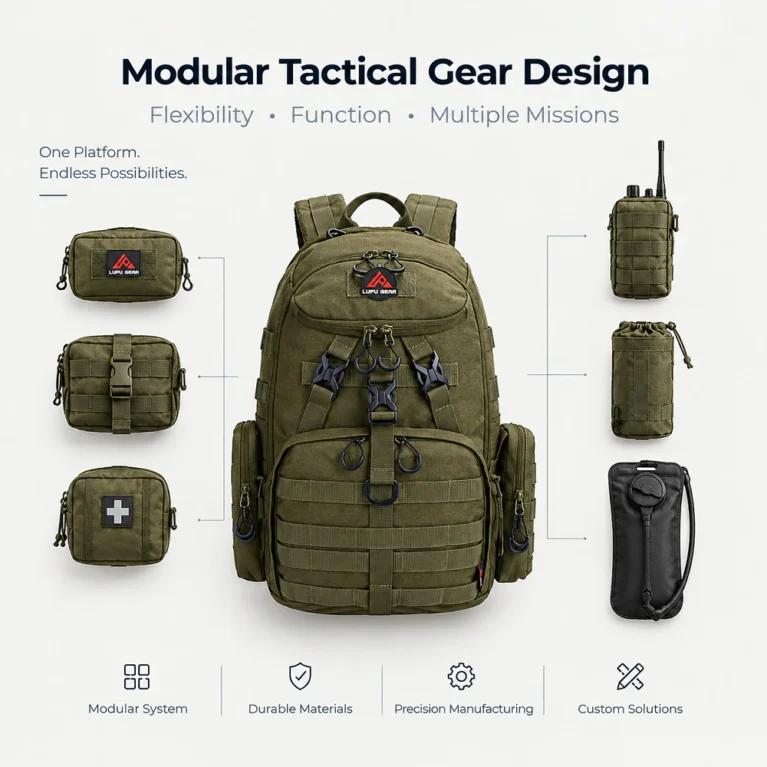
2. Modular Tactical Equipment Systems
Modern operational requirements are becoming increasingly flexible.
Different missions require different equipment configurations.
As a result, modular design is becoming more important.
Examples include:
- MOLLE-compatible systems
- Replaceable components
- Adjustable storage solutions
- Mission-specific attachments
Modular equipment allows users to adapt products according to:
- Mission type
- Environmental conditions
- Equipment requirements
For suppliers, this means product development must focus on flexibility and scalability.
3. Sustainable Tactical Equipment Manufacturing
Environmental responsibility is becoming an important consideration across global manufacturing industries.
Professional tactical manufacturers are increasingly exploring:
- More efficient production processes
- Longer product lifecycles
- Responsible material selection
- Reduced manufacturing waste
Sustainability in tactical equipment does not mean sacrificing performance.
The objective is to create equipment that provides:
- Long service life
- Reliable performance
- Responsible manufacturing practices
Future-oriented suppliers will need to balance operational requirements with sustainable manufacturing approaches.
4. Increasing Demand for OEM and Custom Solutions
As organizations become more specialized, demand for customized tactical equipment continues to grow.
Professional buyers increasingly require:
- Mission-specific designs
- Organization-specific configurations
- Customized branding
- Specialized storage solutions
This trend creates greater demand for suppliers with strong:
- Engineering teams
- Prototype capabilities
- Manufacturing flexibility
Suppliers that only provide standard products may struggle to support advanced customer requirements.
How to Choose the Right Law Enforcement Tactical Gear Supplier?
Selecting the right supplier requires a structured decision-making process.
Professional buyers should evaluate suppliers based on four essential criteria:
1. Technical Capability
The supplier should demonstrate the ability to understand and solve operational requirements.
Evaluate:
- Product development capability
- Engineering support
- Material knowledge
- Tactical application experience
A technically capable supplier can provide more value than a company that simply produces existing designs.
2. Manufacturing Reliability
Reliable manufacturing is the foundation of professional equipment supply.
Evaluate:
- Production capability
- Quality control systems
- Manufacturing experience
- Capacity stability
A supplier must be able to maintain consistent quality across repeated orders.
3. Customization Capability
Professional organizations often require equipment beyond standard solutions.
Evaluate whether the supplier can support:
- OEM projects
- Product modifications
- Custom configurations
- Prototype development
Customization capability demonstrates deeper manufacturing expertise.
4. Partnership Approach
The strongest supplier relationships are built on cooperation.
Evaluate:
- Communication ability
- Technical support
- Problem-solving approach
- Long-term commitment
The ideal supplier is not simply a manufacturer.
They are a partner that helps improve equipment solutions over time.
Conclusion: Selecting a Supplier Is Selecting a Tactical Capability Partner
Choosing a Law Enforcement Tactical Gear Supplier is a strategic decision that directly affects equipment reliability, operational efficiency, and long-term procurement success.
Professional buyers should look beyond:
- Product appearance
- Short-term pricing
- Simple availability
Instead, they should evaluate:
- Manufacturing expertise
- Engineering capability
- Quality management
- Custom development ability
- Long-term supply reliability
A professional tactical equipment supplier understands that every product serves a purpose.
A tactical backpack is not only a bag.
A tactical vest is not only protective equipment.
A mission-support system is a carefully engineered solution designed around real operational requirements.
The right supplier combines technical knowledge, manufacturing experience, and partnership commitment to deliver equipment that professionals can rely on.
For law enforcement agencies, security organizations, distributors, and tactical brands, choosing the right Law Enforcement Tactical Gear Supplier means choosing a long-term capability partner.