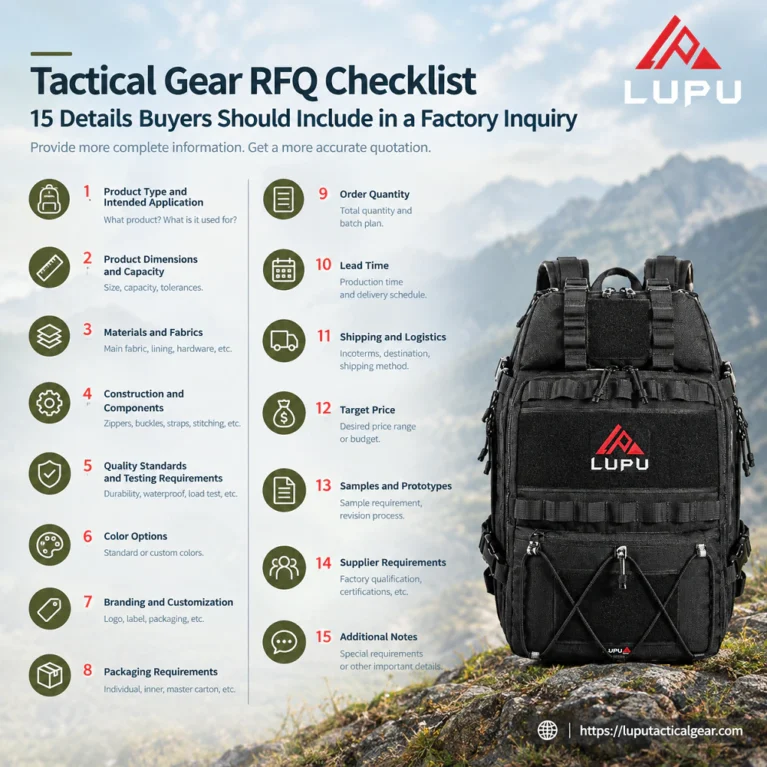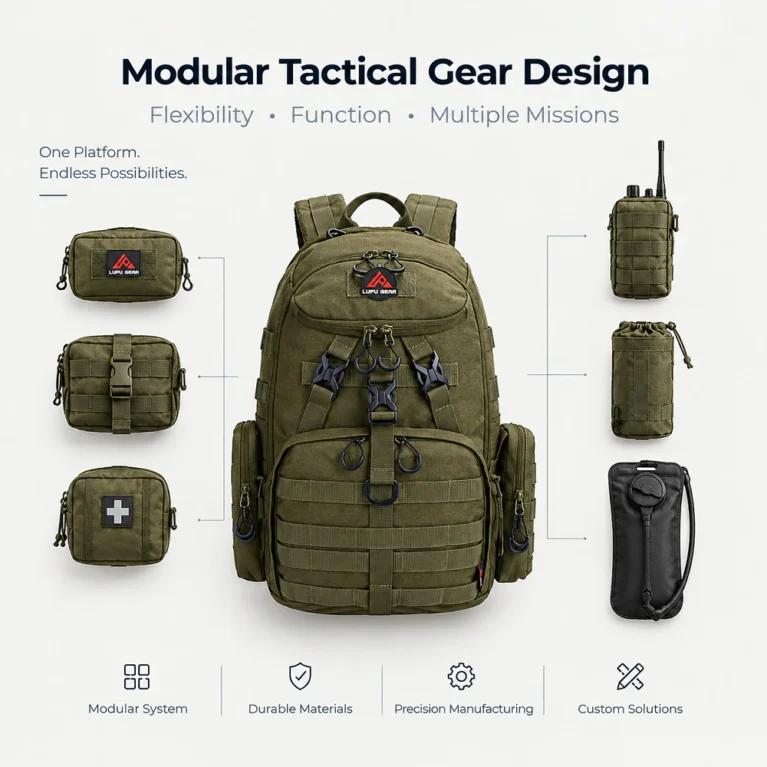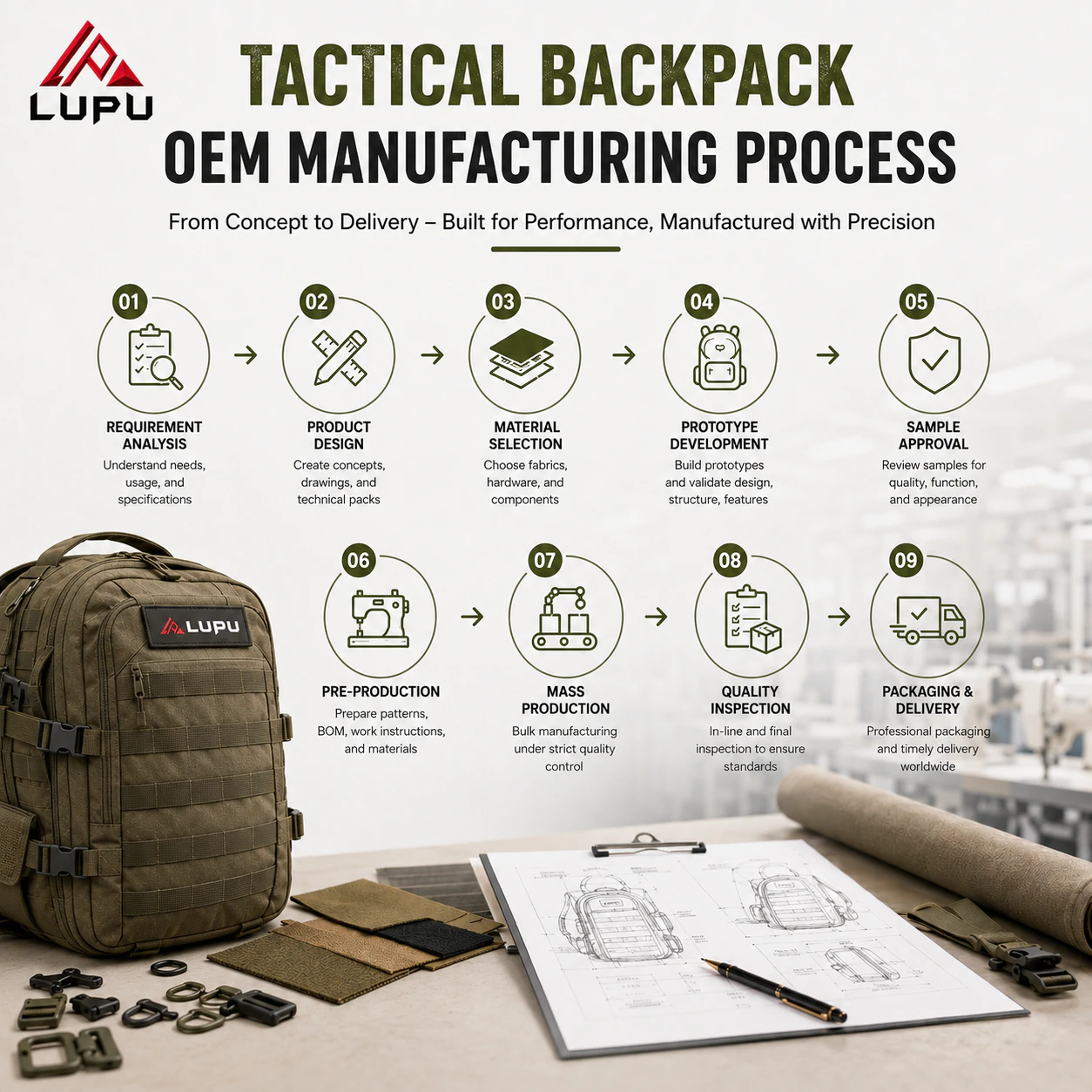
Tactical backpacks are designed for demanding environments where durability, organization, carrying comfort, and functional performance matter. For brands, wholesalers, distributors, and professional gear companies, developing these products requires more than selecting a ready-made bag and adding a logo.
A reliable tactical backpack manufacturing process involves multiple stages, from requirement analysis and structural design to material selection, prototype development, mass production, quality control, and final delivery. Each stage can influence the backpack’s functionality, production consistency, cost, and suitability for its intended market.
For OEM projects, the process becomes even more important because the final product is often developed around specific requirements defined by the customer.
This guide explains how a tactical backpack moves from an initial concept to a production-ready product and what B2B buyers should consider when working with an OEM manufacturer.
Tactical Backpack OEM Manufacturing Process at a Glance
A professional OEM project normally follows a structured development and production workflow:
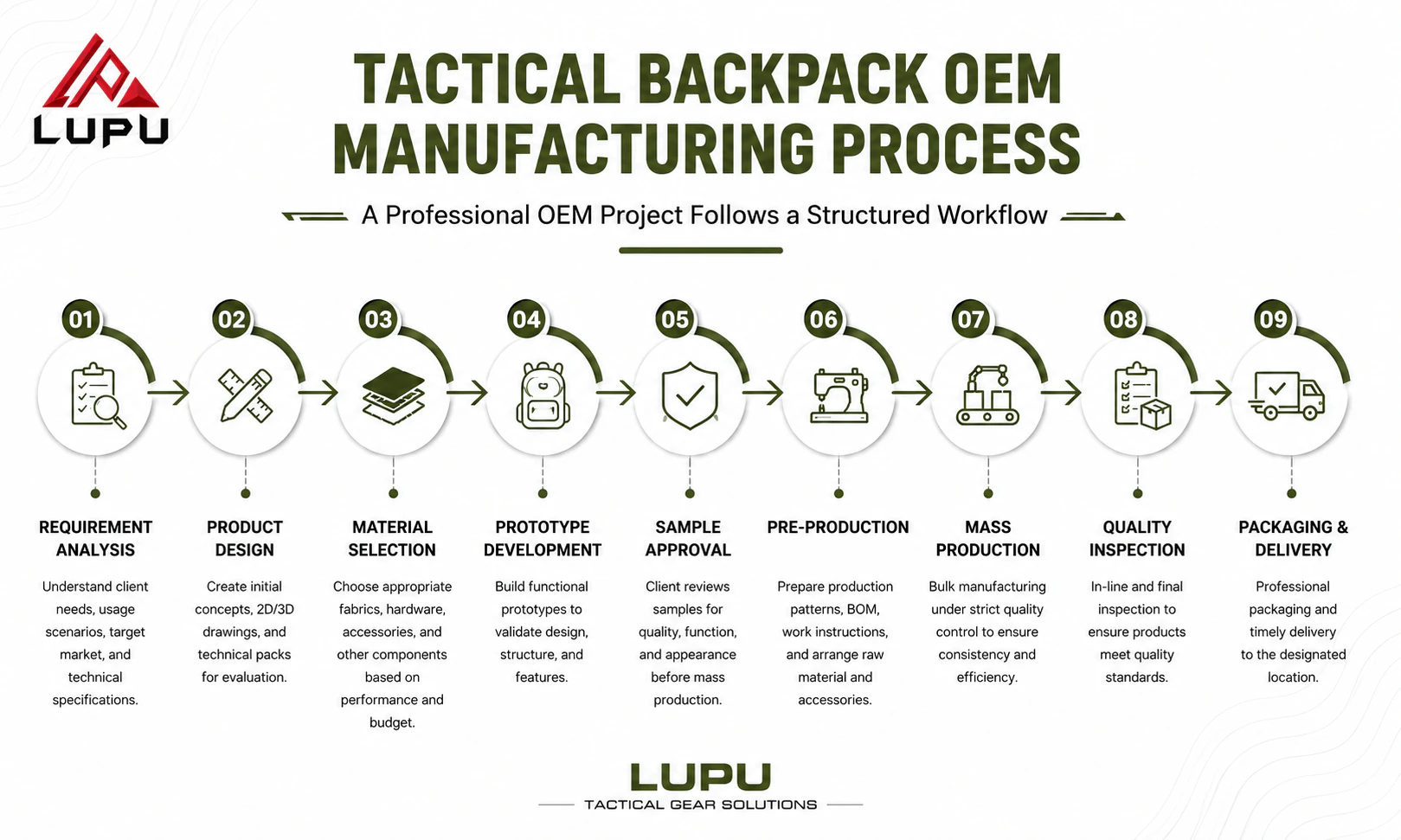
The exact workflow can vary depending on the product, customization requirements, order quantity, and quality specifications. However, the basic principle remains the same: a successful OEM project should be controlled from product requirements through final delivery rather than only during mass production.
1. Stage One: Requirement Analysis in the Tactical Backpack Manufacturing Process
Every tactical backpack OEM project starts with a clear understanding of what the customer actually needs.
Before creating patterns or purchasing materials, the производитель тактических рюкзаков and buyer should establish the product’s intended application, functional requirements, target market, and production expectations.
1.1 Understanding the Product Application
A tactical backpack designed for outdoor use may have different priorities from one designed to carry professional equipment.
The manufacturer should understand factors such as:
- Intended application
- Target users
- Expected carrying load
- Operating environment
- Required storage capacity
- Weather exposure
- Expected product lifespan
- Target market positioning
These requirements help determine the appropriate construction, materials, hardware, and organizational features.
1.2 Defining Product Specifications
Important specifications may include:
- Overall dimensions
- Backpack capacity
- Number of compartments
- Pocket configuration
- MOLLE requirements
- Shoulder strap design
- Back panel construction
- Handle design
- Hydration compatibility
- Weight target
- Hardware requirements
Clear specifications reduce misunderstandings during sampling and mass production.
For B2B buyers, it is useful to provide a detailed product specification sheet rather than relying only on product images or general descriptions.
1.3 Confirming Customization Requirements
OEM customization can involve many individual components.
Depending on the project, customers may request customization of:
- Logo
- Цвет
- Fabric
- Веревка
- Молнии
- Пряжки
- Labels
- Hook-and-loop patches
- Packaging
- Product dimensions
- Pocket configuration
- MOLLE layout
Not every customization is appropriate for every product. A производитель тактического снаряжения should evaluate whether the requested modification is technically practical and commercially reasonable before proceeding.
1.4 Why Clear Requirements Matter
Unclear specifications can create problems later in the production process.
For example, if a customer specifies only “durable tactical backpack” without defining capacity, fabric, hardware, construction, or intended load, different parties may have different expectations about the finished product.
A well-defined specification helps establish a common reference for:
Design → Sampling → Production → Inspection → Delivery
2. Stage Two: Tactical Backpack Product Design
Once the requirements are established, the next stage is converting them into a manufacturable product design.
Good tactical backpack design must balance three factors:
Functionality + Ergonomics + Manufacturability
A visually impressive design is not necessarily a practical production design.
2.1 From Concept to Production-Ready Design
The design stage translates customer requirements into:
- Product dimensions
- Component structures
- Pocket positions
- Material specifications
- Sewing construction
- Hardware locations
- Reinforcement areas
- Branding positions
The objective is to create a product that can be consistently manufactured, not simply a concept that looks good in a rendering.
2.2 Structural Design
A tactical backpack may include:
- Main storage compartment
- Front administrative compartment
- Side pockets
- Internal organization
- Equipment compartments
- Hydration compartments
- MOLLE-compatible attachment areas
- Quick-access pockets
The layout should correspond to the intended use rather than adding features simply for visual complexity.
2.3 Ergonomic Considerations
Carrying comfort is particularly important when a backpack is expected to carry equipment for extended periods.
Design considerations may include:
- Shoulder strap shape
- Strap width
- Padding
- Back panel structure
- Load distribution
- Adjustment range
- Waist or chest support
- Handle positioning
The relationship between these components can influence how the backpack feels when loaded.
2.4 Design for Manufacturing
A production-ready design should also consider how individual panels and components will be cut, sewn, reinforced, and assembled.
Manufacturers need to evaluate:
- Seam accessibility
- Stitching sequence
- Reinforcement requirements
- Component compatibility
- Production efficiency
- Assembly complexity
This approach is commonly referred to as design for manufacturing.
The goal is not simply to make the product easier to manufacture. It is to make the final design more consistent, repeatable, and practical for the intended production volume.
3. Stage Three: Material Selection for Tactical Backpacks
Material selection directly influences a tactical backpack’s durability, weight, appearance, performance characteristics, and production cost.
There is no single fabric that is automatically the best choice for every tactical backpack.
The right material depends on the product’s intended application and performance requirements.
3.1 Common Tactical Backpack Fabrics
Common materials used in tactical and outdoor bags include nylon, polyester, Oxford fabrics, and Cordura® fabrics.
The appropriate choice depends on factors such as:
- Abrasion resistance
- Tear resistance
- Вес
- Surface characteristics
- Water resistance
- Стоимость
- Intended application
Denier is also an important specification, but it should not be treated as the only indicator of fabric quality.
A higher denier can indicate a heavier or thicker construction, but overall performance also depends on yarn characteristics, weave, coating, finishing, and fabric construction.
3.2 Tactical Backpack Material Selection Guide
|
Material / Option |
Key Characteristics |
Suitable Applications |
Main Considerations |
|
500D нейлон |
Balanced weight and durability |
Lightweight tactical and outdoor packs |
Good balance between weight and strength |
|
1000D нейлон |
Heavy-duty construction |
Load-bearing and demanding applications |
Higher weight and material cost |
|
600D Oxford |
Practical and cost-conscious |
General tactical and outdoor products |
Balance performance with production cost |
|
900D Оксфорд |
Durable construction with substantial feel |
Tactical bags and equipment carriers |
Weight and cost should match the application |
|
Cordura® Fabrics |
Available in different constructions and specifications |
Premium tactical and professional gear |
Exact fabric specification should be confirmed |
|
Полиэстер |
Versatile and economical |
Selected outdoor and general-use products |
Performance depends on fabric construction |
The correct material should be selected according to the product’s actual requirements rather than simply choosing the highest denier available.
3.3 Hardware Selection
Hardware is another important part of tactical backpack manufacturing.
Typical components include:
- Молнии
- Пряжки
- D-rings
- G-hooks
- Adjusters
- Slides
- Metal fittings
Hardware affects both functionality and user experience.
For example, a buckle used on a heavily loaded shoulder or compression system may have different requirements from a small buckle used for an internal pocket.
3.4 Webbing and Reinforcement
Webbing is used throughout tactical backpack construction for:
- MOLLE systems
- Компрессионные ремни
- Shoulder straps
- Handles
- Attachment points
- Adjustment systems
High-stress areas may require additional reinforcement layers or specific stitching patterns.
3.5 Material Selection Should Match the Application
One of the most common mistakes in product development is assuming that the most expensive or heaviest material will automatically produce the best backpack.
In reality:
Material selection should match function, environment, target weight, expected durability, and target cost.
For an OEM project, the manufacturer and buyer should confirm the exact fabric specification before sampling.
4. Stage Four: Prototype Development and Sampling
The prototype is where a design begins to become a physical product.
For OEM projects, sampling provides an opportunity to identify structural, functional, and production issues before committing to mass production.
4.1 Why Prototypes Matter
A prototype can help verify:
- Dimensions
- Вместимость
- Pocket accessibility
- Strap adjustment
- MOLLE positioning
- Hardware compatibility
- Material combinations
- Overall appearance
- Construction feasibility
A drawing or digital rendering cannot fully demonstrate how a backpack behaves as a physical product.
4.2 Typical Prototype Manufacturing Process
A basic sampling sequence may include:
Pattern Making → Material Cutting → Component Preparation → Sewing → Assembly → Finishing → Sample Review
Each stage contributes to the final prototype.
4.3 What Should Be Checked During Sample Evaluation?
The customer and manufacturer should review:
Dimensions
Are the finished measurements consistent with the approved specifications?
Storage Layout
Can the intended equipment be organized and accessed efficiently?
MOLLE Configuration
Are the attachment areas positioned correctly for the intended application?
Shoulder Straps and Back Panel
Does the structure provide the expected level of carrying support and adjustment?
Сшивание
Are seams clean and appropriately reinforced?
Hardware
Do zippers, buckles, adjusters, and other components operate correctly?
Внешний вид
Are the fabric, color, logo placement, and overall construction consistent with the approved design?
4.4 Sample Revision and Approval
The first prototype is not necessarily the final production version.
A typical development cycle may involve:
Initial Sample → Customer Feedback → Design Revision → Revised Sample → Approval
Once the final sample has been approved, it should become an important reference for mass production.
5. Stage Five: Pre-Production Preparation
After sample approval, the project moves from product development toward production preparation.
This stage helps ensure that the production team is working from consistent and approved information.
5.1 Production Documentation
Depending on the project, documentation may include:
- Approved sample
- Product specifications
- Material list
- Color references
- Logo artwork
- Construction requirements
- Packaging instructions
- Inspection requirements
The more customized the product, the more important accurate documentation becomes.
5.2 Production Planning
Before mass production begins, the manufacturer may need to prepare:
- Main fabric
- Lining
- Веревка
- Молнии
- Пряжки
- Labels
- Branding components
- Packaging materials
Production scheduling should also take into account material availability, manufacturing capacity, and the required delivery timeline.
5.3 Pre-Production Quality Review
A final pre-production review can help confirm that:
- Materials match the approved specifications
- Colors are correct
- Hardware is correct
- Logo artwork is approved
- Construction details are understood
- Packaging requirements are clear
This checkpoint can reduce the risk of discovering major discrepancies after production has already started.
6. Stage Six: Tactical Backpack Mass Production
Once the prototype and pre-production preparations are approved, the tactical backpack manufacturing process moves into mass production. At this stage, production teams follow approved specifications, patterns, material requirements, and quality standards to ensure consistency across the order.
The exact production sequence can vary according to product structure, but a typical process includes material inspection, cutting, component preparation, sewing, assembly, reinforcement, and finishing.
6.1 Incoming Material Inspection
Before materials enter production, manufacturers may inspect:
- Fabric appearance
- Color consistency
- Surface defects
- Hardware condition
- Веревка
- Молнии
- Other components
Early material inspection can help prevent defective materials from moving further into production.
6.2 Fabric Cutting
Fabric panels are cut according to approved patterns.
Cutting accuracy is important because inconsistent panel dimensions can affect:
- Finished dimensions
- Pocket alignment
- Seam positions
- Overall shape
- Assembly efficiency
For complex products, accurate component identification is also important to prevent incorrect panel assembly.
6.3 Branding and Logo Application
Depending on the customer’s requirements, branding can include:
- Screen printing
- Heat transfer
- Embroidery
- Woven labels
- Hook-and-loop patches
- Other approved branding methods
The branding method should be selected according to the material, design, appearance requirements, and expected production volume.
6.4 Sewing and Component Assembly
Sewing is one of the most important stages in tactical backpack production.
A typical sequence may involve:
Panel Sewing → Pocket Assembly → Compartment Assembly → Strap Assembly → Final Assembly
The actual order can vary according to the backpack’s construction.
6.5 Reinforcement of High-Stress Areas
Certain areas are exposed to greater loads or repeated use.
These can include:
- Shoulder strap attachment points
- Carry handles
- MOLLE attachment areas
- Bottom panels
- Compression strap connections
- Load-bearing seams
Reinforcement methods should be appropriate to the product design and expected application.
6.6 Final Finishing
Before inspection, finished backpacks may go through:
- Thread trimming
- Cleaning
- Shape adjustment
- Hardware inspection
- Surface inspection
- Final appearance preparation
A clean finishing process contributes to both product appearance and production consistency.
7. Stage Seven: Quality Control and Testing
Quality control should not be treated as a single inspection performed at the end of production.
A more reliable approach is to establish checkpoints throughout the manufacturing process.
7.1 Incoming Material Inspection
Materials are checked before production begins.
This helps identify issues before they become part of finished products.
7.2 In-Process Quality Control
During production, manufacturers can inspect areas such as:
- Сшивание
- Component positioning
- Pocket dimensions
- MOLLE alignment
- Hardware installation
- Reinforcement points
- Logo placement
Early identification of defects is generally more efficient than discovering them after the entire order has been completed.
7.3 Final Product Inspection
Final inspection may cover:
- Product dimensions
- Stitching quality
- Seam appearance
- Zipper operation
- Buckle function
- Webbing attachment
- MOLLE alignment
- Logo placement
- Fabric condition
- Overall appearance
- Quantity
Inspection criteria should ideally be based on the approved specifications and agreed quality requirements.
7.4 Functional and Durability Checks
Depending on the project, customers may request specific tests or evaluations related to:
- Abrasion resistance
- Water resistance
- Load-bearing performance
- Hardware function
- Stitching durability
The appropriate testing method depends on the product design and the customer’s requirements.
Manufacturers should avoid making unsupported claims such as “military-grade” or “MIL-SPEC” unless the product has actually been evaluated against the specific applicable requirements.
8. Stage Eight: Packaging and Delivery
Once the products pass final inspection, the order moves into packaging and shipping preparation.
8.1 Product Packaging
Packaging requirements may include:
- Individual polybags
- Custom packaging
- Product labels
- Barcodes
- Carton labels
- Customized inserts
Packaging should protect the products during storage and transportation while meeting the customer’s retail or distribution requirements.
8.2 Pre-Shipment Inspection
Before shipment, the order should be checked against the purchase requirements.
Typical checks include:
- Product quantity
- Product specifications
- Packaging
- Carton markings
- Product labels
- Shipping requirements
8.3 Shipping Preparation
For international B2B orders, manufacturers may also coordinate:
- Carton dimensions
- Packing efficiency
- Shipping documentation
- Delivery schedules
- Freight arrangements
Accurate packing information is particularly important when customers are calculating shipping costs or planning warehouse receiving.
9. How OEM Tactical Backpack Manufacturing Differs from Standard Production
OEM production and standard production serve different business needs.
A standard production model generally follows an existing specification, while OEM production may require the manufacturer to adapt or develop the product according to customer requirements.
OEM vs. Standard Tactical Backpack Production
|
Area |
Standard Production |
OEM Production |
|
Product specification |
Existing specification |
Customer-defined or jointly developed |
|
Дизайн |
Pre-existing design |
Customized or newly developed |
|
Материалы |
Standard options |
Customer-selected or project-specific |
|
Colors |
Existing colors |
Custom colors may be available |
|
Branding |
Standard branding |
Custom branding |
|
Dimensions |
Fixed |
Can be customized depending on design |
|
Pocket configuration |
Existing structure |
Can be modified |
|
MOLLE layout |
Standard configuration |
Can be customized |
|
Hardware |
Standard components |
Can be selected or modified |
|
Sampling |
Limited or existing sample |
Prototype development usually required |
|
Packaging |
Standard packaging |
Custom packaging may be available |
|
Production documentation |
Existing specifications |
Project-specific specifications |
|
Development involvement |
Ограниченный |
Higher |
|
Production flexibility |
Lower |
Higher, subject to feasibility |
|
Typical buyer |
Distributor / reseller |
Brand / wholesaler / professional buyer |
OEM manufacturing should not be confused with simple private labeling.
Adding a logo to an existing backpack is one type of customization. A genuine OEM project may involve product development, structural modification, material selection, sampling, branding, packaging, and controlled mass production.
10. Key Factors That Affect Tactical Backpack Manufacturing Cost
There is no universal price for an OEM tactical backpack because the final cost depends on the product specification and production requirements.
Several factors can influence manufacturing cost.
10.1 Material Selection
Fabric type, weight, construction, coating, and quality can affect material costs.
A heavier or more specialized fabric may increase the overall cost, but the appropriate material should be determined by the intended application.
10.2 Product Size and Capacity
Larger backpacks generally require more fabric and additional components.
Capacity also influences structural requirements and construction.
10.3 Construction Complexity
A simple backpack with fewer components generally requires less production time than a highly structured design with multiple compartments, pockets, reinforcements, and attachment systems.
10.4 Number of Compartments and Pockets
Every additional compartment can introduce:
- More fabric panels
- Additional zippers
- More sewing operations
- More assembly time
Therefore, organizational complexity can influence production cost.
10.5 Hardware Selection
Zippers, buckles, adjusters, D-rings, and other components vary in specification and cost.
The correct hardware should balance functionality, durability, appearance, and budget.
10.6 Custom Branding
Different branding methods require different processes and materials.
For example, embroidery, woven labels, heat transfer, and screen printing can have different setup requirements and production costs.
10.7 Special Manufacturing Processes
Additional processes may include:
- Laser cutting
- Special printing
- Custom molding
- Advanced reinforcement
- Special finishing
These should be evaluated according to the project’s requirements.
10.8 Order Quantity
Production quantity can affect:
- Material purchasing
- Production efficiency
- Setup costs
- Component purchasing
- Overall unit economics
However, MOQ and pricing should be evaluated on a project-by-project basis rather than assuming that every product follows the same pricing structure.
11. How to Choose a Tactical Backpack OEM Manufacturer
When evaluating suppliers, buyers should look beyond product catalogs and examine how clearly the manufacturer manages each stage of the tactical backpack manufacturing process. A reliable OEM partner should be able to explain its approach to product development, material sourcing, sampling, production control, quality inspection, and delivery.
11.1 Manufacturing Experience
Look for a manufacturer with experience producing products similar to your target backpack.
Relevant experience can help the factory identify potential construction and production issues earlier.
11.2 Product Development Capability
For customized products, evaluate whether the manufacturer can support:
- Product design
- Pattern development
- Material selection
- Prototype sampling
- Sample revisions
- Production specifications
11.3 Material and Hardware Sourcing
A capable manufacturer should understand how fabric, webbing, zippers, buckles, and other components work together.
11.4 Sampling Capability
Ask how the manufacturer manages:
- First samples
- Revision requests
- Sample approval
- Production references
A clear sampling process can make OEM development more predictable.
11.5 Quality Control System
Ask what quality checkpoints are used during:
Material Inspection → Production → Final Inspection
Quality control should be part of the production process rather than an afterthought.
11.6 Customization Capability
Depending on the project, buyers may need customization of:
- Size
- Вместимость
- Fabric
- Цвет
- Logo
- Hardware
- MOLLE configuration
- Internal organization
- Packaging
Not every manufacturer supports the same level of customization.
11.7 Production Capacity
Production capacity should be considered together with order quantity, product complexity, and required delivery schedule.
11.8 Communication and Project Management
For international B2B projects, clear communication is essential.
A good поставщик тактического снаряжения should be able to communicate clearly about:
- Product specifications
- Sample revisions
- Material availability
- Production schedules
- Quality issues
- Delivery requirements
11.9 Certifications and Compliance
Depending on the target market, buyers may need to evaluate relevant certifications, testing, product requirements, or supplier compliance documentation.
The specific requirements should be confirmed according to the destination market and product application.
11.10 Long-Term Production Capability
For established brands, the goal is often not a single order but repeatable production.
A suitable OEM partner should be capable of maintaining consistency across repeat orders while following approved specifications.
12. Common Challenges in Tactical Backpack OEM Production
Even a well-planned project can encounter production challenges.
Understanding common risks can help buyers reduce unnecessary delays and revisions.
12.1 Unclear Product Specifications
If product requirements are incomplete, different teams may interpret the design differently.
Solution: Use detailed specifications and an approved physical sample whenever possible.
12.2 Material Substitution
Unapproved changes to fabric or components can affect product performance and appearance.
Solution: Clearly define approved materials and communicate any proposed substitutions before production.
12.3 Inconsistent Colors
Fabric and components can sometimes vary between production batches.
Solution: Establish clear color references and approval procedures.
12.4 Poor Stitching or Reinforcement
Insufficient reinforcement at load-bearing areas can affect long-term performance.
Solution: Identify high-stress areas during design and establish appropriate construction requirements.
12.5 Incorrect MOLLE Positioning
MOLLE systems need consistent spacing and alignment to function as intended.
Solution: Include clear measurements and visual references in production specifications.
12.6 Hardware Mismatch
Different hardware components can affect fit, function, and appearance.
Solution: Confirm hardware specifications during the sampling stage.
12.7 Prototype-to-Mass-Production Differences
A sample may be produced under controlled conditions, while mass production involves multiple operators and a larger production volume.
Solution: Use an approved sample and detailed production specifications as production references.
12.8 Poor Communication
Incomplete information or delayed feedback can cause unnecessary revisions.
Solution: Establish clear communication channels, approval checkpoints, and documentation for each major stage.
13. Why Manufacturing Process Transparency Matters to B2B Buyers
For B2B buyers, understanding the manufacturing process provides more than general knowledge.
It helps buyers evaluate potential suppliers and identify where production risks may occur.
A transparent production process can provide:
Better Project Visibility
Buyers can understand what happens after an order is confirmed.
More Predictable Quality
Clear inspection points make quality expectations easier to define.
More Efficient Communication
Specifications, samples, and approvals create common references between the buyer and manufacturer.
Lower Production Risk
Potential issues can be identified before mass production rather than after shipment.
More Consistent Repeat Orders
Documented specifications and approved samples provide a reference for future production.
Stronger Supplier Relationships
When both parties understand the same product requirements and approval process, long-term cooperation becomes easier to manage.
14. From Product Concept to Finished Tactical Backpack
The complete OEM process can be summarized as:
Requirement Analysis
The manufacturer understands the product concept, application, market, and specifications.
↓
Product Design
The concept is translated into a structured and manufacturable backpack design.
↓
Material Selection
Fabric, webbing, hardware, zippers, and other components are selected according to the intended application.
↓
Prototype Development
The first physical sample is produced and evaluated.
↓
Sample Revision and Approval
Design details are adjusted until the customer approves the production reference.
↓
Pre-Production Preparation
Materials, artwork, specifications, packaging, and production plans are confirmed.
↓
Mass Production
Approved components are cut, sewn, assembled, reinforced, and finished.
↓
Quality Inspection
Finished products are inspected against agreed specifications and quality requirements.
↓
Packaging and Delivery
Approved products are packed, labeled, prepared for shipment, and delivered.
This structured approach allows an OEM project to move from an initial concept toward a repeatable production process.
15. FAQ: Tactical Backpack OEM Manufacturing
What is tactical backpack OEM manufacturing?
Tactical backpack OEM manufacturing is a production model in which a manufacturer develops or produces backpacks according to a customer’s specifications. Depending on the project, customization can include materials, dimensions, structure, colors, branding, hardware, MOLLE configuration, and packaging.
What is the difference between OEM and ODM tactical backpacks?
OEM generally focuses on producing a product according to customer-defined specifications or designs. ODM typically involves modifying or selecting an existing manufacturer-developed product and adapting elements such as materials, colors, branding, dimensions, or features.
The exact scope of OEM and ODM services can vary between manufacturers.
How long does tactical backpack OEM development take?
Development time depends on product complexity, design requirements, material availability, sampling revisions, and customer approval speed.
A simple customization project may require less development time than a completely new backpack involving structural design and multiple prototype revisions.
It is therefore better to establish a project-specific timeline rather than rely on a universal number of days.
What materials are commonly used for tactical backpacks?
Common options include nylon, polyester, Oxford fabrics, and Cordura® fabrics. Different constructions and specifications are available within each material category.
The best choice depends on the required balance of durability, weight, appearance, application, and cost.
Can an OEM manufacturer customize the MOLLE system?
In many OEM projects, MOLLE-compatible areas can be customized according to the product design. However, the exact configuration should be confirmed during product development because attachment layout, spacing, construction, and reinforcement can affect manufacturing feasibility.
Can the backpack size and capacity be customized?
Yes, depending on the manufacturer’s development and production capabilities. Size, capacity, compartment configuration, and dimensions can often be adjusted for specific applications.
Custom dimensions should be confirmed during the design and sampling stage.
Why is a prototype important before mass production?
A prototype allows the manufacturer and customer to evaluate the physical product before committing to a larger production run.
It can reveal issues related to dimensions, storage organization, ergonomics, materials, hardware, stitching, and construction that may not be obvious from drawings alone.
What should buyers provide to an OEM manufacturer?
Useful project information can include:
- Product drawings or reference images
- Target dimensions
- Capacity requirements
- Intended application
- Material preferences
- Color requirements
- Hardware requirements
- Logo artwork
- Packaging requirements
- Target quantity
- Quality expectations
The more clearly the requirements are defined, the easier it is to evaluate feasibility and develop an accurate prototype.
How can buyers reduce risks during tactical backpack production?
Buyers can reduce production risks by:
- Providing clear specifications
- Confirming materials before production
- Reviewing prototypes carefully
- Approving a final production sample
- Defining quality requirements
- Confirming packaging specifications
- Maintaining clear communication throughout production
A structured approval process is particularly important for customized products.
What should I look for in a tactical backpack OEM manufacturer?
Consider the manufacturer’s:
- Manufacturing experience
- Product development capability
- Sampling process
- Material sourcing capability
- Customization options
- Quality control procedures
- Production capacity
- Communication
- Compliance and certification documentation
- Ability to support repeat production
The right supplier should be evaluated based on the complete project requirement rather than unit price alone.
Заключение
A successful tactical backpack manufacturing process starts long before the first production line begins sewing.
For OEM projects, product requirements, design, material selection, sampling, pre-production preparation, mass production, quality control, and delivery are all connected. A weakness in one stage can affect the final product, production efficiency, or sourcing experience.
For brands, wholesalers, distributors, and professional gear companies, working with an experienced OEM manufacturer can simplify the transition from product concept to production. The most effective manufacturing partnerships are built around clear specifications, transparent communication, controlled sampling, consistent production, and practical quality management.
LUPU supports tactical backpack OEM and ODM projects with customization options covering product structure, materials, branding, hardware, and other product requirements. From initial product discussion and prototype development to mass production and quality inspection, the goal is to provide a structured manufacturing process for B2B customers developing tactical gear products.
Looking for a Tactical Backpack OEM Manufacturer?
Whether you have your own tactical backpack design or want to customize an existing product, you can discuss your project requirements with the LUPU team.
Email: info@luputacticalgear.com
OEM/ODM Tactical Backpack Manufacturing | Product Development | Customization | Mass Production