When sourcing tactical backpacks for a private-label brand, wholesale business, or military and law enforcement equipment distribution program, one of the first questions buyers ask is: What is the minimum order quantity?
The answer is more complicated than a single number.
A tactical backpack manufacturer may accept a relatively small order for a standard configuration but require a larger commitment for a fully customized product. The difference often comes down to fabric procurement, component availability, product complexity, production setup, and the cost of establishing a repeatable manufacturing process.
Understanding how tactical backpack MOQ is determined helps buyers evaluate supplier quotations more accurately, negotiate realistic order quantities, and avoid committing too much capital before a product has been validated.
From a manufacturing perspective, MOQ is not simply a sales restriction. It is a commercial decision shaped by the relationship between material purchasing requirements, production efficiency, customization, quality expectations, and order economics.
This guide explains how factories establish minimum order quantities, what drives the cost of small-batch production, and how B2B buyers can work with manufacturers to develop a commercially viable sourcing strategy.
1. What Is MOQ in Tactical Backpack Manufacturing?
MOQ stands for Minimum Order Quantity. It is the minimum quantity a supplier is willing or able to accept under a particular set of commercial and production conditions.
However, three different quantities must be distinguished when evaluating a tactical backpack quotation.
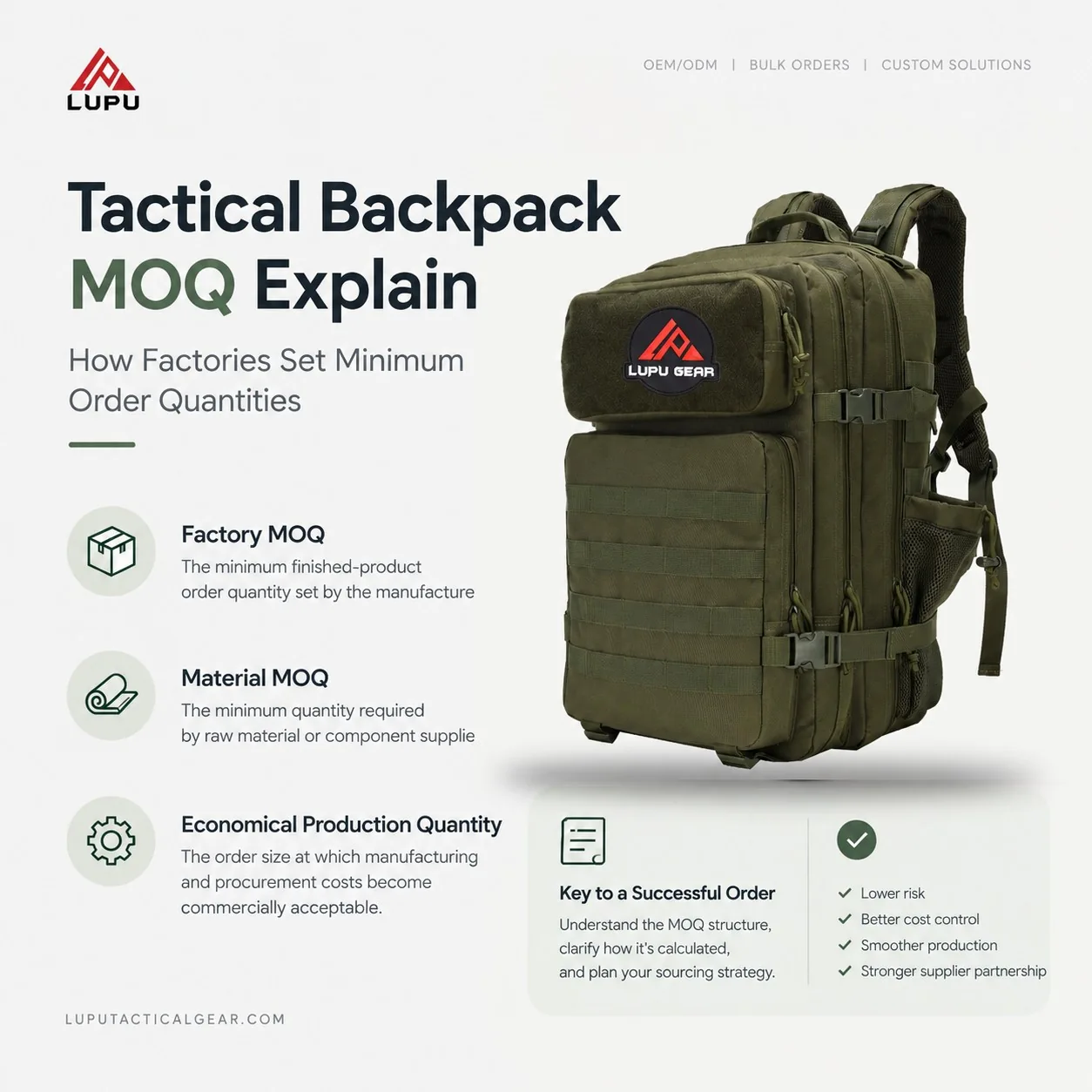
Factory MOQ
Factory MOQ is the minimum finished-product order quantity established by the manufacturer for a particular product or production arrangement.
It may depend on the product design, number of variations, production setup requirements, labor allocation, and the factory’s existing production schedule.
For example, a manufacturer with an established pattern and production process may be able to accommodate a smaller order of a standard tactical backpack. A new design requiring specialized components, custom colors, and additional production preparation may require a different commercial arrangement.
Factory MOQ is therefore product-specific rather than a universal figure applicable to every tactical backpack.
Material MOQ
Material MOQ is the minimum quantity a raw-material or component supplier requires for an order.
Depending on the product specification, this may apply to:
- Nylon or polyester fabrics
- Custom-dyed or specially finished fabrics
- Webbing and binding materials
- Zippers and zipper pulls
- Buckles and adjustment hardware
- Custom labels, patches, and packaging
- Molded or specially manufactured components
The material MOQ may be higher than the quantity needed to manufacture the finished backpacks.
Suppose a project requires a custom fabric color, but the material supplier will only accept an order in a larger production batch. The backpack manufacturer may need to purchase more fabric than the finished-goods order consumes.
That difference creates a purchasing commitment that must be accounted for in the quotation.
Importantly, material MOQ varies by supplier, material construction, color, finishing process, and purchasing arrangement. There is no single material MOQ that applies to all tactical backpack fabrics.
Economical Production Quantity
The economical production quantity is the order size at which the combined manufacturing and procurement costs become commercially acceptable.
A factory may technically be capable of producing a small batch but need to charge more per unit because setup, sampling, production preparation, and other fixed costs must be allocated across fewer products.
A larger order can spread certain costs over more units, although it does not automatically guarantee a lower total cost or a better financial outcome for the buyer.
These three quantities should not be confused. A factory may have a minimum commercial order requirement even when the material supplier can provide smaller quantities, or it may accept a smaller finished-goods order when the buyer agrees to cover additional material or setup costs.
Does MOQ Apply Per Order, Model, or Color?
This is one of the most important questions to clarify before placing an order.
A supplier’s MOQ may apply to the total purchase order, each backpack model, each colorway, or each unique specification. Custom components may also have separate minimum purchase requirements.
Consider a hypothetical order of 1,000 tactical backpacks divided among several models and colors. Although the total order quantity is substantial, the factory may need to manage multiple patterns, material allocations, production setups, and inspection requirements.
A single-model order of the same total quantity may be operationally simpler.
Before comparing quotations, ask the manufacturer to specify exactly how MOQ is calculated and which variations can be combined.
2. The Six Main Factors That Determine Tactical Backpack MOQ
The MOQ of a tactical backpack is influenced by several interconnected manufacturing variables. Evaluating only the finished-product quantity without examining these factors can lead to inaccurate cost comparisons.
2.1 Fabric Procurement and Material Availability
Fabric is one of the first variables a manufacturer evaluates when preparing a quotation.
The relevant considerations extend beyond whether a fabric is described as nylon, polyester, or a particular denier.
A factory must also consider fabric construction, usable width, coating or finishing requirements, color availability, cutting yield, supplier purchasing increments, and replenishment lead time.
For example, a backpack made with an available standard fabric color may be easier to produce in a smaller batch than a product requiring a specially developed color or finish.
The reason is not necessarily that the custom fabric is more expensive per meter. The more important issue may be the quantity the material supplier requires the factory to purchase.
Fabric consumption also depends on the actual product design.
A backpack with numerous compartments, internal dividers, reinforcement panels, and multiple attachment points may require a different cutting layout from a simpler design of similar external dimensions.
The manufacturer must estimate material consumption using the approved pattern and bill of materials (BOM), then account for cutting yield and production allowances.
A simplified material planning formula is:
Net material requirement = Order quantity × Material consumption per unit
The purchasing quantity must then be adjusted for actual cutting yield, supplier purchasing increments, and any applicable material MOQ.
This distinction matters because material required for production is not always equal to material that must be purchased.
What buyers can do: Ask whether the proposed MOQ is driven by the factory’s production process or by a specific material supplier. If custom fabric is the main constraint, explore whether an existing fabric or standard color can satisfy the product requirements without compromising the intended performance.
2.2 Product Design Complexity and Component Count
Two tactical backpacks can have similar dimensions while requiring significantly different manufacturing workflows.
A straightforward backpack may use a relatively established pattern, standard compartments, and readily available hardware.
A more complex design may incorporate multiple internal organizers, reinforced attachment areas, specialized pockets, modular interfaces, additional adjustment systems, and numerous separately cut panels.
Each additional component can introduce more work into cutting, sorting, sewing, assembly, and inspection.
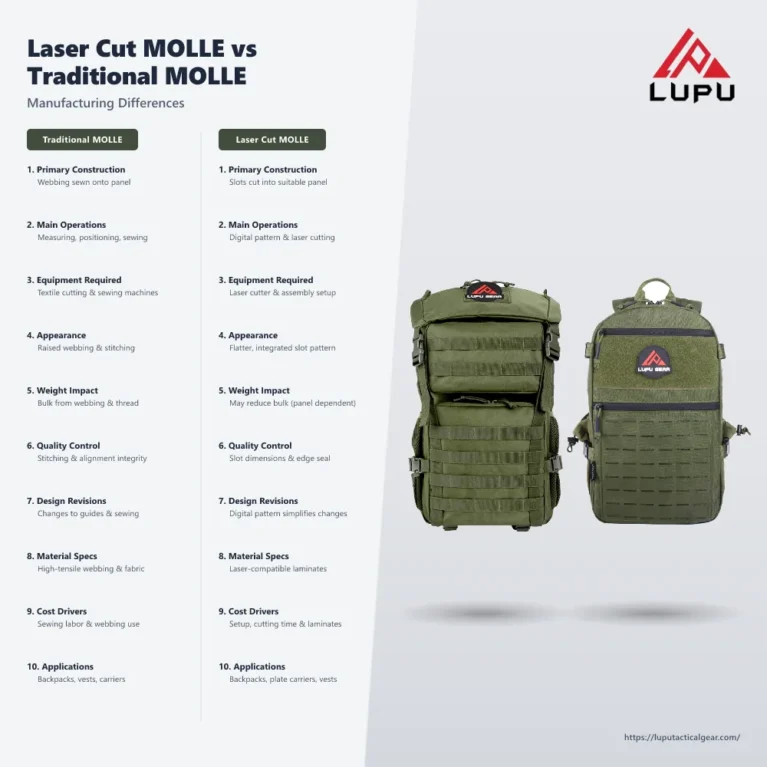
For example, a MOLLE-equipped design may require controlled webbing spacing and consistent stitching across attachment rows. A backpack with specialized internal storage may require additional pattern pieces, assembly sequences, and dimensional checks.
These requirements affect production planning, but design complexity does not automatically translate into a higher MOQ.
A factory with an established process for a particular design may manufacture it efficiently, while a less familiar design may require additional preparation and validation.
The relevant question is how the design interacts with the manufacturer’s existing equipment, production workflow, component supply chain, and quality-control procedures.
What buyers can do: During product development, identify which features are essential to product performance and which are optional. Simplifying nonessential variations in the initial order can reduce production complexity without removing the features that differentiate the product.
2.3 Customization and Private-Label Requirements
Private-label customization is a major consideration in tactical backpack manufacturing.
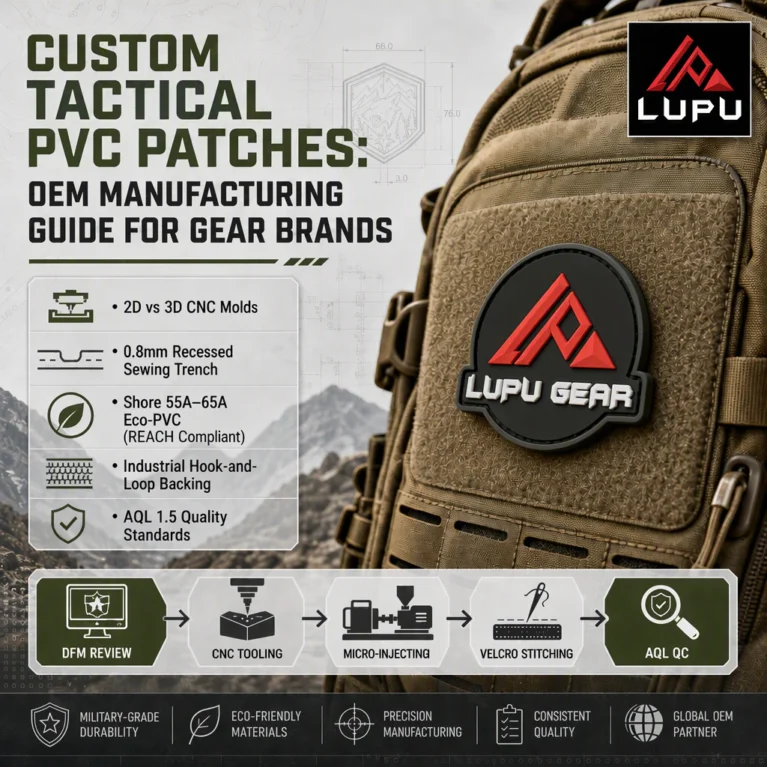
Buyers may request custom colors, branded labels, embroidery, printed graphics, distinctive zipper pulls, custom hardware, specialized packaging, or exclusive component designs.
Each requirement has a different effect on MOQ.
A logo applied using an established process may involve a different purchasing commitment from a custom-molded component that requires dedicated tooling or a separate supplier production run.
Similarly, using an available fabric color is different from requesting a new color that must be developed and produced specifically for a project.
The important distinction is between customization that uses existing manufacturing resources and customization that introduces new material or component commitments.
A mochila tática personalizada may therefore have several separate quantity constraints rather than one single MOQ.
For instance, the factory may be willing to produce a small batch of finished backpacks but need the buyer to purchase a larger quantity of custom labels or retain unused branded materials for future orders.
These conditions should be discussed before production begins.
What buyers can do: Prioritize customization according to its commercial value. For the first production run, consider using standard hardware and established materials while reserving exclusive components for features that genuinely differentiate the product.
This approach can preserve brand identity while limiting the number of separate supplier commitments.
2.4 Cutting, Sewing, and Production-Line Setup
A tactical backpack passes through multiple manufacturing stages before it becomes a finished product.
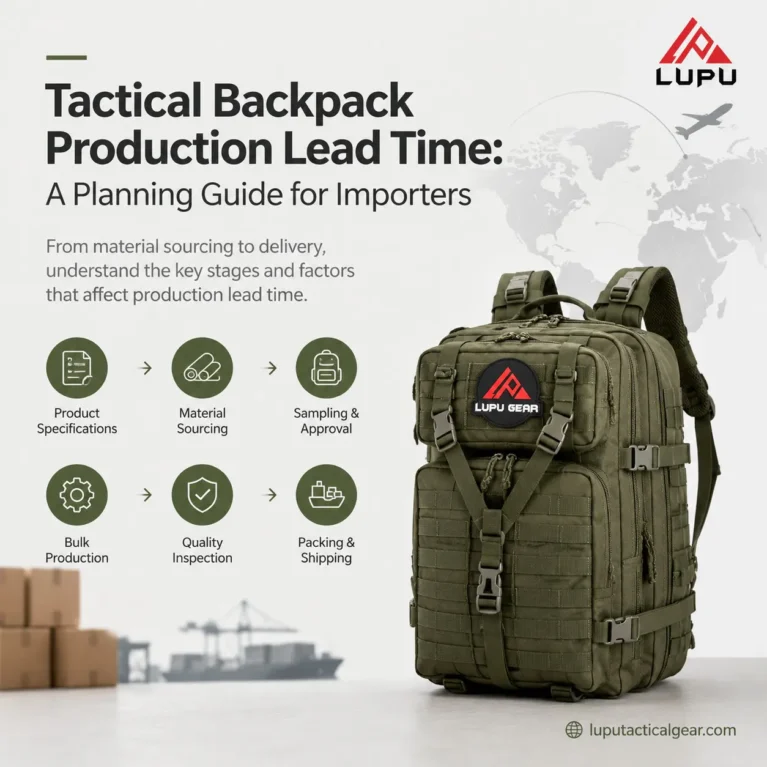
These stages typically include technical specification review, pattern preparation, material allocation, cutting, sewing, assembly, inspection, and packing.
The exact workflow depends on the product and factory.
Before production starts, the fabricante de equipamento tático may need to prepare work instructions, confirm component availability, allocate materials, organize cutting patterns, adjust equipment, brief operators, and establish inspection checkpoints.
For a new design, the first production pieces may require additional verification to confirm that the approved dimensions, construction details, and assembly sequence can be reproduced consistently.
These activities consume resources even when the order quantity is relatively small.
The cost of setup is therefore an important consideration when a buyer requests a small batch of a highly customized product.
For an established backpack design, many preparation activities may already have been completed. For a new design, additional engineering and production preparation may be necessary.
This is why factories sometimes offer a higher unit price for smaller orders rather than rejecting them outright.
What buyers can do: Ask the manufacturer whether the quotation includes development, sampling, tooling, and production setup. These costs should be identified separately where practical, so the buyer can understand which expenses are associated with the initial project and which recur with each order.
2.5 Quality-Control and Testing Requirements
Quality control is not an optional activity that should be considered only after the MOQ has been negotiated.
The required inspection process should be established during product development and quotation.
Depending on the product specification, quality-control activities may include incoming material inspection, dimensional verification, stitching inspection, zipper and buckle function checks, reinforcement inspection, packaging checks, and sampling-based final inspection.
Some projects may also require specialized performance testing based on the intended use and contractual requirements.
For example, a buyer may require particular verification procedures for load-bearing attachment points, seams, or hardware. These requirements need to be defined in advance, including the applicable test method, sample selection, acceptance criteria, and documentation.
Ordinary workmanship inspection should not be confused with specialized performance testing or third-party certification.
Not every tactical backpack requires the same testing program, and no generic inspection checklist can guarantee performance under every operating condition.
Additional testing or more extensive inspection may affect project cost, sample requirements, and scheduling. However, the effect on MOQ depends on the actual arrangement rather than on a universal rule.
What buyers can do: Provide clear acceptance criteria before requesting the final quotation. A well-defined inspection plan reduces ambiguity, helps the factory allocate resources correctly, and minimizes disputes after delivery.
2.6 Production Scheduling and Factory Capacity
Manufacturing capacity is another factor behind MOQ decisions.
A factory must allocate cutting resources, sewing operators, assembly stations, inspection personnel, and production time across multiple orders.
A small order can sometimes be accommodated within an existing production schedule. In other situations, introducing a new product may require a separate setup or interrupt an established workflow.
The factory therefore considers not only whether it can manufacture the requested quantity, but also whether the order can be produced efficiently within the required delivery window.
This is the difference between technical feasibility and commercial feasibility.
Technical feasibility asks whether the factory can manufacture the product.
Commercial feasibility asks whether it can manufacture the product under the proposed quantity, price, delivery schedule, and quality requirements in a sustainable way.
A manufacturer may be able to accept a smaller order if the buyer allows a more flexible delivery schedule, uses existing materials, or agrees to a different pricing arrangement.
Alternatively, a factory operating near capacity may be unable to accommodate a small urgent order without disrupting other commitments.
What buyers can do: Discuss the target delivery date, expected repeat-order frequency, and forecast demand together. A realistic production plan may provide more flexibility than negotiating quantity in isolation.
3. How Factories Calculate a Commercially Viable MOQ
A reliable MOQ quotation should be based on the actual product specification and production requirements.
Although manufacturers use different costing systems, the underlying evaluation generally involves material commitments, production preparation, unit-level costs, and scheduling.
Step 1: Calculate the Material Requirement
The manufacturer starts with the approved product design and bill of materials.
The BOM identifies the materials and components required to build the backpack, while the pattern and cutting plan help estimate material consumption.
The factory then evaluates:
- Required fabric and component quantities
- Expected cutting yield and waste
- Available stock
- Supplier purchasing increments
- Minimum quantities for custom materials
- Material lead times and replenishment conditions
If the project uses existing materials, the factory may have greater purchasing flexibility.
If the project requires custom-dyed fabric or exclusive components, the material supplier may impose a minimum commitment that affects the overall order economics.
The buyer should understand whether the quoted MOQ represents finished backpacks, a material purchasing requirement, or a combination of both.
Step 2: Estimate Production Setup and Operating Costs
The manufacturer identifies the costs necessary to prepare and execute the order.
Depending on the project, these may include:
- Pattern development and sampling
- Technical specification preparation
- Custom tooling or component development
- Printing or embroidery setup
- Production-line preparation
- First-piece verification
- Additional inspection or testing
Some costs are primarily associated with developing the product or preparing the initial order. Others recur with every production run.
Separating these categories helps buyers compare quotations on a consistent basis.
For example, a fornecedor de mochilas tácticas quoting a lower unit price may exclude certain development costs that another supplier includes in its quotation.
A meaningful comparison therefore requires more than comparing the unit price alone.
Step 3: Evaluate the Effect of Order Quantity on Unit Cost
A simplified manufacturing cost model is:
Estimated unit cost = Variable cost per unit + Fixed production costs allocated per unit
Variable costs may include materials, direct labor, and other expenses that increase with production quantity.
Fixed production costs may include certain setup or preparation expenses that do not increase proportionally with every additional backpack.
When fixed costs are spread across a larger order, their contribution to the unit cost generally decreases.
However, this does not mean every larger order automatically delivers a better commercial result.
A larger order may require more working capital, create excess inventory, increase storage costs, or expose the buyer to changing product requirements.
Material purchasing tiers, production efficiency, quality issues, and commercial terms can also affect the final quotation.
The appropriate objective is to identify a quantity that balances manufacturing economics with realistic demand.
Step 4: Confirm Material and Component Availability
The factory checks whether the planned order can be supplied using available stock, standard components, or new procurement.
Compatible products may sometimes share materials or components, allowing purchasing commitments to be coordinated.
However, combining several products does not automatically satisfy every supplier’s MOQ.
The products must genuinely share compatible materials, colors, specifications, and approved components.
A fabric used in one backpack model may not be suitable for another, even if the models look similar. Likewise, custom-colored webbing or branded hardware may have separate purchasing requirements.
The quotation should identify any material commitments that extend beyond the finished-goods quantity.
Step 5: Validate the Production Plan
Before confirming the order, the factory evaluates whether the quantity can be manufactured within the requested timeframe.
This includes reviewing material availability, production scheduling, operator allocation, inspection requirements, and the approved specification.
The objective is to establish a production plan that can deliver the required quantity without relying on unrealistic assumptions about capacity or lead time.
For a new product, sample approval and production preparation should be completed before the main production run is released.
Step 6: Agree on the Final Commercial MOQ
Once the technical and commercial requirements are understood, the factory and buyer can agree on the order quantity and applicable conditions.
The quotation should clearly identify:
- Backpack model and approved specification
- Quantity per model and color
- Material and component requirements
- Unit price and applicable setup charges
- Sampling or development costs
- Expected production lead time
- Inspection and acceptance criteria
- Treatment of unused custom materials, where relevant
- Conditions that may trigger a revised quotation
A factory’s MOQ is a commercial decision informed by manufacturing economics and capacity. It is not a universal mathematical threshold that applies to every backpack design.
4. Illustrative Example: Why Two Tactical Backpack Orders Have Different MOQs
Consider two hypothetical OEM projects.
Both buyers want to launch a tactical backpack for the same broad market. However, their product requirements are different.
Scenario A: Standard-Configuration Tactical Backpack
The first buyer selects an existing backpack design, an available fabric color, standard hardware, and a straightforward branding option.
The manufacturer already has an established production process for the configuration.
Under these conditions, the project may require less new product preparation and fewer separate material purchasing commitments.
The factory may therefore have more flexibility in accepting a smaller order, depending on its schedule and commercial policy.
Scenario B: Fully Customized Tactical Backpack
The second buyer requests a new pocket layout, a custom fabric color, exclusive branding components, modified dimensions, and additional product-specific verification.
The factory must evaluate the new pattern, source the required materials, confirm custom components, and establish the production and inspection process.
The material supplier may also require a larger purchase commitment for a custom color or component.
The factory may respond with a higher MOQ, a higher unit price for a smaller order, separate development charges, or a combination of these arrangements.
None of these outcomes is automatic. The actual quotation depends on the manufacturer’s capabilities, supplier agreements, order quantity, and product specification.
Comparing the Two Manufacturing Scenarios
|
Factor |
Standard Configuration |
Fully Customized Configuration |
|
Fabric sourcing |
Existing stock or established supply |
Potentially custom procurement |
|
Pattern preparation |
Existing approved pattern |
New or modified pattern |
|
Branding |
Established labeling process |
Potentially custom labels or components |
|
Production setup |
Familiar workflow |
Additional preparation may be required |
|
Existing inspection plan, where applicable |
Additional checks may be required |
|
|
MOQ flexibility |
Potentially greater |
Depends on material and development commitments |
|
Main cost consideration |
Economics of a smaller batch |
Development costs and custom material commitments |
This comparison illustrates why buyers should request an explanation of the factors behind an MOQ rather than assume that all tactical backpacks should have the same minimum order quantity.
5. How B2B Buyers Can Reduce Tactical Backpack MOQ
A buyer cannot always eliminate supplier-imposed material minimums or factory production constraints. However, the product specification and purchasing strategy can often be adjusted to improve flexibility.
5.1 Start with Existing Fabrics and Standard Components
One of the most practical ways to simplify an initial order is to select materials and components already available through the manufacturer.
If an existing fabric meets the required performance and appearance specifications, it may avoid the additional purchasing commitments associated with a custom material.
Standard hardware can also reduce the number of separate sourcing requirements.
The trade-off is that standard components may offer fewer opportunities for product differentiation.
The decision should therefore be based on the importance of the customization to the brand and end user, not solely on MOQ.
5.2 Simplify the First Production Run
Consider launching with a controlled product configuration.
This may involve one backpack model, fewer colorways, a common component platform, and a clearly defined set of approved specifications.
The objective is to reduce the number of simultaneous variations the factory must source, prepare, manufacture, and inspect.
For a new product, this can make the first order easier to manage while preserving the option to introduce additional configurations after demand has been validated.
The approach is particularly useful when the buyer is uncertain about the initial sales mix.
5.3 Separate Product Development from Mass Production
Product development and commercial production serve different purposes.
During development, the buyer and manufacturer establish the design, materials, dimensions, construction details, and performance requirements.
Sampling allows the parties to evaluate the proposed product before committing to a larger production run.
The approved sample and specification then provide the reference for production.
Separating these stages can help a buyer control the initial commitment. However, sampling and development may incur separate costs, and a sample order does not necessarily qualify as a commercial production order.
A clear agreement should define what is included in development, which changes are covered, and when the production quotation becomes binding.
5.4 Consolidate Orders Where Specifications Are Compatible
If several products use the same fabric, color, webbing, or hardware, coordinating their material requirements may help improve purchasing efficiency.
For example, compatible models using the same approved fabric may be considered together when planning a material purchase.
However, consolidation works only when the specifications genuinely align.
Different colors, finishes, material constructions, or exclusive components may require separate purchasing arrangements.
Buyers should ask the manufacturer which items can share materials and which remain subject to independent MOQ requirements.
5.5 Discuss Flexible Commercial Arrangements
When a smaller initial quantity is essential, consider discussing alternatives to a standard bulk order.
Possible arrangements include:
- A higher unit price for a smaller batch
- Separately quoted development or setup charges
- Standard-material alternatives
- Staged deliveries against an agreed production quantity
- A planned replenishment schedule for future orders
Each arrangement has different implications.
For example, staged delivery may help coordinate inventory availability, but it does not automatically reduce the total production quantity or the buyer’s overall purchase commitment.
Likewise, paying an additional setup charge may make a small batch commercially possible, but it does not remove an upstream supplier’s minimum material requirement.
The most appropriate option depends on the buyer’s cash flow, demand forecast, delivery needs, and the manufacturer’s operating conditions.
5.6 Prioritize Repeatability Over the Lowest Initial Quantity
A low initial MOQ is useful only if the resulting product can be manufactured consistently and replenished under commercially acceptable conditions.
For B2B marcas de equipamento tático, repeat orders are often as important as the first shipment.
The buyer should therefore evaluate whether the manufacturer can maintain the approved specification, source compatible materials, control quality, and support future production planning.
A slightly larger initial commitment may sometimes be commercially reasonable if it establishes a stable supply arrangement. In other situations, a smaller validation order may be the better choice.
The correct decision depends on demand uncertainty, working-capital constraints, product complexity, and the consequences of running out of stock.
The goal is not to maximize order quantity. It is to establish a reliable and financially sustainable production arrangement.
6. MOQ Negotiation: Questions Every Tactical Backpack Buyer Should Ask
Before accepting a quotation, buyers should clarify the assumptions behind the proposed quantity.
The following questions can help identify the actual constraints.
- Is the MOQ based on the total order or each model and color?
Confirm whether multiple configurations can be combined and how each configuration is counted.
- Is the MOQ driven by the factory or an upstream material supplier?
Understanding the source of the constraint helps identify which alternatives may be available.
- Can existing fabrics or standard components be used?
Ask whether available materials can meet the required specifications without introducing unnecessary compromises.
- Are sampling, tooling, and development costs included?
Separate these costs from recurring manufacturing expenses where practical.
- What changes would reduce MOQ without compromising required performance?
Invite the manufacturer to identify the design or sourcing choices that have the greatest effect on the order quantity.
- Can compatible models share materials or components?
Verify compatibility rather than assuming that all products in the same category can be combined.
- What is the minimum quantity for a repeat order?
The repeat-order arrangement may differ from the initial development project, depending on the materials and production setup.
- How will unused custom materials be handled?
Clarify whether excess materials remain with the factory, are reserved for future orders, or are purchased by the buyer.
- What inspection criteria and acceptance requirements apply?
Document the required workmanship, dimensions, functional checks, and any specialized tests.
- Which specification changes would require a revised MOQ or quotation?
Establish how changes to fabric, color, hardware, dimensions, or branding will be managed after approval.
A transparent manufacturer should be able to explain the major assumptions behind its quotation, even when some supplier arrangements or commercial terms remain confidential.
7. Common MOQ Mistakes That Increase Procurement Risk
Choosing a Supplier Based on MOQ Alone
The lowest MOQ does not necessarily indicate the best manufacturing partner.
Buyers should also evaluate product quality, technical communication, specification control, production planning, and the ability to support repeat orders.
A supplier may offer a small initial quantity but charge a higher unit price or require compromises in materials and customization.
The full quotation must be evaluated against the intended product requirements.
Changing Specifications After Quotation Approval
Changes to fabric, dimensions, components, colors, or branding can affect material availability and production planning.
A modification that appears minor from a design perspective may introduce a new supplier requirement or make previously purchased materials unsuitable.
The buyer should establish a controlled approval process and document changes before the factory proceeds.
Ignoring Material MOQ
A quotation for finished backpacks may not make the upstream material commitment immediately obvious.
If the factory must purchase a larger quantity of custom material than the order consumes, the parties need to agree on how the remaining material and associated cost will be handled.
Failing to address this issue can create disputes over payment, ownership, storage, and repeat-order availability.
Ordering Too Much to Obtain a Lower Unit Price
A lower unit price does not automatically create a lower total business cost.
Excess inventory ties up working capital and may create storage expenses, slow-moving stock, or product obsolescence.
Buyers should compare the expected demand, inventory holding costs, replenishment lead time, and available cash before increasing the order quantity.
Failing to Define Acceptance Criteria
Without clear specifications and acceptance criteria, both parties may have different interpretations of acceptable workmanship or product performance.
Dimensions, stitching, components, functional requirements, packaging, and inspection methods should be agreed upon before production.
This is especially important when the product includes specialized load-bearing or modular features.
Treating Sample Approval as Automatic Production Approval
A prototype demonstrates a proposed design, but it does not automatically establish that every production detail has been finalized.
Before bulk production, the buyer should confirm the approved sample, BOM, construction details, permitted tolerances, materials, and inspection requirements.
This helps ensure that production is evaluated against an agreed standard rather than an informal visual reference.
8. How to Evaluate a Tactical Backpack Manufacturer’s MOQ Policy
A professional manufacturer should be able to discuss MOQ in the context of the product’s actual engineering and production requirements.
When evaluating suppliers, consider the following areas.
Material and Cost Transparency
Can the manufacturer explain whether the quantity requirement comes from fabric procurement, custom components, production setup, or commercial policy?
Can it distinguish development costs from recurring production costs?
Clear answers make supplier quotations easier to compare.
Technical Specification Management
Can the manufacturer work from a structured product brief and maintain an approved BOM, pattern, and specification?
Does the process clearly identify which changes require renewed approval?
These capabilities help reduce misunderstandings between development and production.
Sample-to-Production Control
Does the manufacturer have a defined process for sample review, approval, first-piece verification, and bulk production release?
The objective is to establish consistency between the approved product and the finished goods.
Quality-Control Procedures
Can the manufacturer explain its incoming inspection, in-process checks, final inspection, and any product-specific testing?
The procedures should match the actual requirements of the backpack and the buyer’s acceptance criteria.
Production Scheduling and Repeat-Order Planning
Can the supplier explain how the requested quantity, material availability, and delivery date interact?
For buyers with recurring demand, it is also useful to discuss replenishment planning and the handling of approved materials across orders.
A Clear and Comparable Quotation
Request a quotation based on a defined specification and quantity.
It should identify the applicable model, color, customization, price, lead time, inspection requirements, and any separate development or material commitments.
When comparing several manufacturers, use the same specification and commercial assumptions wherever possible.
This makes it easier to distinguish a genuinely competitive offer from one that appears cheaper because important costs or requirements have been excluded.
9. Frequently Asked Questions About Tactical Backpack MOQ
What is a typical MOQ for custom tactical backpacks?
There is no single MOQ that applies to every custom tactical backpack.
The minimum quantity depends on the manufacturer, material suppliers, product complexity, customization requirements, production schedule, and commercial terms.
A standard configuration using available materials may have different requirements from a product that needs custom colors, exclusive components, or substantial development work.
For an accurate quotation, provide a defined product specification and request the MOQ for each proposed configuration.
Can I order tactical backpacks in small quantities with a custom logo?
In some cases, yes.
The feasibility depends on the branding method, available materials, setup requirements, and the manufacturer’s production policy.
A logo applied through an established process may be easier to accommodate than a custom-molded branding component or a specialized production method.
Ask the manufacturer which branding options are available for smaller orders and whether any setup charges apply.
Why is the MOQ higher for custom-colored tactical backpacks?
Custom colors may require a separate dyeing or finishing process and a minimum material purchase from the fabric supplier.
The manufacturer may therefore need to commit to more fabric than the finished-product order consumes.
The actual requirement varies by supplier and material specification.
Using an available color may provide more flexibility, provided it satisfies the buyer’s product and brand requirements.
Does a higher tactical backpack MOQ always mean a lower unit price?
No.
A larger quantity can reduce the fixed-cost allocation per unit and may improve production efficiency. However, the final unit price also depends on materials, labor, product complexity, purchasing conditions, and quality requirements.
Buyers should also consider inventory carrying costs, working capital, and the risk of excess stock.
The best order quantity is the one that supports sustainable economics across both manufacturing and inventory management.
Can several tactical backpack models share one MOQ?
Sometimes, but not automatically.
The answer depends on the factory’s commercial policy and whether the models can share compatible materials, colors, components, and production processes.
Separate colorways or custom components may remain subject to individual purchasing requirements even when the finished products are included in one purchase order.
Request a model-by-model and color-by-color breakdown before confirming the order.
Can a factory accept a sample order before bulk production?
Many manufacturers offer a development or sampling stage before commercial production, although the specific arrangement varies.
A prototype can help validate the design, materials, dimensions, and construction details.
The parties should clarify sampling costs, revision allowances, sample lead time, and the approval process.
A sample order should not be assumed to qualify as a commercial bulk order or to be subject to the same pricing and MOQ conditions.
What information should I provide to get an accurate MOQ quotation?
Prepare a product brief containing as much of the following information as possible:
- Backpack dimensions and intended use
- Fabric type, construction, and color requirements
- Pocket layout and key functional features
- MOLLE or other attachment requirements
- Zippers, buckles, webbing, and hardware specifications
- Logo, label, and packaging requirements
- Estimated quantity per model and color
- Target delivery date
- Inspection and acceptance requirements
If some specifications are not finalized, identify them as open items rather than making unsupported assumptions.
A complete brief helps the manufacturer identify material constraints, estimate production costs, and recommend realistic options for the initial order.
Conclusion: Choose an MOQ That Supports Sustainable Production
Understanding tactical backpack MOQ is essential for buyers who want to develop custom products, manage procurement costs, and build a reliable manufacturing relationship.
MOQ is shaped by more than the finished-product quantity. Material purchasing requirements, design complexity, customization, production setup, quality-control requirements, and factory scheduling all influence the final commercial arrangement.
Buyers can often improve MOQ flexibility by using suitable standard materials, limiting unnecessary variations, separating product development from bulk production, and coordinating compatible material requirements.
However, reducing the initial quantity should not come at the expense of product performance, agreed quality standards, or future supply continuity.
The most effective approach is to work from a clear product specification, understand the assumptions behind the quotation, and evaluate the relationship between order quantity, unit cost, inventory exposure, and repeat-order requirements.
Planning a custom tactical backpack project?
Prepare your product specifications, customization requirements, and estimated order quantity before requesting a quotation. A qualified manufacturing partner can help identify the factors driving MOQ and determine which adjustments may create a commercially viable production plan.
At LUPU Tactical Gear, buyers can discuss their tactical backpack requirements, customization options, and OEM/ODM project needs to establish a practical starting point for production planning.