For product managers, procurement officers, and tactical brand founders, selecting the foundational textile for a custom military pack is one of the most critical decisions in the product development lifecycle. The fabric you choose dictates not only the pack’s retail price point and manufacturing viability but also its survival in the field.
In the mid-to-high-end tactical and heavy-duty gear markets, two textile titans dominate the conversation: 900D Oxford vs 1000D Cordura.
While consumer-facing marketing often treats terms like ‘heavy-duty nylon” or “military-grade” as interchangeable buzzwords, engineering a high-performance pack requires a deeper, factory-floor understanding of textile mechanics. This comprehensive B2B guide skips the marketing fluff to deliver a raw, data-backed factory analysis of these two fabrics—comparing their raw material costs, manufacturing wear, coating chemistry, and field longevity to help you optimize your next bulk production run.
1. Deconstructing the Materials: What Are They Exactly?
To understand how these fabrics perform under stress, we must first look at how they are chemically and structurally constructed at the yarn level.
Understanding the “D” (Denier)
The “D” in 900D and 1000D stands for Denier, a legal textile unit of measurement indicating the linear mass density of a yarn. Specifically, it is the weight in grams of 9,000 meters of a single continuous strand of fiber. A higher denier generally implies a thicker, heavier yarn weave, but denier alone does not determine strength; the base polymer and spinning technology matter just as much.
900D Oxford (Polyester or Nylon Base)
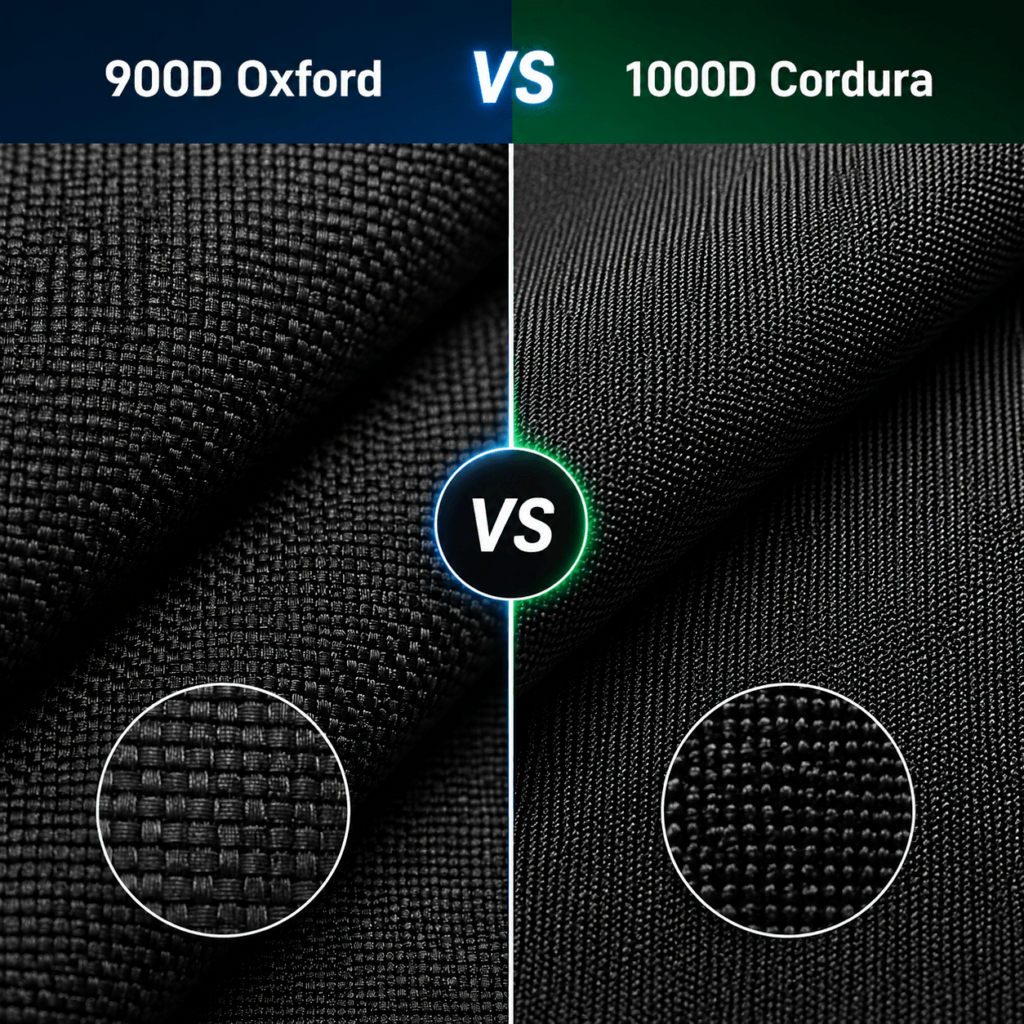
Oxford fabric refers to a specific structural weaving style—a basketweave pattern where multiple warp and weft threads are crossed over each other. In tactical gear manufacturing, 900D Oxford is most commonly woven from high-density filament Polyester (PET), though nylon variants exist.
- The Structure:It has a relatively smooth, slightly glossy surface.
- The Role:It serves as the economic backbone of the commercial tactical market, delivering a clean tactical aesthetic and reasonable structural integrity at a highly competitive production cost.
1000D Cordura (Premium Air-Textured Nylon 6.6)
Cordura is a proprietary brand name owned by INVISTA, signifying a specific family of high-tenacity synthetic fabrics. True military-spec 1000D Cordura is woven from Nylon 6.6 (Polyamide).
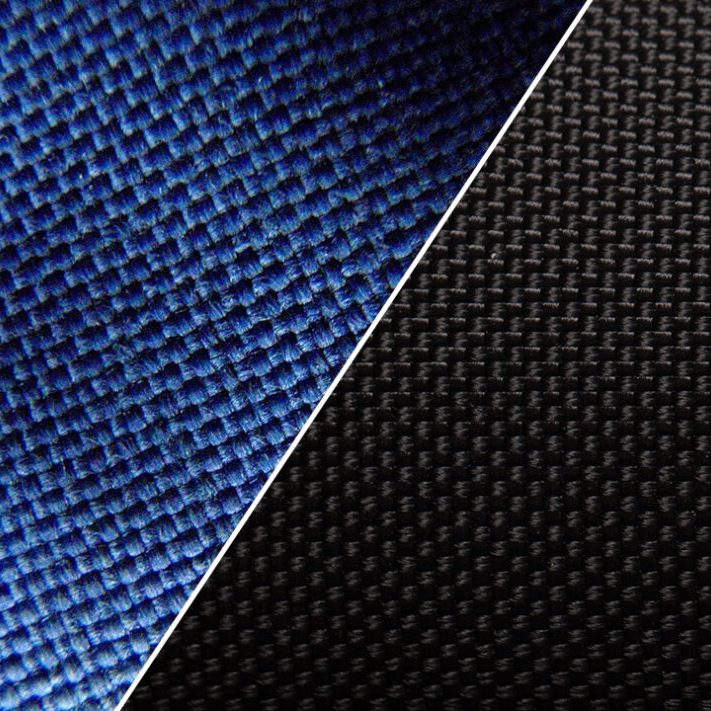
- The Structure:What truly sets it apart is the Air-Jet Texturing process. The smooth nylon filaments are blasted with compressed air to loop and crimp the fibers. This creates a fuzzy, matte, canvas-like texture.
- The Role:This textured yarn possesses microscopic bulk, which acts as a protective shield against friction. It has decades of military pedigree and remains the golden standard for official defense contracts worldwide.
|
Technical Metric |
900D Oxford (Polyester Base) |
1000D Cordura (Nylon 6.6) |
|
Base Polymer |
Filament Polyester (PET) |
High-Tenacity Polyamide (Nylon 6.6) |
|
Yarn Texture |
Smooth, filament structure |
Air-jet textured, high-bulk matte |
|
Average Weight (g/m²) |
≈ 310 – 360 (depending on backing) |
≈ 330 – 380 |
|
Melting Point |
≈250℃ |
≈ 265℃ |
|
Market Segment |
Commercial, Civilian Tactical, Fitness |
Active Duty Military, Law Enforcement, Premium Brands |
2. The Direct Showdown: Performance Metrics That Matter to Buyers
When evaluating 900D Oxford vs 1000D Cordura for custom military packs, product designers must weigh how each material behaves under physical and environmental duress.
Abrasion Resistance & Tensile Strength
This is where the chemical difference between Polyester and Nylon 6.6 becomes glaringly obvious. Nylon 6.6 has inherently longer, more resilient molecular bonds than polyester.
When subjected to a standard Taber Abrasion Test (where a weighted abrasive wheel grinds down the fabric), 1000D Cordura outlasts 900D Oxford by a massive margin. Cordura”s air-textured loops absorb friction by shifting slightly, meaning it can take thousands of cycles of being dragged across concrete, gravel, or body armor before a hole develops. 900D Oxford, while tough against clean tears, will pill and thin out much faster under repetitive low-friction abrasion.
Weight vs. Rigidity
A 1000D Cordura pack shell is naturally rigid. It yields a self-supporting structure; even when empty, a Cordura bag retains its aggressive tactical shape. However, this rigidity comes with a weight penalty.
If your brand is targeting the modern “Lightweight Tactical” or “Digital Nomad” commuter crossover market, 900D Oxford offers a more pliable, supple alternative. It conforms better to irregular loadouts and shaves vital ounces off the pack’s dry weight, enhancing long-term user comfort during non-combat transit.
Waterproof Coatings & Temperature Backings
Because raw woven fabric naturally leaks water through its needle holes, the backing chemistry applied during the milling process is crucial.
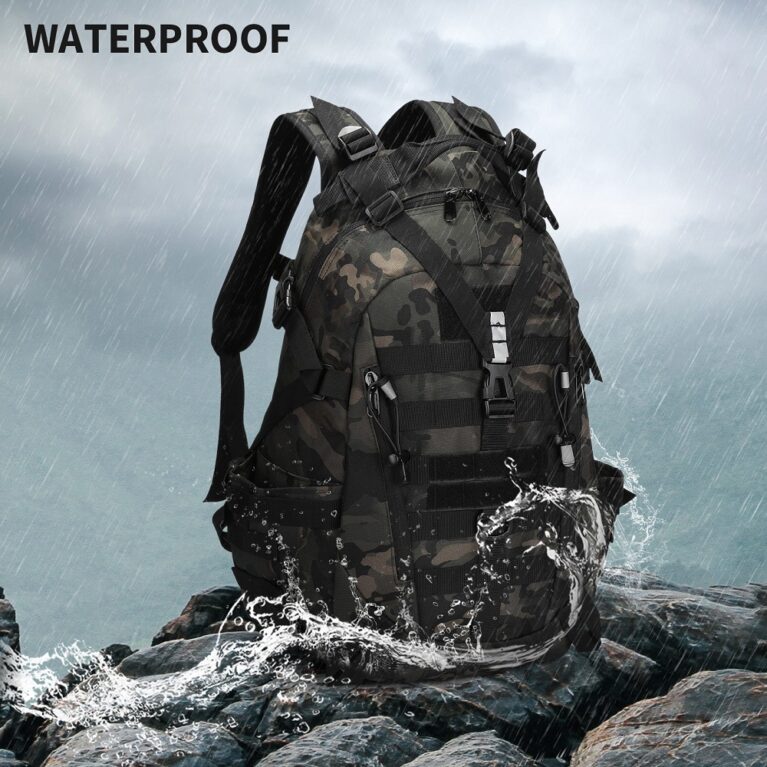
- 900D Oxford Processing:To compensate for its lighter weave, 900D Oxford is frequently paired with a heavy PVC (Polyvinyl Chloride) or thick PU (Polyurethane) interior coating. PVC is highly waterproof and incredibly cheap, but it has a fatal flaw for true military gear: thermal instability. In sub-zero environments (e.g., -15℃ or lower), PVC coatings stiffen, turn brittle, and crack, completely destroying the pack”s water resistance over time.
- 1000D Cordura Processing:Premium 1000D Cordura uses a multi-pass, lightweight PU interior coating combined with an exterior PFAS-Free DWR (Durable Water Repellent) treatment. This combination ensures the fabric remains completely flexible down to -40℃, maintaining its water barrier through extreme seasonal shifts.
3. The Financial Reality: ROI and Manufacturing Economics
Choosing a material isn’t just an engineering decision; it’s a boardroom decision. As a factory with 20 years of integrated trade and industrial manufacturing experience based in Guangzhou, we constantly help brands navigate these cost structures.
[Raw Fabric Sourcing] ──► 900D Oxford ──► Low Material Cost ──► High Profit/Low Retail Price
──► 1000D Cordura ──► High Material Cost ──► Premium Brand Margin Tier
The Raw Material Price Gap
Genuine, licensed Cordura nylon is an expensive raw asset. Because of brand licensing fees, strict chemical processing, and imported Nylon 6.6 yarn, 1000D Cordura can cost 2.5 to 3.5 times more per yard than standard 900D Oxford cloth. When extrapolated across a production run of 5,000 units, this material delta alone can shift your Bill of Materials (BOM) by tens of thousands of dollars.
MOQ (Minimum Order Quantity) Constraints
Because 900D Oxford is the standard workhorse of the global bag industry, factories maintain massive stock inventories of it in standard tactical colors (Black, Coyote Tan, Ranger Green, Wolf Grey). This allows us to offer much lower fabric MOQs for small or experimental product launches.
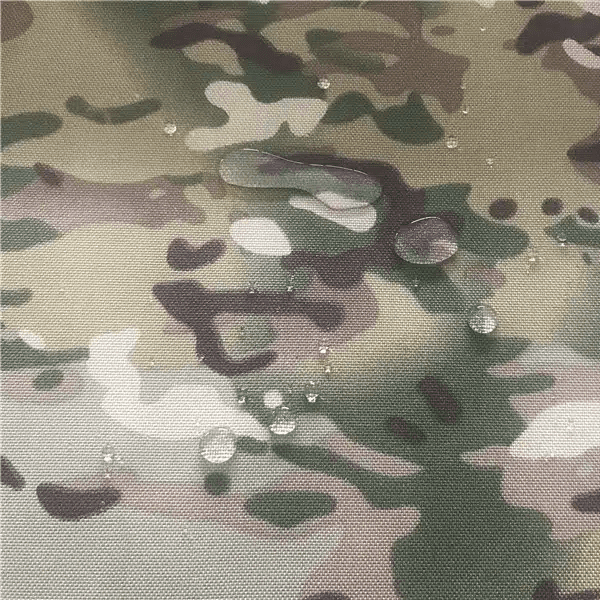
Conversely, authentic Cordura—especially specialty, branded camouflages like official MultiCam or Kryptek—must be sourced from licensed mills with rigid minimum dye-lot requirements, making it better suited for well-funded, high-volume production cycles.
O “Per-Pack” Retail Margin Value
While 1000D Cordura drives up your manufacturing cost, it simultaneously unlocks an entirely different retail ecosystem. Savvy end consumers, active-duty personnel, and gear enthusiasts actively look for the official Cordura hangtag.
A pack made of 900D Oxford might max out at a civilian retail price of $60 – $90. The exact same design executed in 1000D Cordura can easily command a premium MSRP of $180 – $280 +. The return on investment (ROI) per unit is often vastly superior with Cordura, provided your target audience values elite tier durability.
4. Factory Recommendation: Matching Fabric to Your Target Market
Neither fabric is universally “better” than the other; it is entirely a matter of aligning your product’s structural engineering with your target audience’s budget and operational expectations.
When to Specify 900D Oxford:
- Commercial Airsoft & Paintball Gear:Where the visual tactical style is highly desired, but the gear won’t face real battlefield attrition.
- CrossFit & Gym Fitness Packs:Heavy-duty gym bags and weight-vest carriers that face indoor environments and require competitive retail pricing.
- Everyday Urban Commuter (EDC) Packs: Bags designed to carry laptops, tech pouches, and light jackets through transit hubs rather than jagged mountain ridges.
- Strict Budget Contract Tenders: High-volume municipal bids where winning the contract depends entirely on presenting the lowest per-unit cost.
When to Specify 1000D Cordura:
- Active Defense & Law Enforcement Tenders: Official military unit deployments where gear failure compromises mission safety and must pass strict lab testing.
- Rugged Hunting & Expedition Packs: Heavy-load haulers designed to survive dense briars, sharp rocks, blood stains, and heavy back-country abuse.
- Premium Heirloom Brands: Companies whose entire brand promise is anchored on “Buy It For Life” warranties and absolute invulnerability.
- Specialized Weapon Cases: Heavy-duty double rifle bags and plate carrier shell covers that support massive dead-weights and sharp metal edges.
5. Conclusion & The Factory Advantage
When mapping out your next production run, navigating the trade-offs of 900D Oxford vs 1000D Cordura doesn’t have to be guesswork. Your choice determines whether your custom military packs will be agile and cost-effective or heavy-duty and premium.
Operating as an integrated industrial and trade enterprise in Guangzhou, China, for over two decades, our factory houses comprehensive inventories of both certified 900D Oxford variants and authentic, high-tenacity Cordura options. Our automated pattern-cutting systems, programmable CNC bartack sewing bays, and inline quality control lines are optimized to handle both fabrics with flawless precision, ensuring your tolerances are kept down to the millimeter.
Are you currently developing a new line of tactical packs, IFAK medical pouches, or load-bearing vests?
Don’t leave your material verification to digital screens. Contact our Guangzhou engineering department today. Let our team analyze your tech pack, provide side-by-side physical textile swatches, and help you engineer a sample run that perfectly balances field performance with your target profit margins. Let’s build gear that lasts.
Relacionadas:
Diferenças entre os tecidos Oxford 600D e Oxford 900D