Introduction: Understanding Tactical Backpack Selection from a Market Perspective
The tactical backpack market has evolved significantly beyond traditional military applications. Today, tactical backpacks are widely used across military operations, law enforcement, outdoor adventures, hunting, emergency preparedness, travel, and everyday carry markets. For brands, distributors, wholesalers, and professional buyers, selecting the right tactical backpack category is not only about product features—it is a strategic decision that directly affects market positioning, customer satisfaction, and long-term business growth.
Among the many tactical backpack options available, two categories often create the most discussion: Heavy Duty Tactical Backpack and Lightweight Tactical Backpack.
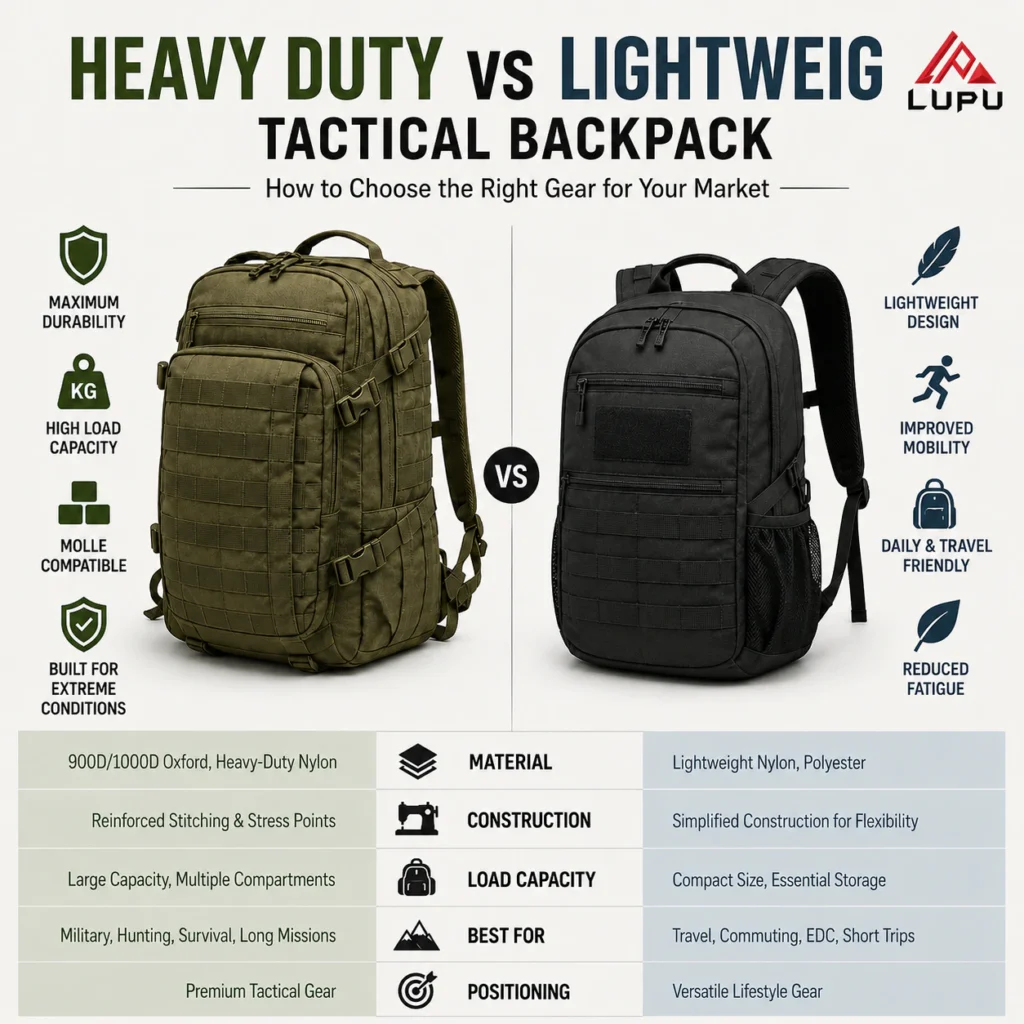
Both designs serve different user needs. A heavy duty tactical backpack focuses on maximum durability, load capacity, and long-term performance in demanding environments. A lightweight tactical backpack prioritizes mobility, comfort, and convenience for users who require flexibility and reduced carrying weight.
For B2B buyers, understanding the differences between these two categories is essential. Choosing the right product depends on target customers, application scenarios, regional market demand, and brand positioning.
This guide provides a professional comparison of heavy duty and lightweight tactical backpacks to help businesses make informed sourcing and product development decisions.
1. What Is a Heavy Duty Tactical Backpack?
A Heavy Duty Tactical Backpack is designed for users who require exceptional durability, stronger load-bearing capability, and reliable performance in challenging environments. Unlike standard backpacks, heavy duty tactical backpacks are engineered with reinforced structures, rugged materials, and modular systems to support demanding outdoor and professional applications.
These backpacks are built for situations where equipment reliability matters. Whether used for military operations, extended outdoor missions, hunting trips, or emergency situations, a heavy duty tactical backpack provides the strength and storage capacity required for carrying essential gear.
Core Features of Heavy Duty Tactical Backpacks
A professional heavy duty tactical backpack typically includes:
High-Density Durable Materials
The choice of fabric plays a critical role in backpack performance. Common materials include:
- 900D Oxford fabric
- 1000D nylon
- High-density polyester
These materials provide:
- Excellent abrasion resistance
- Improved tear resistance
- Long service life
- Better protection for stored equipment
For professional buyers, material quality is one of the most important indicators of product reliability.
Reinforced Construction
Heavy duty tactical backpacks usually feature reinforced stress points, including:
- Shoulder strap connections
- Carry handles
- Zipper areas
- Bottom panels
- Load-bearing sections
Advanced stitching techniques, such as cross-stitch reinforcement and bartack stitching, help improve structural strength and prevent failure during heavy use.
High Load Capacity
One of the biggest advantages of a heavy duty tactical backpack is its ability to carry more equipment.
Typical users may need to store:
- Communication devices
- Survival equipment
- Outdoor tools
- Medical supplies
- Protective gear
- Navigation equipment
A larger capacity and stronger frame structure make these backpacks suitable for extended missions and professional applications.
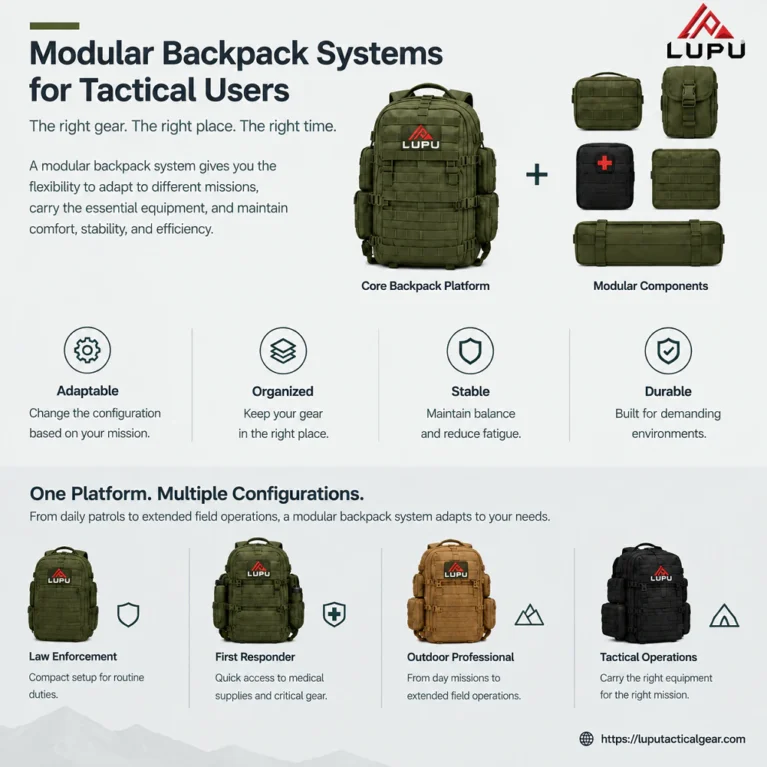
MOLLE Modular Compatibility
Many heavy duty tactical backpacks incorporate a MOLLE system (Modular Lightweight Load-carrying Equipment), allowing users to attach:
- Utility pouches
- First aid kits
- Magazine pouches
- Tool holders
- Additional storage modules
This modular design increases versatility and allows users to customize their equipment setup.
2. What Is a Lightweight Tactical Backpack?
A Lightweight Tactical Backpack is designed around mobility, comfort, and everyday practicality. Instead of maximizing carrying capacity, lightweight tactical backpacks focus on reducing unnecessary weight while maintaining essential tactical features.
They are popular among users who need a functional backpack without the bulk of professional heavy duty equipment.
Advantages of Lightweight Tactical Backpacks
Improved Mobility
A lighter backpack allows users to move faster and more comfortably.
This makes lightweight tactical backpacks suitable for:
- Urban environments
- Short outdoor trips
- Daily commuting
- Travel applications
For users who carry limited equipment, reducing backpack weight can significantly improve comfort.
Reduced Carrying Fatigue
Long-term backpack use can create pressure on shoulders and back. Lightweight designs help minimize fatigue, especially for:
- Daily users
- Travelers
- Outdoor enthusiasts
- Students and professionals
Easy Transportation
Lightweight tactical backpacks are easier to:
- Carry on airplanes
- Store in vehicles
- Use in crowded environments
- Combine with other luggage
This makes them attractive for lifestyle and travel-focused markets.
3. Heavy Duty Tactical Backpack vs Lightweight Tactical Backpack: Key Differences
Understanding the differences between these two categories helps B2B buyers select products that match their customers’ expectations.
3.1 Material and Construction Comparison
Material selection and construction quality are among the most important factors when evaluating tactical backpacks. For professional buyers, the difference between heavy duty and lightweight tactical backpacks directly affects product positioning, durability expectations, and target market suitability.
|
Comparison Factor |
Heavy Duty Tactical Backpack |
Lightweight Tactical Backpack |
|
Primary Design Goal |
Maximum durability, strength, and long-term performance in demanding environments |
Improved mobility, comfort, and everyday carrying convenience |
|
Fabric Materials |
Typically uses high-density fabrics such as 900D/1000D Oxford or heavy-duty nylon for enhanced abrasion resistance |
Usually uses lightweight nylon, polyester, or blended fabrics to reduce overall weight |
|
Construction Method |
Features reinforced stitching, stress-point reinforcement, bartack stitching, and stronger structural support |
Uses simplified construction methods to maintain flexibility and reduce weight |
|
Durability Performance |
Designed to withstand harsh outdoor conditions, heavy loads, and frequent professional use |
Designed for moderate use where portability and comfort are higher priorities |
|
Weight Level |
Heavier due to reinforced materials and additional structural components |
Lighter for easier transportation and reduced carrying fatigue |
|
Load-Bearing Capability |
Suitable for carrying professional equipment, tools, survival gear, and tactical accessories |
Suitable for carrying essential daily items and lightweight outdoor equipment |
|
Typical Applications |
Military operations, law enforcement, hunting, survival, extended outdoor missions |
Travel, urban outdoor activities, commuting, EDC, short hiking trips |
|
Market Positioning |
Premium tactical gear focused on reliability and professional performance |
Versatile tactical lifestyle gear focused on convenience and accessibility |
For brands, distributors, and wholesalers, understanding these construction differences helps determine the right product strategy. Heavy duty tactical backpacks are better positioned for professional markets that prioritize durability and performance, while lightweight tactical backpacks appeal to broader consumer segments seeking flexibility and everyday usability.
3.2 Load Capacity and Storage Performance
Storage capability is one of the most important differences.
Heavy Duty Tactical Backpack
Ideal for carrying:
- Large equipment
- Multiple accessories
- Survival supplies
- Professional tools
It supports users who need extended storage capacity.
Lightweight Tactical Backpack
Better for:
- Essential daily items
- Minimal outdoor equipment
- Personal belongings
It supports users who prefer a compact and efficient setup.
3.3 Durability and Product Lifespan
For professional markets, durability directly influences customer satisfaction.
Heavy duty tactical backpacks typically offer:
- Higher resistance to wear
- Stronger load support
- Better performance under harsh conditions
This makes them attractive for:
- Military suppliers
- Outdoor equipment brands
- Professional gear retailers
Lightweight tactical backpacks may have excellent durability but are generally optimized for lower-weight applications.
3.4 Comfort and Mobility
Comfort depends on more than backpack weight. A professional design should consider:
- Ergonomic shoulder straps
- Breathable back panels
- Balanced weight distribution
- Adjustable carrying systems
Heavy duty backpacks provide strength but may require better ergonomic design to manage heavier loads.
Lightweight backpacks naturally provide easier mobility but may have limitations for carrying large equipment.
4. How to Choose the Right Tactical Backpack for Different Markets
For B2B buyers, product selection should begin with understanding the target market.
4.1 Military and Professional Tactical Markets
Recommended Choice:
Heavy Duty Tactical Backpack
Military and professional users typically require:
- Maximum reliability
- High carrying capacity
- Long-term durability
- Modular attachment options
A heavy duty design better matches these expectations.
4.2 Outdoor and Adventure Markets
Recommended Choice:
Heavy Duty or Hybrid Tactical Backpack
Outdoor users often require a balance between:
- Durability
- Weight control
- Storage capacity
- Weather resistance
For long-distance hiking, hunting, and survival activities, durability remains a major purchasing factor.
4.3 Urban Lifestyle and Everyday Carry Markets
Recommended Choice:
Lightweight Tactical Backpack
Urban users usually prioritize:
- Comfortable carrying
- Compact design
- Versatile appearance
- Daily practicality
Lightweight tactical backpacks are better suited for commuting, travel, and casual outdoor use.
4.4 Retailers and Distributors
When selecting products for retail markets, businesses should evaluate:
Customer Profile
Understand whether customers are:
- Outdoor professionals
- Tactical enthusiasts
- Travelers
- Everyday users
Market Positioning
Different backpack categories support different pricing strategies:
- Heavy duty backpacks → premium positioning
- Lightweight backpacks → broader consumer appeal
Product Differentiation
Features such as:
- MOLLE webbing
- Hook-and-loop panels
- Reinforced handles
- Custom branding options
can help brands create competitive advantages.
5. Key Features B2B Buyers Should Evaluate Before Sourcing Tactical Backpacks
Selecting the right supplier requires evaluating more than appearance. Professional buyers should focus on engineering quality and manufacturing capability.
5.1 Material Quality
Important factors include:
Fabric Strength
Evaluate:
- Fabric density
- Abrasion resistance
- Water resistance
- Color durability
Hardware Quality
Consider:
- Zipper reliability
- Buckle strength
- Webbing quality
- Stitching performance
Small components often determine long-term product reliability.
5.2 Manufacturing Quality
A professional tactical backpack manufacturer should have strong control over:
- Stitching accuracy
- Reinforcement methods
- Production consistency
- Quality inspection
Critical areas include:
- Shoulder strap attachment points
- Handle connection areas
- MOLLE webbing stitching
- Bottom reinforcement
5.3 Modular Design Capability
Modern tactical users value customization.
Important modular features include:
- MOLLE systems
- Hook-and-loop panels
- External attachment points
- Expandable storage solutions
These features allow users to configure backpacks according to different missions and applications.
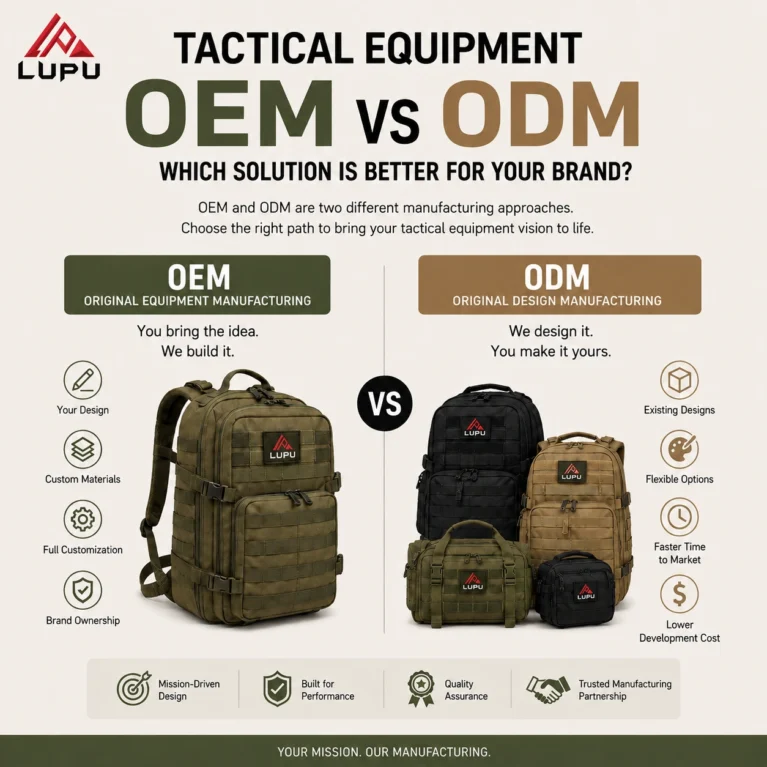
5.4 OEM and ODM Customization
For brands and distributors, customization capability is an important sourcing advantage.
Professional suppliers should support:
- Custom logos
- Custom colors
- Packaging solutions
- Design improvements
- Product development
This allows businesses to build unique market identities.
6. Market Trends: Why Heavy Duty Tactical Backpacks Continue to Grow
The demand for tactical backpacks continues expanding because consumers increasingly value durability, functionality, and versatility.
6.1 Growth of Outdoor Activities
Outdoor recreation continues driving demand for reliable equipment.
Applications include:
- Camping
- Hiking
- Hunting
- Survival training
- Adventure travel
Users increasingly prefer products that offer professional-level durability.
6.2 Tactical Gear Moving Beyond Military Applications
Modern tactical backpacks are no longer limited to military users.
They are increasingly adopted by:
- Outdoor enthusiasts
- Travelers
- Photographers
- Emergency preparedness communities
- Everyday carry users
This creates new opportunities for brands and distributors.
6.3 Premium Product Opportunities
For businesses, heavy duty tactical backpacks offer opportunities to compete through:
- Better materials
- Superior craftsmanship
- Functional design
- Long-term durability
Quality-focused products often achieve stronger customer loyalty and market differentiation.
7. Choosing the Right Tactical Backpack Supplier
A successful tactical backpack product depends not only on design but also on manufacturing expertise.
7.1 What Professional Buyers Should Look For
A reliable supplier should provide:
- Consistent production quality
- Strong material sourcing
- Experienced manufacturing teams
- Quality control processes
- Product development capability
7.2 Importance of Product Engineering
Professional tactical backpacks require careful engineering.
Key considerations include:
- Weight distribution
- Structural reinforcement
- User comfort
- Functional accessibility
- Durability testing
A well-engineered backpack delivers better user experience and fewer quality issues.
7.3 OEM and ODM Partnership Benefits
Working with an experienced manufacturer allows brands to:
- Develop unique products
- Improve market competitiveness
- Create customized solutions
- Expand product lines
For B2B buyers, supplier capability is a key factor in long-term success.
Conclusion: Choosing the Right Tactical Backpack for Your Market
The choice between a Heavy Duty Tactical Backpack and a Lightweight Tactical Backpack depends on market needs, customer expectations, and product positioning.
A Heavy Duty Tactical Backpack is the better choice for users who require:
- Maximum durability
- Higher load capacity
- Professional performance
- Long-term reliability
A Lightweight Tactical Backpack is better suited for users who prioritize:
- Mobility
- Comfort
- Everyday usability
- Lightweight transportation
For brands, wholesalers, and distributors, the right decision is not simply choosing the strongest or lightest backpack. It is about selecting the product category that best matches the target market and creates long-term commercial value.
By understanding customer requirements, evaluating product construction, and partnering with experienced tactical gear manufacturers, businesses can develop tactical backpack solutions that deliver performance, reliability, and competitive advantages in a growing global market.