A tactical backpack is more than a storage solution. It is a load-carrying system designed to help users transport equipment efficiently, maintain mobility, and access essential items when needed. Its performance depends not only on fabric strength, pocket configuration, or external appearance, but also on how the backpack fits the user and responds to the intended load.
For brands developing a new tactical backpack, these requirements should be established before the first prototype is made.
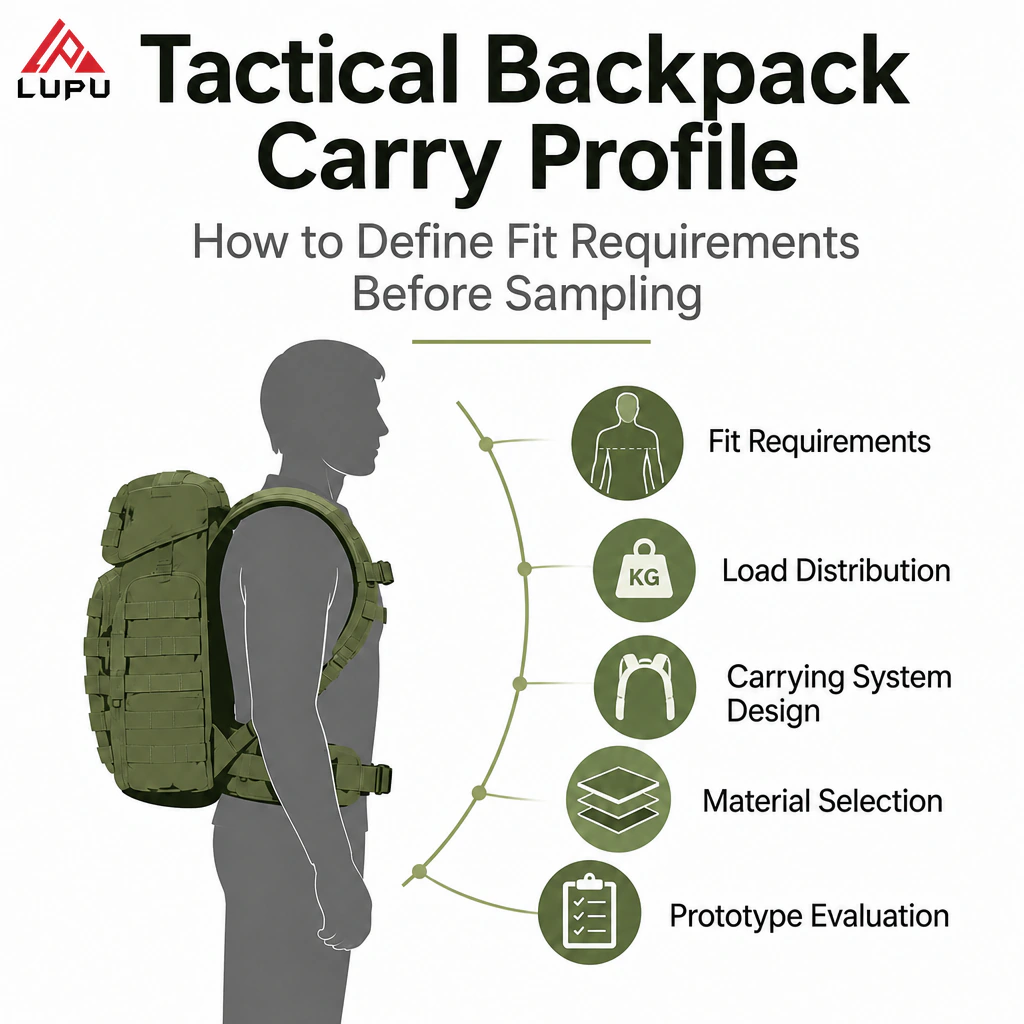
One of the most important steps in this process is defining a Tactical Backpack Carry Profile. This profile translates the intended application, user characteristics, equipment load, and carrying preferences into practical design requirements. It gives product designers and manufacturers a clear reference for selecting dimensions, materials, carrying components, and structural features.
Without a well-defined carry profile, product development can become a cycle of guesswork and repeated modifications. A backpack may look right on paper but feel uncomfortable when loaded. It may offer sufficient storage volume but distribute weight poorly. Its shoulder straps may appear substantial yet fail to provide the adjustment range required by the target users.
This guide explains how to establish a tactical backpack carry profile before sampling and how to turn that information into a more reliable product specification.
1. Start with the Intended Carrying Application
Before deciding on backpack dimensions or materials, define what the backpack is expected to carry and where it will be used.
Different applications create different carrying requirements. A backpack designed for everyday equipment transport does not necessarily need the same structure as one intended for extended outdoor use or professional tactical applications.
The intended application influences nearly every major design decision, including capacity, compartment layout, access points, reinforcement, and carrying-system configuration.
Everyday Carry and Lightweight Tactical Use
An everyday tactical backpack generally needs to balance compact dimensions, practical organization, and comfortable daily carrying.
Typical design priorities include:
- A manageable overall size for regular transportation
- Compartments for personal items, documents, electronics, and small equipment
- Convenient access to frequently used items
- A streamlined profile that does not create unnecessary bulk
- Adjustable shoulder straps and a back panel suitable for repeated daily use
For this category, excessive external attachments or oversized dimensions may reduce practicality. The goal is to provide useful organization without making the backpack unnecessarily complicated.
Outdoor Activities and Extended Carrying
Outdoor applications often involve longer carrying periods and a wider range of equipment.
Depending on the intended activity, the backpack may need to accommodate clothing, hydration supplies, food, tools, protective accessories, and other essentials.
Important considerations include:
- Sufficient capacity for the expected equipment
- Stable load distribution during movement
- A carrying system with appropriate adjustment options
- Reinforced areas around high-stress attachment points
- Practical access to equipment without unnecessary unloading
A larger backpack is not automatically a better backpack. Capacity should be determined by the actual equipment list and carrying duration rather than by volume alone.
Professional and Tactical Applications
Professional tactical applications may require more specialized organization and equipment compatibility.
For example, users may need modular attachment areas, reinforced compartments, durable webbing, or dedicated storage for specific equipment.
Design considerations can include:
- MOLLE-compatible external webbing where appropriate
- Reinforced attachment points
- Secure closures and dependable hardware
- Clearly organized equipment compartments
- A carrying system suited to the expected load
- A configuration that allows users to access essential equipment efficiently
The important point is to define which tactical features serve a real function. Adding MOLLE webbing, multiple compartments, or additional reinforcement without considering their purpose can increase weight, cost, and complexity without improving the user experience.
2. Define the Target User and Fit Requirements
Once the application is clear, the next step is understanding who will carry the backpack.
A tactical backpack should be designed around the physical characteristics and carrying needs of its intended users. A single size or strap configuration may not provide an equally suitable fit for every body type.
A practical fit specification should consider at least four areas: torso length, shoulder width, adjustment range, and contact with the back.
Torso Length and Backpack Dimensions
Torso length is an important reference when determining the relationship between the backpack and the user’s body.
If a backpack is too long for the intended user, its lower section may sit awkwardly and interfere with movement. If it is too short, the shoulder straps and load-bearing structure may not align as intended.
During product development, consider:
- Overall back-panel length
- Shoulder strap attachment position
- Distance between the upper and lower strap connections
- Backpack width relative to the user’s back
- The position of the loaded backpack during normal movement
The dimensions should be evaluated together rather than treated as isolated measurements.
Shoulder Width and Strap Position
Shoulder straps need to follow a practical path over the shoulders without creating excessive pressure or restricting movement.
Their width, curvature, padding thickness, and attachment position all influence the carrying experience.
For a zaino tattico personalizzato, the manufacturer should clarify:
- Intended shoulder strap width
- Strap curvature and spacing
- Padding material and thickness
- Adjustment range
- Reinforcement at strap attachment points
A strap that is too narrow may concentrate pressure over a smaller contact area. A strap that is too wide or poorly positioned may interfere with arm movement or sit uncomfortably against the user’s neck and shoulders.
The correct configuration depends on the backpack’s dimensions, target users, and expected load.
Adjustment Range and User Compatibility
When a backpack is intended for a broad customer base, adjustability becomes especially important.
Shoulder straps should provide enough adjustment to accommodate the expected range of users while maintaining a stable carrying position.
Depending on the product category, additional features may include:
- Cinghie sternali regolabili
- Adjustable load-bearing straps
- Removable or adjustable waist belts
- Multiple strap attachment positions
- Flexible adjustment hardware
Not every backpack requires every feature. The objective is to provide the necessary adjustment without introducing unnecessary components or complexity.
Back Panel Contact and Stability
The back panel affects how the backpack sits against the user’s body.
Its dimensions, padding, surface construction, and internal support structure can influence comfort and stability. A back panel should be designed with the intended load and carrying duration in mind.
For example, a compact everyday backpack may use a relatively simple padded construction, while a backpack designed for heavier equipment may require a more supportive internal structure.
The design should also consider how the loaded backpack behaves when the user walks, bends, reaches, or changes direction.
3. Establish the Load Profile Before Choosing Capacity
Backpack capacity is often one of the first specifications discussed during product development. However, choosing a volume before understanding the expected load can lead to poor design decisions.
A more effective approach is to define the load profile first.
A load profile identifies what the backpack needs to carry, how much the equipment weighs, where it should be stored, and how frequently users need to access it.
Identify the Expected Equipment
Start by listing the main categories of equipment.
Depending on the intended application, these may include:
- Personal belongings
- Clothing and spare layers
- Hydration supplies
- Apparecchiature di comunicazione
- Tools and accessories
- Dispositivi di protezione
- Documents and electronic devices
The list should distinguish between essential items, optional accessories, and equipment that users may carry only occasionally.
This distinction helps determine which compartments should be permanent features and which storage areas should remain flexible.
Estimate the Loaded Weight
The expected carrying weight is just as important as the total volume.
Two backpacks with identical capacities can perform very differently when loaded. One may carry lightweight clothing and personal items, while the other carries dense tools or equipment.
During specification development, establish:
- The typical equipment load.
- The expected maximum working load.
- The approximate weight of individual equipment categories.
- The distribution of heavier and lighter items.
- Any additional weight from external attachments.
These figures provide a useful reference for selecting materials, reinforcement, strap construction, and structural support.
The design should be evaluated against the intended working load rather than an arbitrary capacity figure.
Plan Load Distribution
Load distribution is a central part of tactical backpack design.
Heavy items should be positioned with consideration for their distance from the user’s back, their vertical placement, and their effect on balance. Poorly arranged equipment can create unnecessary pulling forces, cause the backpack to shift, or increase pressure on specific contact areas.
A practical compartment layout should consider:
- Where heavier equipment will be positioned
- Which items require quick access
- Which items need separation or protection
- How internal dividers affect available space
- Whether external attachments change the center of the load
For many backpack configurations, positioning dense items relatively close to the user’s back can help reduce the feeling of the load pulling away from the body. However, the final arrangement must also account for the equipment’s shape, safety requirements, and intended access.
Design Storage Around Real Usage
More pockets do not necessarily create better organization.
Each compartment should have a clear purpose. Excessive compartment divisions can reduce usable space, increase manufacturing complexity, and make the backpack more difficult to configure.
A well-planned layout should answer three questions:
- What equipment will be stored here?
- How often will the user need to access it?
- Does this compartment need additional protection, separation, or reinforcement?
Per zaini tattici, MOLLE webbing can provide modular attachment options. However, its placement and coverage should be determined by the intended accessories and the backpack’s structural requirements.
External webbing should be positioned where it adds practical value, rather than being added simply to create a tactical appearance.
4. Engineer the Carrying System Around the Load
After defining the user and load profile, the next step is translating those requirements into the backpack’s carrying system.
The carrying system includes the shoulder straps, back panel, sternum strap, waist belt where applicable, and the structural connections between these components.
These elements must work together. Increasing padding thickness alone does not guarantee better carrying performance.
Shoulder Straps: Shape, Padding, and Reinforcement
Shoulder straps are among the most important components of a tactical backpack.
Their design should be based on the backpack’s dimensions, expected load, and target user group.
Key specifications include:
- Strap width and length
- Curved or contoured shape
- Foam type and thickness
- Outer fabric and lining
- Adjustment hardware
- Stitching and reinforcement
- Attachment geometry
The strap construction should balance flexibility, support, and durability.
The connection between the shoulder straps and the backpack body deserves particular attention. This area experiences repeated loading and movement, so its reinforcement and stitching design should reflect the intended working conditions.
Back Panel: Structure and Contact Comfort
The back panel should provide appropriate support while maintaining a practical level of comfort.
Its construction may include:
- Foam padding
- Multiple padding zones
- Mesh or fabric contact surfaces
- Internal support panels
- Shaped or segmented padding
- Ventilation-oriented surface structures
The appropriate configuration depends on the product category and expected load.
For a lightweight backpack, a simple padded panel may be sufficient. For a backpack intended to carry heavier equipment, a more structured construction may be worth evaluating.
Designers should also consider how the back panel behaves when the backpack is fully loaded. A panel that feels comfortable when empty may respond differently under weight.
Sternum Straps and Waist Belts
Sternum straps and waist belts can help improve carrying stability when properly designed and adjusted.
A sternum strap connects the shoulder straps across the chest. Its position and adjustment range should allow users to secure the shoulder straps without restricting normal movement.
A waist belt may help transfer part of the load toward the hip area, depending on its construction and the backpack’s overall support system.
Before adding either component, consider:
- Expected carrying weight
- Typical carrying duration
- Backpack dimensions
- User movement requirements
- Whether the feature provides a meaningful functional benefit
For smaller tactical backpacks, a waist belt may be unnecessary. For larger configurations designed around heavier loads, it may be an important part of the carrying system.
Reinforce the Structural Connection Points
A carrying system is only as dependable as its connections to the backpack body.
Important stress areas commonly include:
- Shoulder strap attachment points
- Upper carrying handle
- Waist belt connections
- Sternum strap attachment areas
- External webbing and accessory attachment points
- Bottom and side panels
Reinforcement methods may include additional fabric layers, suitable webbing, bartack stitching, and carefully planned seam construction.
The specific solution should be selected according to the expected forces, material characteristics, and intended use. Reinforcement should be functional and consistent with the product’s weight and cost targets.
5. Select Materials Based on Functional Requirements
Material selection should follow the carrying requirements rather than precede them.
A fabric that works well for one tactical backpack may not be the best choice for another. The right material depends on the expected abrasion exposure, weight target, construction method, appearance, and budget.
Choose the Main Fabric According to the Application
Common options in tactical backpack manufacturing include:
- 500D nylon: Often considered for products seeking a balance between fabric weight and practical durability.
- 600D Oxford fabric: Commonly used in tactical backpacks and outdoor bags where a practical balance between weight, cost, and everyday durability is desired.
- 900D Oxford fabric: Commonly used in backpacks where a heavier fabric construction and structured appearance are desired.
- 1000D nylon: Often selected for products with demanding abrasion and wear considerations.
These denier values describe yarn linear density, not a complete measurement of fabric performance.
Two fabrics with the same denier rating may differ in yarn quality, weave, coating, finishing, thickness, and actual test results. Therefore, material evaluation should consider the full fabric specification rather than relying on denier alone.
Evaluate Webbing, Foam, and Hardware Together
A tactical backpack contains several material systems that influence its overall function.
Webbing: Consider width, thickness, weave, material, and attachment requirements. Webbing used for load-bearing connections may need different specifications from webbing used for general organization.
Foam: Evaluate thickness, density, resilience, and compression behavior. The right foam should support the intended carrying structure without adding unnecessary bulk.
Buckles and adjustment hardware: Consider material, dimensions, operating requirements, compatibility, and expected use conditions.
Zippers and closures: Select suitable zipper sizes, slider configurations, and closure designs according to compartment dimensions and access frequency.
Lining and reinforcement fabrics: These materials should support the intended internal structure, protect relevant areas, and remain compatible with the main fabric and manufacturing process.
A backpack’s material system should be evaluated as a complete assembly. A strong main fabric cannot compensate for unsuitable hardware, weak stitching, or poorly designed attachment points.
6. Translate the Carry Profile into a Clear Sampling Specification
Once the main requirements have been defined, they should be converted into a technical brief that a product development team and manufacturing partner can follow.
This is where the Tactical Backpack Carry Profile becomes especially valuable. It turns general product ideas into measurable design inputs.
A practical sampling specification should cover the following areas.
Product Application and Target User
Record the intended use, target customer group, expected carrying duration, and relevant user characteristics.
Avoid descriptions that are too broad, such as “for all tactical applications.” More specific information creates a stronger foundation for design decisions.
Dimensions and Capacity
Specify:
- Overall height, width, and depth
- Main compartment dimensions
- Secondary compartment dimensions
- Target capacity
- Internal organization
- External attachment layout
Where possible, include dimensioned drawings or reference photographs.
Load and Carrying Requirements
Document:
- Typical loaded weight
- Expected maximum working load
- Main equipment categories
- Load distribution priorities
- Shoulder strap configuration
- Back panel construction
- Sternum strap and waist belt requirements
These details help the manufacturer determine whether the proposed structure is appropriate for the intended application.
Material and Construction Details
List the preferred specifications for:
- Main fabric
- Lining
- Webbing
- Foam
- Zippers and buckles
- Reinforcement materials
- Stitching and seam construction
- Branding and labeling
If the material is not yet finalized, indicate the desired performance characteristics and ask the produttore di attrezzi tattici to propose suitable options.
Branding and Customization
For brands developing a private-label tactical backpack, the technical brief should also include:
- Logo position and application method
- Brand labels
- Color requirements
- Custom zipper pulls or hardware, if needed
- Packaging specifications
- Required product markings
Providing these details before sampling can reduce unnecessary revisions later.
7. Validate the Prototype Before Approving Bulk Production
A prototype should not be approved based on appearance alone.
A tactical backpack may look accurate against a design drawing but behave differently when worn and loaded. Sampling should therefore evaluate both manufacturing accuracy and actual carrying function.
A structured prototype review helps identify problems before they become expensive production issues.
Stage 1: Inspect the Unloaded Backpack
Begin with a basic construction inspection.
Check:
- Overall dimensions
- Fabric and color consistency
- Compartment layout
- Zipper operation
- Buckle and hardware installation
- Stitching quality
- Shoulder strap symmetry
- Back panel construction
- Branding placement
Compare the sample against the approved technical brief and identify any deviations.
Stage 2: Conduct Controlled Loaded Evaluations
The next step is to evaluate the backpack under a representative load.
Use equipment or test weights that reflect the intended application. Record the total load and how it is arranged inside the backpack.
Assess:
- How the backpack sits against the body
- Whether the shoulder straps remain in position
- Whether the load shifts during movement
- Whether adjustment components work as intended
- Whether access to essential compartments remains practical
- Whether any structural areas show unexpected deformation
Testing should be conducted under controlled and appropriate conditions. Do not assume that a successful unloaded inspection proves the backpack is suitable for its intended working load.
Stage 3: Evaluate Different User Profiles
If the product is intended for a broad customer group, evaluate the sample on users with different relevant body dimensions.
Observe whether:
- The shoulder straps provide sufficient adjustment
- The backpack sits at an appropriate height
- The back panel makes suitable contact
- The sternum strap can be positioned comfortably
- The loaded backpack remains stable during movement
This step can reveal fit problems that are not obvious when only one person evaluates the sample.
Stage 4: Record Feedback and Make Targeted Revisions
Sample evaluation should produce specific feedback rather than general comments such as “make it more comfortable.”
Ad esempio:
- The shoulder straps require a wider adjustment range.
- The upper attachment points should be repositioned.
- The main compartment needs more usable depth.
- The waist belt creates unnecessary bulk for the target application.
- The external webbing layout needs to accommodate a particular accessory.
Clear observations make it easier for the manufacturer to identify the cause and implement the right modification.
After revisions, review the updated sample against the original requirements. Once the design, construction, and fit are approved, the specification can serve as the reference for bulk production.
8. Common Mistakes That Increase Tactical Backpack Sampling Costs
Many product development delays are caused not by manufacturing problems, but by incomplete requirements at the beginning of the project.
The following mistakes are worth avoiding.
Mistake 1: Choosing Capacity Before Defining the Load
A 30L, 40L, or 45L backpack is not automatically suitable simply because the volume sounds appropriate.
Without an equipment list and load estimate, designers may select dimensions that do not match actual usage.
Better approach: Define the equipment categories, approximate weight, and storage priorities before finalizing capacity.
Mistake 2: Focusing on Appearance Instead of Carrying Function
A backpack may have an attractive tactical appearance but still lack suitable strap positioning, load stability, or compartment access.
Better approach: Evaluate the carrying system and loaded configuration as part of the initial design process.
Mistake 3: Adding Too Many Features
Extra pockets, webbing, zippers, and reinforcement can increase weight, material consumption, sewing time, and production complexity.
Better approach: Give every feature a defined purpose. Prioritize the components that directly support the intended carrying application.
Mistake 4: Selecting Fabric by Denier Alone
Choosing nylon 1000D simply because the number is higher does not guarantee that the finished backpack will outperform every 500D or 900D alternative.
Better approach: Compare complete material specifications, construction quality, and relevant test results.
Mistake 5: Approving Samples Without Loaded Evaluation
An unloaded backpack cannot demonstrate how the carrying system responds to its intended load.
Better approach: Include controlled loaded evaluations and record specific observations before sample approval.
Mistake 6: Changing Requirements During Sampling Without Documentation
Unrecorded design changes can create confusion between the buyer, designer, and manufacturer.
Better approach: Maintain an updated technical specification with revision notes, drawings, measurements, and approval records.
A clear development process helps reduce avoidable sample revisions and gives both sides a more consistent production reference.
9. How a Defined Carry Profile Supports OEM/ODM Tactical Backpack Development
For brands, wholesalers, and distributors, a tactical backpack project involves more than selecting an existing model and adding a logo.
A successful OEM/ODM project requires alignment between the target market, product function, design specifications, material selection, sampling, and manufacturing requirements.
A defined Tactical Backpack Carry Profile helps establish this alignment from the beginning.
It gives the development team a practical basis for discussing:
- Product dimensions and capacity
- Target user and fit requirements
- Carrying-system configuration
- Main fabric and component selection
- Compartment and MOLLE layout
- Branding and customization
- Prototype evaluation
- Bulk production specifications
For manufacturers, a clear carry profile also makes it easier to assess the feasibility of a proposed design and identify areas that may require adjustment.
For buyers, it provides a more objective way to review samples and communicate expectations.
At LUPU, tactical backpack development can be approached around the buyer’s intended application, material preferences, structural requirements, branding needs, and order specifications. Whether the project involves adapting an existing design or developing a custom configuration, clear technical requirements provide a stronger starting point for sampling and production.
Conclusion: Define the Carry Requirements Before Designing the Backpack
A well-designed tactical backpack begins with a clear understanding of the person who will carry it and the equipment it needs to support.
Defining the Tactical Backpack Carry Profile before sampling helps connect user fit, load distribution, compartment planning, carrying-system design, and material selection into one consistent development process.
Instead of starting with appearance or capacity alone, start with the application, target user, and expected load. Translate those requirements into measurable specifications, evaluate the prototype under representative conditions, and document every approved revision.
The result is a more focused product development process, fewer avoidable sampling changes, and a tactical backpack design that is better aligned with its intended purpose.
Develop Your Custom Tactical Backpack with LUPU
Looking for a manufacturing partner for your next tactical backpack project?
LUPU supports OEM/ODM development and bulk customization for brands, wholesalers, and distributors.
Discuss your custom tactical backpack requirements with our team.