In high-stakes operations, tactical field deployments, or rugged outdoor expeditions, equipment failure isn’t just an inconvenience—it’s a mission-critical liability. For international brand owners, military equipment distributors, and B2B procurement officers, sourcing subpar inventory does more than trigger costly product returns; it erodes brand reputation and compromises end-user safety.
The global marketplace is saturated with tactical gear suppliers claiming to offer “military-grade” gear. However, true tactical backpack quality isn’t determined by tactical aesthetics, rugged colorways, or a collection of superficial straps. It is engineered at the foundational structural level. When you look past the initial presentation and audit the seams, raw thread integrity, and reinforcement matrices, the illusion of quality often fades.
To help professional buyers navigate the complexities of supply chain sourcing, this comprehensive technical guide provides an industry-standard inspection framework used by elite manufacturing facilities to evaluate structural stitching integrity and long-term product durability.
1. The Blueprint of Fabric Integrity: Beyond the Denier Rating
Before analyzing how a pack is put together, an inspector must understand the raw textile platform. Many buyers fall into the trap of looking exclusively at fabric weight, commonly measured as Denier (D), which indicates the mass in grams of 9,000 meters of the fiber.
|
Material Type |
Technical Characteristics |
Primary B2B Application |
|
Genuine Cordura® / Premium Nylon |
500D to 1000D; exceptional tensile strength; high abrasion and tear resistance; PU coated for water repellency. |
Elite Military Backpacks, Tactical Modular Vests, Law Enforcement Duty Gear |
|
Heavy-Duty Oxford Fabric |
900D; optimal strength-to-weight ratio; tight plain weave; excellent flexibility and puncture resistance. |
High-End Fitness Tactical Bags (e.g., 45L Cargo Packs), Range Bags, Daily EDC Carriers |
However, the industry’s best-kept secret is that even a premium 1000D Nylon fabric will fail if it is paired with sub-standard structural assembly. Fabric choice merely sets the performance ceiling; the actual tactical backpack quality is dictated by how those fabrics are joined together in the tactical gear manufacturing process.
2. The Core Inspection Checklist: Evaluating Stitching Quality
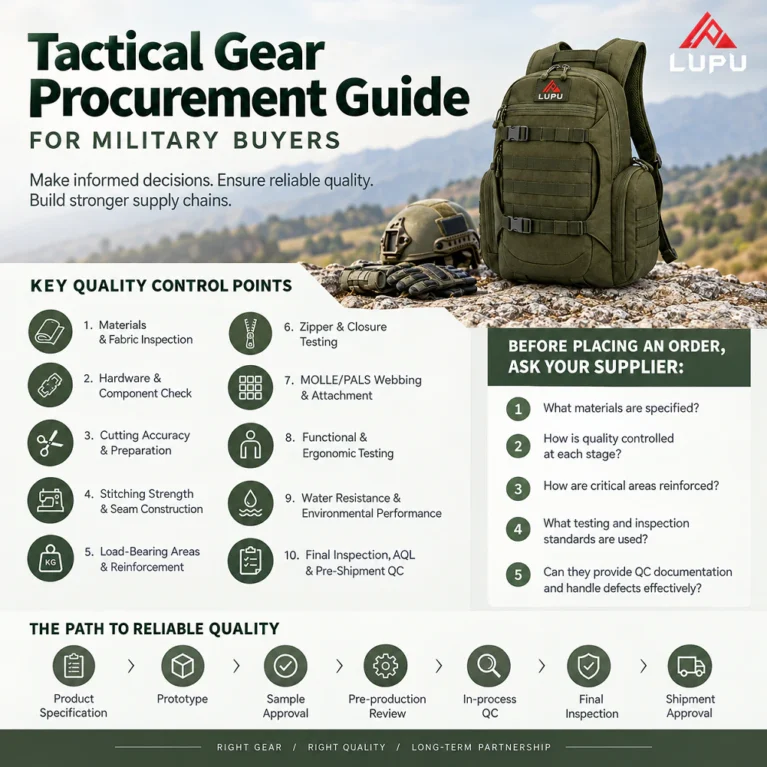
When conducting a quality assurance (QA) audit on a pre-production sample or a mass-production batch, the stitching line is your primary point of scrutiny. The following parameters separate commercial-grade fashion backpacks from heavy-duty tactical survival gear.
A. Stitch Density and Consistency (SPI)
Stitch Density is measured in Stitches Per Inch (SPI).
- The Gold Standard:For heavy-load tactical applications, the industry standard requires 7 to 9 SPI. This density ensures that stress is distributed evenly across the fabric fibers without cutting or perforating the textile base.
- Red Flags:An SPI lower than 6 indicates cheap, fast production, resulting in weak seams prone to pulling apart under tension. Conversely, an SPI greater than 11 can over-perforate the fabric, acting like a tear-off coupon line that rips easily under extreme loads. Inspectors must look for skipped stitches, irregular spacing, or loose looping along the entire seam line.
B. Thread Material and Composition
A premium stitch is useless if the thread itself degrades over time. Standard commercial packs often utilize cheap cotton or basic nylon threads. Professional tactical manufacturing demands Bonded Nylon or Polyester Composite Threads (typically Size T-70 or V-69 for structural seams).
Bonded threads undergo a specialized chemical treatment that prevents the plies from untwisting during high-speed sewing. This ensures the thread remains highly resistant to:
- Friction and mechanical abrasion
- Chemical rot and mildew from prolonged moisture exposure
- UV degradation caused by extended direct sunlight exposure
C. Heavy-Duty Sewn Construction vs. Laser-Cut Points
While modern aesthetics lean toward minimalist laser-cut slots for modular attachments, classic heavy-duty sewn construction remains the uncontested benchmark for heavy, sustained payload distribution. Clean, heavy-duty perimeter sewing locks the multi-layer fabric panels into a single structural block. When executed properly, multi-needle lockstitched seams absorb kinetic shocks when a user drops or flings a fully loaded pack, preventing catastrophic seam blowouts.
3. Stress Point Auditing: Where Quality Wins or Fails
A tactical pack must bear significant weight while undergoing sudden movements. To determine real-world tactical backpack quality, inspectors must conduct a localized stress-point audit across three vulnerable zones.
A. The Bartack Stitching Specification
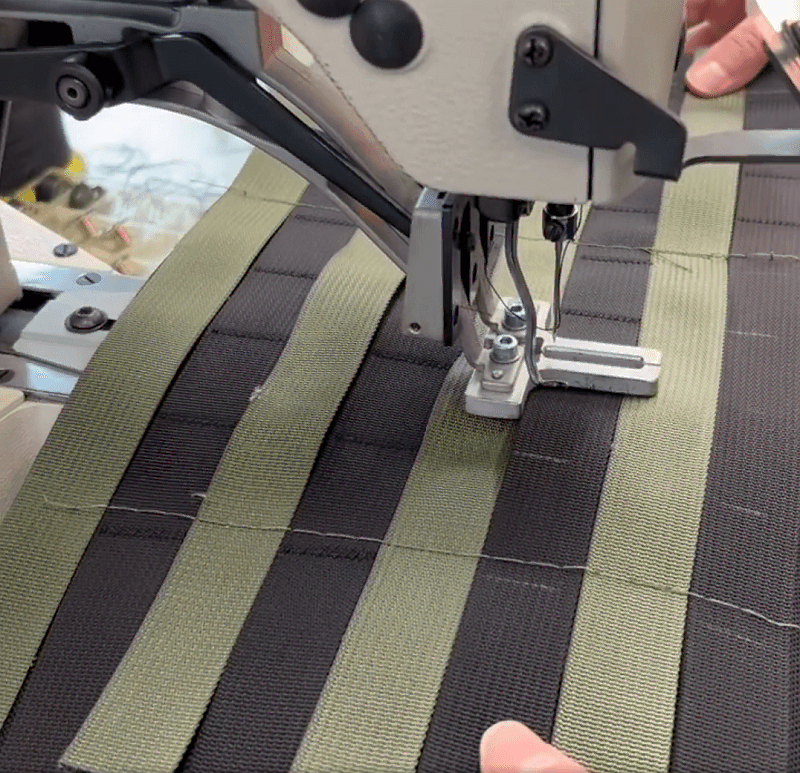
A standard straight stitch cannot support localized, heavy weight. Structural reinforcement requires Bartacking—a high-density, automated zigzag stitch formation designed to anchor high-stress junctions.
Standard Stitch: —————————————
Bartack Stitch: [|||||||||||||||||||||||||||||||||||||] <- High Density Reinforcement
During your physical inspection, ensure that heavy bartacks are explicitly placed at:
- The upper junction where the shoulder straps meet the main rear panel.
- The mounting anchors of the top drag or extraction handles.
- The load-bearing base connections of the lower compression straps.
B. MOLLE/PALS Webbing Load-Bearing Capacity
The Pouched Attachment Ladder System (PALS), commonly referred to as MOLLE webbing, allows users to modularly configure their gear. To inspect a grid for premium quality:
- Verify that webbings are constructed from high-tensile polyamide or reinforced polypropylene.
- Ensure each 1.5-inch interval division is secured with a heavy vertical bartack stitch.
- The Structural Test:The vertical rows of webbing must be sewn directly into the structural panel seams of the backpack, rather than merely tacked onto the surface of an exterior pocket face. This configuration ensures that weight attached via MOLLE is transferred directly to the backpack’s core suspension matrix.
C. Lower Front Utility Pocket and Flap Closures
The lower sections of a tactical pack frequently experience deep structural tension when the main compartment is packed tight. If the pack features a lower front utility pocket or a compartment secured by a flap with a dual strap-and-buckle closure system, inspect the fastening anchors closely.
The straps must be reinforced with an “X-in-a-box” (box stitch with cross-fill) configuration before running into the heavy-duty quick-release buckles. This geometric stitch distribution guarantees that repetitive, forceful pulling to tighten or secure the flap cover will not tear the webbing out from the lower pocket seam.
4. Structural Interior Integrity & Hardware Integration
True premium manufacturing doesn’t cut corners on the parts of the backpack that remain hidden from plain view. Open the compartments and inspect the internal finishing.
- Internal Seam Binding:Raw, cut edges of heavy fabrics like 1000D Nylon or 900D Oxford will naturally unravel over time due to friction. High-quality production requires all internal raw edges to be completely enclosed with premium nylon binding tape, secured via a double-needle lockstitch.
- Hardware and Zipper Anchoring:Zippers take immense punishment. The track of a heavy-duty zipper (such as YKK or premium custom tracks) must be double- or triple-stitched to the fabric wall. Check the zipper endpoints; they must feature heavy thread stoppers or fabric-wrapped fold-overs to prevent the sliders from derailing under heavy radial pressure.
5. The B2B Sourcing Checklist: Vetting Your Factory’s Capabilities
Evaluating a physical sample is critical, but securing reliable mass production requires verifying that your manufacturing partner runs a standardized, compliant facility. When sourcing a high-volume custom OEM/ODM order, look for a tier-1 facility that presents the following industrial credentials:
- ISO 9001 Certification:This certification proves that the factory operates under a strict, documented Quality Management System (QMS). Every batch produced will match the verified golden sample.
- BSCI Auditing Compliance:Business Social Compliance Initiative audits ensure the factory treats workers ethically and operates under safe, legal, and highly standardized industrial conditions. Ethical manufacturing practices directly correlate with stable assembly lines and lower product defect rates.
- Proven Industry Tenure:A facility backed by 20 to 25 years of specialized bag and tactical equipment engineering brings invaluable technical expertise. They understand how to properly balance materials, configure specialized sewing machinery, and preemptively solve manufacturing bottlenecks.
Conclusion: Securing Your Supply Chain
In the competitive tactical and outdoor gear landscape, premium tactical backpack quality is never an accident. It is the direct result of deliberate material selection, precise thread specifications, rigid stitch density enforcement, and meticulous factory floor auditing. By applying this framework during your sourcing cycles, you protect your brand from quality degradation and deliver elite, field-ready gear to your end-users.
Partner with a Proven Industry Leader
Looking to scale your private label brand or secure a reliable supply chain with military-grade precision? Explore our comprehensive Tactical Gear Manufacturing Services or contact our Guangzhou-based project management team today. Bring your tech packs, design blueprints, or custom specifications, and let our 20+ years of manufacturing expertise deliver the rapid OEM/ODM prototyping and mass-production reliability your brand deserves.
Correlato:
Top 50: Elenco globale delle marche di attrezzi tattici
I 12 principali produttori di stivali da combattimento militari nel mondo