A tactical bag is expected to handle more than ordinary daily storage. Whether it is used for outdoor activities, equipment transportation, training, travel, or everyday carry (EDC), it must withstand repeated handling, changing environmental conditions, friction, and the demands of carrying different types of loads.
However, not every bag that looks rugged is genuinely durable. Heavy-looking fabric, oversized buckles, and military-inspired styling do not necessarily indicate long-term performance. True tactical bag durability comes from the combined quality of its materials, construction, structural design, hardware, manufacturing processes, and intended application.
From a manufacturing perspective, durability must be considered throughout the entire product development process. A strong fabric cannot compensate for weak stitching. Reinforced seams cannot fully protect a poorly designed load-bearing structure. Even premium components can fail if they are incorrectly assembled or used beyond their intended specifications.
For buyers, brands, and wholesale distributors, understanding these details makes it easier to evaluate product quality and select reliable manufacturing partners.
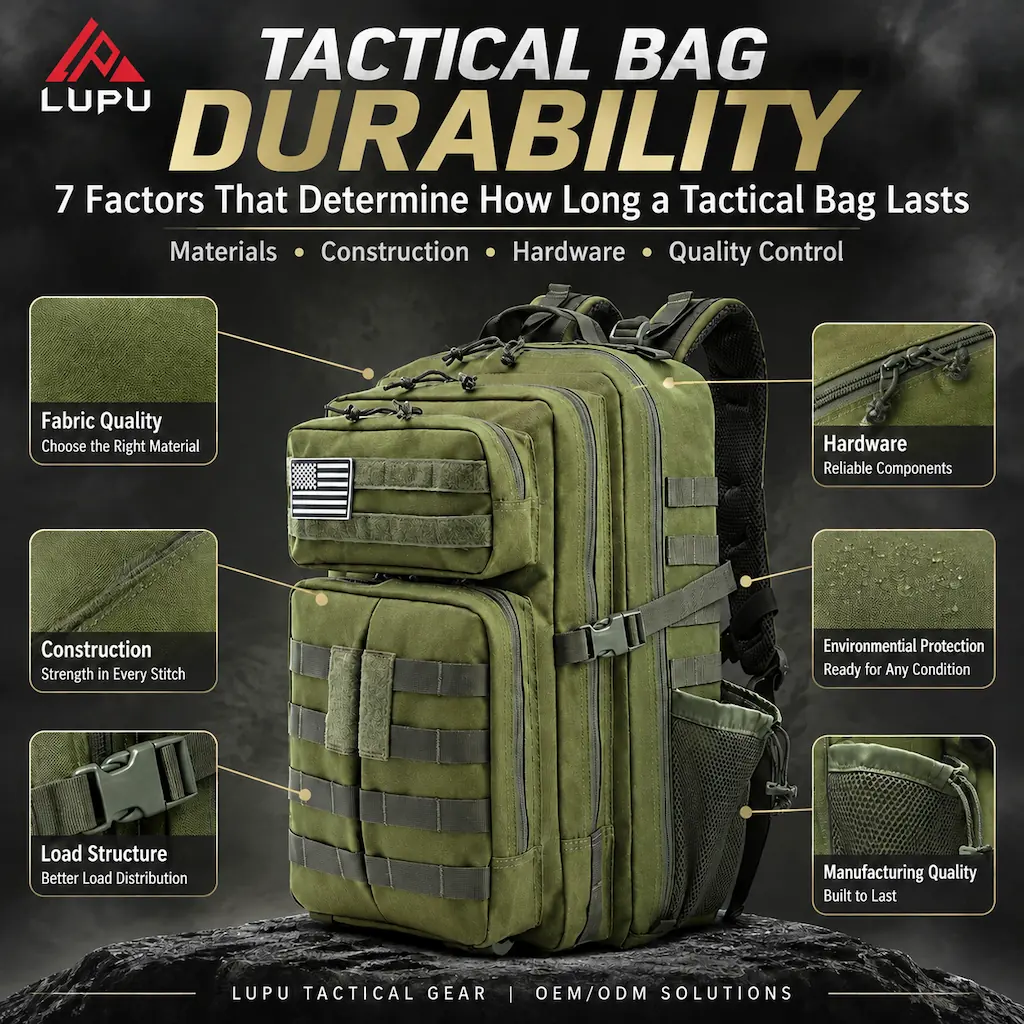
In this guide, we examine seven essential factors that determine tactical bag durability, explain what to look for in a well-constructed bag, and discuss how manufacturers can improve long-term product performance.
1. Fabric Quality and Material Selection
Fabric is the foundation of tactical bag construction. It forms the main body of the bag, supports its compartments, and protects stored equipment from external contact and environmental exposure.
The right fabric should provide an appropriate balance of strength, abrasion resistance, weight, flexibility, and cost. The best choice depends on the bag’s intended application rather than a single specification.
Understanding Common Tactical Bag Fabrics
Several fabric types are commonly used in sacs tactiques and backpacks.
Nylon
Nylon is widely used in performance-oriented bags because of its strength-to-weight characteristics, flexibility, and abrasion resistance. Different nylon constructions offer different performance profiles, making it suitable for backpacks, equipment bags, pouches, and other applications.
Polyester
Polyester is another common option for tactical and outdoor bags. It offers useful dimensional stability, relatively low moisture absorption, and good color retention. Its actual durability depends on fiber quality, fabric construction, coating, and finishing.
Oxford Fabric
Oxford fabric refers to a woven fabric construction rather than a specific fiber composition. It is commonly manufactured using polyester or nylon yarns and is available in different denier specifications.
Its suitability for tactical bags depends on the yarn, weave density, finishing, coating, and intended load conditions.
When evaluating a fabric, buyers should look beyond its commercial name and request clear material specifications.
500D vs. 600D vs. 900D vs. 1000D: What Is the Difference?
Denier (D) is a unit of measurement used to describe the linear mass density of yarn. It indicates the mass, in grams, of 9,000 meters of yarn. In general, a higher denier value means a heavier yarn, but it does not automatically indicate better abrasion resistance, tear strength, or overall fabric durability.
Tactical bags commonly use 500D Nylon, 600D Oxford, 900D Oxford, and 1000D Nylon. Although these specifications are often compared, it is important to understand that Oxford fabric and Nylon refer to different aspects of textile construction: Oxford describes a type of weave, while Nylon identifies the fiber material. Oxford fabrics can be made from polyester or nylon, depending on the specification.
600D Oxford Fabric
600D Oxford fabric is a common choice for everyday tactical bags, lightweight backpacks, utility bags, and pouches. It offers a practical balance of weight, flexibility, and cost, making it suitable for products designed for regular use.
Its actual performance depends on factors such as fiber composition, weave construction, fabric density, and coating quality.
900D Oxford Fabric
900D Oxford fabric uses a higher-denier yarn than 600D Oxford, resulting in a heavier fabric specification. It is often considered for tactical backpacks, equipment bags, and other products that require a more substantial fabric construction.
Depending on its fiber composition and finishing, 900D Oxford can be a suitable option for bags designed for frequent handling and demanding everyday applications. However, its performance should be evaluated through actual fabric specifications rather than denier alone.
500D Nylon Fabric
500D Nylon is widely used in tactical backpacks, assault packs, outdoor bags, and modular pouches. It is valued for its balance of strength, flexibility, and weight, making it suitable for products where mobility and reduced overall weight are important.
Its durability depends not only on the 500D specification but also on the nylon yarn quality, weave structure, fabric treatment, and manufacturing consistency.
1000D Nylon Fabric
1000D Nylon is a heavier fabric option commonly considered for sacs à dos tactiques, equipment bags, utility bags, and reinforced panels. It may be suitable for applications where a more substantial fabric construction is preferred, particularly in areas exposed to frequent contact and handling.
Compared with 500D Nylon, 1000D Nylon generally uses heavier yarn. This can contribute to a heavier and more substantial fabric, but it may also increase the overall weight and stiffness of the finished bag.
What Really Determines Tactical Bag Fabric Durability?
A higher denier rating does not automatically mean that a fabric performs better in every durability category. The actual performance of tactical bag fabric is influenced by several factors:
Fiber composition: Nylon and polyester have different material properties that affect strength, abrasion resistance, moisture behavior, and overall performance.
Yarn quality: The quality and consistency of the yarn influence the reliability of the finished fabric.
Weave construction and fabric density: The way yarns are woven and arranged affects the fabric’s structure and performance.
Abrasion and tear resistance: These properties should be evaluated through appropriate material specifications or test results.
Coating and finishing: PU coatings and other fabric treatments can influence water resistance, surface performance, and long-term material stability.
Weight and flexibility: A heavier fabric may provide a more substantial construction, while a lighter and more flexible option may be better suited to mobility-focused designs.
Manufacturing consistency: Consistent material sourcing, cutting, sewing, and quality control help ensure reliable product construction.
For example, a well-selected 900D Oxford fabric may be more suitable for a particular tactical bag than 1000D Nylon if the design prioritizes a specific balance of weight, flexibility, and cost. Similarly, 500D Nylon may be a better choice than 1000D Nylon for a lightweight tactical backpack.
Ultimately, the best fabric is not necessarily the one with the highest denier rating. It is the one that meets the product’s intended requirements for weight, durability, functionality, and cost.
The correct approach is to match fabric specifications to the intended product requirements.
Fabric Coatings and Surface Protection
Coatings are often applied to tactical bag fabrics to improve specific performance characteristics.
Polyurethane (PU) coating is commonly used to improve water resistance and provide an additional protective layer. Other finishing treatments may be selected depending on the desired appearance, flexibility, and environmental performance.
When evaluating coated fabric, manufacturers and buyers should consider:
- Coating uniformity.
- Adhesion between the coating and base fabric.
- Flexibility during repeated folding and movement.
- Resistance to surface deterioration.
- Performance after exposure to moisture and environmental conditions.
It is also important to distinguish between water-resistant fabric and a waterproof finished bag.
A coated fabric may resist water penetration, but water can still enter through seams, zippers, openings, and other construction details. Waterproof performance requires the entire product design to support that objective.
Manufacturing insight: Fabric selection should begin with the intended application, expected load, environmental conditions, and target product weight. Choosing the highest denier fabric without considering these factors can increase cost and weight without delivering a meaningful improvement in overall performance.
2. Stitching Quality and Seam Construction
Fabric provides the main material structure, but stitching connects the individual components into a functional bag.
In tactical bag manufacturing, seams are particularly important because they must withstand repeated movement, loading, pulling, and friction.
A bag can use premium fabric and still experience premature failure if its seams are poorly constructed.
Stitch Density and Consistency
Stitch density refers to the number of stitches within a given length of seam. It influences how fabric panels are connected and how loads are transferred across the seam.
However, more stitches do not automatically produce stronger construction.
Excessive stitch density can create too many needle penetrations, potentially weakening certain fabrics. Insufficient stitch density may result in inadequate seam security.
The appropriate stitch configuration depends on:
- Fabric thickness and construction.
- Thread material and thickness.
- Needle size.
- Seam design.
- Expected mechanical stress.
- Sewing equipment and production settings.
Consistency is equally important. Uneven stitches, skipped stitches, loose threads, and inconsistent thread tension can indicate problems in the sewing process.
Reinforcement at High-Stress Points
Certain areas of a tactical bag experience significantly more stress than others.
These typically include:
- Shoulder strap attachment points.
- Carrying handles.
- Main compartment corners.
- Side compression strap connections.
- Zipper termination points.
- Webbing attachment areas.
- Load-bearing MOLLE attachment locations.
Manufacturers use reinforcement techniques to improve the strength of these connections.
Two common techniques are:
Bar-Tack Stitching
Bar-tack stitching creates a concentrated group of closely spaced stitches. It is commonly used to reinforce attachment points where localized stress is expected.
Box-X Stitching
Box-X stitching forms a rectangular reinforcement pattern with diagonal stitching across the center. It is frequently used for handles, straps, and other load-bearing connections.
Neither method should be applied indiscriminately. Reinforcement patterns must be designed around the component, fabric thickness, loading direction, and expected application.
Thread Selection and Sewing Compatibility
Thread quality is another important part of tactical bag durability.
The thread must be compatible with the fabric and suitable for the expected operating environment. Its tensile strength, abrasion resistance, and resistance to environmental exposure should be considered.
Correct needle selection and thread tension are also essential. Poor sewing settings may cause thread damage, fabric distortion, skipped stitches, or inconsistent seam formation.
Manufacturing insight: A reliable tactical bag requires more than strong stitching. It requires correctly engineered seams, appropriate thread selection, consistent sewing operations, and reinforcement at locations where loads are transferred.
3. Structural Design and Load Distribution
A tactical bag is a complete load-bearing structure. Its durability depends not only on individual materials but also on how the entire product manages weight and mechanical stress.
Poor structural design can cause premature wear even when high-quality materials and components are used.
How Bag Design Influences Durability
The arrangement of panels, compartments, pockets, and attachment systems determines how loads move through a bag.
For example, a heavily loaded front compartment may pull on the main body and shoulder straps. If the attachment points are not designed to accommodate that loading condition, stress may become concentrated in a small area.
A well-designed structure distributes loads more effectively across the bag.
Parmi les éléments importants à prendre en compte, on peut citer :
- Main compartment dimensions.
- Panel geometry and material orientation.
- Reinforcement placement.
- Compartment attachment methods.
- Load-bearing connection design.
- Bottom panel construction.
The design should reflect how the bag will actually be packed and carried.
Shoulder Straps, Handles, and Attachment Systems
Shoulder straps and carrying handles are critical structural components.
Their performance depends on several interconnected factors:
- Strap material and width.
- Padding and internal construction.
- Stitching and reinforcement.
- Attachment geometry.
- Load distribution across connection points.
- Compatibility with the bag’s overall capacity.
For backpacks intended to carry heavier equipment, shoulder strap attachments should be engineered to withstand repeated loading rather than relying solely on the strength of the main fabric.
Carrying handles also require attention. A handle may appear secure during visual inspection but fail under repeated lifting if its reinforcement and attachment structure are inadequate.
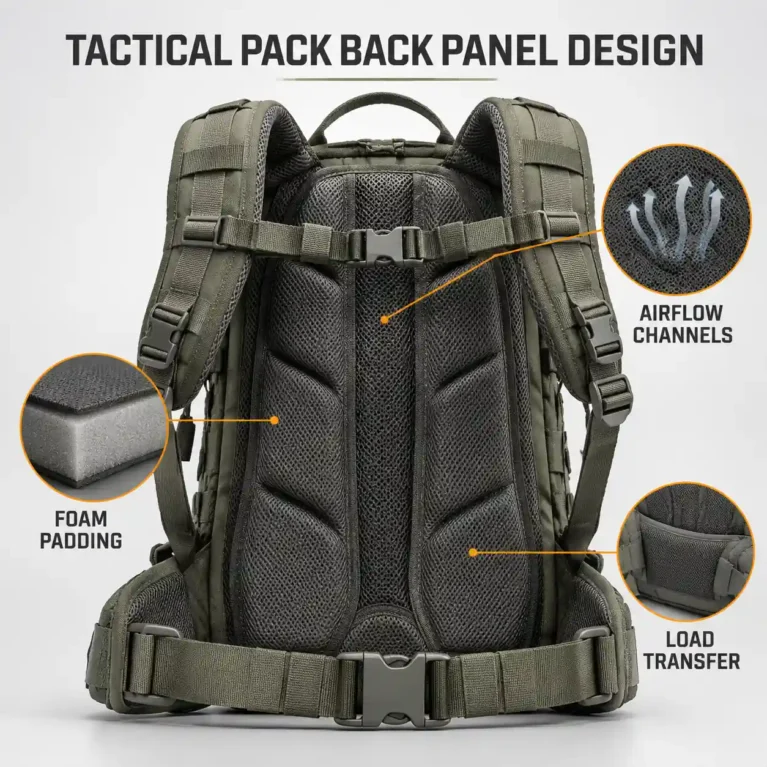
Back Panels and Ergonomic Support
The back panel affects both carrying comfort and the way a backpack performs under load.
Common design features include:
- Foam padding.
- Breathable mesh.
- Structured back panels.
- Contoured support areas.
- Reinforced contact zones.
Breathable mesh can improve airflow between the bag and the user’s back, while padding helps distribute contact pressure.
Although these features primarily support carrying comfort, they also contribute to practical product performance by helping users carry loads more effectively.
Weight Distribution and Overloading
Overloading is one of the most common causes of unnecessary stress on a bag.
When the load is unevenly distributed, certain seams, straps, zippers, and attachment points may experience greater stress than intended.
Manufacturers should consider realistic loading conditions during product development, including:
- Typical equipment weight.
- Expected load distribution.
- Frequency of lifting and carrying.
- Dynamic movement.
- Repeated opening and closing.
- Attachment of external equipment.
Users should also follow the manufacturer’s recommended loading guidance and avoid exceeding the product’s intended capacity.
Manufacturing insight: Structural durability is a system-level property. The strongest fabric and stitching cannot fully compensate for a design that concentrates loads in poorly reinforced areas.
4. Zippers, Buckles, Webbing, and Hardware
Hardware components are often smaller than the main fabric panels, but their failure can make an otherwise functional tactical bag difficult or impossible to use.
Zippers, buckles, webbing, adjusters, and attachment systems should therefore be treated as essential parts of the overall durability design.
Zipper Quality and Performance
Zippers are among the most frequently operated components of a tactical bag.
Their performance depends on several factors:
- Zipper chain construction.
- Slider quality.
- Zipper tape strength.
- Stitching around the zipper.
- Alignment during installation.
- Protection from dirt and external contact.
Common zipper problems include slider damage, chain separation, misalignment, and excessive resistance during operation.
Zipper selection should be based on compartment size, opening frequency, expected loading, and the product’s intended application.
A large compartment carrying heavy equipment may require a different zipper specification from a small accessory pocket.
The zipper installation process is just as important as the component itself. Incorrect alignment or poor stitching can create unnecessary stress and reduce functional reliability.
Buckles and Plastic Hardware
Buckles and adjustment components are used in shoulder straps, compression systems, sternum straps, and external attachment points.
Their performance depends on:
- Material properties.
- Component geometry.
- Manufacturing quality.
- Compatibility with webbing width.
- Fastening and release performance.
- Exposure to temperature and environmental conditions.
A buckle should fit its intended webbing correctly and operate smoothly without excessive looseness or difficulty.
For products intended for demanding environments, component selection should consider the possibility of repeated operation, impact, and mechanical stress.
Webbing and MOLLE Attachment Systems
Webbing is widely used in tactical bags for carrying, adjustment, compression, and modular attachment.
Its performance depends on fiber composition, weave construction, width, thickness, and attachment quality.
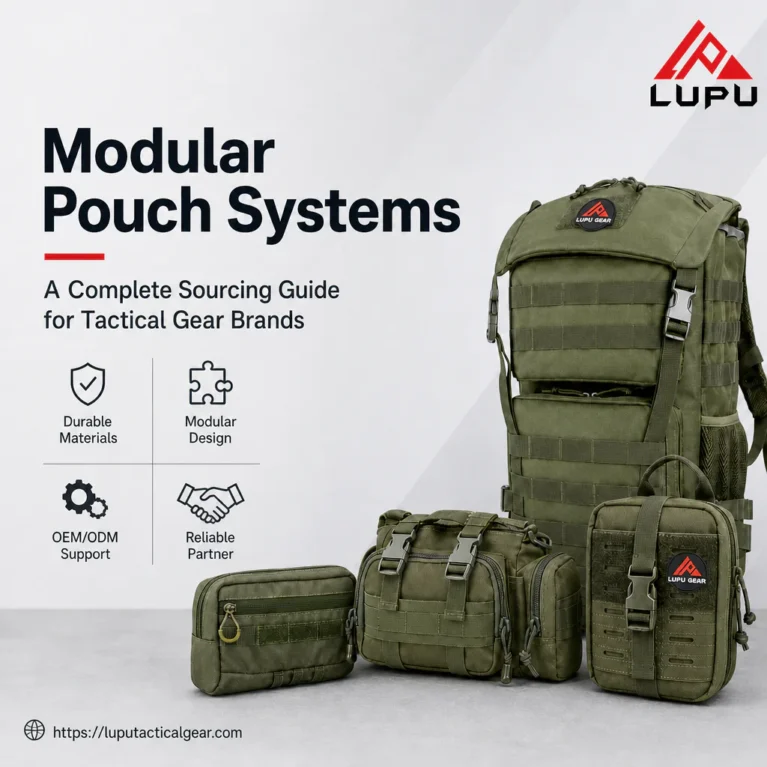
MOLLE systems allow compatible pouches and accessories to be attached to a bag through a modular webbing arrangement.
Traditional MOLLE webbing and laser-cut attachment panels use different construction approaches.
Traditional MOLLE systems generally use sewn webbing rows, while laser-cut systems use engineered panels with openings designed for compatible attachments.
Neither approach is automatically more durable in every application. Performance depends on the base material, panel thickness, attachment design, manufacturing accuracy, and intended load.
Buyers should inspect:
- Webbing alignment and consistency.
- Stitching along webbing edges.
- Attachment point reinforcement.
- Panel stability.
- Compatibility with intended accessories.
Manufacturing insight: Hardware should be evaluated as part of the complete bag assembly. Even a high-quality buckle or zipper can become a weak point if it is incorrectly selected, installed, or reinforced.
5. Fabric Treatments and Environmental Resistance
Tactical bags may be exposed to rain, dust, sunlight, humidity, temperature changes, and repeated contact with rough surfaces.
Environmental resistance is therefore another important part of tactical bag durability.
However, different environmental challenges affect materials in different ways. A treatment that improves water resistance does not necessarily improve abrasion resistance or UV stability.
Water Resistance and Moisture Protection
Water protection is influenced by more than the fabric coating.
The complete construction may include:
- Water-resistant base fabric.
- Protective coatings.
- Water-resistant zipper designs.
- Covered openings.
- Appropriate seam construction.
- Moisture-resistant compartment details.
A water-resistant tactical bag can help protect contents during light rain or incidental moisture exposure, depending on its construction.
However, a water-resistant bag should not automatically be described as waterproof.
A genuinely waterproof product requires suitable design and construction throughout the entire bag, including openings and seams. Its performance should be supported by appropriate testing.
UV Exposure and Color Stability
Long-term sunlight exposure can affect synthetic fabrics, coatings, thread, and plastic components.
Depending on the materials and exposure conditions, UV radiation may contribute to:
- Color fading.
- Surface deterioration.
- Reduced material strength.
- Coating degradation.
- Changes in component flexibility.
For bags intended for frequent outdoor use, material selection should consider the expected level of sunlight exposure.
UV resistance should be evaluated using suitable material specifications and testing rather than assumed from fabric appearance alone.
Abrasion, Dirt, and Repeated Friction
Abrasion occurs when the bag repeatedly contacts rough or textured surfaces.
Common high-wear areas include:
- Bottom panels.
- Lower corners.
- Side panels.
- Shoulder strap edges.
- External attachment points.
- Areas in contact with equipment.
Manufacturers can reduce premature wear through appropriate fabric selection, reinforcement panels, protective construction, and thoughtful placement of seams.
Dirt and debris can also affect zippers, buckles, and moving components. Regular cleaning helps prevent unnecessary mechanical wear.
Temperature and Environmental Conditions
Extreme heat, cold, and humidity may affect fabric coatings, plastic hardware, elastic materials, and adhesives.
For example, certain plastic components may become less flexible under low-temperature conditions, while prolonged heat exposure may affect some coatings and adhesives.
Manufacturers should select materials according to the intended operating environment and consider environmental conditions during product testing.
Manufacturing insight: Environmental resistance is not a single material feature. It is the result of suitable fabric treatments, component selection, seam construction, and overall product design.
6. Manufacturing Processes and Quality Control
A tactical bag’s durability is determined not only during design but also during production.
Even a well-engineered product can suffer from inconsistent quality if material preparation, sewing, assembly, and inspection are not properly controlled.
For this reason, manufacturing quality control is essential to achieving repeatable product performance.
Precision Cutting and Material Preparation
Accurate cutting ensures that fabric panels match the approved dimensions and design specifications.
Poor cutting accuracy may lead to:
- Uneven panel alignment.
- Incorrect seam allowances.
- Distorted compartment shapes.
- Inconsistent assembly.
- Unnecessary tension during sewing.
Material preparation should also include checking fabric condition, coating consistency, color, and other relevant specifications before production begins.
Sewing and Assembly Standards
The sewing and assembly process determines how individual components become a finished tactical bag.
Important production controls include:
- Consistent stitch formation.
- Correct thread tension.
- Accurate reinforcement placement.
- Proper zipper installation.
- Secure webbing attachment.
- Consistent panel alignment.
Appropriate handling of thick fabric layers.
Manufacturers should establish clear technical specifications and production procedures so that the finished product remains consistent across different production batches.
Quality Inspection During Production
Quality inspection should not be limited to the finished product.
A practical quality control process generally includes several stages.
Incoming Material Inspection
Check whether incoming fabric, webbing, zippers, buckles, thread, and other components meet the approved specifications.
In-Process Inspection
Monitor cutting, sewing, reinforcement, and assembly to identify defects before they affect additional production stages.
Final Product Inspection
Inspect finished products for construction defects, functional issues, appearance, dimensions, and compliance with approved specifications.
Typical inspection points include:
- Loose or skipped stitching.
- Uneven seams.
- Incorrect dimensions.
- Damaged fabric.
- Defective zippers.
- Poorly attached hardware.
- Inconsistent webbing placement.
- Missing components.
A documented inspection process helps manufacturers identify recurring issues and improve production consistency.
Durability Testing and Performance Verification
Visual inspection is useful, but it cannot establish every aspect of product durability.
Where appropriate, manufacturers should use relevant tests to evaluate materials and finished components.
Examples include:
Fabric Abrasion Testing
Evaluates how fabric responds to repeated surface friction under specified test conditions.
Seam Strength Testing
Assesses the resistance of sewn seams to separation under controlled loading.
Zipper Cycle Testing
Evaluates zipper operation over repeated opening and closing cycles.
Buckle Operation Testing
Examines fastening, release, and functional performance under defined conditions.
Webbing Attachment and Load Testing
Evaluates how webbing and its attachment points respond to specified loads.
Water-Resistance Evaluation
Assesses fabric or finished-product resistance to water penetration using an appropriate test method.
It is important to distinguish between laboratory material tests and finished-product performance tests.
A fabric passing an abrasion test does not automatically prove that the complete bag will withstand every type of field use.
Likewise, a seam test on a sample does not guarantee that every production unit has identical performance unless manufacturing consistency is maintained.
Reliable testing requires defined procedures, suitable samples, measurable acceptance criteria, and accurate records.
Manufacturing insight: A reliable fabricant de sacs tactiques should be able to explain its material specifications, production controls, inspection procedures, and relevant test evidence. Durability should be supported by verifiable quality practices rather than unsupported marketing claims.
7. Intended Use, Maintenance, and Long-Term Care
Even a well-designed and properly manufactured tactical bag has practical operating limits.
Its service life depends partly on how it is used, loaded, cleaned, stored, and maintained.
A bag designed for everyday carry may not be suitable for carrying heavy equipment over extended periods. Similarly, a lightweight tactical daypack should not be evaluated against the requirements of a heavy-duty equipment carrier.
Match the Bag to Its Intended Application
Different tactical bag categories have different performance requirements.
EDC Bags
Everyday carry bags are generally designed for frequent handling, convenient organization, and regular transportation of personal items.
Sacs à dos tactiques
These may require reinforced shoulder straps, durable compartment construction, practical storage organization, and compatible external attachment systems.
Assault Packs
Assault packs may be designed around specific carrying capacities, modular attachment requirements, and demanding movement conditions.
Medical Bags
Medical bags often require organized compartments, accessible openings, and secure storage for medical equipment.
Equipment and Duffel Bags
These products may prioritize spacious storage, reinforced handles, durable bottom panels, and convenient transportation of bulky equipment.
The correct design should match the expected load, usage frequency, and operating environment.
Proper Loading and Daily Handling
Loading habits have a direct influence on bag performance.
To reduce unnecessary stress:
- Distribute heavy items evenly.
- Avoid placing excessive weight in small external compartments.
- Secure loose equipment inside the main compartment.
- Use compression straps where appropriate.
- Avoid exceeding the manufacturer’s recommended load.
Lift the bag using its designated handles or carrying system.
Avoid dragging the bag across abrasive surfaces whenever possible.
These practices help reduce unnecessary stress on seams, straps, zippers, and attachment points.
Cleaning and Maintenance
Regular maintenance helps preserve fabric, hardware, and functional components.
General care recommendations include:
- Remove loose dirt and debris using a soft brush or cloth.
- Clean affected areas with mild soap and water when compatible with the material.
- Avoid harsh chemicals or aggressive cleaning methods that may damage coatings.
- Allow the bag to dry completely before storage.
- Check zippers, buckles, seams, and webbing regularly.
- Follow the manufacturer’s specific care instructions.
A bag should not be stored while damp, as prolonged moisture may contribute to odor, material deterioration, or other problems.
Recognizing Early Signs of Wear
Regular inspection can help identify problems before they affect the bag’s overall functionality.
Look for:
- Fraying webbing.
- Loose or broken stitching.
- Damaged zipper teeth or sliders.
- Cracked or malfunctioning buckles.
- Fabric thinning in high-friction areas.
- Peeling or deteriorating coatings.
- Loose shoulder strap attachments.
Depending on the severity and location of the damage, repair may be possible. Structural damage to critical load-bearing areas should be assessed carefully before continued use.
Manufacturing insight: Product durability is influenced by both design and operating conditions. Choosing the right bag and maintaining it properly help users achieve its intended performance.
8. How to Evaluate Tactical Bag Durability Before Purchasing
For individual users and professional buyers, evaluating tactical bag durability should involve more than checking the fabric denier or examining product photographs.
A practical assessment should cover the entire construction.
Use the following checklist when comparing products or reviewing samples.
Tactical Bag Durability Inspection Checklist
- Fabric and Materials
- Are the fabric composition and denier clearly specified?
- Is the material suitable for the intended application?
- Are coating and finishing details available?
- Are high-contact areas appropriately protected?
- Stitching and Seams
- Are stitches consistent and properly formed?
- Are there any skipped stitches or loose threads?
- Are high-stress areas reinforced?
- Are seams properly aligned?
- Structural Construction
- Are shoulder straps and handles securely attached?
- Is the bottom panel designed for expected contact and loading?
- Are compartments constructed without unnecessary stress points?
- Is the load distribution appropriate for the intended capacity?
- Hardware and Attachment Systems
- Do zippers operate smoothly?
- Are buckles compatible with their webbing?
- Are MOLLE webbing or laser-cut attachment points properly constructed?
- Are hardware components securely installed?
- Environmental Protection
- Are water-resistance claims clearly defined?
- Are coatings and materials suitable for the expected environment?
- Are product limitations communicated accurately?
- Manufacturing and Quality Assurance
- Are product specifications documented?
- Is there a defined inspection process?
- Are relevant test reports available?
- Can the manufacturer maintain consistent specifications across bulk orders?
A thorough evaluation should combine visual inspection, functional checks, specification review, and appropriate testing.
For wholesale buyers, reviewing a production sample before approving a bulk order is particularly important.
9. What Should Brands and Wholesale Buyers Look for in a Tactical Bag Manufacturer?
Pour tactical brands, importers, distributors, and wholesalers, product durability is closely connected to supplier reliability.
A manufacturer should be able to translate product requirements into clear material specifications, practical construction methods, consistent production standards, and suitable quality checks.
Material Transparency
A reliable supplier should provide understandable material information.
Instead of relying on general descriptions such as premium fabric or military-grade material, buyers should request details including:
- Fabric composition.
- Denier specification.
- Coating type.
- Webbing material.
- Hardware specifications.
- Relevant performance information.
Clear specifications make it easier to compare samples and maintain product consistency.
Manufacturing Capability
Manufacturing capability should be evaluated through actual production details.
Buyers should examine the supplier’s experience with:
- Tactical backpack construction.
- Reinforced stitching.
- MOLLE webbing systems.
- Laser-cut attachment panels.
- Multi-compartment designs.
- Heavy-duty zipper installation.
- Custom product development.
It is also important to determine whether the supplier can reproduce approved samples consistently during mass production.
OEM and ODM Customization
OEM and ODM tactical gear services allow brands to develop tactical bags that match their market requirements.
Depending on the manufacturer’s capabilities, customization may include:
- Fabric selection and material specifications.
- Bag dimensions and carrying capacity.
- Compartment layout and pocket configuration.
- Shoulder strap and back-panel design.
- MOLLE webbing or laser-cut panels.
- Color combinations.
- Zippers, buckles, and other hardware.
- Logo application and private labeling.
- Emballage et présentation des produits.
A structured development process should include requirement confirmation, technical design, sample development, sample evaluation, and production approval.
This helps reduce misunderstandings and ensures that the final product matches the approved specifications.
Quality Assurance and Supplier Communication
Good supplier communication is essential throughout the development and production process.
Before placing a bulk order, buyers should clarify:
- Product specifications.
- Material approval requirements.
- Sample confirmation procedures.
- Inspection standards.
- Testing requirements.
- Production timelines.
- Defect handling procedures.
- Packaging and shipping specifications.
A manufacturer that communicates clearly and maintains documented product requirements is better positioned to support long-term sourcing relationships.
10. Conclusion: Tactical Bag Durability Is the Result of the Entire Manufacturing System
Tactical bag durability cannot be determined by one specification or component.
It is the combined result of fabric quality, stitching, structural design, hardware, environmental resistance, manufacturing processes, and proper use.
A high-denier fabric may provide a suitable foundation, but it cannot compensate for weak seams. Strong stitching is valuable, but it cannot correct poor load distribution. Quality hardware is important, but it must be properly installed and matched to the product’s intended application.
For users, the best approach is to choose a bag that matches its intended load and environment, inspect its construction carefully, and maintain it according to the manufacturer’s recommendations.
For brands and wholesale buyers, evaluating the complete manufacturing system is equally important. Clear specifications, consistent production, appropriate testing, and reliable supplier communication all contribute to better product quality.
At LUPU Tactical Gear, we understand that a dependable tactical bag begins with thoughtful material selection and continues through structural design, manufacturing, and quality inspection. We support OEM and ODM development for tactical backpacks and bags, with customization options for materials, dimensions, compartments, colors, attachment systems, and branding.
Whether you are developing a new tactical backpack collection or sourcing customized tactical bags for your market, choosing the right manufacturing partner is an important step toward building products that meet your customers’ expectations.
Contact LUPU Tactical Gear at info@luputacticalgear.com to discuss your OEM/ODM requirements and explore customized tactical bag solutions for your business.
11. Frequently Asked Questions About Tactical Bag Durability
Q1. What determines the durability of a tactical bag?
Tactical bag durability depends on several interconnected factors, including fabric quality, stitching, structural design, hardware, environmental resistance, manufacturing consistency, and usage conditions. Evaluating the complete construction provides a more accurate understanding of product durability than looking at one specification alone.
Q2. Is 900D Oxford fabric more durable than 600D fabric?
Not necessarily in every application. Denier describes the linear density of the yarn, not the complete durability of a finished fabric or bag. Fiber composition, weave construction, coating, yarn quality, and manufacturing processes also influence performance. The best choice depends on the intended application and required balance of strength, flexibility, and weight.
Q3. What type of stitching is best for tactical bags?
Bar-tack and box-X stitching are commonly used to reinforce high-stress areas such as handles and strap attachment points. However, the appropriate stitching method depends on the fabric, component design, expected loading, and seam construction. Correct thread selection and consistent sewing quality are equally important.
Q4. How can I tell if a tactical bag is well-made?
Inspect the fabric, seams, reinforced attachment points, zippers, buckles, webbing, and bottom panel. Check for consistent stitching, secure hardware installation, accurate assembly, and suitable material specifications. For professional purchasing, request relevant quality inspection records and test documentation.
Q5. Are waterproof tactical bags more durable?
Waterproofing and mechanical durability are different performance characteristics. Waterproof construction helps prevent water penetration under specified conditions, while mechanical durability relates to resistance against wear, tearing, seam failure, and component damage. A waterproof bag is not automatically more durable than a water-resistant one.
Q6. How can I extend the service life of a tactical backpack?
Avoid overloading, distribute weight evenly, clean the bag according to its material requirements, dry it completely before storage, and inspect seams, zippers, buckles, and webbing regularly. Proper use and maintenance help reduce unnecessary wear.
Q7. What should wholesale buyers check before ordering tactical bags in bulk?
Wholesale buyers should review material specifications, construction details, hardware quality, sample consistency, production capabilities, inspection procedures, and relevant test reports. Approving a production sample and confirming technical specifications before mass production can help reduce quality risks.