Introduction: Understanding the Evolution Behind the Tactical Backpack Trend 2026
 As a tactical backpack designer and industry specialist with years of experience analyzing load-bearing systems, material development, and field-use requirements, I have witnessed a fundamental transformation in how tactical backpacks are designed, manufactured, and utilized.
For decades, tactical backpacks were primarily evaluated by three basic standards: durability, storage capacity, and resistance to harsh environments. While these elements remain essential, the modern tactical equipment industry has entered a new stage of development. Today’s users require gear that is lighter, smarter, more adaptable, and better integrated with real-world operational demands.
Les Tactical Backpack Trend 2026 represents this next phase of evolution. It is not simply about adding more pockets, stronger fabrics, or additional attachment points. Instead, it reflects a deeper shift toward creating complete mobility systems that support users through changing environments, complex missions, and diverse applications.
From military and law enforcement professionals to outdoor specialists, emergency responders, and everyday users seeking reliable equipment, expectations for tactical backpacks have expanded significantly. The next generation of tactical gear must provide:
- Faster customization for different missions
- Improved mobility through weight reduction
- Enhanced comfort during extended use
- Better protection against environmental challenges
- Greater compatibility with modern technology
In this article, I will examine seven key design innovations shaping the future of tactical backpacks and explain how these developments are redefining professional-grade equipment.
1. Adaptive Modular Architecture: The Rise of Mission-Specific Customization
Moving Beyond Traditional Fixed Backpack Structures
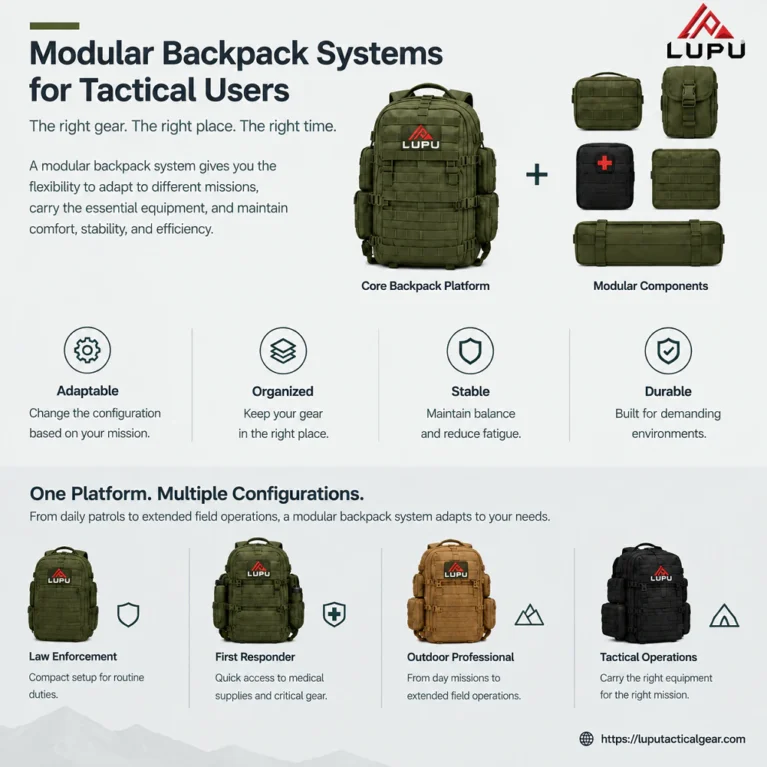
One of the most important developments within the Tactical Backpack Trend 2026 is the transition from fixed storage systems toward highly adaptable modular platforms.
Traditional sacs à dos tactiques were often designed around a predetermined configuration. Users had limited options to modify the internal layout or external attachment system. However, modern operational environments demand flexibility. A backpack used for a short patrol, wilderness expedition, emergency response task, or extended deployment may require completely different equipment arrangements.
Next-generation tactical backpacks are increasingly designed as customizable platforms rather than simple carrying containers.
Key Modular Innovations
Future-oriented tactical backpack systems are incorporating:
Interchangeable Storage Components
Instead of relying on permanently attached compartments, advanced designs allow users to adjust storage layouts according to mission requirements.
Examples include:
- Detachable accessory pouches
- Adjustable internal dividers
- Expandable compartments
- Mission-specific attachment modules
This approach allows one backpack platform to support multiple applications without requiring users to purchase separate equipment for every scenario.
Advanced Attachment Systems
While MOLLE remains a widely recognized tactical attachment standard, designers are exploring additional lightweight and streamlined solutions.
Emerging approaches focus on:
- Faster accessory attachment
- Reduced unnecessary weight
- Cleaner external profiles
- Improved compatibility between different equipment systems
Expert Perspective
From a professional design standpoint, modularity is not about adding more features—it is about improving operational efficiency.
A well-designed modular tactical backpack should allow users to configure their equipment quickly while maintaining structural integrity and balance.
The future of tactical gear will increasingly favor adaptable systems capable of supporting multiple environments rather than single-purpose designs.
2. Advanced Lightweight Materials: Achieving Maximum Strength with Reduced Weight
The Material Revolution Behind Future Tactical Backpacks
Weight management has become one of the most important challenges in modern tactical backpack design.
Historically, durability was often achieved through heavier materials. However, advances in textile engineering are allowing manufacturers to develop materials that deliver exceptional strength without unnecessary weight.
The modern Tactical Backpack Trend emphasizes the principle of “lighter without becoming weaker.”
Emerging Material Technologies
Future tactical backpacks are increasingly utilizing advanced performance materials, including:
High-Performance Technical Fabrics
Modern tactical fabrics are engineered to provide:
- High abrasion resistance
- Improved tear strength
- Long-term durability
- Reduced overall weight
Composite Material Structures
Composite textiles combine multiple layers to achieve improved protection while maintaining flexibility.
Benefits include:
- Better weather resistance
- Enhanced structural stability
- Reduced fabric bulk
Water-Resistant Material Solutions
Advanced coatings and laminated fabrics help protect equipment from:
- Heavy rain
- Humidity
- Dust exposure
- Harsh outdoor conditions
Why Lightweight Design Matters?
A tactical backpack is carried for extended periods. Every unnecessary gram contributes to fatigue.
Reducing weight improves:
- User mobility
- Energy efficiency
- Long-duration comfort
- Overall operational performance
However, professional designers must carefully balance weight reduction with durability. An extremely lightweight backpack that fails under demanding conditions does not provide true value.
The goal of next-generation tactical gear is optimized weight—not simply minimal weight.
3. Smart Tactical Integration: How Technology Is Transforming Backpack Design
The Digital Evolution of Tactical Equipment
Technology integration is becoming an increasingly important aspect of the Tactical Backpack Trend 2026.
Modern users carry more electronic equipment than ever before, including communication devices, navigation tools, cameras, and power systems. Tactical backpacks must evolve to support these changing requirements.
Emerging Smart Features
Future tactical backpack designs may include:
Integrated Power Management
Advanced designs are exploring solutions for:
- Organized cable routing
- Portable charging support
- Protected electronic storage areas
The challenge is ensuring technology integration does not compromise reliability.
Device Protection Systems
Dedicated compartments are being developed to protect sensitive equipment from:
- Impact
- Moisture
- Dust
- Temperature variation
Intelligent Organization
Smart organization focuses on reducing search time by creating intuitive storage systems.
Professional users need immediate access to essential equipment. A well-designed tactical backpack should support efficient decision-making under pressure.
Expert Perspective
Technology should enhance tactical equipment—not complicate it.
The most successful future designs will combine traditional tactical reliability with carefully selected technological improvements.
A backpack remains a field tool first. Innovation must always serve practical performance.
4. Ergonomic Load Management: Redefining Comfort Under Heavy Loads
Human-Centered Design Becomes a Core Priority
A tactical backpack is not simply carried—it becomes part of the user’s movement system.
One of the defining characteristics of the next-generation tactical backpack is improved ergonomic integration.
The Tactical Backpack Trend 2026 increasingly focuses on how equipment interacts with the human body.
Advanced Ergonomic Features
Adjustable Suspension Systems
Modern suspension systems allow users to customize:
- Shoulder positioning
- Load height
- Weight distribution
This improves comfort across different body types.
Improved Shoulder Harness Design
Advanced shoulder straps focus on:
- Pressure reduction
- Better stability
- Increased movement freedom
Ventilated Back Panels
Long-duration use creates heat and moisture challenges. Improved airflow systems help increase comfort during extended activity.
Load Distribution Engineering
A professional tactical backpack should distribute weight effectively between:
- Shoulders
- Chest area
- Hips
- Core body structure
Poor load management can reduce mobility and increase physical strain.
Expert Analysis
The future of tactical backpacks will be increasingly human-centered.
Capacity alone no longer defines performance. The ability to carry equipment efficiently while maintaining mobility is becoming a critical design benchmark.
5. Low-Profile and Multi-Environment Design: The Demand for Versatile Tactical Gear
From Specialized Equipment to Everyday Capability
Another significant development in the Tactical Backpack Trend 2026 is the growing demand for versatile designs.
Modern users often require equipment that performs across multiple environments instead of being limited to one specific operational context.
Key Design Directions
Low-Profile Tactical Appearance
Contemporary tactical backpacks are moving toward cleaner designs featuring:
- Reduced external complexity
- More discreet styling
- Improved urban compatibility
Multi-Scenario Functionality
Future tactical backpacks are expected to support:
- Outdoor activities
- Emergency preparedness
- Professional transportation needs
- Everyday carry applications
Flexible Organization
A successful multi-purpose tactical backpack must balance:
- Tactical functionality
- Practical storage
- Comfortable everyday usability
Expert Perspective
Versatility has become one of the strongest indicators of modern tactical equipment quality.
The best designs are those that maintain professional performance while adapting naturally to different environments.
6. Enhanced Durability and Environmental Protection: Building Gear for Extreme Conditions
Reliability Remains the Foundation of Tactical Equipment
Despite rapid innovation, durability continues to be the defining characteristic of tactical backpacks.
A backpack may include advanced technology and modular features, but it must still perform reliably under demanding conditions.
Future Durability Improvements
Reinforced Construction
Professional-grade designs emphasize:
- Strong stitching methods
- Reinforced stress points
- Durable hardware components
Environmental Resistance
Advanced tactical backpacks are increasingly engineered to withstand:
- Rain
- Mud
- Dust
- Temperature changes
- Heavy mechanical stress
Professional Testing Standards
High-quality tactical gear development involves extensive evaluation, including:
- Load testing
- Abrasion testing
- Environmental simulation
- Long-term field assessment
Expert Perspective
Durability is not created by a single material choice. It is the result of complete system engineering—from fabric selection to manufacturing precision.
A reliable tactical backpack must perform consistently throughout its service life.
7. Sustainable Tactical Gear Development: The Future of Responsible Manufacturing
Sustainability Meets Tactical Performance
Sustainability has become an emerging factor influencing the future of tactical backpack manufacturing.
However, tactical equipment presents unique challenges. Unlike ordinary consumer products, tactical gear must prioritize reliability, durability, and performance.
The future direction is not replacing performance with sustainability, but finding ways to achieve both.
Sustainable Design Approaches
Longer Product Lifecycles
Durable construction reduces the need for frequent replacement.
Repair-Friendly Systems
Modular components and replaceable parts can extend equipment lifespan.
Responsible Material Development
Fabricants d'équipements tactiques are exploring:
- Recycled technical fabrics
- More efficient production methods
- Reduced manufacturing waste
Industry Outlook
The next generation of tactical gear will likely focus on responsible innovation—creating equipment that performs professionally while considering environmental impact.
Sustainability will become another important dimension of advanced tactical backpack design.
Conclusion: The Future Direction of the Tactical Backpack Trend 2026
The evolution of tactical backpacks in 2026 reflects a broader transformation within the tactical equipment industry.
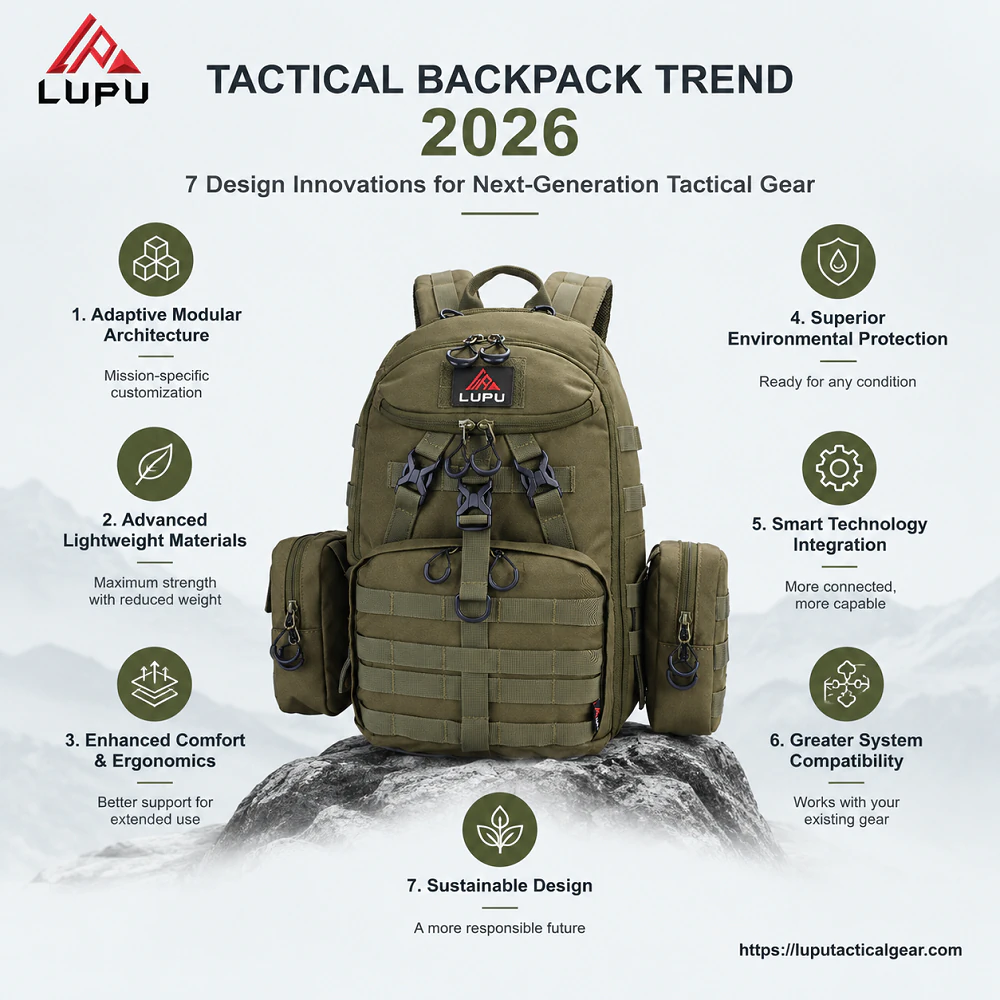
The future is being shaped by seven major design innovations:
- Adaptive modular architecture
- Advanced lightweight materials
- Smart technology integration
- Ergonomic load management
- Multi-environment versatility
- Enhanced durability engineering
- Sustainable manufacturing approaches
From a senior tactical backpack design perspective, the most important change is the transition from traditional storage solutions toward integrated personal mobility systems.
The Tactical Backpack Trend 2026 is not defined by adding more complexity. It is defined by smarter engineering—creating equipment that adapts faster, carries more efficiently, protects better, and supports users in increasingly diverse environments.
The next generation of tactical backpacks will belong to designs that successfully combine durability, adaptability, comfort, and intelligent innovation. As technology and user expectations continue to evolve, tactical gear will become more refined, more capable, and more closely connected to the real needs of those who depend on it.