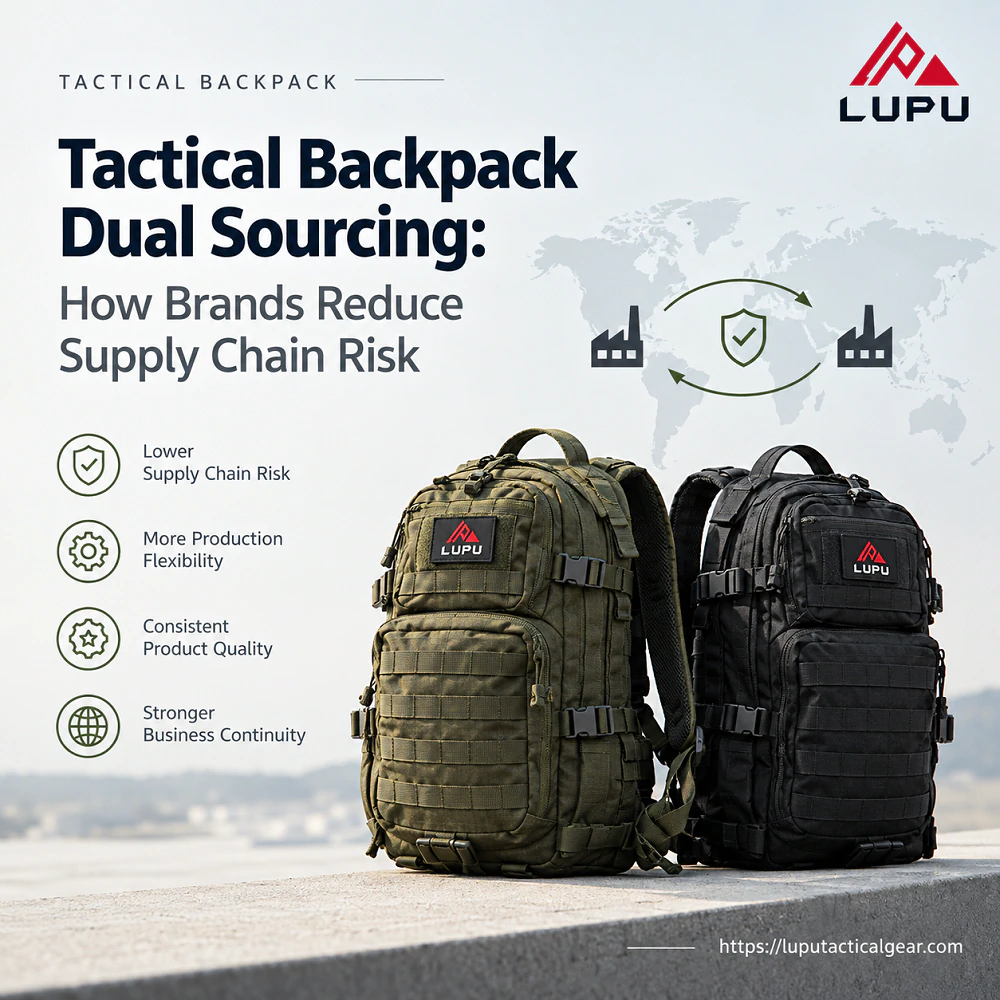
For tactical backpack brands, relying on a single manufacturer can simplify purchasing, product development, and quality management. It can also create a significant supply chain dependency.
If one supplier experiences production delays, material shortages, quality problems, capacity constraints, or unexpected disruptions, a brand may have limited alternatives—especially when the product requires custom materials, proprietary specifications, or specialized construction.
Tactical backpack dual sourcing provides a structured way to reduce that dependency. Instead of purchasing every product from one manufacturer, a brand develops two qualified supply sources for selected products, materials, or production requirements.
However, dual sourcing is not simply a matter of sending the same purchase order to two factories. If the tactical gear suppliers produce noticeably different products, use different materials, or follow inconsistent quality standards, the strategy can create new problems instead of reducing risk.
For tactical backpack brands, effective dual sourcing requires careful supplier qualification, specification control, quality management, and product allocation.
This guide explains how brands can use tactical backpack dual sourcing to improve supply chain resilience while maintaining product consistency and commercial control.
What Is Tactical Backpack Dual Sourcing?
Tactical backpack dual sourcing is a procurement strategy in which a brand maintains two qualified manufacturing or supply sources for the same or closely related tactical backpack products.
The two suppliers may manufacture:
- The same backpack model
- Different versions of the same product
- Different products within the same collection
- The same product for different markets
- Primary and backup production volumes
- Different components or materials used in the same product
For example, a tactical backpack brand may normally allocate 70% of production to Supplier A and 30% to Supplier B.
Supplier A remains the primary manufacturing partner, while Supplier B maintains production capability and product familiarity.
If Supplier A experiences a capacity issue, the brand can increase the allocation to Supplier B without starting the entire supplier-development process from zero.
The objective is not necessarily to split production equally.
The objective is to create qualified manufacturing redundancy without sacrificing product consistency or commercial efficiency.
Why Single-Supplier Dependence Can Create Supply Chain Risk?
A single-source strategy has legitimate advantages.
Working with one manufacturer can simplify:
- Communication
- Product development
- Quality control
- Forecasting
- Purchasing
- Packaging
- Logistics coordination
- Supplier relationship management
For stable products and reliable fournisseurs de sacs à dos tactiques, this model can be highly efficient.
The problem occurs when a brand becomes unable to replace the supplier quickly.
Several types of risk can create this dependency.
Production Capacity Risk
A supplier may receive several large orders at the same time.
If production capacity becomes constrained, smaller customers may experience longer lead times or reduced flexibility.
This can become particularly important before seasonal sales periods or major product launches.
Material Supply Risk
Tactical backpacks can involve multiple materials and components, including:
- Nylon or polyester fabrics
- Sangle
- Hook-and-loop materials
- Boucles
- Fermetures à glissière
- Foam
- Maille
- Labels
- Hardware
- Packaging materials
A shortage of one critical component can delay the finished product even when sewing capacity is available.
Quality Risk
If a manufacturing problem affects a large production run, a brand depending entirely on one supplier may have fewer immediate alternatives.
A second qualified supplier can provide additional manufacturing capacity and a potential route for future production.
Geographic and Operational Risk
Unexpected disruptions can affect manufacturing, transportation, ports, labor availability, utilities, or regional logistics.
A diversified sourcing structure can reduce dependence on one production location or operating network.
Supplier Dependency Risk
The longer a brand works exclusively with one manufacturer, the more product knowledge, specifications, tooling, communication processes, and production history may become concentrated with that supplier.
Switching suppliers later can therefore become expensive and time-consuming.
How Dual Sourcing Reduces Supply Chain Risk?
The main benefit of dual sourcing is redundancy.
A brand does not have to rely on a single production path for every order.
Instead, it creates an alternative manufacturing route that has already been evaluated and developed.
A simplified sourcing structure might look like this:
|
Sourcing Model |
Primary Supplier |
Secondary Supplier |
Main Characteristic |
|
Single sourcing |
100% |
None |
High supplier dependency |
|
Dual sourcing |
70% |
30% |
Balanced resilience and efficiency |
|
Dual sourcing |
90% |
10% |
Primary supplier remains dominant |
|
Backup sourcing |
100% |
Qualified backup |
Maximum focus on one supplier with contingency capability |
The appropriate structure depends on product volume, supplier capability, risk exposure, product complexity, and the cost of maintaining a second source.
Dual sourcing therefore should not be viewed as an automatic requirement for every tactical backpack.
It is a risk-management decision.
Three Tactical Backpack Dual Sourcing Models
Not every brand needs to divide production in the same way.
Three common approaches can be useful depending on the business model.
1. Split-Volume Dual Sourcing
The brand regularly purchases from both suppliers.
For example:
- Supplier A: 70%
- Supplier B: 30%
Both factories remain familiar with the product and maintain active production experience.
Avantages
- Both suppliers maintain product knowledge.
- Production capacity exists at two sources.
- Supplier B does not become completely inactive.
- The brand can adjust future allocation based on demand and performance.
Considerations
Managing two production sources requires additional coordination.
The brand must control:
- Product specifications
- Approved materials
- Quality standards
- Packaging
- Labels
- Inspection requirements
Without standardized specifications, the same product may gradually develop differences between factories.
2. Primary Supplier + Qualified Backup
In this model, Supplier A handles most or all regular production while Supplier B is qualified as a contingency source.
Supplier B may periodically produce samples, pilot orders, or limited production runs to maintain familiarity with the product.
This model can reduce the operational complexity of splitting every order.
However, a backup supplier that has never actually produced the product may not be a true backup.
If the supplier needs several months to source materials, develop patterns, make samples, and solve production issues, its emergency value is limited.
For this reason, maintaining production readiness can be more important than simply having a supplier’s contact information.
3. Product-Line Dual Sourcing
Instead of having two suppliers produce the exact same backpack, a brand can divide its product portfolio.
For example:
- Supplier A → 20L and 25L tactical backpacks
- Supplier B → 30L and 40L tactical backpacks
This approach can reduce operational overlap while still preventing the entire product portfolio from depending on one factory.
It can be especially practical for brands with multiple backpack categories.
However, the brand should maintain transferable manufacturing standards across suppliers where possible.
When Should a Tactical Backpack Brand Consider Dual Sourcing?
Dual sourcing becomes more relevant when the cost of supplier disruption is significant.
Consider the strategy when one or more of the following conditions apply.
1. The Product Is a Core Revenue Generator
If a tactical backpack represents a major portion of a brand’s sales, supply interruption can have a disproportionate commercial impact.
Maintaining an alternative production source can provide additional resilience.
2. The Product Has Long Development Lead Times
Custom backpacks may require:
- Pattern development
- Prototype sampling
- Material approval
- Hardware selection
- Logo development
- Packaging development
- Testing
- Production approval
Replacing a manufacturer becomes more difficult when all of this knowledge exists with only one supplier.
3. Demand Is Growing
A supplier that can comfortably support 5,000 units per month may not necessarily support 20,000 units without changes in production scheduling.
A second qualified manufacturer can provide additional capacity as demand increases.
4. The Brand Sells Into Multiple Markets
Different markets may have different seasonal demand patterns.
Dual sourcing can provide additional flexibility when production needs change across regions.
5. Supply Interruption Would Be Expensive
If a delayed backpack shipment could result in:
- Missed seasonal sales
- Retail stockouts
- Delayed customer deliveries
- Lost purchase orders
- Product launch delays
then the cost of maintaining an alternative source may be easier to justify.
Dual Sourcing Does Not Mean Finding Two Identical Factories
One common mistake is assuming that the two suppliers must be identical.
They do not.
Instead, the objective is to make the finished product and critical production requirements sufficiently consistent.
Two factories may have different:
- Sewing equipment
- Production layouts
- Workforce structures
- Material suppliers
- Production capacities
- Manufacturing processes
Yet both can produce an acceptable backpack if the brand establishes clear specifications and quality requirements.
The brand should therefore distinguish between:
Supplier-Level Differences
These may be acceptable.
For example:
- Factory layout
- Internal production workflow
- Equipment configuration
- Workforce organization
Product-Level Differences
These usually require tighter control.
For example:
- Fabric specification
- Fabric weight
- Couleur
- Webbing width
- Stitching requirements
- Hardware specification
- Zipper specification
- Logo placement
- Finished dimensions
- Load-bearing construction
This distinction is critical.
The goal of dual sourcing is not identical factories. It is controlled product consistency.
The Importance of a Detailed Product Specification
A weak specification can make dual sourcing difficult.
A strong specification creates a common reference point for both suppliers.
For tactical backpacks, the specification should clearly define relevant requirements such as:
Matériaux
Specify, where appropriate:
- Fiber/material type
- Négationniste
- Fabric construction
- Coating
- Couleur
- Poids
- Approved alternatives
Avoid relying only on terms such as “high-quality nylon.”
That description is too subjective to provide strong production control.
Dimensions
Define important finished dimensions and acceptable tolerances.
Depending on the product, this may include:
- Overall dimensions
- Main compartment dimensions
- Pocket dimensions
- Strap dimensions
- Webbing placement
Construction
Document requirements for:
- Couture
- Seam construction
- Reinforcement
- Bartacks
- Stress points
- Webbing attachment
- Handle construction
Components
Define approved requirements for:
- Boucles
- Fermetures à glissière
- Hook-and-loop
- Maille
- Foam
- Hardware
Branding
Document:
- Logo dimensions
- Logo location
- Application method
- Label specifications
- Packaging requirements
The more precisely the product is documented, the easier it becomes to qualify a second supplier without changing the product itself.
How to Qualify a Second Tactical Backpack Manufacturer?
Adding a second supplier should be treated as a supplier-development project rather than a simple purchasing decision.
Step 1: Define the Required Capability
Determine what the second supplier must actually be capable of producing.
Consider:
- Product category
- Monthly capacity
- Material capabilities
- Customization requirements
- Quality standards
- Packaging requirements
- Target markets
- Expected order volume
Do not select a supplier solely because it offers a low quotation.
Step 2: Evaluate Manufacturing Capability
Assess whether the fabricant d'équipements tactiques has relevant experience with tactical backpacks and similar sewn products.
Important areas may include:
- Production equipment
- Sewing capability
- Cutting capability
- Pattern development
- Sample development
- Material sourcing
- Quality control
- Production planning
- Capacity management
A supplier’s ability to produce a sample is not necessarily proof of its ability to maintain consistent mass production.
Step 3: Develop and Approve Samples
The second supplier should produce samples based on the same product specifications.
Compare:
- Dimensions
- Matériaux
- Construction
- Couture
- Components
- Apparence
- Functionality
- Packaging
Any differences should be documented and resolved before production allocation.
Step 4: Run a Pilot Order
A pilot order can reveal problems that may not appear during sampling.
Evaluate:
- Production consistency
- Material consistency
- Defect rates
- Production communication
- Packaging
- Delivery performance
- Inspection results
A supplier should demonstrate production capability before being treated as a fully qualified second source.
How to Maintain Product Consistency Across Two Suppliers?
This is one of the most important challenges in tactical backpack dual sourcing.
Even when two factories receive the same product drawing, differences can develop during production.
A practical control system should include several layers.
Standardized Technical Documentation
Both suppliers should work from the same approved specification.
This may include:
- Product drawings
- Bill of materials
- Approved material list
- Construction requirements
- Measurement tolerances
- Packaging specifications
- Quality standards
Golden Sample
Maintain an approved physical reference sample.
The sample can be used as a visual and functional benchmark during production and inspection.
Approved Material List
Where material consistency is critical, specify approved fabric, webbing, hardware and other components.
If alternatives are allowed, define the approval process before substitution.
Pre-Production Approval
Before mass production, confirm that:
- Materials are approved
- Samples meet specifications
- Packaging is correct
- Labels are correct
- Production requirements are understood
This reduces the risk of discovering major differences after bulk production begins.
Quality Control Becomes More Important With Dual Sourcing
Two suppliers create two production environments.
That means quality control needs to be standardized.
A brand can establish common inspection criteria for both manufacturers.
Depending on the product, inspection may cover:
Apparence
- Fabric defects
- Color consistency
- Logo placement
- Stitching appearance
- Component appearance
Dimensions
- Overall dimensions
- Pocket dimensions
- Strap dimensions
- Critical measurement points
Construction
- Stitch strength
- Bartacks
- Seam quality
- Reinforcement
- Webbing attachment
Function
- Zipper operation
- Buckle operation
- Adjustment systems
- Compartment access
- Load-bearing features
The exact inspection criteria should be based on the product’s specifications and intended application rather than generic assumptions.
The Hidden Cost of Dual Sourcing
Dual sourcing can reduce supply risk, but it is not free.
Brands should consider the additional costs of:
- Supplier qualification
- Sampling
- Factory audits
- Quality inspections
- Technical documentation
- Communication
- Material management
- Smaller production volumes
- Additional logistics coordination
There may also be a loss of purchasing efficiency if production volume is divided between suppliers.
For example, if one factory offers better pricing at higher production volumes, splitting the same annual demand between two factories could increase the average unit cost.
This creates an important business trade-off:
Supply resilience vs. operational efficiency
The correct strategy depends on the potential cost of disruption.
How Brands Can Allocate Orders Between Two Suppliers?
There is no universal percentage that works for every company.
Instead, consider the role of each supplier.
A brand may evaluate:
|
Factor |
Supplier A |
Supplier B |
|
Product familiarity |
Haut |
Medium/High |
|
Production capacity |
Haut |
Moyen |
|
Cost efficiency |
Haut |
Moyen |
|
Geographic diversification |
Faible |
Higher |
|
Backup capability |
— |
Haut |
|
Product specialization |
Haut |
Haut |
|
Current allocation |
Primary |
Secondary |
The allocation can then be reviewed periodically.
For example, if Supplier B consistently demonstrates strong quality, reliable delivery, and competitive pricing, the brand may gradually increase its allocation.
The allocation should be based on documented supplier performance rather than arbitrary percentages.
What Brands Should Avoid When Implementing Dual Sourcing?
Several mistakes can undermine the strategy.
Choosing the Cheapest Second Supplier
A low quotation does not necessarily mean low total cost.
Consider:
- Quality
- Lead time
- Communication
- Material sourcing
- Production consistency
- Defect rates
- Logistics
- Supplier reliability
A cheaper unit price can become expensive if quality problems create returns or delays.
Waiting Until a Crisis to Qualify Supplier B
A second supplier should ideally be qualified before an emergency occurs.
If Supplier A suddenly cannot fulfill an order, there may not be enough time for Supplier B to start development from scratch.
Allowing Uncontrolled Material Substitution
Material substitutions can affect:
- Poids
- Apparence
- Durabilité
- Hand feel
- Water resistance
- Product positioning
Substitutions should therefore follow an agreed approval process.
Treating the Two Suppliers as Completely Independent
If each factory maintains its own undocumented specifications, product differences can gradually increase.
The brand should remain the central owner of the product specification.
Ignoring Low-Volume Production Economics
Splitting a relatively small annual order across two factories may increase costs and reduce production efficiency.
Dual sourcing should be evaluated against actual demand.
A Practical Tactical Backpack Dual Sourcing Framework
Brands can evaluate their sourcing strategy using five questions:
1. How important is this product?
Is it a core SKU, seasonal product, or experimental product?
2. What would happen if production stopped?
Estimate the commercial consequences of a prolonged supply interruption.
3. How quickly could another supplier take over?
Consider whether the second supplier already has:
- Approved samples
- Material sources
- Product specifications
- Production experience
4. How difficult is it to maintain consistency?
Simple products may be easier to dual-source than highly customized backpacks with complex construction.
5. What is the cost of maintaining redundancy?
Compare supplier-development and management costs with the potential impact of supply disruption.
This framework helps turn dual sourcing from a generic procurement concept into a product-specific risk-management decision.
Dual Sourcing vs. Supplier Switching
These strategies are often confused.
Supplier switching means replacing one supplier with another.
Dual sourcing means maintaining two qualified sources before a disruption occurs.
The difference is important.
Supplier switching is generally reactive.
Dual sourcing is a proactive supply-chain strategy.
A brand that has already qualified a second tactical backpack manufacturer can potentially respond faster to changes in capacity, quality, demand, or logistics conditions.
How Manufacturers Can Support a Dual-Sourcing Strategy?
A capable fabricant de sacs à dos tactiques should be able to provide more than basic production.
For brands considering dual sourcing, useful supplier capabilities may include:
- Detailed product documentation
- Prototype development
- Material sourcing
- OEM/ODM support
- Private-label production
- Consistent production processes
- Quality control
- Flexible production planning
- Scalable capacity
- Clear communication
The manufacturer’s role is particularly important during the second-source qualification stage.
A supplier should be able to reproduce the approved product according to the agreed specifications rather than simply produce a visually similar backpack.
For brands developing a second manufacturing source, the initial objective should therefore be repeatable production, not simply a competitive quotation.
Final Checklist for Tactical Backpack Dual Sourcing
Before approving a second supplier, a brand should be able to answer “yes” to most of the following questions:
- Is the supplier capable of producing the required backpack category?
- Has the product specification been documented?
- Have materials been clearly defined?
- Has a production sample been approved?
- Has a pilot order been evaluated?
- Are quality requirements standardized?
- Are critical components controlled?
- Can the supplier meet expected production volumes?
- Can the supplier scale production if required?
- Are lead times understood?
- Is packaging standardized?
- Is there a clear process for material substitutions?
- Can production be transferred without redesigning the product?
- Has the supplier demonstrated consistent quality?
If several of these questions cannot be answered confidently, the second source may not yet be operationally ready.
Conclusion
Tactical backpack dual sourcing is not simply about placing orders with two factories. It is about creating a controlled alternative supply route without losing control over product quality, specifications, cost, and delivery.
For brands, the most effective approach is usually to qualify the second supplier before it is urgently needed. Clear product specifications, approved materials, standardized quality requirements, pilot production, and ongoing supplier evaluation can make the transition between manufacturing sources significantly more manageable.
The right sourcing structure will depend on the product, annual volume, market requirements, supplier capabilities, and the financial impact of potential disruption.
For brands developing or expanding a tactical backpack collection, working with manufacturers that understand OEM/ODM development, material selection, construction requirements, and repeatable production can make dual-sourcing implementation more practical.
A resilient sourcing strategy is not about eliminating every supply-chain risk. It is about ensuring that one supplier problem does not automatically become a product availability problem for the entire brand.
Looking for a Custom Tactical Backpack Manufacturer?
Turn your backpack concept into a production-ready product with LUPU’s OEM and ODM manufacturing solutions.
Talk to LUPU about your next tactical backpack project.
Email: info@luputacticalgear.com
Frequently Asked Questions
1. What is tactical backpack dual sourcing?
Tactical backpack dual sourcing is a procurement strategy in which a brand maintains two qualified manufacturing sources for the same or related tactical backpack products. It can reduce dependence on a single supplier and provide additional production flexibility when capacity, quality, or supply-chain disruptions occur.
Is dual sourcing more expensive than single sourcing?
It can be. Maintaining two qualified suppliers may increase costs related to sampling, supplier management, quality control, and production allocation. However, the additional cost should be evaluated against the potential commercial impact of supply disruption.
2. Why should tactical backpack brands use two manufacturers?
Using two qualified manufacturers can give a brand greater flexibility when demand changes or when the primary supplier faces capacity constraints. More importantly, maintaining a second source can reduce the time required to respond to an unexpected production problem because the alternative supplier has already been evaluated and understands the product requirements.
Dual sourcing can also support business continuity during periods of rapid growth. Instead of replacing a supplier under pressure, the brand can shift part of its production allocation to an existing qualified source.
The key is that the second manufacturer should be genuinely production-ready, rather than simply being a supplier listed in the purchasing database.
3. How do you maintain product consistency between two tactical backpack suppliers?
Product consistency starts with controlling the product definition rather than trying to make two factories operate in exactly the same way.
A brand should establish one approved reference for the product, covering critical materials, dimensions, construction details, components, branding and quality requirements. Both suppliers should work from the same documentation and approved sample.
It is also useful to identify which specifications are critical and which manufacturing differences are acceptable. For example, two factories may use different internal workflows while still producing backpacks that meet the same dimensional, material and functional requirements.
A brand may also establish standardized inspection procedures, including sampling methods and AQL-based quality inspection where appropriate.
4. Is dual sourcing more expensive than single sourcing?
It can be, particularly when annual order volumes are divided between two manufacturers. Lower production volumes may reduce economies of scale, while supplier qualification, sampling, inspections and ongoing coordination create additional costs.
However, unit price is only one part of the sourcing equation. A brand should also consider the potential cost of delayed shipments, stockouts, emergency production transfers, quality problems and missed sales.
For this reason, the decision should be based on the total cost of supply risk, rather than comparing factory quotations alone.
5. How do you qualify a second tactical backpack manufacturer?
A practical qualification process should move beyond reviewing a supplier’s catalog or factory profile.
Start by checking whether the manufacturer can handle the required product construction, materials, customization and expected production volume. Then provide the same technical requirements used by the primary supplier and evaluate a development sample.
If the sample meets expectations, a controlled pilot order can provide additional evidence of production consistency, communication, quality control and delivery performance.
A second supplier should generally be considered qualified only when it can reproduce the approved product under realistic production conditions—not simply when it can make an acceptable prototype.
6. What should be included in a tactical backpack product specification?
A useful product specification should give both suppliers an objective definition of what they are expected to manufacture.
Depending on the backpack, it may include:
- Material type, denier, weight and approved alternatives
- Finished dimensions and tolerances
- Construction and reinforcement requirements
- Webbing, zipper and hardware specifications
- Pocket and compartment configuration
- Logo and labeling requirements
- Packaging instructions
- Quality standards and inspection criteria
For complex products, drawings, reference samples and a bill of materials can provide additional clarity.
The goal is to reduce interpretation between the brand and manufacturer so that the same product can be reproduced consistently by different production sources.
7. What is the difference between dual sourcing and supplier switching?
The main difference is timing and preparedness.
Supplier switching usually occurs when a brand decides to replace its existing manufacturer. The new supplier may need to learn the product, develop samples, source materials and establish production processes before taking over the order.
Dual sourcing, by contrast, establishes an alternative source before a disruption occurs. The second supplier may already have approved samples, product specifications and production experience.
In practical terms, supplier switching is primarily a replacement decision, while dual sourcing is a strategy for maintaining manufacturing flexibility before a replacement becomes necessary.