Introduction: Why Tactical Backpack Capacity Matters for Market Success
For tactical gear brands, distributors, and professional buyers, selecting the right backpack specification is not simply a matter of choosing a larger or smaller bag. Tactical Backpack Capacity directly influences product positioning, target customers, retail performance, and real-world usability.
A backpack designed for everyday carry (EDC) users has completely different requirements from one designed for military operations, emergency preparedness, or multi-day outdoor missions. A compact tactical backpack may succeed in urban markets because of its mobility and convenience, while a larger capacity backpack may perform better in survival and professional equipment markets because users require additional storage for mission-critical gear.
For manufacturers and brands developing tactical backpack product lines, capacity planning should always begin with a clear understanding of:
- Target customer groups
- Market application scenarios
- Expected carrying requirements
- Regional purchasing preferences
- Product positioning strategy
A successful tactical backpack collection is not built around one universal size. Instead, leading brands usually develop multiple capacity options to serve different market segments effectively. Capacity, organization, modularity, and carrying comfort must work together to create a commercially successful product.
Understanding Tactical Backpack Capacity: What Does Liter Capacity Mean?
How Is Tactical Backpack Capacity Measured?
Backpack capacity is commonly measured in liters (L), representing the approximate internal storage volume available inside the backpack.
For example:
- A 20L tactical backpack is designed for lightweight daily equipment.
- A 35L tactical backpack provides additional space for extended daily missions or short trips.
- A 45L tactical backpack supports larger equipment loads and multi-day applications.
- A 60L+ tactical backpack is designed for extended operations and heavy gear requirements.
However, professional buyers should understand that the listed capacity does not tell the entire story.
Two backpacks with the same volume rating can perform very differently depending on:
- Internal compartment layout
- Pocket configuration
- Opening design
- Compression system
- External MOLLE attachment capability
- Weight distribution structure
A well-designed 40L tactical backpack may provide better usability than a poorly designed 50L backpack because users can access and organize equipment more efficiently.
Capacity Is More Than Storage Volume
When developing or sourcing sacs à dos tactiques, capacity should not be evaluated independently.
Professional users do not simply ask:
“How much can this backpack hold?”
They ask:
“Can this backpack carry the right equipment efficiently for this mission?”
A tactical backpack must balance:
1. Storage Requirement
The backpack must provide enough space for necessary equipment.
Examples:
- Communication devices
- Medical supplies
- Hydration systems
- Clothing layers
- Outdoor tools
- Documents
- Electronic equipment
2. Mobility Requirement
Increasing capacity usually increases potential weight.
A larger backpack without proper ergonomic design can create:
- Reduced movement speed
- Increased fatigue
- Poor weight distribution
- Reduced user comfort
Therefore, capacity selection must always consider the relationship between volume and mobility.
3. Market Expectation
Different customers have different expectations.
For example:
A tactical retailer serving urban professionals may prioritize 20L–30L products.
A survival equipment distributor may require 40L–60L models.
A military supplier may need specialized large-capacity solutions.
Understanding these differences is essential for brands planning their tactical backpack portfolio.
Tactical Backpack Capacity Categories and Market Applications
Small Capacity Tactical Backpacks (10L–30L)
Small-capacity tactical backpacks focus on mobility, quick access, and everyday usability.
These products are commonly positioned for:
- Everyday Carry (EDC)
- Urban tactical users
- Security personnel
- Short-duration operations
- Range activities
Typical Carrying Items:
A compact tactical backpack may include:
- Laptop or tablet
- Documents
- Small medical kit
- Flashlight
- Multi-tool
- Water bottle
- Personal accessories
Key Product Advantages:
Small tactical backpacks offer:
- Lightweight carrying experience
- Faster movement
- Lower profile appearance
- Easier daily transportation
For brands targeting the EDC or urban tactical market, compact capacity models are often attractive because they combine tactical styling with practical everyday functionality.
However, the limitation is obvious: limited space prevents users from carrying bulky equipment or extended mission supplies.
Medium Capacity Tactical Backpacks (30L–50L)
The Most Versatile Market Segment
For many fabricants de sacs à dos tactiques and brands, the 30L–50L category represents the most commercially flexible range.
This capacity range creates a balance between:
- Storage capability
- Mobility
- Confort
- Product versatility
A medium-capacity tactical backpack can serve multiple markets, including:
- Outdoor brands
- Tactical retailers
- Hiking equipment suppliers
- Military-style gear distributors
- Adventure travel companies
Typical Applications:
Medium-capacity backpacks are suitable for:
- Day hiking
- Camping
- Travel
- Tactical training
- Short field missions
- Emergency preparedness
A 40L or 45L tactical backpack, for example, can provide enough room for:
- Clothing layers
- Hydration reservoir
- First aid supplies
- Navigation equipment
- Food supplies
- Outdoor accessories
while remaining manageable for extended carrying.
This makes medium-capacity tactical backpacks attractive for brands seeking a product with broad market appeal.
Recommended Features for Medium Capacity Models:
A professional medium-capacity tactical backpack should ideally include:
Compatibilité MOLLE
Allows users to customize external storage through:
- Utility pouches
- Medical pouches
- Magazine pouches
- Tool attachments
Compatibilité avec l'hydratation
A dedicated hydration compartment and tube access port improve usability for outdoor and tactical applications.
Ergonomic Carrying System
Important features include:
- Breathable back panel
- Adjustable shoulder straps
- Chest strap
- Reinforced load-bearing structure
Compartiments multiples
Effective organization improves the user experience by separating:
- Main equipment
- Small accessories
- Electronics
- Emergency supplies
Large Capacity Tactical Backpacks (50L+): Designed for Extended Missions and Heavy Loads
Large-capacity tactical backpacks are developed for users who require additional storage space, enhanced load management, and long-duration carrying capability.
These backpacks are typically positioned for professional and specialized markets, including:
- Military supply chains
- Law enforcement operations
- Search and rescue organizations
- Survival equipment brands
- Expedition and adventure companies
- Emergency preparedness markets
Large-capacity models are generally selected when users need to carry more than basic mission equipment, including clothing layers, food supplies, medical equipment, communication devices, technical tools, and survival gear. Capacity categories above 50L are commonly associated with extended missions and heavy-load applications where storage efficiency and load distribution become critical design factors.
Typical Applications of Large Tactical Backpacks
Multi-Day Outdoor Operations
For expedition users, a large-capacity tactical backpack provides space for:
- Sleeping equipment
- Additional clothing
- Cooking supplies
- Navigation tools
- Emergency equipment
- Larger hydration systems
The priority is not only volume but also accessibility. A professional outdoor user needs to quickly locate essential items without completely unpacking the backpack.
Military and Professional Field Use
Military and professional users often require backpacks capable of supporting longer deployments.
Important requirements include:
- High load-bearing capability
- Reinforced stitching
- Durable materials
- Adjustable suspension systems
- MOLLE compatibility
- Weather-resistant construction
In professional applications, a large backpack must distribute weight efficiently. Poor weight management can reduce mobility and increase fatigue during extended operations.
Recommended Features for Large Capacity Tactical Backpacks
When developing large-capacity products, manufacturers should focus on:
1. Advanced Suspension Systems
Large backpacks carry heavier loads, making ergonomic design essential.
Recommended features:
- Padded shoulder straps
- Adjustable sternum straps
- Waist belt support
- Reinforced back panel
- Load adjustment straps
A backpack with excellent capacity but poor carrying comfort will have limited market acceptance.
2. Modular Storage Architecture
Large tactical backpacks should provide flexible organization through:
- MOLLE webbing
- External attachment points
- Sangles de compression
- Multiple access compartments
Modularity allows users to configure the backpack according to different missions.
3. Durability-Oriented Materials
For professional markets, material selection directly affects product positioning.
Common options include:
- 500D nylon for lightweight tactical applications
- Nylon 1000D for heavy-duty environments
- Reinforced polyester solutions for cost-sensitive markets
The correct material depends on the target market, price positioning, and expected usage intensity.
Choosing Tactical Backpack Capacity by Target Market
Selecting the right Tactical Backpack Capacity requires understanding the specific needs of each market segment.
A successful product strategy begins with answering three questions:
- Who is the end user?
- What equipment do they need to carry?
- How long will they use the backpack in the field?
Different markets require different capacity solutions.
Military and Defense Market
Recommended Capacity Range:
30L–70L+
Military customers typically require backpacks that support mission flexibility.
The capacity requirement depends on:
- Mission duration
- Operational environment
- Equipment requirements
- Unit-specific standards
Key Requirements:
Military-oriented tactical backpacks usually prioritize:
Modular Compatibility
Including:
- MOLLE/PALS systems
- Accessory attachment points
- Expandable storage options
Load Management
Important features:
- Ergonomic shoulder straps
- Adjustable carrying systems
- Reinforced structure
Equipment Organization
Military users often carry:
- Communication equipment
- Medical supplies
- Navigation tools
- Protective equipment
- Personal essentials
A balanced capacity design allows users to carry necessary equipment while maintaining operational mobility.
Law Enforcement and Security Market
Recommended Capacity Range:
20L–40L
Law enforcement users usually require a balance between accessibility and mobility.
Unlike extended field operations, many security applications require:
- Fast response
- Quick equipment access
- Compact carrying profile
Common Applications:
- Patrol equipment
- Tactical response kits
- Security operations
- Training activities
Recommended Product Features:
For this market, brands should prioritize:
- Multiple quick-access compartments
- Compact organization
- Durable construction
- Comfortable daily carrying
A smaller tactical backpack can often outperform a larger model in law enforcement scenarios where speed and movement are more important than maximum storage.
Outdoor and Adventure Market
Recommended Capacity Range:
30L–60L
The outdoor market represents one of the most diverse applications for tactical backpacks.
Users include:
- Hikers
- Campers
- Bushcraft enthusiasts
- Adventure travelers
- Outdoor professionals
Outdoor users typically evaluate backpacks based on:
- Capacité
- Confort
- Weather resistance
- Organization
- Hydration compatibility
The 30L–50L range is especially attractive because it provides versatility across hiking, camping, and adventure applications.
Outdoor Market Product Recommendations:
For outdoor-focused brands, consider:
30L–40L Models
Suitable for:
- Day hiking
- Short trips
- Lightweight adventures
40L–50L Models
Suitable for:
- Weekend camping
- Multi-purpose outdoor use
- Travel applications
50L+ Models
Suitable for:
- Extended expeditions
- Remote environments
- Survival applications
EDC and Urban Tactical Market
Recommended Capacity Range:
15L–35L
The EDC market requires a different approach.
Urban users typically value:
- Compact design
- Professional appearance
- Daily practicality
- Organization efficiency
Typical Contents:
An urban tactical backpack may carry:
- Ordinateur portable
- Tablet
- Documents
- Chargers
- Personal items
- Small tools
- Emergency supplies
For this segment, excessive capacity can become a disadvantage because users prefer a streamlined profile suitable for commuting and daily transportation.
Survival and Emergency Preparedness Market
Recommended Capacity Range:
40L–70L
The survival and preparedness market focuses on readiness for uncertain situations.
Users may need storage for:
- Water systems
- Food supplies
- Medical kits
- Shelter equipment
- Emergency tools
Capacity Considerations:
A survival backpack should balance:
Storage Capacity
Enough space for essential supplies.
Weight Control
Avoid unnecessary equipment overload.
Accessibility
Critical items must remain easy to reach.
For brands entering the survival market, capacity selection should consider regional climate, user expectations, and emergency scenarios.
How Brands Should Build a Tactical Backpack Product Portfolio?
For tactical gear brands and distributors, offering only one backpack capacity is usually not an effective market strategy.
Different customer groups require different solutions.
A professional product portfolio should include multiple capacity levels.
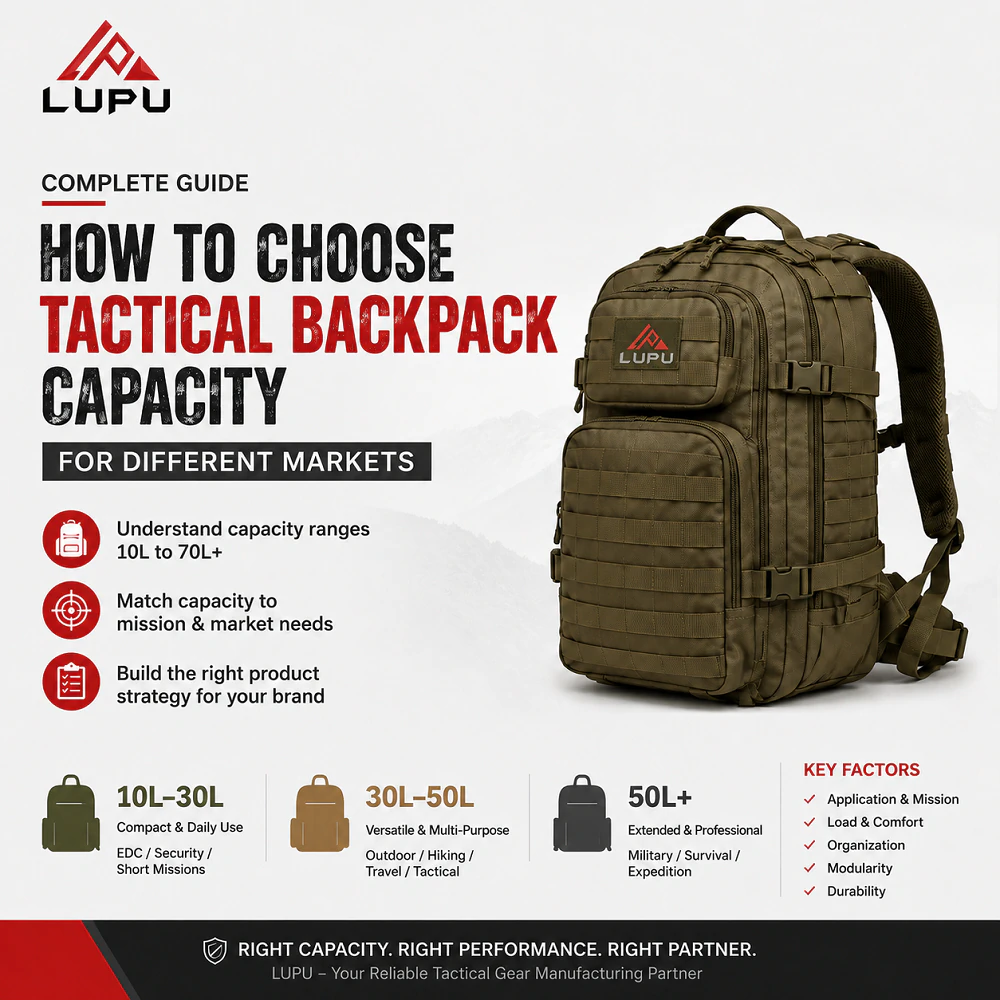
Recommended Three-Level Capacity Strategy
|
Catégorie de produits |
Capacity Range |
Target Market |
|
Compact Tactical Backpack |
15L–30L |
EDC, Security, Urban Users |
|
Multi-Purpose Tactical Backpack |
30L–50L |
Outdoor, Tactical, Travel |
|
Extended Mission Backpack |
50L+ |
Military, Survival, Expedition |
Why a Multi-Capacity Product Line Creates Better Business Opportunities?
A diversified capacity strategy helps brands:
Expand Customer Coverage
Different users naturally enter the market through different product categories.
Example:
A customer may purchase a 20L backpack for daily use and later upgrade to a 45L model for outdoor activities.
Improve Retail Performance
Retailers benefit from offering:
- Entry-level products
- Mid-range best sellers
- Premium professional models
This creates a complete purchasing pathway.
Support Different Price Segments
Capacity often influences:
- Material requirements
- Manufacturing complexity
- Retail pricing
A broader product range allows brands to serve different customer budgets.
Key Design Factors Beyond Tactical Backpack Capacity
Although Tactical Backpack Capacity is one of the most important product selection factors, professional buyers should understand that capacity alone does not determine a backpack’s market success.
A well-designed tactical backpack must achieve a balance between:
- Storage volume
- Carrying comfort
- Durabilité
- Organization efficiency
- User application requirements
For brands and distributors, selecting the correct capacity without considering the overall design system can lead to products that are difficult to sell or unsuitable for the intended market.
1. Compartment Organization: Maximizing Usable Capacity
A common misunderstanding is that a larger backpack automatically provides better functionality.
In reality, usable storage efficiency is often more important than total volume.
For example:
A poorly organized 50L backpack may create difficulty when users need quick access to equipment, while a professionally designed 40L tactical backpack with multiple compartments may offer a better user experience.
Important organizational features include:
Main Storage Compartment
Designed for:
- Clothing
- Larger equipment
- Outdoor supplies
- Mission essentials
Compartiments secondaires
Suitable for:
- Documents
- Electronics
- Small accessories
- Personal items
External Access Storage
Useful for:
- Frequently used tools
- Medical supplies
- Flashlights
- Communication equipment
Bottom or Separate Compartments
Features such as dedicated shoe compartments or wet/dry separation systems can significantly improve product value, especially for outdoor and travel markets.
For tactical backpack brands, intelligent organization can become a stronger selling point than simply increasing capacity.
2. Weight Distribution: The Difference Between Capacity and Carrying Performance
A tactical backpack is not only a storage product; it is a load-carrying system.
As capacity increases, weight management becomes increasingly important.
Professional backpack design should consider:
Shoulder Strap Structure
High-quality shoulder straps should provide:
- Comfortable weight distribution
- Pressure reduction
- Long-duration carrying support
Sternum Strap System
A chest strap improves:
- Stability
- Balance
- Movement efficiency
It is especially valuable for:
- Randonnée
- Tactical training
- Outdoor missions
Waist Support
For larger-capacity backpacks, waist belts help transfer weight from the shoulders to the hips.
This reduces fatigue during extended carrying periods.
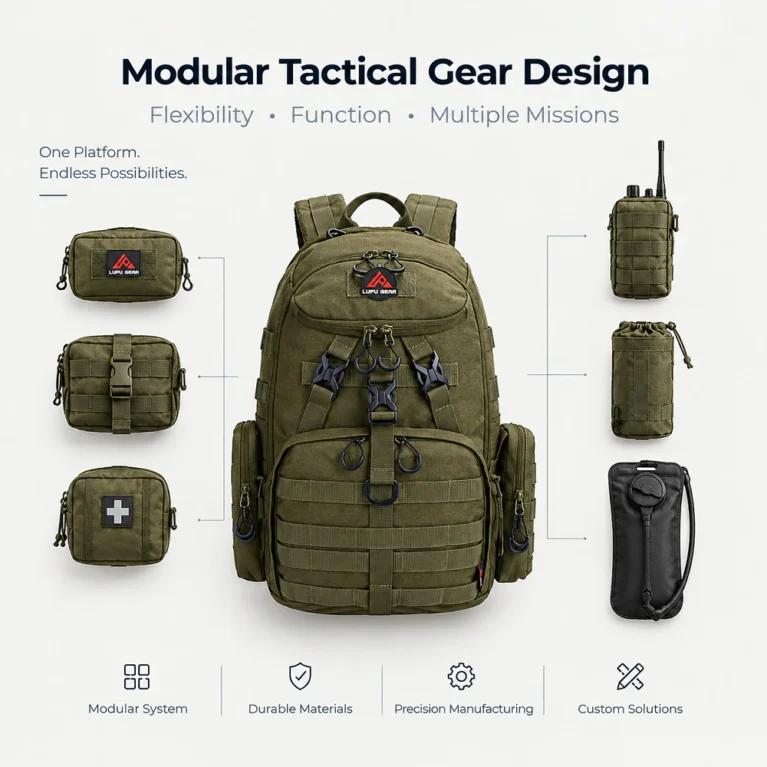
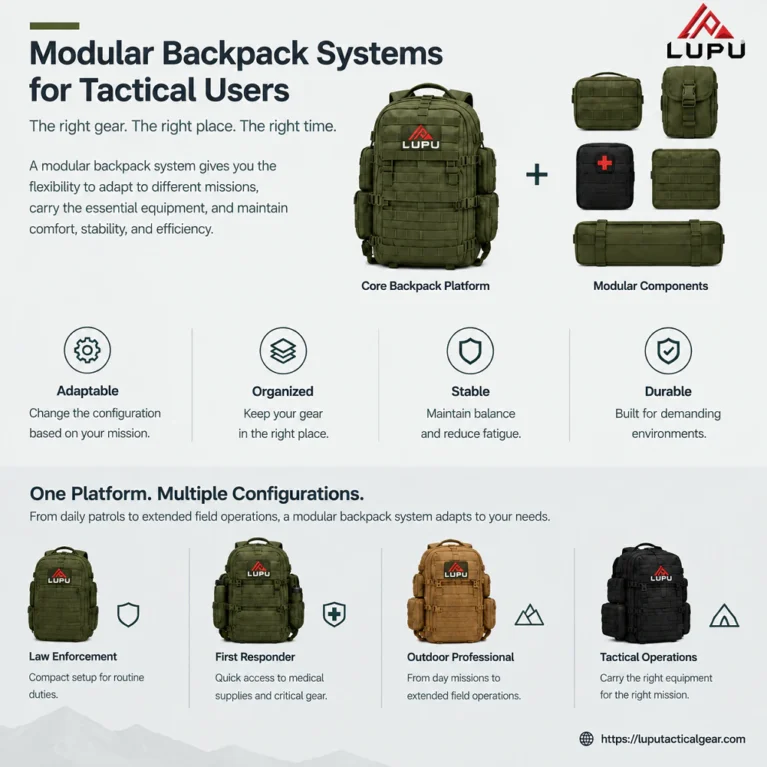
3. Modular Expansion Capability
Modern tactical users increasingly value customization.
A backpack’s practical capacity is not limited to internal volume.
External expansion capability can significantly increase usability.
Common modular features include:
Système de sangles MOLLE
Allows users to attach:
- Utility pouches
- Medical kits
- Tool bags
- Accessory modules
Compression Straps
Compression systems help:
- Stabilize loads
- Reduce unnecessary movement
- Adjust backpack volume
External Attachment Points
Useful for carrying:
- Jackets
- Tripods
- Outdoor equipment
- Specialized tools
For brands developing tactical backpacks, modularity allows one product platform to serve multiple market segments.
4. Material Selection and Capacity Planning
Capacity decisions should always be connected with material selection.
A larger tactical backpack carries heavier loads, which requires stronger construction.
Common material considerations include:
Nylon 500D
Advantages:
- Léger
- Flexible
- Suitable for mobile applications
Recommended for:
- EDC backpacks
- Lightweight tactical products
- Urban markets
Nylon 1000D
Advantages:
- Higher abrasion resistance
- Stronger durability
- Suitable for demanding environments
Recommended for:
- Military applications
- Heavy-duty outdoor use
- Professional tactical markets
Cost-Optimized Materials
For price-sensitive markets, manufacturers may recommend alternative materials that balance:
- Durabilité
- Apparence
- Manufacturing cost
Professional tactical backpack manufacturers help brands select materials based on target market expectations rather than simply choosing the strongest option.
Common Mistakes When Selecting Tactical Backpack Capacity
Many brands and buyers make capacity decisions based on assumptions rather than market research.
The following mistakes can negatively affect product performance.
Mistake 1: Choosing Maximum Capacity Without Understanding User Needs
A larger backpack may appear more attractive, but excessive capacity can create:
- Unnecessary weight
- Reduced mobility
- Lower user comfort
The best Tactical Backpack Capacity is the one that matches the intended application.
Mistake 2: Ignoring Regional Market Differences
Different regions often have different purchasing preferences.
Examples:
North American Market
Often shows strong demand for:
- Outdoor adventure
- Chasse
- Survival preparedness
- Large-capacity backpacks
European Market
Often values:
- Lightweight design
- Hiking compatibility
- Practical organization
Professional Security Market
Usually prioritizes:
- Mobility
- Quick access
- Compact solutions
Brands should analyze their target market before finalizing product capacity.
Mistake 3: Developing Products Without Defining the End User
A tactical backpack designed for:
- Personnel militaire
will not necessarily perform well for:
- Urban commuters
Likewise, an EDC backpack may not satisfy:
- Expedition users
Before manufacturing begins, brands should clearly define:
- User profile
- Main application
- Expected equipment load
- Selling channel
Mistake 4: Focusing Only on Capacity Instead of Complete Product Value
Successful tactical backpacks combine:
- Appropriate capacity
- Ergonomic design
- Durable materials
- Functional organization
- Modular expansion
Capacity is only one part of a complete product solution.
How Tactical Backpack Manufacturers Help Brands Select the Right Capacity?
For brands entering or expanding within the tactical gear market, working with an experienced manufacturer provides valuable product development advantages.
A professional tactical backpack manufacturer can support:
Market-Based Product Recommendations
Manufacturers with industry experience understand:
- Popular capacity ranges
- Regional preferences
- Application requirements
They can help brands avoid developing products with limited market potential.
Prototype Development
Before mass production, manufacturers can assist with:
- Capacity testing
- Structural improvements
- Material selection
- Function optimization
This reduces development risks.
OEM and Private Label Solutions
Brands can customize:
- Backpack capacity
- Pocket configuration
- MOLLE layout
- Fabric selection
- Color options
- Branding elements
This allows companies to create products aligned with their target customers.
Production Quality Control
A reliable manufacturing partner evaluates:
- Stitching strength
- Load performance
- Hardware durability
- Zipper reliability
- Overall construction quality
Quality consistency is especially important for wholesale buyers and international distributors.
Conclusion: Selecting the Right Tactical Backpack Capacity Creates Better Market Opportunities
Choosing the correct Tactical Backpack Capacity is not simply about selecting the largest available volume. It is a strategic decision that affects:
- Product positioning
- Target customers
- Market competitiveness
- User satisfaction
- Long-term brand growth
For different markets:
- 15L–30L: Ideal for EDC, urban tactical, and security applications
- 30L–50L: The most versatile range for outdoor, tactical, and multi-purpose markets
- 50L+: Suitable for professional, survival, military, and extended mission requirements
For tactical gear brands and distributors, the most successful product strategy is usually a balanced capacity portfolio supported by professional design, reliable manufacturing, and market-driven development.
By understanding customer needs and selecting the right Tactical Backpack Capacity, brands can create products that deliver better performance in real-world applications while achieving stronger commercial results.
Frequently Asked Questions (FAQ)
Q1: What is the best Tactical Backpack Capacity for most markets?
A:
For many commercial markets, 30L–50L is considered the most versatile range because it provides a strong balance between storage space, mobility, and user comfort.
Q2: Is a 45L tactical backpack suitable for professional use?
A:
Yes. A 45L tactical backpack is widely suitable for outdoor missions, tactical applications, travel, and emergency preparedness because it offers substantial storage while remaining manageable for extended carrying.
Q3: Should tactical backpack brands offer multiple capacity options?
A:
Yes. Offering different capacities allows brands to serve different customer groups, including EDC users, outdoor enthusiasts, professional operators, and wholesale buyers.
Q4: How should a brand choose Tactical Backpack Capacity for a new product?
A:
Brands should evaluate target users, market applications, expected equipment loads, regional preferences, and retail positioning before selecting capacity.
Q5: Can manufacturers customize tactical backpack capacity?
A:
Yes. Professional OEM tactical backpack manufacturers can customize capacity, compartment structures, materials, MOLLE layouts, and other specifications according to brand requirements.