Introduction: The Evolution of Modern Tactical Gear
In the world of tactical equipment, every gram matters. Whether used by military personnel, law enforcement officers, outdoor professionals, or everyday carry enthusiasts, modern gear must balance strength, adaptability, weight reduction, and mobility.
For decades, traditional MOLLE (Modular Lightweight Load-carrying Equipment) systems dominated tactical equipment design. The familiar rows of stitched nylon webbing provided a reliable method for attaching pouches, accessories, and mission-specific equipment.
However, as tactical requirements evolved, users began demanding equipment that was:
- Lighter
- Less bulky
- More streamlined
- Faster to configure
- More comfortable during extended use
This demand led to the development of Laser Cut MOLLE, an advanced modular attachment system that replaces traditional sewn webbing with precision-engineered laser-cut panels.
Today, Laser Cut MOLLE has become one of the most significant innovations in tactical backpacks, plate carriers, chest rigs, belts, and other modular load-bearing equipment.
But what exactly is Laser Cut MOLLE? How does it work? Is it stronger than traditional MOLLE? And why has it become increasingly popular among modern fabricantes de equipos tácticos and users?
This comprehensive guide explains everything you need to know.
1. What Is Laser Cut MOLLE?
Understanding the Concept Behind Laser Cut MOLLE
Laser Cut MOLLE is a modern MOLLE attachment system manufactured by using high-precision laser technology to cut attachment slots directly into a reinforced fabric panel instead of sewing traditional nylon webbing onto the surface.
Traditional MOLLE relies on rows of heavy-duty nylon straps stitched onto the exterior of a backpack, vest, or carrier.
Laser Cut MOLLE uses:
- Laser-cut slot patterns
- Laminated composite materials
- Reinforced fabric structures
- Precision manufacturing techniques
The result is a cleaner, lighter, and more streamlined modular attachment platform.
The basic principle remains the same:
Allow users to attach, remove, and reposition tactical accessories according to mission requirements.
The difference lies in the construction method.
2. How Does Laser Cut MOLLE Work?
The manufacturing process behind Laser Cut MOLLE involves several advanced steps.
2.1 Material Selection
The performance of a Laser Cut MOLLE system depends heavily on the materials used.
Common materials include:
500D Cordura Nylon
A popular choice for tactical equipment because of:
- Excellent abrasion resistance
- Balanced weight
- Long service life
Nylon Cordura 1000D
Used for heavy-duty applications requiring:
- Maximum durability
- High abrasion resistance
- Extreme field performance
Laminated Nylon Fabrics
Modern Laser Cut MOLLE systems often use laminated composite materials.
Advantages include:
- Reduced weight
- Improved structural stability
- Cleaner appearance
- Better dimensional control
Material selection directly affects:
- Load capacity
- Resistance to wear
- Long-term durability
2.2 Precision Laser Cutting
The defining feature of Laser Cut MOLLE is the laser cutting process.
Instead of manually stitching rows of webbing, computer-controlled lasers create precise slot patterns directly into the material.
Benefits include:
- Extremely accurate slot spacing
- Consistent manufacturing quality
- Reduced material waste
- Cleaner edges
Laser cutting also allows manufacturers to create complex designs that would be difficult or impossible with traditional sewing methods.
2.3 Lamination and Reinforcement
After laser cutting, the fabric panel is usually reinforced through lamination.
This process bonds multiple layers together to improve:
- Structural strength
- Shape retention
- Load distribution
A high-quality Laser Cut MOLLE panel is not simply a piece of fabric with holes cut into it. It is an engineered load-bearing structure.
2.4 Integration Into Tactical Equipment
Laser Cut MOLLE technology is commonly integrated into:
- Mochilas tácticas
- Plate carriers
- Chest rigs
- Cinturones tácticos
- Medical bags
- Equipment pouches
The system maintains compatibility with standard MOLLE accessories while reducing unnecessary bulk.
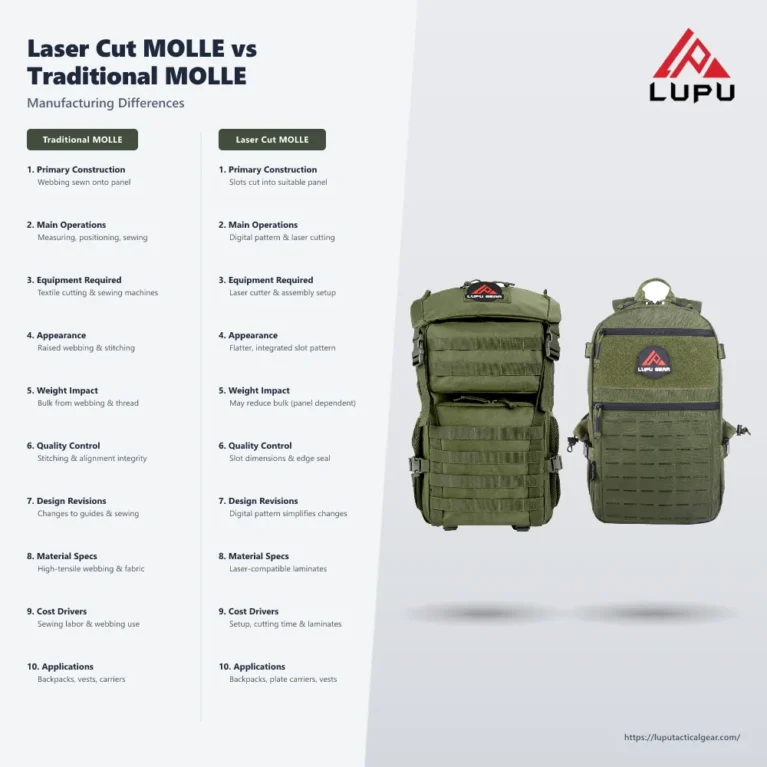
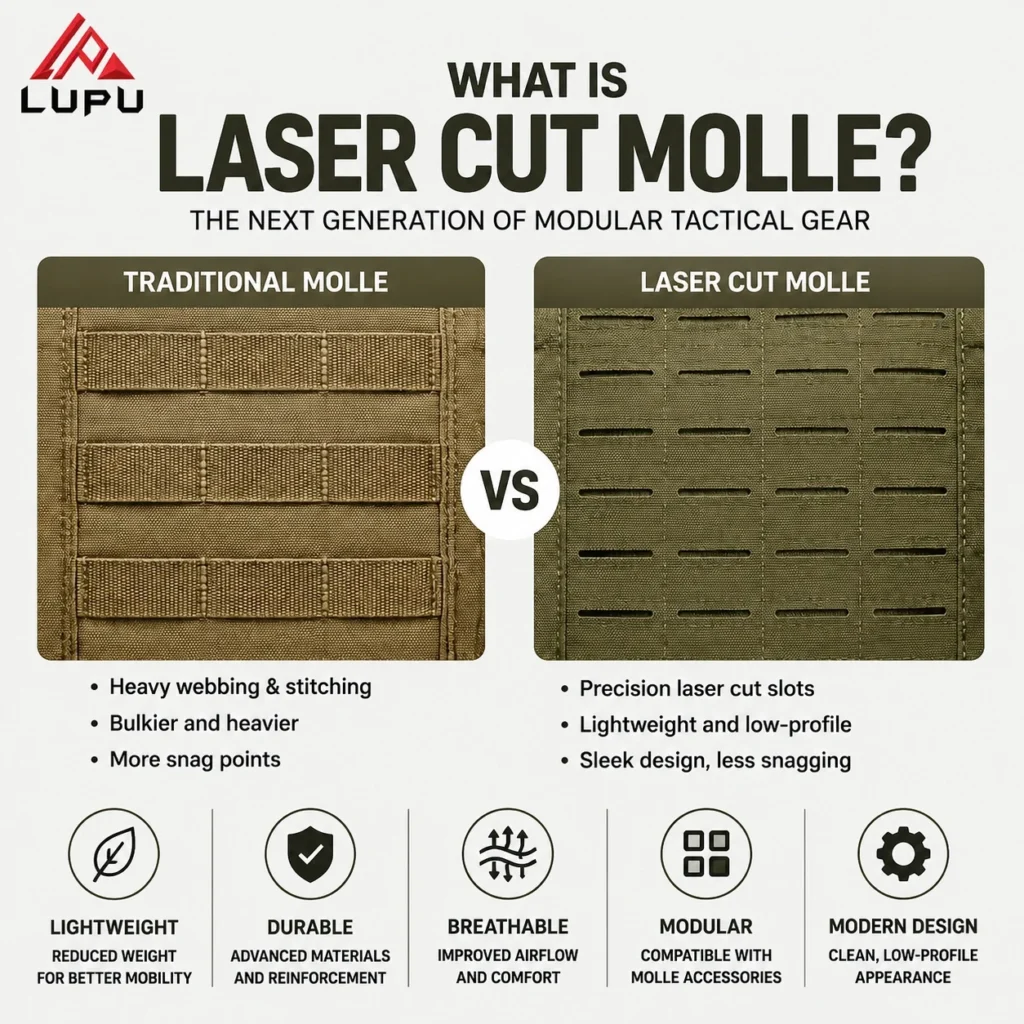
3. Traditional MOLLE vs Laser Cut MOLLE
To understand the advantages of Laser Cut MOLLE, it is important to compare it with traditional MOLLE systems.
Traditional MOLLE System
Traditional MOLLE uses:
- Sewn nylon webbing rows
- Reinforced stitching points
- Heavy-duty fabric construction
Advantages:
- Proven battlefield reliability
- Excellent load-bearing capability
- Easy accessory attachment
- Widely compatible
However, traditional MOLLE also has limitations:
- Increased weight
- Larger profile
- More external components
- More potential snag points
Laser Cut MOLLE System
Laser Cut MOLLE replaces stitched webbing with integrated slot patterns.
Advantages:
- Lower overall weight
- Reduced thickness
- Cleaner appearance
- Improved mobility
- Modern aesthetic
Laser Cut MOLLE vs Traditional MOLLE Comparison
|
Característica |
Traditional MOLLE |
Laser Cut MOLLE |
|
Construction |
Sewn nylon webbing |
Laser-cut panels |
|
Peso |
Heavier |
Ligero |
|
Profile |
Higher profile |
Low profile |
|
Apariencia |
Classic military style |
Modern tactical design |
|
Manufacturing |
Labor-intensive sewing |
Precision laser process |
|
Personalización |
Excellent |
Excellent |
|
Mobility |
Good |
Improved |
Neither system is universally superior. The best choice depends on the intended application.
4. Advantages of Laser Cut MOLLE
4.1 Reduced Weight Without Losing Functionality
One of the biggest advantages of Laser Cut MOLLE is weight reduction.
Traditional MOLLE requires:
- Additional nylon webbing
- Extra stitching
- Reinforced attachment points
Laser Cut MOLLE removes unnecessary material while maintaining modular capability.
For users carrying equipment for many hours, weight reduction can significantly improve:
- Mobility
- Confort
- Endurance
- Operational efficiency
This is especially important for:
- Military operations
- Search and rescue
- Outdoor expeditions
- Tactical training
4.2 Low-Profile Tactical Design
Modern tactical users increasingly prefer equipment with a low-profile design.
Laser Cut MOLLE provides:
- A flatter external surface
- Reduced snag risk
- Improved movement flexibility
This makes it ideal for:
- Urban environments
- Vehicle operations
- Close-quarter environments
- Everyday carry applications
A lower profile does not simply improve appearance—it can improve practical performance.
4.3 Enhanced Durability and Structural Performance
A common misconception is that laser-cut systems are weaker because they have fewer visible attachment straps.
In reality, durability depends on:
- Fabric quality
- Lamination technology
- Manufacturing standards
- Engineering design
Professional-grade Laser Cut MOLLE systems use reinforced materials designed to withstand demanding environments.
The strength comes from the entire structure rather than individual webbing strips.
4.4 Improved Ventilation and Comfort
Traditional MOLLE webbing creates a thicker external structure.
Laser Cut MOLLE panels can reduce unnecessary material coverage, improving:
- Air circulation
- Heat management
- User comfort
This advantage becomes especially noticeable in:
- Hot climates
- Long-duration missions
- Outdoor activities
5. Common Applications of Laser Cut MOLLE
5.1 Laser Cut MOLLE Backpacks
A Laser Cut MOLLE backpack combines storage capability with modular customization.
Common features include:
- MOLLE-compatible attachment panels
- Lightweight construction
- Durable tactical materials
- Expandable accessory options
Applications include:
- Tactical operations
- Senderismo
- Survival activities
- Emergency response
- Everyday carry
Users can attach:
- Utility pouches
- Medical kits
- Water bottle holders
- Tool organizers
5.2 Laser Cut MOLLE Plate Carriers and Tactical Vests
Plate carriers and chalecos tácticos are among the most common applications.
Advantages include:
- Reduced weight
- Better mobility
- Improved comfort
- Streamlined configuration
Modern operators often choose Laser Cut MOLLE systems because they provide modular capability without excessive bulk.
5.3 Laser Cut MOLLE Tactical Belts
Tactical belts require both strength and flexibility.
Laser Cut MOLLE belts offer:
- Lightweight construction
- Reduced thickness
- Modular attachment capability
They can support:
- Magazine pouches
- Medical accessories
- Utility equipment
- Tool attachments
5.4 Laser Cut MOLLE Accessories
Many accessories are designed specifically for Laser Cut MOLLE platforms.
Examples include:
- Magazine pouches
- Medical pouches
- Radio holders
- Utility pouches
- Dump pouches
- Equipment organizers
6. Is Laser Cut MOLLE Strong Enough for Professional Use?
One of the most common questions is:
Is Laser Cut MOLLE durable enough for military and professional applications?
The answer depends on product quality.
A professionally manufactured Laser Cut MOLLE system can provide excellent performance when using:
- High-quality materials
- Proper reinforcement
- Correct engineering
- Reliable manufacturing processes
However, not all Laser Cut MOLLE products are equal.
Low-quality products may suffer from:
- Weak laminate bonding
- Poor slot design
- Material failure
- Reduced load capacity
When selecting tactical gear, manufacturing quality matters as much as the design concept.
7. How to Choose High-Quality Laser Cut MOLLE Gear
7.1 Evaluate Material Quality
Look for:
- Genuine Cordura fabrics
- High-strength laminates
- Abrasion-resistant materials
Material quality determines long-term performance.
7.2 Check Laser Cutting Precision
High-quality Laser Cut MOLLE panels should have:
- Clean edges
- Accurate slot spacing
- Consistent patterns
- No excessive melting or damage
7.3 Examine Load-Bearing Performance
Important factors include:
- Reinforced attachment areas
- Strong hardware
- Reliable stitching
- Proper stress distribution
7.4 Confirm MOLLE Compatibility
A good Laser Cut MOLLE system should work with standard MOLLE accessories.
Before purchasing, verify:
- Slot dimensions
- Attachment compatibility
- Load requirements
8. The Future of Laser Cut MOLLE Technology
The tactical equipment industry continues moving toward:
- Lightweight materials
- Materiales compuestos avanzados
- Modular designs
- Improved ergonomics
Future Laser Cut MOLLE developments may include:
- More durable laminate materials
- Hybrid MOLLE systems
- Sustainable tactical fabrics
- Integrated smart equipment solutions
The goal is clear:
Create tactical equipment that is lighter, stronger, and more adaptable.
Conclusion: Why Laser Cut MOLLE Represents the Future of Tactical Gear
Laser Cut MOLLE is more than a visual upgrade to traditional MOLLE systems. It represents a fundamental shift in tactical equipment engineering.
By combining:
- Precision laser manufacturing
- Advanced materials
- Lightweight construction
- Modular capability
Laser Cut MOLLE provides a modern solution for users who demand performance without unnecessary weight.
From tactical backpacks and plate carriers to belts and accessories, this technology continues to redefine how professionals and outdoor enthusiasts carry essential equipment.
Traditional MOLLE remains a proven and reliable system, but Laser Cut MOLLE offers the next generation of modular tactical design—one focused on mobility, efficiency, and adaptability.
As tactical requirements continue to evolve, Laser Cut MOLLE will remain a key technology shaping the future of professional gear.
Looking for a trusted partner for your next tactical gear project?
Contact LUPU today to explore customized Laser Cut MOLLE backpacks, tactical equipment, and OEM/ODM manufacturing solutions designed for modern professionals.
Build lighter. Move faster. Perform better.