Introduction: The Untold Story Behind WWII Military Bags
When people study the equipment of World War II, attention is often drawn to weapons, vehicles, uniforms, and battlefield technology. However, one category of equipment quietly played a critical role in every soldier’s daily operation — WWII Military Bags.
Military bags were not simply containers for carrying personal belongings. They were carefully engineered systems designed to support mobility, endurance, and battlefield efficiency. A soldier’s ability to carry ammunition, rations, medical supplies, clothing, communication equipment, and essential tools often determined how effectively they could operate in demanding environments.
During World War II, armies around the world faced unprecedented challenges. Soldiers moved across deserts, forests, mountains, islands, and urban battlefields. Each environment created unique requirements for equipment design. As a result, military bags evolved from traditional canvas packs into more specialized carrying systems focused on weight distribution, durability, accessibility, and adaptability.
Many concepts introduced during this period continue to influence modern tactical backpacks, outdoor equipment, and professional gear systems. Today’s modular backpacks, MOLLE-compatible platforms, and mission-specific packs all share design principles that can be traced back to innovations developed during WWII.
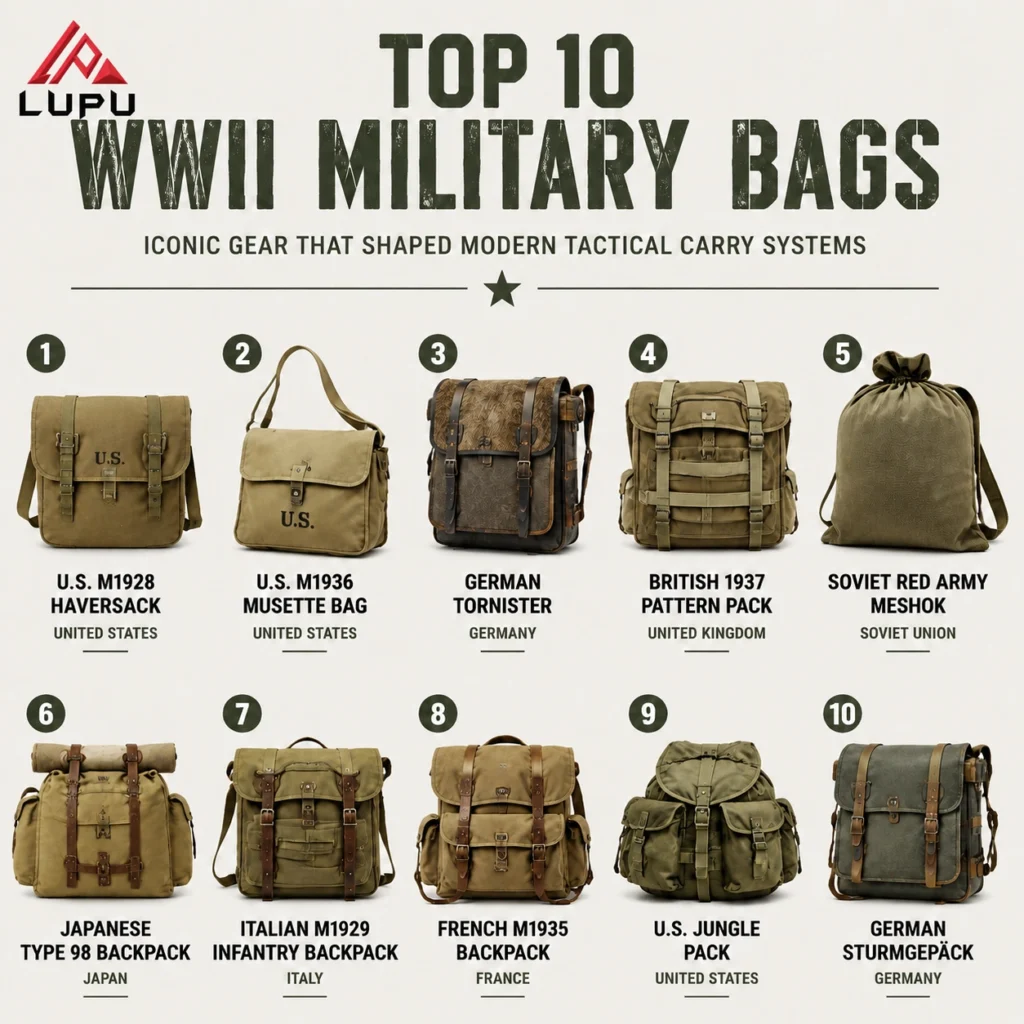
This article explores the Top 10 WWII Military Bags that shaped military equipment history and examines how their design philosophy continues to influence modern tactical carry systems.
1. U.S. M1928 Haversack: The Foundation of American Military Carry Systems
The U.S. M1928 Haversack remains one of the most recognizable examples of American WWII military equipment. Developed as part of the U.S. Army’s standardized web equipment system, it represented a major step toward organized and modular load carriage.
Unlike simple civilian bags of the era, the M1928 Haversack was designed around the needs of infantry soldiers who required reliable access to essential equipment while maintaining mobility.
Design Features
The M1928 Haversack featured:
- Heavy-duty canvas construction for battlefield durability
- Expandable storage capacity
- Integrated attachment points for additional equipment
- Compatibility with military accessories such as:
- Entrenching tools
- Canteens
- Ammunition pouches
- Personal field supplies
Its design allowed soldiers to carry necessary equipment without relying on multiple unrelated bags.
Historical Influence
The M1928 demonstrated an important principle still used today: a military bag should function as part of a larger equipment system.
Modern tactical backpacks continue this concept through:
- Modular attachment systems
- External accessory mounting
- Customizable load configurations
The M1928 Haversack was an early example of organized tactical storage.
2. U.S. M1936 Musette Bag: Lightweight Efficiency for Airborne Operations
The M1936 Musette Bag represented a different approach to military carrying equipment. While larger infantry packs focused on capacity, the Musette Bag prioritized mobility.
It became particularly associated with U.S. airborne forces, where weight and movement efficiency were critical.
Design Features
The Musette Bag offered:
- Compact canvas construction
- Lightweight design
- Flexible carrying options
- Easy integration with airborne equipment systems
Paratroopers needed equipment that would not restrict movement during aircraft operations, parachute deployment, and rapid ground movement.
Modern Design Impact
The Musette Bag influenced modern:
- Assault packs
- Compact tactical backpacks
- Lightweight EDC bags
Its design philosophy remains relevant today: carrying less weight efficiently can improve operational performance.
3. German Tornister: A Symbol of Durability and Long-Distance Carry
Among European military backpacks, the German Tornister is one of the most historically recognized designs.
Used extensively by Wehrmacht infantry, the Tornister reflected traditional military backpack engineering focused on endurance and heavy-load transportation.
Design Characteristics
Typical features included:
- Reinforced structural support
- Durable leather and fabric components
- Large storage capacity
- Strong construction for extended field use
The Tornister was designed for soldiers who often traveled long distances carrying significant personal equipment.
Design Legacy
Although heavier than many modern backpacks, the Tornister highlighted important principles:
- Strong construction
- Reliable materials
- Stable load support
These remain essential requirements in professional tactical backpack design today.
4. British 1937 Pattern Pack System: Early Modular Equipment Organization
The British military approached equipment design from a system perspective. The 1937 Pattern Web Equipment became one of the most organized load-carrying systems of WWII.
Instead of treating a backpack as an independent item, Britain developed an integrated system where different equipment components worked together.
Características principales
The system provided:
- Adjustable webbing
- Balanced weight distribution
- Organized equipment placement
- Improved soldier mobility
Why It Matters?
The British approach introduced an important idea:
A good military bag is not only about storage volume — it is about how the entire carrying system works together.
This principle remains central to modern tactical gear development.
5. Soviet Red Army Meshok: Simplicity Under Extreme Conditions
The Soviet Meshok represents one of the simplest yet most effective WWII military bags.
Unlike complex military packs, the Meshok focused on practicality, affordability, and mass production.
Design Features
The Meshok offered:
- Simple fabric construction
- Lightweight performance
- Easy manufacturing
- Basic but functional storage
During large-scale warfare, millions of soldiers required reliable equipment that could be produced quickly and maintained easily.
Lessons From the Meshok
The Meshok demonstrated that successful military equipment does not always require complicated engineering.
Its core principles remain valuable:
- Function first
- Reliable construction
- Practical usability
6. Japanese Type 98 Army Backpack: Mobility in Challenging Environments
The Japanese military operated across diverse environments, including tropical islands and mountainous regions. These conditions influenced the design of their military carrying equipment.
The Type 98 Army Backpack focused on lightweight mobility and practical infantry use.
Design Features
Characteristics included:
- Canvas construction
- Compact design
- Reduced weight
- Adaptability for mobile operations
Historical Importance
The Type 98 reflects how geography and operational requirements influence equipment design.
Modern tactical backpacks continue this approach by creating specialized products for:
- Jungle environments
- Desert operations
- Cold-weather conditions
- Urban use
7. Italian M1929 Infantry Backpack: Traditional European Craftsmanship
The Italian M1929 Infantry Backpack represented classic European military equipment design before and during WWII.
Built around traditional materials and construction methods, it focused on durability and storage capacity.
Key Characteristics
Features included:
- Canvas body construction
- Leather reinforcement
- Structured support
- Large carrying capability
Design Contribution
The M1929 demonstrates how military bags evolved through decades of practical battlefield experience.
Its emphasis on craftsmanship and reliability remains relevant in modern premium tactical gear.
8. French M1935 Backpack: Pre-War Innovation and Adaptation
Before and during the early stages of WWII, France developed military equipment designed around infantry mobility and field requirements.
The French M1935 Backpack reflected European military thinking before the rapid technological changes brought by global warfare.
Design Elements
Important features included:
- Durable fabric materials
- Structured carrying design
- Practical storage arrangement
Historical Value
The M1935 represents an important stage in the evolution of military backpacks, connecting traditional field packs with later tactical systems.
9. U.S. Jungle Pack: Specialized Equipment for Pacific Warfare
The Pacific Theater created unique challenges for military equipment designers.
Heavy traditional backpacks were often unsuitable for humid jungles, difficult terrain, and extended movement.
The U.S. developed specialized lightweight carrying solutions to address these challenges.
Design Priorities
Jungle-oriented packs focused on:
- Reduced weight
- Improved mobility
- Environmental adaptability
- Efficient equipment access
Modern Influence
The lessons learned from jungle warfare influenced today’s:
- Lightweight tactical backpacks
- Outdoor expedition packs
- Adventure gear systems
10. German Sturmgepäck Assault Pack System: Compact Combat Carry
The German Sturmgepäck concept focused on carrying essential combat equipment while maintaining mobility.
Unlike traditional large backpacks, assault packs emphasized compactness and mission-focused organization.
Design Features
Key characteristics included:
- Compact storage
- Equipment attachment capability
- Frontline usability
Influence on Modern Tactical Gear
The Sturmgepäck concept helped establish the idea of specialized assault packs designed for:
- Short missions
- Rapid movement
- Essential equipment only
This philosophy directly connects with modern tactical assault backpacks.
How WWII Military Bags Influenced Modern Tactical Backpacks?
The legacy of WWII Military Bags extends far beyond historical collections. Many modern tactical backpack features originated from concepts developed during this period.
1. Modular Carry Systems
One of the biggest developments from WWII was the movement toward adaptable equipment systems.
Modern examples include:
- MOLLE webbing
- Removable pouches
- External attachment points
- Custom equipment configurations
The goal remains the same:
Allow users to configure their equipment according to specific requirements.
2. Durable Materials and Reinforced Construction
WWII military bags relied on:
- Heavy canvas
- Strong stitching
- Reinforced stress points
- Reliable hardware
Modern mochilas tácticas have advanced through:
- Nylon fabrics
- Waterproof coatings
- High-strength materials
- Improved manufacturing techniques
However, the fundamental requirement remains unchanged:
A military-grade bag must perform when conditions become demanding.
3. Mission-Specific Design
WWII proved that one backpack cannot meet every operational requirement.
Different environments required different solutions:
- Infantry packs
- Airborne bags
- Jungle packs
- Assault packs
- Field equipment carriers
This concept continues today through specialized tactical backpacks designed for:
- Military applications
- Law enforcement
- Outdoor exploration
- Professional equipment transport
What Modern Backpack Designers Can Learn From WWII Military Bags?
Function Before Appearance
The best military bags were designed around real user needs.
Every pocket, strap, and attachment point served a purpose.
Modern designers should focus on:
- Practical organization
- Efficient access
- User experience
Balance Between Capacity and Mobility
A larger backpack is not always better.
WWII designs demonstrated the importance of balancing:
- Storage capacity
- Peso
- Confort
- Movement efficiency
Adaptability Creates Long-Term Value
The most successful bolsas militares were flexible enough to support different missions.
Modern users expect the same:
- Custom configurations
- Multi-purpose performance
- Expandable storage options
Conclusion: The Lasting Legacy of WWII Military Bags
The history of WWII Military Bags is a story of innovation, adaptation, and practical engineering.
From the American M1928 Haversack to specialized airborne and jungle packs, these designs solved real-world challenges faced by soldiers across different environments.
Although materials and technologies have changed dramatically, the fundamental principles remain the same:
- Durabilidad
- Functionality
- Organization
- Adaptabilidad
- Reliable performance
Modern tactical backpacks, outdoor packs, and professional gear systems continue to build upon these foundations.
The WWII Military Bags were not simply storage equipment — they were carefully engineered tools that helped people move farther, carry smarter, and operate more effectively. Their influence continues to shape modern mochilas tácticas personalizadas designed for professional and outdoor applications.
Create Your Custom Tactical Backpack with Lupu Tactical — OEM/ODM solutions designed for durability, functionality, and your unique brand identity.
Email: